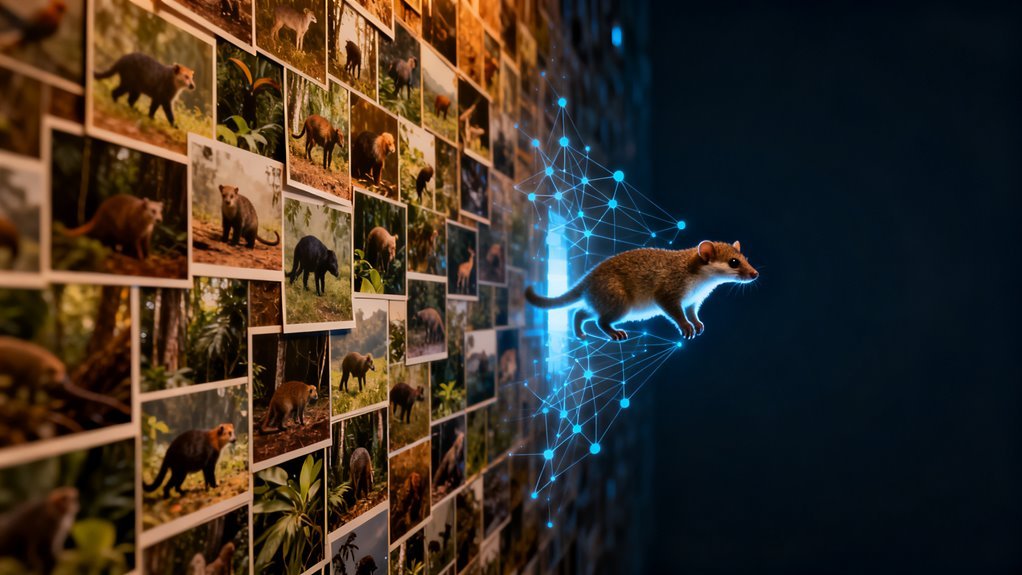
For decades, the bottleneck in biodiversity research was never really about data collection. Camera traps have been generating millions of images across every continent, silently documenting species interactions, migration patterns, and population dynamics with mechanical reliability. The real problem was always what came after: someone had to actually look at all those photos.
That constraint is now dissolving. And the implications stretch well beyond ecology departments.
From Volunteer Armies to Automated Pipelines
Consider the scale of the challenge. The Snapshot Serengeti program, one of the most cited camera trap projects in the world, produces six months of imagery that requires thousands of citizen science volunteers working for two to three months just to label. That is an enormous lag between capture and insight. Multiply that delay across hundreds of similar monitoring programs globally, and you begin to see the problem. Vast repositories of wildlife imagery have been sitting largely untouched, representing a kind of dark data for conservation science.
Computer vision has changed the math entirely. The current generation of tools follows a two stage approach: an object detector like MegaDetector scans each frame to locate animals, then a species classifier examines the cropped regions and assigns taxonomic labels. Microsoft’s SpeciesNet, built for global deployment, covers 2,498 categories spanning mammals, birds, reptiles, and broader groupings. It even handles non-animal classes like vehicles and researchers who accidentally photograph themselves, a surprisingly common occurrence in field work.
What makes this generation of models genuinely useful rather than merely interesting is the accuracy they have achieved. A World Wildlife Fund system detects 99.4 percent of frames containing animals, with 98.7 percent precision on animal presence predictions and 94.5 percent species level accuracy. Fine-tuned SpeciesNet deployments routinely push F1 scores past 95 percent. On the Snapshot Serengeti dataset specifically, AI classification hits 96.6 percent accuracy, matching the performance of human volunteers who spend weeks on the same task.
Those numbers deserve a moment of reflection. Matching human accuracy is the threshold where automation stops being a helpful supplement and becomes the default workflow. Moreover, this shift towards automation is reminiscent of how AI transforms drug discovery by optimizing complex processes and integrating vast datasets.
Why This Matters Beyond Conservation
The obvious application here is faster, cheaper biodiversity monitoring. But the more consequential development is what happens when you process archives that nobody previously had the resources to examine.
When classifiers encounter specimens that do not match any known species profile, they flag anomalies. Those flags become leads for taxonomists. In practical terms, AI systems are now surfacing potential species discoveries from photographic evidence that has been gathering digital dust in institutional storage. This is not theoretical. The workflow exists. The accuracy supports it. The scale demands it.
Think about what this represents in the broader AI landscape. For years, the dominant narrative around computer vision focused on commercial applications: autonomous vehicles, facial recognition, retail analytics, medical imaging. Conservation biology was treated as a niche use case, interesting but economically marginal. That framing missed something important. Ecological monitoring generates exactly the kind of massive, unstructured, visually complex datasets where deep learning creates the most dramatic efficiency gains. The ratio of available data to available human analysts is arguably more extreme in wildlife research than in almost any commercial domain.
The Technical Economics Are Shifting
One detail in the current research deserves particular attention. SpeciesNet performance plateaus after roughly 250 to 500 locally labeled training images per species class. That number is significant because it means deploying a high accuracy classifier for a new geographic region or target species group does not require a heroic data collection effort. A few hundred labeled examples gets you most of the way there.
This is a direct consequence of transfer learning architectures becoming more mature. Deep convolutional networks pretrained on massive general datasets can be fine-tuned for specific ecological contexts with modest additional investment. Researchers working with snakes, lizards, and toads, groups that are notoriously difficult to identify even for trained herpetologists, have reached 87 percent accuracy using VGG16 based transfer learning. For species where visual differences are subtle, that number will climb as vision transformer architectures replace older convolutional approaches.
The practical implication is that the barrier to entry for automated wildlife monitoring is dropping fast. A research team in a developing country with limited computational resources can now fine-tune an existing model on a few hundred labeled images and deploy a system that processes years of backlogged camera trap data in days rather than months.
Who Benefits and What Gets Overlooked
Conservation organizations with large photo archives stand to gain the most immediately. Groups like WWF, the Wildlife Conservation Society, and national park systems sitting on terabytes of unprocessed imagery now have a realistic path to extracting value from that data. Governments managing protected areas get better species inventories without proportional increases in staffing budgets.
The technology sector benefits too, though less directly. Microsoft’s investment in conservation AI through its AI for Earth program positions the company favorably in a growing market for environmental monitoring tools. As biodiversity reporting requirements tighten under frameworks like the Taskforce on Nature-related Financial Disclosures, corporate demand for automated ecological assessment will increase. Companies required to report on their biodiversity impact will need tools that can process environmental data at scale.
What gets overlooked in the current enthusiasm is the verification problem. A classifier flagging an anomalous specimen as a potential new species is the beginning of a discovery process, not the end. Taxonomic description still requires physical specimens, genetic analysis, morphological comparison, and peer-reviewed publication. AI accelerates the detection phase dramatically but does not compress the validation timeline. There is a risk that the speed of automated detection creates a backlog at the taxonomic review stage, potentially leading to premature announcements or, worse, conservation decisions based on unconfirmed identifications.
There is also a data sovereignty question that rarely surfaces in technical discussions. Camera trap networks operate in countries with varying regulations around biological data, indigenous knowledge, and genetic resources. When AI systems process wildlife imagery collected in one jurisdiction and train models deployed elsewhere, questions about who owns the derived insights and who profits from species discoveries become relevant. The Nagoya Protocol on access and benefit sharing was designed for genetic resources, but the principle extends naturally to biodiversity data pipelines.
What Comes Next
The trajectory here points toward continuous, near real-time biodiversity monitoring. Camera traps are getting cheaper. Edge computing is making it feasible to run inference directly on field devices rather than uploading everything to cloud servers. Satellite imagery and acoustic monitoring are producing complementary data streams that can be fused with camera trap outputs. Ecological datasets present characteristic challenges such as long-tail distributions and unknown species, which means these systems must be designed to handle rare categories gracefully as they scale.
Within three to five years, expect automated systems that do not just identify known species but actively model population dynamics, detect behavioral changes linked to climate shifts, and flag ecosystem disruptions as they begin rather than after they become crises. The foundation for that capability is being laid right now in the accuracy benchmarks and deployment architectures described above.
The deeper signal here is about a pattern repeating across domains. When AI classification accuracy reaches human parity on a specific task, the constraint shifts from “can we do this” to “how fast can we process the backlog.” Wildlife monitoring is experiencing that transition today. The winners will be organizations that recognized the value of collecting data even when they could not analyze it, because the analysis capability just arrived.