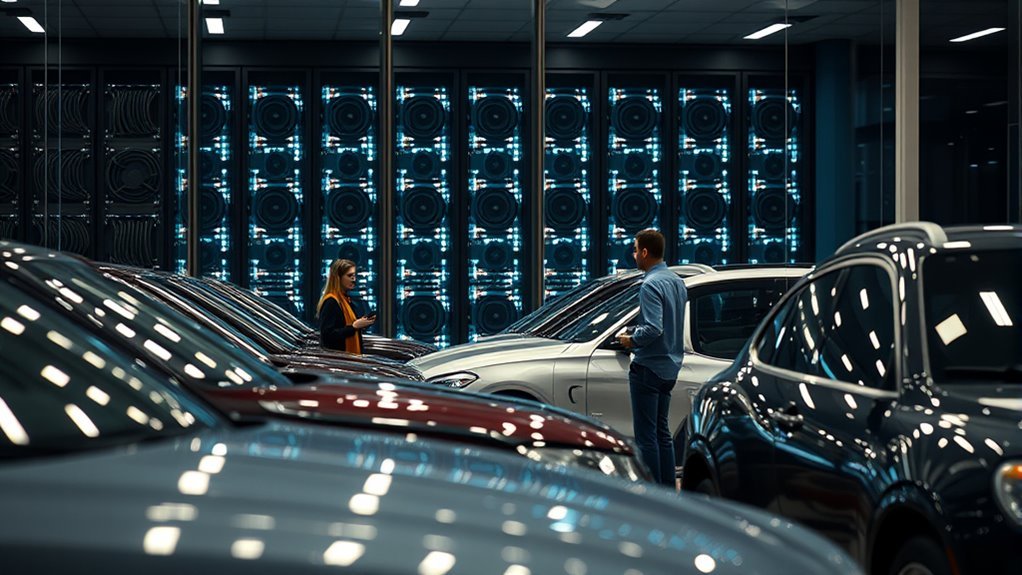

Cars are about to get more expensive for a reason that is not immediately obvious when you look at a showroom sticker. The same artificial intelligence boom that is fueling vast new data centers is quietly consuming the memory chips that modern vehicles depend on, and the cost shock is beginning to flow straight into car prices.
Why this matters now
Over the past year, demand for DRAM and NAND memory in AI data centers has exploded as companies rush to train and deploy ever larger models on specialized accelerators.
AI data centers are suddenly devouring DRAM and NAND as ever larger models come online
Memory suppliers are prioritizing high bandwidth products such as HBM and advanced server DRAM that sit next to those accelerators because they carry premium margins and long multiyear contracts with major technology platforms.
That shift in factory capacity is not just a story about cloud providers. It is pulling supply away from automotive, consumer electronics and industrial systems, and it is doing so at a time when vehicles rely on more memory than ever before for infotainment, connectivity and driver assistance. As a result, automakers such as Ford are already planning around constrained memory supply, with reports of panic buying and rising component costs across the sector.
Industry groups representing automakers, retailers and electronics firms have warned that the imbalance could translate into significant and sustained near term price increases for households and disrupt critical supply chains in the United States.
From the pandemic chip crisis to the AI memory crunch
The auto industry already lived through a painful lesson about semiconductor dependency during the pandemic era, when shortages of microcontrollers and analog chips forced production cuts and left dealer lots half empty.
The current situation is different in two important ways.
First, the pressure is centered on memory rather than on simple control chips. DRAM and NAND are the workhorses that store and shuttle data in everything from instrument clusters to advanced driver assistance systems.
Second, the underlying demand is not transient consumer gadget cycles but structural growth in AI infrastructure, where hyperscale data centers can lock in long term capacity for their preferred memory types.
Reports from analysts and trade associations describe a world in which AI data centers are consuming a massive share of available memory production, leaving automakers and other manufacturers to compete for what remains.
This is not a one quarter inventory hiccup. It is the result of deliberate fab allocation decisions that favor AI oriented products and that are expected to persist for years.
What memflation really looks like
Analysts have started using a new term for the result of this tug of war over memory capacity. They call it memflation, a rapid and broad based rise in memory prices that is unlike past cycles in the sector.
In DRAM, contract and spot markets have moved with extraordinary speed. TrendForce, UBS and Wells Fargo data show automotive and server DRAM prices rising by double digits quarter after quarter, with some segments nearly doubling each quarter.
Wells Fargo estimates that current spot prices for DDR5 are more than eight times higher and DDR4 prices more than sixteen times higher than 2024 averages.
Consulting and brokerage firms report that spot DRAM prices have climbed several hundred percent in extreme cases. One widely cited analysis from Kearney puts the jump in spot DRAM prices at roughly 450 percent between September 2025 and January 2026.
NAND flash, used for storage, is following a similar trajectory. Morgan Stanley notes that since mid 2025, spot prices for DRAM and NAND have seen sustained double digit increases, contributing to what some call a triple super cycle across HBM, DRAM and NAND, with elevated prices expected to run through the second half of the decade.
The picture is even more challenging for older generations of automotive grade DRAM such as LPDDR4. Industry research indicates that prices for these parts have already risen around 70 percent year over year by early 2026, with suppliers signaling further increases and eventual phase outs as they shift to newer technologies.
A separate analysis warns that certain legacy components used broadly in vehicles could be essentially unavailable by 2028 as fabs retool for more profitable lines.
Why cars are suddenly in the line of fire
Modern vehicles have become rolling computers, and memory is one of the quiet enablers of that transformation.
Cockpit systems, connectivity modules and driver assistance platforms all rely on sizable pools of DRAM and NAND, and that content has climbed sharply as screens get larger, software stacks grow more complex and sensor suites multiply.
Analysts estimate that DRAM content today runs roughly 50 to 110 dollars per vehicle, with premium and electric models at the top end of that range.
For high technology electric vehicles with rich infotainment and autonomy features, DRAM value per car can exceed 150 dollars and approach or surpass 200 dollars.
Once memflation is layered on top of that baseline, the impact becomes material very quickly. Industry analysis cited by EE Times and others suggests that the cost to build a premium smart electric vehicle has already risen by roughly 880 to 1,470 dollars purely because of higher memory prices.
Morgan Stanley calculates incremental cost headwinds on the order of 100 to 200 dollars per internal combustion vehicle and as much as 300 to 400 dollars per battery electric vehicle, driven largely by DRAM and NAND price spikes.
These are not costs automakers can easily swallow. Margins on many models are already under pressure from broader inflation, compliance expenses and investment in electrification.
Research from UBS and other financial institutions indicates that automakers and their suppliers are sharing the burden, but that carmakers still expect to absorb the majority of the increase and will likely pass a significant portion through to consumers.
Trade associations are explicit about the risks. In a recent letter to US authorities, groups representing automakers, retailers and electronics firms warned that an urgent imbalance in the market for memory chips could lead to sustained price increases for households and threaten the availability of automobiles and other goods.
Where memory sits inside the vehicle
To understand why this shortage is especially disruptive, it helps to look inside the electronic architecture of a modern car.
Advanced driver assistance systems and emerging autonomous driving platforms are among the most memory hungry domains. They ingest data from cameras, radar and lidar, run perception and fusion algorithms and support real time decision making for functions such as lane keeping, adaptive cruise and automated emergency braking.
Many of these systems rely on large pools of DDR4, LPDDR4 and other DRAM technologies tailored for automotive conditions.
Digital cockpits and infotainment systems are another major consumer. Multiple high resolution displays, rich media interfaces and constantly connected telematics services all need fast memory to cache graphics, maps and application data.
As a result, premium and autonomy focused models are the most exposed to volatility in DRAM and NAND pricing.
Manufacturers of these vehicles face the uncomfortable choice of absorbing higher component costs, raising prices or reconfiguring feature packages. Analysts warn that persistent increases in memory costs could prompt some automakers to reassess the standard fitment of sophisticated assistance and convenience features, potentially shifting them from default equipment to optional or top trim features.
How automakers are responding
The industry is not standing still in the face of memflation, but the options are constrained.
Many automakers are revisiting their sourcing strategies, diversifying suppliers and seeking longer term contracts to lock in at least a portion of their memory needs at predictable prices.
Others are accelerating plans to migrate from older DRAM generations to newer ones that memory makers are more eager to produce, though that can require redesigns of electronic control units and validation work that takes time.
Some are also reexamining product mix and feature content. Analysts and supply chain monitors report that manufacturers are contemplating production pauses for certain high technology trims, delaying model launches that depend on scarce memory components or simplifying options to reduce the most memory intensive features.
A Z2Data assessment notes that carmakers such as Tesla have already flagged memory shortages as a factor that could affect their production in 2026.
Price is the bluntest instrument, and it is likely to be used. Several research houses forecast that rising semiconductor costs, led by memory, will translate into noticeable sticker price increases in the second half of 2026 and into 2027, particularly for vehicles loaded with advanced electronics.
Broader implications for technology and society
The most immediate consequence for consumers is straightforward. Vehicles, especially those rich in software and safety technology, are likely to become more expensive.
In a market where many households already find new cars unaffordable, another several hundred or more dollars in component derived cost can be enough to push buyers toward cheaper models, older vehicles or delaying purchases altogether.
There is a deeper concern as well. If memory costs remain structurally high, automakers may be tempted to limit the availability of advanced driver assistance and safety features to higher trims or premium models.
That could widen the gap between what entry level buyers and affluent customers receive in terms of safety and convenience technology, even as regulators and safety advocates push for broader adoption of these systems.
On the technology side, the situation highlights how intertwined automotive progress has become with the broader AI ecosystem.
The same chips that feed transformer models in data centers also enable perception stacks in cars. When capacity is scarce, policy choices about industrial investment, trade and infrastructure directly influence how fast and how broadly smart vehicle features can spread.
For businesses, this episode is another reminder that AI is not just a software story. It is a physical supply chain story with fabs, wafers and capital expenditure behind it.
Companies in sectors far from the cloud have to account for AI driven component cycles in their planning, from inventory strategy to product design.
What to watch in the next few years
Looking ahead, several indicators will tell whether memflation is a passing storm or a new climate.
First, watch the pace at which Samsung, SK Hynix, Micron and other memory makers add capacity and how much of it they dedicate to HBM and server DRAM versus more conventional DRAM and NAND suitable for automotive and consumer devices.
If most new investment continues to chase AI data center demand, pressure on vehicle electronics will persist.
Second, monitor price trajectories for older automotive grade DRAM such as LPDDR4 and mainstream DDR4. Current forecasts suggesting continued increases and eventual phase outs through the second half of the decade imply that carmakers will need to adapt architectures to newer generations sooner rather than later.
Third, pay attention to regulatory and policy moves. The strong language in letters from automotive and retail associations to US authorities shows that this is being framed as a supply chain resilience issue as much as a pricing problem.
Incentives for domestic memory production or mechanisms to guarantee a baseline of capacity for critical industries could alter the dynamic over time, though those measures take years to materialize.
Finally, consider the possibility that AI hardware demand itself will evolve. If efficiency gains, model design changes or shifts in AI investment cycles moderate the hunger for HBM and server DRAM, that could free some capacity for other sectors.
Conversely, if AI workloads continue to scale aggressively, the triple super cycle across HBM, DRAM and NAND may last well into the second half of this decade.
The core takeaway is simple. Memory chips have moved from a hidden commodity in the background of car manufacturing to a strategic resource shaped by the trajectory of artificial intelligence.
For buyers, that likely means paying more for technology rich vehicles in the near term. For automakers and policymakers, it means treating AI driven hardware demand not just as a growth engine, but as a constraint that must be managed if progress in mobility is to remain broadly accessible and safe.
Conclusion
A global shortage of memory chips driven by artificial intelligence data centers is starting to push up car prices and the cost of driver assistance features, as vehicles compete with servers for the same silicon. Automakers are adjusting design plans, supply strategies and pricing models, but the result for drivers is higher costs and fewer genuinely affordable options.
Why the AI memory crunch matters for cars right now
In the past year the economics of memory chips has flipped. Chipmakers are allocating more production to high margin orders from artificial intelligence data centers, leaving fewer chips for consumer devices and cars. DRAM spot prices in some categories have jumped several times over, with one analysis citing increases of up to 450 percent between late 2025 and early 2026 and nearly 700 percent in the most extreme cases. TrendForce data shows general purpose DRAM contract prices rising roughly 90 to 95 percent quarter over quarter in the first quarter of 2026, while NAND flash is projected to climb another 70 to 75 percent in the second quarter.
Automakers and retailers in the United States have already warned that this memory chip shortage is pushing up costs across a wide range of products, including automobiles and medical devices. Companies such as Ford and Tesla have signaled that rising chip prices will feed through to higher vehicle prices and slimmer margins. General Motors is guiding for about a 0.5 percent increase in North American vehicle pricing this year, a small number on paper but meaningful when layered on top of broader inflation and financing costs.
How chips quietly became a core part of the car
During the pandemic era chip crisis most headlines focused on microcontrollers and analog components that forced automakers to idle plants and ship vehicles without certain features. Memory was present in those stories but it was not the main character. That has changed as software has become the defining feature of modern vehicles.
Today even modest models rely on DRAM to power infotainment screens, digital dashboards, connectivity modules and basic driver assistance. Premium and electric vehicles add more sensors, higher resolution cameras and increasingly complex autonomous driving platforms. Analysts estimate DRAM content per vehicle in the range of 25 to 150 dollars, with premium models at the upper end and some high tech vehicles already above 100 dollars of DRAM value in 2025.
For many years that memory cost was a small fraction of a vehicle bill of materials. Some estimates put DRAM at roughly 1 percent of the cost of an electric vehicle, although in extreme cases recent price spikes could push the per vehicle impact from a few hundred dollars toward 1200 dollars, effectively adding up to 1000 dollars to the price of a car. One large Chinese automaker has reported that the current surge in memory prices is already increasing hardware cost per vehicle by several hundred to more than one thousand yuan depending on the model.
The numbers behind the current shock
What makes the current situation different is the speed and concentration of the memory price surge. TrendForce, UBS, Wells Fargo and others are all reporting significant jumps. Contract prices for DRAM used in automotive and consumer products are projected to rise 70 to 100 percent in 2026 compared with 2025 levels. Some automotive grade DDR4 and DDR5 categories have seen prices rise two to three times since the second half of 2025.
Analysts at UBS and Wells Fargo describe DRAM spot prices up more than 100 percent, with some data sets showing DDR5 prices eight times higher and DDR4 prices sixteen times higher than 2024 averages in certain segments. Consulting firm Kearney cites a roughly 450 percent jump in DRAM spot prices between September 2025 and January 2026. Memory manufacturers are planning disciplined quarterly price hikes of 20 to 70 percent across key DRAM families through 2026.
Industry forecasts suggest this is not a brief spike. TrendForce expects that by 2027 the artificial intelligence sector could absorb about 70 percent of global DRAM production capacity, leaving considerably less for traditional industries such as automotive and smartphones. One projection from a Chinese industrial source suggests that by 2030 the proportion of memory costs in total hardware cost per vehicle could exceed 15 percent as terabyte level storage becomes standard.
This dynamic is already being labeled with a new term in some coverage. The phenomenon of rapidly rising memory costs is being called memflation and is estimated to raise the cost to build a premium smart electric vehicle by roughly 880 to 1470 dollars per unit.
Why driver assistance and digital features are in the crosshairs
Advanced driver assistance systems rely on memory in a way that traditional mechanical features never did. Cameras, radar, lidar and ultrasonic sensors generate streams of data that must be buffered, processed and sometimes retained for model training and regulatory logs. That workload translates directly into more DRAM and flash per vehicle.
Because the looming DRAM shortage disproportionately affects vehicles with rich digital cockpits and autonomy features, the impact lands hardest on the segment that has leaned most aggressively into software defined vehicles. Premium models and smart electric vehicles that already had north of 150 dollars of DRAM content in 2025 are now exposed to price increases on every unit shipped.
The business model around driver assistance features amplifies the effect. Many carmakers have shifted from one time payments to ongoing subscriptions for features such as adaptive cruise control, lane keeping assist and higher levels of automated driving. As memory and compute costs rise, the pressure to recoup those expenses through higher subscription pricing or bundling becomes stronger. In practical terms, the silent increase in DRAM costs shows up not only in the sticker price but also in monthly fees for software features that rely on that memory footprint.
How automakers are responding
Automakers learned hard lessons from the pandemic era chip crunch and are not going into this memory shortage unprepared. Many are trying to diversify suppliers, lock in longer term contracts and redesign platforms to use more flexible memory architectures. Several industry reports note that buyers who expected DRAM prices to cool off after the holidays are instead confronting plans for sequential price hikes, which is pushing procurement teams to secure inventory earlier in the year.
One line of response is to reduce memory requirements through smarter engineering. That can involve optimizing software to use less RAM, consolidating electronic control units and adopting centralized computing architectures that share memory resources across functions. Another response is to prioritize high margin models and regions, ensuring that limited DRAM supplies go first to vehicles and markets where customers will tolerate higher prices.
There is also a renewed push for closer collaboration between automakers and chip manufacturers. Industry groups representing automakers, retailers and electronics companies have jointly warned governments that current allocation decisions favoring data centers risk undermining manufacturing and availability of automobiles and other essential goods. Their goal is to persuade policymakers and suppliers that transportation and medical devices should not be permanently crowded out by artificial intelligence workloads.
Still, there are limits to what the industry can do. When spot prices for key memory parts have multiplied and a majority of future production is prebooked for artificial intelligence data centers, even well prepared automakers face higher build costs and tighter supply. That gap shows up gradually in product planning, delayed feature rollouts and decisions to reserve the most advanced assistance systems for expensive trims.
What this means for drivers and the broader economy
For drivers the most immediate effect is financial. Rising memory costs are being passed through in a mix of higher vehicle prices, richer option packages and subscription fees for digital and driver assistance features. The headline increase of half a percent in average pricing that one major automaker guided for in North America sits on top of these component pressures, and it is unlikely to be the last adjustment.
The less visible effect is on choice. When memory becomes scarce and expensive, manufacturers tend to prioritize models and features that deliver the best return on investment. Entry level vehicles may ship with simpler digital interfaces, fewer always on connectivity features and more limited driver assistance suites. Premium segments continue to get the latest capabilities, but the gap between baseline and top trim widens.
At the societal level this introduces uncomfortable questions about equity and safety. If advanced driver assistance, over the air updates and rich sensor suites become more concentrated in expensive models, then the safety benefits and convenience of these technologies may accrue disproportionately to wealthier buyers. Regulators who encouraged wider adoption of assistance systems to reduce accidents will need to consider whether memory supply constraints are unintentionally slowing that progress.
There is also a strategic angle for countries trying to maintain domestic automotive production. As artificial intelligence data centers absorb more global DRAM capacity, nations that invest heavily in memory fabrication may gain leverage over both digital infrastructure and vehicle manufacturing. Governments that treat automotive grade memory as part of critical infrastructure policy rather than a generic commodity may be better positioned to secure supply for their domestic industries.
Lessons from the last chip crisis and what comes next
Compared with the pandemic era semiconductor crunch, the current memory shortage is more targeted but could be longer lasting. Then the bottleneck was largely about limited capacity and disrupted logistics across a broad range of chips. Now the constraint is amplified by a structural shift in demand toward artificial intelligence workloads that promise higher margins to chipmakers.
The experience and data available today suggest a few practical takeaways. First, memory content per vehicle is likely to keep rising as cars become more software defined, even if automakers work hard to optimize usage. Second, as long as data centers are prepared to pay premium prices for DRAM, traditional industries will either pay more or accept design compromises. Third, the cost impact on individual vehicles may look modest on a percentage basis but becomes significant when multiplied across millions of units and layered with other inflationary pressures.
Looking ahead, several scenarios are plausible. Continued investment in new memory fabrication plants could ease supply constraints over the next three to five years, especially if governments offer incentives tied to serving automotive and industrial demand. At the same time, improvements in memory efficiency, compression and edge processing could reduce the amount of DRAM needed per function in a vehicle, helping to blunt memflation over time.
Until those longer term shifts materialize, the reality is straightforward. Cars have become rolling computers, and those computers now compete directly with artificial intelligence servers for the same memory chips. In that contest drivers will fund much of the outcome through higher upfront prices, growing software fees and a market where truly affordable vehicles with modern digital and driver assistance capabilities are harder to find.