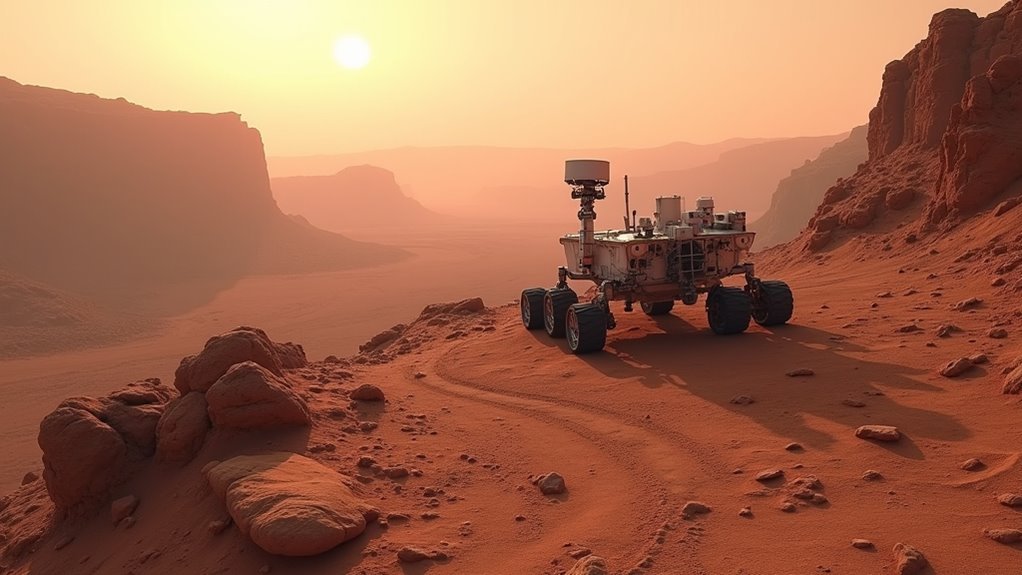

In December 2025, NASA quietly crossed a threshold that space and AI communities have anticipated for years. For the first time, a Mars rover drove along routes that were not painstakingly traced by human planners on Earth, but instead were designed end to end by a generative AI system. What might sound like a modest software upgrade is actually a major shift in how we explore other worlds and in how much trust we are willing to place in machine decision making millions of kilometers away.
From hand drawn rover routes to AI copilots
For most of the history of Mars rovers, navigation has been a very human craft. Engineers and scientists would pore over stereo images and topographic maps, then mark out a path meter by meter to avoid rocks, sand traps, and steep slopes. The onboard systems of early rovers such as Spirit and Opportunity could make short reactive adjustments, but the overall traverse strategy was still driven from Earth.
For decades, rover paths were hand drawn from Earth, every meter debated, defended, and delicately planned
The Curiosity rover pushed further with an early version of autonomous navigation that could find safe paths around obstacles using stereo vision, but mission teams still had to define daily driving goals and broad constraints. By the time Perseverance landed in Jezero crater in 2021, its upgraded AutoNav system was ready to take a larger share of the work.
NASA reports that during one of its long campaigns, Perseverance used AutoNav to autonomously evaluate a large majority of a roughly 17.7 kilometer journey and achieved a record single stretch of nearly 700 meters without needing new commands from Earth. AutoNav uses stereo imaging and terrain modeling to identify rocks, sand ripples, and slopes, and can adjust its path on the fly while preserving safety margins. More recently, Mars Global Localization has given the rover the ability to independently determine its precise location by comparing panoramic camera views to onboard orbital terrain maps, sharply reducing the need for human-assisted positioning. As a result, this integration of AI has led to a broad but shallow diffusion of technology across many applications.
These capabilities were impressive, but they still sat on top of a planning process that depended heavily on human judgment and time. The new generative AI planning experiments are about shifting that balance.
How Perseverance let AI plan where to drive
On December 8 and December 10 2025, Perseverance executed two drives near the rim of Jezero crater whose routes were planned by a generative AI system rather than by the usual team of rover planners. In the first drive, the rover traveled about 210 meters, and in the second about 246 meters, across complex terrain that included rocks and subtle slopes.
These traverses were carried out without any navigation incidents, providing a strong initial validation that AI generated plans could be trusted for real operations. The AI system did not improvise blindly. It ingested high resolution rover imagery, terrain maps, and hazard information, then produced a continuous route broken into safe waypoints that Perseverance could follow.
NASA and external analyses describe how the model effectively learned the same tradeoffs human planners make every day on this mission, balancing distance, efficiency, and safety while dealing with uncertain terrain. Some reports group these AI planned segments into a longer traverse of about 456 meters across Jezero crater, again emphasizing that the underlying plan came from a generative model rather than a deterministic rule based planner.
Other summaries speak of nearly 400 meters of AI designed path, reflecting slight differences in how individual drives are counted. That spread in reported distances underscores a broader point: what matters here is not an exact tally of meters but the fact that a large scale route on another planet was entrusted to an AI system, under real mission constraints, and that it worked.
Crucially, this was not an uncontrolled experiment. Engineers at the Jet Propulsion Laboratory reviewed the AI generated waypoints, tested them in simulators, and monitored the drives closely as they unfolded on Mars. This supervised approach reflects NASA’s current philosophy with powerful AI systems: use them to accelerate and enrich planning, but keep humans firmly in the loop for validation and oversight.
The new generative planning tools do not replace AutoNav. They sit on top of it. AutoNav remains the onboard system that actually steers the rover around hazards during a drive, evaluating terrain with stereo cameras and shifting path when unexpected obstacles appear.
Over Perseverance’s early years on Mars, AutoNav demonstrated that a rover could independently evaluate most of a long traverse and still respect strict safety margins. The system continuously scans for rocks, sharp slopes, and sand features, then replans locally to keep the vehicle within its safe envelope while maximizing daily distance covered.
Before generative planning arrived, the typical workflow was that human planners would design a route that looked safe and efficient on orbital and rover imagery, then let AutoNav handle the last step of actually driving around small features. The AI planned drives show a different division of labor: now a model can propose the high level route while AutoNav handles the fine grained execution.
In practical terms, that means the scarce human hours of rover planners can be redirected from tracing waypoints to interpreting scientific data and choosing the most interesting regions to visit next. Over years, that reallocation of effort could translate into significantly more science return from fixed mission budgets.
Science autonomy with AEGIS and SuperCam
Navigation is only part of Perseverance’s autonomy story. NASA has also invested in AI that helps the rover decide what to study once it arrives at a new location. A key example is AEGIS, short for Autonomous Exploration for Gathering Increased Science.
AEGIS was first developed for the Mars Exploration Rover mission and later used on the Curiosity rover to autonomously select rock targets for the ChemCam instrument. It uses computer vision to scan wide angle images, identify rocks that match scientists criteria, and then direct instruments to collect measurements without waiting for new commands from Earth.
On Perseverance, AEGIS is now paired with the SuperCam instrument. NASA reported in 2022 that SuperCam successfully used AEGIS to autonomously select and analyze targets on Mars for the first time. In a 2024 update, NASA described how upgraded AI capabilities allow SuperCam and AEGIS to better identify promising rocks and automatically fire its laser induced breakdown spectroscopy system at them.
Because these decisions happen on the rover, Perseverance can capture transient features and subtle compositional variations during or immediately after long drives, rather than losing time waiting for ground teams to review every new panorama. That is especially valuable when communication opportunities are limited or when scientists want to cover more ground than human review cycles would normally allow.
Together, AEGIS and the new route planning tools suggest a future where a Mars rover can not only decide how to travel across the landscape but also what to investigate along the way, guided by mission level priorities rather than micromanaged commands.
Large models planning routes from orbit
One of the most intriguing aspects of the December 2025 demonstrations is that they build on work done with external generative models, including Anthropic’s Claude family. In these experiments, the AI does not sit on the rover at all. Instead, it runs on Earth, where it can process large volumes of orbital data that would be impractical to handle on a radiation hardened flight computer.
Claude was tasked with planning multi hundred meter routes across Jezero crater using imagery from the HiRISE camera on the Mars Reconnaissance Orbiter and terrain slope data from digital elevation models. HiRISE provides surface details at roughly half meter pixel resolution, revealing boulder fields, bedrock, and subtle ripples in sand that can trap a rover.
The model broke proposed routes into segments of roughly ten meters and iteratively refined them through self critique, checking each segment for hazards such as rocks, steep gradients, and likely soft soil. In one detailed account, the AI achieved a reported hazard detection accuracy above ninety eight percent, then converted its chosen waypoints into Rover Markup Language, the command format used by Jet Propulsion Laboratory engineers.
These AI generated plans were then validated in a digital twin of the rover and its environment, incorporating hundreds of thousands of telemetry variables to predict how Perseverance would behave along the proposed path. Human engineers reviewed the output, made modest adjustments, and only then transmitted the route to Mars, where the rover drove hundreds of meters according to the plan.
Some French language analysis of the project highlights that NASA believes this approach can cut route planning time roughly in half, a serious advantage when operations teams are stretched across multiple instruments and campaigns. Taken together, these demonstrations illustrate a hybrid model of autonomy: large generative systems plan using global orbital context, traditional onboard autonomy handles local execution, and humans supervise the entire loop.
Why this matters for technology and society
From a technology perspective, these Mars drives mark a convergence between modern generative AI and classic robotics. Planetary rovers have long been testbeds for autonomy, but the algorithms were typically hand crafted and narrowly scoped.
Generative models that can reason over images, maps, and mission constraints unlock a more flexible style of planning that begins to resemble human thinking about routes and risk. For the space industry, the implications are concrete. If AI can reliably plan long traverses and prioritize scientific targets, agencies can contemplate more ambitious missions to rougher terrain, where constant human supervision would be impossible or unaffordable.
Future sample return rovers, lunar surface explorers, and missions to icy moons could all benefit from systems that can improvise within well defined safety bounds. There are clear spillovers for terrestrial applications as well. The same techniques used to analyze orbital images and plan safe paths over unknown terrain can be adapted for remote mining operations, disaster response robots, and autonomous vehicles operating in poorly mapped regions on Earth.
Combining global aerial or satellite imagery with ground level sensors and a generative planner is a powerful pattern that extends well beyond Mars. At the same time, the Mars experiments highlight real risks. Generative models can be brittle when conditions differ from their training data, and Martian terrain is full of edge cases that would challenge any system.
Misclassifying a patch of soft sand or underestimating a slope could damage a multi billion dollar asset. That is why NASA currently keeps humans in the review loop, confines AI suggestions to pre checked waypoints, and relies on proven onboard systems such as AutoNav to enforce safety in real time.
Transparency and verification are also central concerns. Teams need ways to audit why an AI proposed a particular route or target, especially when decisions trade some level of risk for scientific gain. The self critique and simulation steps used in the Perseverance experiments are early examples of how to embed checks and explanations into AI assisted planning.
Finally, there is a broader societal aspect. The story of a large model helping drive a rover on Mars will inevitably influence public perceptions of AI, for better and for worse. On one hand, it showcases a constructive use case far from the controversies of social media or generative text misuse. On the other, it may reinforce expectations that AI can and should take on high stakes decision making, which raises ethical and governance questions that extend well beyond space exploration.
Open questions and the road ahead
For all the excitement, it is worth being clear about what has not happened yet. Perseverance is not simply pressing a button and letting a general purpose AI roam free on an alien world. Every AI planned drive so far has been a carefully staged experiment with extensive human oversight, simulation, and fallback mechanisms.
The number of such drives is still small compared with the rover’s lifetime activity. Several technical questions remain open. Teams will want to understand how generative planners behave in regions that combine steep slopes, loose regolith, and limited visibility, and how robust they are to errors in the underlying terrain models.
There is also the question of how far such systems can be pushed within the power and computing limits of space qualified hardware, especially if future missions want more onboard decision making. On the scientific side, one of the most interesting challenges will be encoding mission priorities into machine understandable objectives.
AEGIS shows one path, by letting scientists specify what kinds of rocks or textures are most interesting and then turning that into visual criteria. Extending this idea to route planning and daily activity selection could give scientists high level control over what a mission values while letting AI handle most of the operational details.
Policy and governance will have to evolve in parallel. Space agencies will need guidelines for how much authority to delegate to AI, what kinds of tasks must remain under direct human control, and how to document and audit AI influenced decisions across multi year missions. Experiences from Perseverance and AEGIS will likely inform these frameworks, much as earlier Mars missions shaped standards for planetary protection and fault management.
Key takeaways and what to watch next
First, AI planned drives on Mars are no longer science fiction. Perseverance has already followed routes designed by generative models over hundreds of meters of real terrain, with no navigation incidents and with human teams confirming their trust in these tools.
Second, this is an evolution rather than a sudden break. AutoNav and AEGIS laid the groundwork by proving that rovers can make reliable local decisions about driving and targeting. Generative models now extend that autonomy into higher level reasoning about where to go and what to study, but within a careful framework of checks and human oversight.
Third, the same pattern of combining global sensing, generative planning, local autonomy, and human supervision will likely spread across both future space missions and demanding environments on Earth. It offers a pragmatic way to harness the strengths of modern AI while mitigating its weaknesses through redundancy, simulation, and transparent review.
The next few years will show whether these early demonstrations become routine practice. If they do, the phrase mission operations may come to mean something very different, with human teams setting scientific intent and safety limits while AI systems negotiate the day to day tradeoffs of exploration.
In that world, every new panorama from Mars will not just be a postcard from a distant rover, but also a glimpse into how humans and machines learn to share responsibility in some of the harshest environments we have ever attempted to explore.
Conclusion
Mars rovers are quietly crossing a threshold that will shape the next era of planetary exploration. For the first time, artificial intelligence is not just helping scientists interpret data. It is deciding how a flagship rover moves across an alien world, in real time, without waiting for instructions from Earth. That shift matters because it directly tackles the core bottleneck in Mars exploration today: the long communications delay and the limited human time available to plan every move from millions of kilometers away.
From joystick driving to autonomous explorers
For most of the history of Mars rovers, driving has been a slow, carefully choreographed process. Early machines such as Sojourner in the nineteen nineties and later Spirit and Opportunity were largely driven step by step by engineers who examined stereo images, marked safe paths and uploaded short drive commands for the next Martian day. Those missions did have basic autonomy for hazard avoidance, but humans remained firmly in charge of where and how the rover moved.
Curiosity and then Perseverance pushed this further by adding more advanced autonomous navigation systems, including AutoNav and related software that can map nearby terrain, estimate motion and avoid obstacles with minimal human intervention. In practice, AutoNav allows Perseverance to follow a route planned by humans and adapt as it encounters rocks, slopes or sand without waiting for new commands from Earth. This already made driving more efficient, but mission teams still had to do the hard work of route planning by hand, frame by frame, before each long drive.
Researchers at NASA and partner institutions have explored semi autonomous rover concepts for decades, including long range field tests in Mars like terrain and early design work on systems that would blend global planning with local hazard avoidance. What is different now is that modern AI techniques can take on the full route planning task using large datasets of orbital and surface imagery and can do so fast enough to be useful in daily operations.
The recent breakthrough in AI planned driving
In late twenty twenty five NASA demonstrated a new capability on Perseverance that marks a genuine turning point. On December eight and December ten the rover completed drives on Mars where the entire route was planned by artificial intelligence rather than by human rover planners on Earth. The system used a vision capable model that analyzed the same images and terrain data normally used by engineers, including high resolution orbital images and slope information derived from computer models, then generated safe waypoints for the rover to follow.
During these demonstrations the AI identified hazards such as rocks, steep slopes and boulder fields and constructed a path with station points that avoided those features while still meeting the mission goals for distance and direction. Perseverance then executed the AI planned routes, traveling on the order of a few hundred meters per drive while continuously checking its local environment using onboard cameras and navigation software. Independent coverage of the tests has noted that these were the first drives on another world where generative AI handled that complex decision making task normally reserved for expert human planners.
Subsequent experiments have extended this work. Reporting from European outlets describes a May twenty twenty six drive of roughly one hundred fifty meters in which AI planned the entire route, no human interventions were needed during the traverse and the trip proceeded about twenty percent faster than traditional human planned drives. In that test the AI system also made real time decisions about obstacle avoidance and adjusted the plan on the fly as the rover advanced. These are still controlled demonstrations, but they show that AI planned navigation is moving from concept to operational reality.
Localization and navigation intelligence inside the rover
Route planning is only part of the autonomy story. Perseverance now carries a generative AI based system called Mars Global Localization that allows the rover to determine its own location on the planet with high precision without asking engineers to solve that problem. The algorithm compares panoramic images from the rover navigation cameras with an onboard map derived from orbital data, then finds the best match to estimate the rover position. It runs on a processor originally used to communicate with the Ingenuity helicopter and typically takes about two minutes to pinpoint the rover within roughly twenty five centimeters.
This localization capability matters because safe navigation and science targeting depend on knowing exactly where the vehicle is relative to mapped hazards and scientific features. In the past teams had to manually align rover images with orbital maps, a process that could be time consuming and occasionally uncertain. Now that work can be done directly on Mars by the rover itself, freeing human experts to focus on higher level decisions about science strategy rather than pixel matching.
NASA also lists Enhanced AutoNav, machine learning based navigation tools and terrain relative navigation as part of its broader portfolio of AI assisted systems for Mars exploration. Together these systems allow Perseverance to perceive the surrounding terrain, reason about it at different scales and execute motion plans that balance safety, efficiency and science yield. In practical terms, most of Perseverance driving is already planned or mapped autonomously, with a Science Robotics analysis in twenty twenty three reporting that nearly eighty nine percent of driving up to that point relied on autonomous modes.
How this changes mission operations day to day
To appreciate the impact, it helps to remember that a signal traveling between Earth and Mars can take anywhere from roughly four to more than twenty minutes one way, depending on the orbital geometry. That delay rules out direct manual driving where humans steer in real time. Instead mission teams work in daily cycles. They examine data from the previous sol, plan the next sequence of activities, simulate those plans on Earth and then send them to the rover.
AI planned navigation compresses that loop. Instead of route planners spending hours clicking through images to place waypoints around hazards, an AI model can propose a complete route in minutes based on the same datasets. Engineers still examine and approve the plan, but the labor intensive part shifts from detailed layout to reviewing and refining AI proposals. Over time this can increase the number of ambitious drives the team can safely attempt and reduce the time spent parked while humans think through every meter of terrain.
There is also a psychological shift. When engineers describe these systems they emphasize that the rover is starting to feel more like a colleague that can take initiative, rather than a remote controlled instrument that waits passively for instructions. AI allows Perseverance to make local decisions about how to approach a rock, how to place an instrument or how to thread through a cluster of obstacles, as long as those choices fit within safety policies defined by the mission. In that sense embedded intelligence is becoming a core part of how Mars missions are run, not an optional add on.
Scientific dividends and future exploration potential
The most immediate benefit of AI powered navigation is greater access to challenging terrain. Manual route planning tends to be conservative, in part because humans must reason about complex three dimensional hazards from two dimensional images and in part because any mistake can be costly. AI can systematically explore more options in the data, finding paths that might be safe but non obvious to human eyes. That opens up steep slopes, rubble fields and layered outcrops that carry rich geological and astrobiological information but have been hard to reach.
Scientific targeting also stands to improve. Systems such as AEGIS AI are designed to identify scientifically interesting targets in camera images and then autonomously point instruments or cameras at those targets without waiting for human commands. In some cases this may allow the rover to capture fleeting events or to sample more rocks in a given area before moving on, increasing the diversity and statistical strength of the data collected. For missions that have limited time in each region, that extra agility can translate directly into better science.
Looking ahead to future planetary missions, these developments point toward a model where embedded AI routinely manages mobility risks, optimizes traverses and frees human teams to focus on strategic questions. NASA has already identified AI navigation as a key use case for future Mars rovers and other planetary explorers, including machine learning based tools for movement across especially rough terrain. As sample return architectures and more complex networks of surface assets are considered, autonomous navigation at the level now being tested on Perseverance will likely be a foundational capability rather than an experiment.
Risks, limitations and the path to trustworthy autonomy
It is important to be clear about what these systems do not yet do. Perseverance is not a fully independent agent deciding its own science goals or choosing destinations with no human oversight. Every AI system involved in navigation and targeting operates within strict boundaries defined by mission safety requirements and science priorities, and human controllers remain responsible for approving plans and monitoring execution.
There are technical risks as well. AI models trained on existing Mars imagery may encounter terrain that falls outside their training distribution, such as unusual rock textures or lighting conditions, and could misclassify hazards or overestimate safety margins. Engineers mitigate this with layered safeguards including traditional hazard detection, conservative speed limits and fallback modes that can stop the rover if something appears abnormal. The localization system itself relies on accurate orbital maps and camera calibration, and errors in those inputs could propagate into navigation decisions if not carefully checked.
Another limitation is transparency. Vision language models and generative systems can be difficult to interpret, especially when they make borderline calls about which route is safer. As autonomy increases, mission teams are investing in tools and methods to audit AI decisions, compare them with human judgement and understand failure modes before they cause real problems on Mars. This is an area where lessons from terrestrial autonomous vehicles, robotics and safety engineering can inform space exploration, but the environment and stakes are unique enough that dedicated research is essential.
Broader implications beyond Mars
From a technology and business perspective, what is happening on Mars is both a proving ground and a powerful story. The same core ideas behind AI navigation for Perseverance appear in industrial robotics, autonomous mining equipment and advanced driver assistance systems on Earth. High reliability AI that can operate in a remote extreme environment with limited bandwidth and no possibility of on site maintenance is a compelling benchmark for any company working on mission critical autonomy.
There is also a social dimension. Space exploration often serves as a public lens for thinking about new technologies. Seeing AI plan drives on another planet can shift public attitudes from abstract concern to concrete curiosity. People naturally ask how much control machines should have, how we audit their decisions and what values are embedded in their objectives. In that sense Mars is becoming a stage where society can watch and debate the practical ethics of autonomy in a controlled setting, long before similar systems become widespread in everyday life.
At the same time, success on Mars can feed back into Earth based systems. Techniques for robust localization using sparse maps, for dealing with long latency communication and for layering traditional control with learned models are directly relevant to terrestrial infrastructure, disaster response robots and off highway vehicles. The Perplexity Sonar research base shows that NASA and its partners are already publishing detailed technical work on these topics, making the Mars program a significant contributor to the broader AI and robotics community.
Key takeaways and what to watch next
Three themes stand out. First, AI planned navigation on Mars is no longer a speculative idea. It has been demonstrated on a flagship rover using operational data, with drives that covered significant distances and showed clear efficiency gains over traditional methods. Second, localization, perception and navigation are increasingly integrated, giving the rover a coherent sense of where it is, what surrounds it and how to move safely while pursuing science. Third, autonomy remains bounded and supervised, with human experts retaining responsibility for mission outcomes even as they hand more tactical decisions to onboard intelligence.
In the near term the most important questions are how often these AI modes will be used in routine operations, how they will scale to more complex terrain and how reliably they will perform over years rather than in isolated demonstrations. Watching how NASA reports on the continued use of Mars Global Localization, AI route planning and science targeting tools will offer concrete evidence of whether this autonomy is truly ready to be a standard part of planetary missions or remains an experimental add on.
If the current trajectory continues, future rovers and landers on Mars and other worlds will likely be designed from the outset as semi autonomous explorers that manage their own mobility and much of their local science work. Human teams will shift toward setting objectives, interpreting results and handling rare edge cases, while embedded AI handles the everyday details of driving and observing. That is a profound change in how exploration is done, and it is arriving faster than many expected reddit