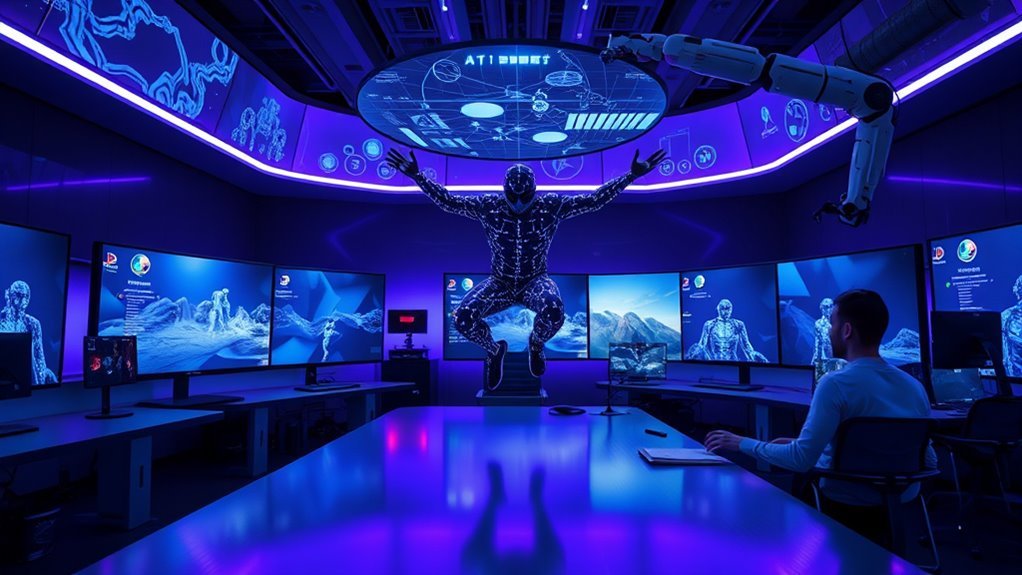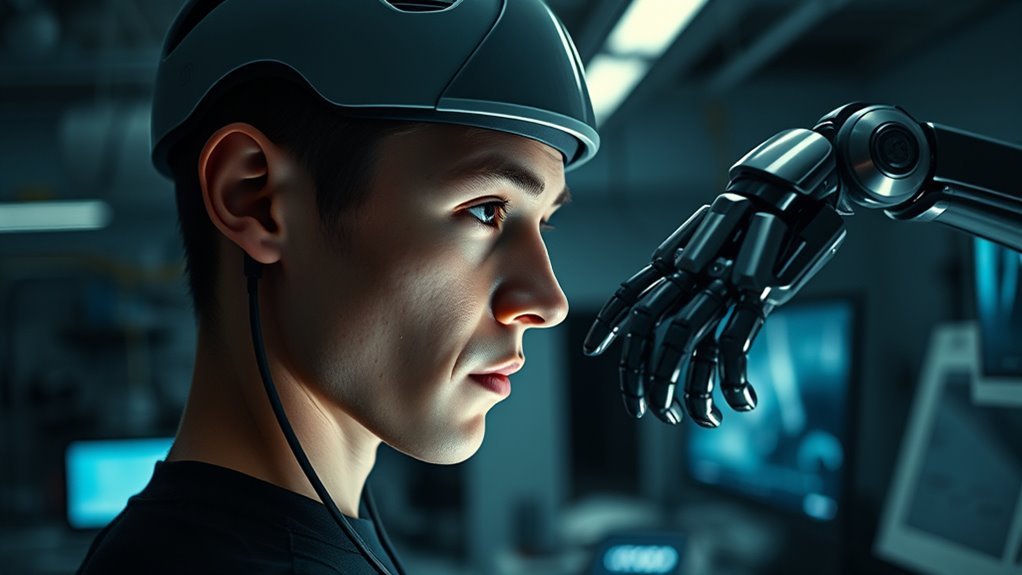

Brain waves are quietly reshaping how robots learn and how people will one day direct complex machines with little more than a glance at the screen or a sense that something has gone wrong. As artificial intelligence pushes deeper into physical environments from warehouses and hospitals to homes and battlefields, the ability to supervise and guide robots without constant manual input is becoming crucial. Brex’s AI governance framework establishes policies that could enhance the reliability of such systems.
From mistake signals to a new teaching channel
One of the most intriguing building blocks of brain-driven robot learning is the error-related potential. These are brief patterns in electroencephalography that appear when a person perceives that an action or stimulus is wrong, even if that person does not press a button or say anything. Error-related potentials can be seen when a robot chooses the wrong object, when a cursor moves to the wrong position, or when a command is decoded incorrectly.
Error-related brain potentials silently flag robot mistakes, turning fleeting neural reactions into machine-readable corrections
Neuroscience studies link these signals to brain areas involved in monitoring errors, especially the anterior cingulate cortex, which activates when outcomes deviate from expectations. A typical error-related potential contains a positive peak around 50 milliseconds, followed by negative and positive components that stretch out to roughly 600 milliseconds, all measurable at the scalp. That compact waveform gives machine learning models a distinctive pattern to latch onto and classify.
Robotics and brain-computer interface groups have spent more than a decade turning these mistake signals into feedback for robots. In work with the Baxter robot at MIT, a human observer simply watches as the robot indicates which object it plans to pick up. When the human silently notices that the choice is wrong, an error-related potential appears in the EEG, and the system classifies it in real time, enabling the robot to correct its decision mid-task. Similar approaches have been deployed in assistive scenarios where robots adjust their trajectories or behaviors whenever the human partner’s brain signals indicate that something has gone off course.
Research on continuous control shows that error-related potentials can be decoded even while a robot is moving rather than only during discrete yes or no decisions. That matters for realistic settings such as navigation or manipulation, where errors unfold over time. Across multiple studies, classification accuracy for detecting these error responses has reached levels that approach or exceed eighty percent and is steadily improving with better features and models. Feature-based methods that analyze temporal frequency and statistical properties of the signal can generalize across subjects and tasks, reducing the need for individual calibration. Deep neural networks trained on these signals can decode whether a robot action succeeded or failed regardless of robot design, suggesting broad applicability.
In effect, error-related potentials turn natural human reactions into labels. The operator does not have to pause the system or manually annotate each event. When something looks wrong, the brain reacts, and the robot can learn that the corresponding action was a mistake.
Sparse but powerful supervision for robot learning
From a learning perspective, error-related potentials are a sparse supervisory channel. People only generate strong error responses when they notice a meaningful mistake. During routine correct behavior, the signal is weak or absent. This might sound like a limitation, yet it aligns well with modern reinforcement learning and imitation learning, where sparse but high-quality feedback often matters more than dense low-quality labels.
Roboticists have already used error-related potentials as intrinsic rewards for reinforcement learning. In one study, robots refined gesture-based control by treating detected error signals as negative rewards and absence of error as positive feedback. Over time, the system reduced mistakes and aligned robot behavior with human expectations without manual grading of each trial.
Because error-related potentials indicate the perceived success or failure of an action, they bypass the need to define detailed task-specific reward functions. A robot that learns from these signals can, in principle, improve at tasks ranging from grasping to navigation as long as a human partner can recognize and react to errors. That flexibility is especially appealing for shared autonomy, where human and robot collaborate on complex tasks such as assisting disabled users or helping workers in hazardous environments.
There are clear limits. Error signals are not perfectly reliable. People may miss errors or generate responses to events that are surprising but not truly wrong. EEG remains a noisy modality, and long sessions can be tiring. Even so, this approach offers a pragmatic way to inject human judgment into robot learning loops without the overhead of full teleoperation or manual dataset labeling.
Brain-driven control beyond yes and no
Error-related supervision is only one side of brain wave-driven robotics. Parallel efforts aim to decode richer intentions that produce full repertoires of robot behavior. Recent work on Neural Signal Operated Intelligent Robots at Stanford demonstrates that a wearable EEG cap can let users control robots for about twenty everyday tasks through direct neural communication.
Lab projects such as the Neural Signal Operated Intelligent Robots initiative show that a non-invasive EEG cap combined with modern decoders can trigger on the order of twenty distinct everyday actions rather than a single command. These include moving household objects, cleaning surfaces, slicing food, tying ribbons, playing simple games, and assisting with cooking. The key idea is to map distinct patterns of brain activity to a library of predefined behaviors so that the user can call up complex routines with minimal physical effort.
Other research at MIT uses EEG not to issue direct movement commands but to express approval or disapproval of proposed robot actions. In this setup, the Baxter robot suggests an object sorting decision, and the human brain signals convey whether that decision is acceptable. Error-related potentials and related approval signals guide the robot toward better choices over time. This transforms brain activity into a kind of preference model that can shape decision policies.
At EPFL and related institutions, machine learning methods decode ongoing brain signals from tetraplegic users to adapt assistive robot motions. Users can influence trajectories and corrections in real time, allowing the system to compensate for motor limitations while remaining responsive to changing intentions. Military laboratories investigate similar techniques for controlling unmanned vehicles and exoskeleton-style wearable systems with the goal of thought-guided platforms that operate in demanding conditions where traditional controls are slow or impractical.
These projects share a theme. EEG becomes both a control input and a feedback channel. The robot not only moves in response to brain commands but also uses brain reactions to refine its own behavior.
How we got here
The idea that EEG signals could control physical robots dates back to the late nineteen eighties when early prototypes demonstrated simple movements based on slow and noisy brain activity. Those systems offered only a few bits per second of communication and required intense concentration from the user.
Since then, several trends have changed the landscape. Signal processing and machine learning have made it possible to detect subtle patterns such as error-related potentials with reasonable accuracy even in unconstrained settings. Neuroergonomics, the study of brain function in real-world tasks, has shifted the focus from laboratory button-pressing experiments to natural human-robot collaboration.
Online asynchronous decoding means that systems no longer wait for fixed trial structures but continuously monitor EEG and react when error signatures appear. Instead of rigid command and control interfaces, modern setups treat the brain as an additional sensor that reports when the world does not match expectations. This evolution mirrors broader changes in robotics from preprogrammed motion to adaptive behavior and from isolated industrial arms to collaborative assistants.
Implications for technology and business
For technology companies building embodied AI, error-aware brain interfaces are a way to close the loop between foundation models and physical robots. Large models can propose actions, policies, or entire task plans while human observers use brain reactions to veto or correct problematic steps without the friction of manual oversight.
In industrial robotics, brain-based supervision could help human workers oversee fleets of robots on production lines or in warehouses. Workers might not control each motion directly, yet their EEG signals could flag unsafe or inefficient behaviors, triggering automated corrections or alerts. Even partial deployment of such systems could reduce training time and enhance safety in collaborative environments.
Healthcare and assistive technology stand to benefit even more. For users with severe motor impairments, EEG-based control and feedback can provide agency where traditional interfaces fail. Combined with shared autonomy, error-aware robots can adapt to each individual’s capabilities and preferences, improving quality of life while limiting cognitive burden.
For businesses, this creates both opportunity and responsibility. Companies that invest in brain-aware robotic systems gain differentiation in usability and adaptability. At the same time, they take on stewardship of deeply personal neural data.
Risks, limitations, and unanswered questions
Despite the progress, there are significant open issues. EEG remains relatively low bandwidth and sensitive to noise. Hair, skin, and movement artifacts all degrade signal quality. Many current systems still require carefully controlled conditions or trained operators.
User experience is a major concern. Long sessions with EEG caps can be uncomfortable, and mental fatigue reduces reliability. Designers need interfaces that respect attention limits and that allow people to disengage without penalty.
Ethical and privacy risks are real. Brain signals can reveal information about attention, emotional state, and perhaps even latent preferences beyond overt control commands. Storing and analyzing these signals raises questions about consent, data protection, and potential misuse. Any deployment in workplaces, military settings, or consumer products will need clear governance and regulation.
There is also a deeper question about dependency. If robots come to rely heavily on human brain feedback, they may mirror existing human biases in what counts as an error or a correct action. Careful calibration and diverse user testing are essential to avoid encoding narrow norms into autonomous systems.
Key takeaways and what to watch next
The convergence of error-related potentials and robot learning offers a practical path to safer, more adaptive embodied AI. Robots can learn from the same internal signals that tell people something is wrong without forcing users to micromanage every move. Brain wave-driven control extends this idea, turning EEG into a versatile interface that can trigger complex behaviors and refine policies over time.
In the near term, expect to see more hybrid systems that combine conventional sensors and models with brain-based supervision, especially in high-stakes domains such as surgery, manufacturing, and defense. Over the longer term, advances in signal acquisition, wearable hardware, and decoding algorithms may push brain-robot interaction from niche assistive applications toward mainstream collaboration tools.
The central message is simple. As robots enter everyday life, the best results will come from systems that listen not only to cameras and force sensors but also to human brains, treating neural feedback as a first-class teaching signal rather than an afterthought.
Conclusion
Why brain wave trained robots matter now
Robots are finally leaving carefully scripted factory lines and moving into messy, unpredictable environments. That shift demands something we still struggle to give them: reliable intuition about the physical world. At the same time, the easy fuel that powered large language models text from the public internet does not exist for physical skills like folding laundry, wiring a panel, or packing irregular goods. Robotics teams are running into a hard data wall.
This is why the new experiments with using human brain waves as teaching signals for robots matter. If even a small portion of human intent, surprise, and error awareness can be captured from neural activity and injected into robot training pipelines, it could change how quickly and safely machines learn physical tasks, especially in industrial and assistive settings.
The work is still early. But after years of lab demos where people steered robots with their thoughts, research is shifting toward a deeper question: Can brain signals do more than control robots in real time and actually help train them to learn better in the first place
How we got here: from thought control to thought informed robots
The idea of controlling machines with brain activity has been explored for decades, but for most of that history it lived in clinical research and small neuroscience labs. Early work focused on invasive implants in animals and a few human patients, mainly to restore movement.
Over the past decade, non invasive systems based on electroencephalography also known as EEG changed the landscape. Lightweight caps and headsets allowed researchers to read coarse brain signals from the scalp, making it possible to test mind based control in more realistic environments.
Some important milestones
- Researchers at MIT CSAIL and Boston University built systems where an EEG monitor detects when a human notices a robot making a mistake. Their models classify so called error related potentials in tens of milliseconds, fast enough to let a person silently veto or correct a robot sorting task simply by reacting mentally to its choice.
- Follow on work combined brain activity with hand gestures so that users could correct robot behavior with a mix of thought and minimal motion. Rather than steering every step, humans supervise and nudge, while machine learning models interpret the signals.
- Teams at EPFL created machine learning programs that adapt robot motion in response to human brain signals, with a strong focus on assistive robotics for people with severe paralysis. The long term vision is that a wheelchair or robotic arm could respond to the users intentions with minimal training.
- Stanford researchers recently demonstrated NOIR, a cap based system that decodes complex brain wave activity so users can direct robots to do everyday tasks such as slicing fruit, cleaning a counter, or playing simple games using only their neural signals.
These projects share a common pattern. They treat the brain mainly as a control interface a way to steer robots in real time or flag errors. That alone is significant, especially for accessibility. But the new wave of work on physical AI goes one step further and asks whether brain data can reshape how robots are trained in the first place.
The new shift: brain waves as training data for physical AI
Modern robotics increasingly relies on data hungry foundation models that learn from videos, sensor streams, and rich annotations of how humans manipulate the world. The problem is that unlike text, there is no open web of detailed demonstrations for industrial tasks. Companies must manufacture their own datasets, and it is expensive.
Encord, a data tools provider for AI, is one of the firms now testing brain wave sensors as part of that data creation pipeline. At a dedicated facility in San Leandro, California, workers operate robots while wearing headsets from Zander Labs that record their brain activity.
During each task the system tries to infer mental states such as
- When the worker feels they made an error
- When the outcome is surprising
- When they are strongly focused on a specific intent or goal
These neural signals are then aligned with egocentric video from head mounted cameras, along with classic labels such as hand trajectories and object states. The result is a brain wave tagged dataset that does more than show what happened in the scene. It attempts to encode how the human expert experienced the task in real time.
According to reporting on this work, the project is explicitly framed as a trial. The plan is to build a relatively small dataset, plug it into robotics models, and measure whether performance improves compared to models trained only on video and conventional annotations.
The key question is not whether robots can be driven by thought that has already been shown. It is whether brain informed data can help robots learn more efficiently, especially in data scarce physical domains.
Why brain signals might be useful teaching signals
From years of following both brain computer interface research and robotics, there are a few reasons this approach is attracting serious attention.
First, brain signals can encode information that is hard to see in video. When a human expert performs a task smoothly, most of their competence is invisible. They may notice a subtle slip, anticipate that an object is unstable, or feel that a trajectory is risky long before anything obvious appears in the camera feed. Error related potentials and surprise responses show up in EEG data even when the person does not move or speak.
Second, intent is often ambiguous in pure visual data. A hand moving toward a shelf could be reaching for one of several objects. If synchronized brain activity indicates strong focus on a particular outcome, that signal can help disambiguate labels and guide the learning process. Early reports about Encords setup explicitly mention mental intent as one of the core states they hope to capture.
Third, robotics models are increasingly bottlenecked by annotation quality, not only quantity. Detailed descriptions of hand contacts, forces, and subgoals are expensive for humans to write. Brain wave data is not a magic substitute, but it might provide a low bandwidth channel of high value corrections and priorities that complement traditional labels.
In short, the bet is that even a noisy and individual specific signal might still be valuable if it captures things that current datasets miss.
What is happening inside the lab: practical realities
The romantic picture of telepathic robots hides a lot of messy engineering. EEG is sensitive to muscle movements, eye blinks, and environmental noise. Headsets must fit reliably across different people and shifts. Brain signals also vary widely between individuals, which means models often require calibration or personalization to interpret them correctly.
Current efforts acknowledge these constraints. Reports describe the work as proof of concept and emphasize that brain wave collection is more cumbersome than simply recording video from a factory floor. The goal is not yet broad deployment but careful measurement of whether the signal is worth the extra cost.
Alongside neural data, teams like Encords build conventional datasets using leader follower rigs, where one robot demonstrates a motion that another repeats, and high resolution egocentric video with detailed textual annotations of hand movements. Brain signals are an extra layer on top of this stack, not a replacement.
This layered approach reflects a pattern we have seen repeatedly in AI: initial enthusiasm around a new modality followed by a period of integration where it finds its role alongside more mature data types.
Implications for industry and society
If brain wave informed training works even modestly well, the impact could show up in several areas.
For robotics companies
- Improved sample efficiency would let firms train competent manipulation models with fewer physical demonstrations, lowering costs in domains where data is scarce and expensive to collect.
- Brain tagged data might make it easier to capture expert intuition for complex niche tasks that only a small workforce can perform today, preserving know how as models that can be transferred to other sites.
For factories and warehouses
- Human workers could shift from micromanaging robots to supervising and teaching them, using subtle reactions rather than constant teleoperation to improve performance. MITs earlier work on brain based error correction suggests that people can oversee robots quite naturally when the system interprets their reactions in real time.
- This could support safer collaboration. Robots that are trained with data emphasizing human notions of error and risk might learn behaviors that align better with what people consider safe, which is particularly important in close quarters manufacturing and logistics.
For accessibility and healthcare
- The boundary between assistive control and training data is blurry. Systems developed to let paralyzed users correct or guide robotic arms may end up generating high quality training data about safe and comfortable motion around the human body.
- As these models improve, they could in turn make assistive robots more capable out of the box, lowering the barrier for individuals who cannot easily participate in long calibration sessions.
For society and policy
- Brain data is profoundly sensitive. Using it as training fuel for industrial robots raises new questions about consent, privacy, and ownership. Workers who provide neural signals are not just sharing motion patterns, they are exposing aspects of their cognitive state. This will likely demand clear governance, transparent data handling practices, and perhaps new regulations.
- If brain informed training gives a significant edge, it may concentrate power among organizations that can afford specialized facilities and sensors, widening the gap between leading robotics firms and smaller competitors.
Open questions, risks, and what experience tells us
Given the history of AI and brain computer interfaces, it is important to be realistic. Several uncertainties are still unresolved.
- Generalization: Models trained on brain signals from a small group of experts may struggle when deployed with different users, tasks, or environments. Prior work on brain controlled robots showed some success at working with unseen users, but scaling this across an industrial workforce remains an open challenge.
- Noise and interpretability: EEG signals are low resolution and difficult to interpret cleanly. There is a real risk that brain labels add confusion rather than clarity unless the models and experimental design are extremely robust.
- Worker experience: Wearing a brain sensing headset for long shifts may be uncomfortable or intrusive. The technology will need to become less obtrusive and more ergonomic to be accepted spontaneously on shop floors.
From years of watching similar cycles play out, one pattern is clear. The most durable advances tend to come when new modalities like brain signals are integrated thoughtfully into existing pipelines, not when they are positioned as replacements. The current experiments appear to recognize this. Brain waves are treated as an additional supervisory channel whose value must be proven quantitatively, not assumed. That cautious stance is encouraging.
Takeaways and what to watch next
Brain waves moving from a control interface to a training signal marks a quiet but important shift in how we think about physical intelligence. Instead of programming robots line by line or relying solely on what cameras can see, researchers are starting to pipe aspects of human internal experience directly into machine learning systems.
Over the next few years, the key indicators to watch will be
- Whether small brain wave tagged datasets measurably improve manipulation performance or safety in real industrial benchmarks compared with video only baselines.
- How well these methods generalize across different workers without extensive recalibration, a requirement for any practical deployment.
- The emergence of technical and policy standards for collecting, storing, and using neural data in commercial settings, including meaningful consent and safeguards.
If the gains are real, we may see a new class of robots that internalize not only what humans do, but how humans feel about what they are doing, especially in moments of error and surprise. That would not make machines conscious or human like, but it could make them better collaborators in the physical world and accelerate progress toward flexible, trustworthy physical AI. reddit