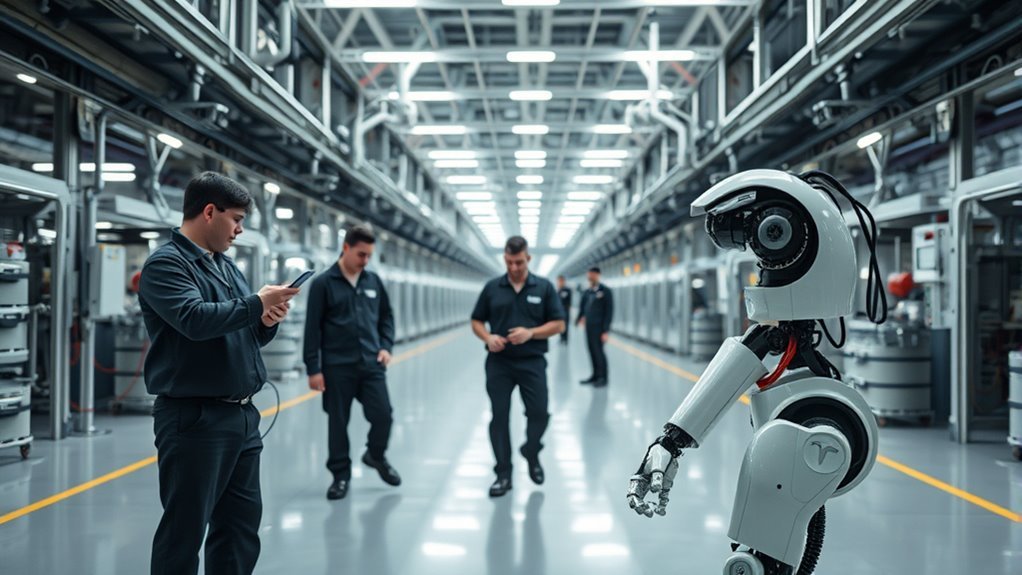
Unitree Robotics is about to become a major test case for how capital markets value embodied artificial intelligence, at a time when humanoid and legged robots are moving from lab curiosities into real industrial and service tools. The company’s planned listing on Shanghai’s STAR Market is not only large in absolute terms but symbolically important for China’s ambition to turn its robotics ecosystem into a pillar of the next phase of AI driven growth.
From quadruped experiments to embodied AI champion
Unitree is headquartered in Hangzhou and has spent the past decade building a portfolio of quadruped and humanoid robots that emphasize agility, affordability, and tight integration between hardware and AI control systems. By 2023, Unitree was estimated to hold nearly 70% of the global quadruped robot market, turning its pioneering work on legged machines into clear commercial dominance. Early products focused on dog-like robots that could navigate complex terrain, a segment that began as a niche research and hobbyist market but has steadily expanded into logistics, inspection, and security use cases.
As interest in embodied AI grew, Unitree pushed into humanoid platforms, positioning itself as a provider of full stack systems that combine mechanical design, sensing, and model-based control algorithms. The company’s prospectus and recent coverage highlight rapid revenue and profit growth on the back of rising global demand for robots that can operate in human-centric environments, such as factories, warehouses, and service spaces. Furthermore, their recent initiatives to open offline retail stores showcase a commitment to consumer engagement and market expansion.
In private markets, Unitree’s valuation climbed sharply through successive funding rounds, with estimates in the low to mid-billion dollar range before the IPO filing. That private trajectory set the stage for the current push to capture a significantly higher valuation in public markets, reflecting both operational progress and the broader market narrative around embodied AI.
Inside the STAR Market IPO
Unitree plans to raise about 4.2 billion yuan through an initial public offering on Shanghai’s STAR Market, the city’s technology-focused board for innovative companies. The deal is structured entirely as a primary sale of new A shares, with existing shareholders not selling stock in the transaction according to the prospectus and regulatory filings.
The offering involves at least 40.45 million new shares, representing a minimum of ten percent of the company’s post-IPO share capital, which implies a free float of no less than that threshold. On the basis of targeted proceeds and the indicated minimum float, market watchers estimate an initial valuation of roughly 42 billion yuan, or about 6.2 billion dollars, placing Unitree among the more valuable listed robotics companies globally.
Pre-IPO commentary and investor analyses suggest that Unitree has considered valuation scenarios as high as seven billion dollars, underscoring ambitious expectations for its growth and margin profile. That would represent a several-fold increase over its Series C valuation and reflects confidence in both the company’s technology roadmap and the momentum of the embodied intelligence theme.
A record speed path through China’s reformed listing process
The timing and mechanics of Unitree’s listing are as interesting as the headline numbers. The Shanghai Stock Exchange formally accepted the company’s STAR Market application on March twenty, twenty twenty-six, recording the status as accepted under a preliminary review mechanism designed for high-quality technology companies.
The listing committee scheduled its hearing for June one, and subsequently approved the IPO application, meaning the review took only seventy-three days from acceptance to committee green light, setting a new speed record under the reformed STAR Market process introduced in twenty twenty-five. This fast track path signals that regulators are willing to move quickly on what they see as strategically important hard tech offerings.
Following exchange approval, the China Securities Regulatory Commission received the review opinion and registration documents and granted IPO registration, allowing Unitree to raise the planned 4.2 billion yuan within a twelve-month window. The approval completes the formal sequence, but the company has not yet announced a launch date or price range, leaving market participants closely watching for signs of broader sentiment toward Chinese growth tech listings.
How Unitree plans to use the capital
Unitree’s prospectus and related disclosures show a clear focus on strengthening its technical moat rather than simply boosting short-term sales capacity. The proceeds are earmarked for four major categories of investment.
- Research and development of intelligent robot models and embodied AI control systems, including large-scale models that can handle complex perception, planning, and interaction tasks in real-time environments.
- Development of next-generation robot hardware, spanning humanoid and legged platforms with improved actuators, materials, and sensor integration that can meet demanding industrial requirements.
- New product innovation for industrial and service markets, targeting use cases such as manufacturing assistance, logistics, inspection, and potentially consumer-facing applications as costs come down.
- Construction and expansion of smart manufacturing bases to increase production capacity, automate more of the assembly process, and support consistent quality at scale.
This capital allocation aligns with the broader industry view that competitive advantage in robotics will come from the tight coupling of AI models, mechanical design, and production capabilities, rather than from any single component alone. By investing across all three dimensions, Unitree is trying to convert its current market position into durable technical and commercial leadership.
Why this IPO matters for China’s robotics and AI ecosystem
Unitree’s listing is widely described as China’s first embodied artificial intelligence stock on the A share market, and one of the most watched technology offerings on the STAR board. That matters for several reasons.
First, it provides a valuation benchmark for humanoid and legged robot makers, which are still relatively new to public investors. If Unitree prices at or near its targeted valuation and trades well, it will strengthen the case that embodied AI companies can command meaningful multiples in Chinese capital markets, encouraging more peers to file domestically rather than seeking overseas listings.
Second, the deal validates the STAR Market’s evolving role as a home for hard tech companies, following regulatory reforms that introduced faster and more tailored pre-review mechanisms for high-quality issuers. Regulators have repeatedly signaled that robotics, advanced manufacturing, and AI are priority sectors, and the record speed of Unitree’s review underscores that policy stance.
Third, the IPO will test investor appetite for companies that blend hardware and software in a capital-intensive segment. Humanoid robots require substantial ongoing investment in research, tooling, and safety testing, and profitability can lag revenue growth. The way analysts and portfolio managers underwrite these risks in Unitree’s case will influence how other robotics firms position their own IPO stories.
Balancing opportunity and risk
From a technology perspective, Unitree sits at the intersection of two powerful trends. One is the maturation of AI models that can control complex physical systems with increasing reliability. The other is the spread of flexible automation into domains where traditional industrial robots are too rigid or expensive to deploy. This combination has generated intense enthusiasm around humanoid platforms that can, in theory, perform a wide variety of tasks in human-designed spaces.
The opportunity is clear. If Unitree can scale production and drive down unit costs while maintaining performance, its robots could become standard equipment in logistics centers, factories, and eventually some public environments. That would create recurring revenue streams from hardware, software updates, and service contracts, and build a large installed base that feeds data back into its AI models.
There are equally real risks. The global humanoid field is crowded, with strong competitors in the United States, Europe, and other parts of Asia, many of whom are backed by deep-pocketed technology giants. Execution challenges include reducing failure rates, meeting safety and regulatory standards, and proving that total cost of ownership beats conventional automation or human labor in specific use cases. A high initial valuation can magnify the pressure to deliver near-term financial performance even while heavy investment in long-term R&D remains essential.
Macro conditions also matter. Chinese equity markets have experienced periods of volatility and shifting investor preference between growth and value. In such an environment, sentiment toward expensive technology names can swing quickly, and companies like Unitree must communicate transparently about milestones, risks, and realistic timelines for commercial rollout.
Role of advisors and the signal to mainstream finance
Unitree’s choice of leading domestic securities firms as advisors and underwriters reflects growing comfort among mainstream investment banks with the embodied AI theme. Their involvement suggests that the sector is moving beyond speculative storytelling and into a phase where financial intermediaries are prepared to put reputational capital behind specific names and structures.
For the wider ecosystem, that matters because serious coverage and underwriting can improve disclosure standards, foster better risk assessment, and make it easier for institutional investors to allocate capital thoughtfully rather than chasing hype. Over time, this can help distinguish companies with genuine technical depth and commercial traction from those primarily riding the narrative.
What to watch next
Several practical questions will determine how important this IPO becomes in hindsight.
- Pricing and valuation discipline. The eventual offering price relative to the indicated valuation range will show how much risk investors are willing to take on embodied AI stories at this stage of the cycle.
- Early trading performance. Post listing price action and liquidity will reveal whether Unitree is perceived as a long-term strategic holding or a short-term momentum trade in Chinese tech portfolios.
- Execution against use of proceeds. Observers will be watching for concrete progress in AI model development, hardware upgrades, and factory expansion tied to the four major investment projects outlined in the prospectus.
- Industry ripple effects. The strength or weakness of Unitree’s debut will likely influence filing decisions by other robotics and hard tech firms that are currently evaluating STAR Market or other venues.
Taken together, Unitree’s IPO marks a turning point for embodied intelligence. It translates years of engineering work and private market backing into a public market test of value, credibility, and long-term potential. If the company can use this capital to deepen its technology, scale production, and prove economically compelling use cases, it will set an important precedent for how humanoid and legged robots move from promise to productive infrastructure in China and beyond.
Conclusion
Unitree decision to go public in Shanghai is emerging as a defining test of whether humanoid robotics has matured from laboratory experiment to investable industrial sector.
With regulatory approval in place and a planned raise of about 4.2 billion yuan, Unitree offering will be watched closely by technology investors in China and by anyone tracking the global effort to build capable general purpose robots.
How Unitree reached this moment
Over the past decade, humanoid robots have moved from science conference stages and research labs into early commercial pilots in logistics, manufacturing and retail environments.
China has treated advanced robotics as a strategic industry, creating dedicated boards such as the Shanghai Science and Technology Innovation Market and encouraging domestic listings for hardware and artificial intelligence companies.
Unitree itself started as a maker of agile quadruped robots and gradually layered in more capable humanoid platforms, positioning the company as one of China leading robot manufacturers.
By 2025 it had already attracted dozens of institutional investors and was being discussed as a potential unicorn level listing candidate on China technology focused board.
Regulatory filings and tutoring processes with securities authorities during 2025 and early 2026 cleared the path for a full initial public offering.
The company now plans to float shares on the Shanghai Science and Technology Innovation Market, commonly called the STAR Market, which is the country main venue for high growth technology listings.
Unitree application to list was formally accepted by the Shanghai Stock Exchange in March 2026, starting an unusually fast review cycle.
The exchange listing committee examined the deal at a meeting on the first of June and approved it, with commentators noting that the review and approval took only seventy three days, among the quickest cases on this board.
In early July China securities regulator granted registration approval for the offering, clearing the last major regulatory hurdle before pricing and trading can begin.
Inside the planned IPO
According to its prospectus and related analyses, Unitree aims to raise about 4.2 billion yuan through the sale of at least around forty million new shares.
Given rules that require at least ten percent of the company to float, this implies an initial market capitalization of roughly forty two billion yuan, or about six billion United States dollars.
Earlier discussions and reports in 2025 had suggested that Unitree and some of its backers were considering valuations of up to fifty billion yuan, around seven billion United States dollars, which illustrates how much investor expectations have cooled and normalized as the deal moved through formal channels.
The official use of proceeds centers on research and development and scaling up production.
Unitree plans to invest heavily in large artificial intelligence models tailored for robotics, research on robot bodies and actuators, the design of new intelligent robots and the construction of a smart manufacturing base.
This combination shows that the company is trying to keep pace with frontier advances in software while also solving the practical challenges of building thousands of reliable physical machines.
The listing will take place on a board that has become a barometer for China ambitions in semiconductors, electric vehicles and now robotics.
As of late July 2026, the offering has approval but has not yet been priced, and the final subscription date and debut remain pending, with observers expecting a possible listing in late July or August if market conditions cooperate.
What a twenty five percent humanoid share really means
Unitree reported that humanoid robots now account for a substantial portion of its revenue, with one widely cited investor update describing a business where robot dogs still make up the majority of sales but humanoid platforms already represent around one third.
The company has also claimed a leading position in quadrupeds globally and a growing share of the humanoid market in China, which aligns with the user provided figure of roughly twenty five percent of the humanoid segment.
In practical terms, a quarter of the market in such a young field suggests that the competitive landscape is still fluid.
Humanoid deployments today are typically small batches in warehouses, factories or service environments, often framed as pilots or proofs of concept rather than large scale replacements for human labor.
Unitree ability to convert these pilots into recurring orders will be one of the key metrics investors focus on once quarterly reports start arriving.
Why this offering matters for technology and capital markets
Unitree IPO is significant because it links three trends that have mostly been discussed separately until now robotic hardware, advanced artificial intelligence and public equity markets in China.
If the deal prices smoothly and trades well, it will strengthen the argument that humanoid robotics is becoming a mainstream investable theme rather than a niche bet reserved for venture capital and sovereign funds.
For technology, the fresh capital provides runway for long cycle research that does not always fit private fund timelines.
Investment in robot specific artificial intelligence models can narrow the gap between promising demonstrations and systems that operate safely and autonomously in cluttered real world environments.
Expanded manufacturing capacity can lower per unit costs, which in turn makes it easier for customers to justify moving from pilots to fleet level deployments.
For businesses that buy robots, a listed Unitree offers greater transparency.
Prospectus documents, ongoing disclosures and analyst coverage will expose more detail on revenue mix, margins, failure rates and research spending than is usually visible in private robotics firms.
Large buyers in logistics, retail and manufacturing can use this information to gauge vendor stability and compare Unitree with global competitors that are still privately held or listed in other markets.
For China capital markets, the deal is a test of investor appetite for complex deep tech stories.
The STAR Market has hosted semiconductor designers, fabrication equipment makers and other hardware heavy firms, but humanoid robotics adds a new combination of hardware risk and artificial intelligence uncertainty.
A strong reception could encourage regulators and exchanges to support more offerings from advanced robotics and automation companies, reinforcing national efforts to build domestic supply chains in critical technologies.
Risks and open questions
Despite the optimism, several risks should be kept in view.
First, valuations for frontier technology companies can swing sharply when expectations collide with the reality of slow adoption and capital intensive manufacturing, as seen in earlier waves of solar and electric vehicle listings.
Unitree is entering public markets just as many investors are reexamining how much growth and profitability they expect from hardware intensive artificial intelligence plays.
Second, unit economics for humanoid robots remain largely unproven.
There is limited data on how long these machines can operate before major overhauls, how expensive maintenance will be and how customers will value them relative to human labor or simpler automation.
If early deployments expose reliability issues or safety incidents, demand could stall and weigh on the share price.
Third, competition is intensifying.
Large technology companies and well funded startups in the United States, Europe and other parts of Asia are racing to bring their own humanoid platforms to market, often with access to massive general purpose artificial intelligence models.
Global buyers may choose to diversify suppliers rather than commit to a single dominant vendor in one country.
Finally, regulatory and geopolitical factors are impossible to ignore.
Robots that can operate in industrial and public spaces raise questions about surveillance, labor displacement and cross border technology transfer.
Policy shifts that affect export controls, data handling or workplace automation could change the trajectory of demand in ways that are difficult to model today.
What to watch next
Unitree planned listing will serve as an early benchmark for how public markets value humanoid robotics and advanced automation more broadly.
If the company secures the targeted funding and trades stably, it will signal that investors believe humanoids are on a path from pilot deployments toward scaled profitable use in real industries.
If the deal struggles or the shares are volatile, it may reinforce the view that humanoid robotics is still in an extended experimentation phase rather than ready for mainstream adoption.
Either way, this offering will give the market a concrete data point on how much investors are willing to pay for a company that already commands a meaningful share of a nascent humanoid robot market and that sits at the intersection of physical automation and artificial intelligence.
For executives planning automation strategies, for policymakers shaping industrial and labor policy and for researchers building the next generation of robot intelligence, Unitree journey from private startup to listed robotics champion will be worth following closely over the coming quarters.