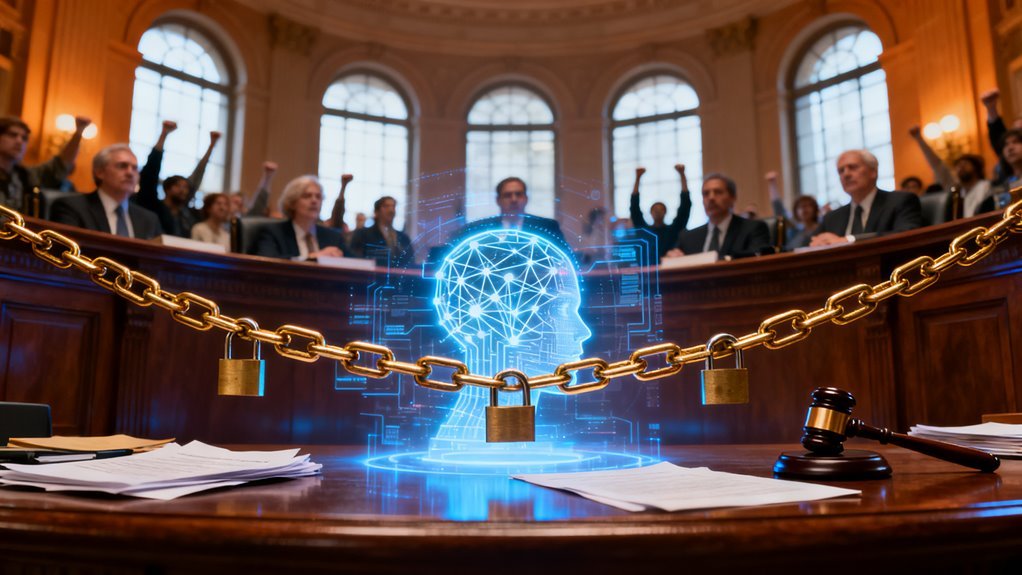

Europe Is No Longer Talking About AI Regulation. It Is Doing It.
For years, the European Union’s approach to artificial intelligence regulation existed mostly as a series of proposals, drafts and political negotiations. That changed in February 2024 when the European AI Office opened its doors in Brussels with a mandate that goes well beyond publishing guidelines. This is now an enforcement body, staffed with more than 140 specialists organized into five distinct units, and its primary target is the foundational model layer of the AI stack. The companies building the most powerful systems in the world, OpenAI, Google DeepMind, Anthropic and others, are now operating under a regulatory clock that runs out in August 2026.
What makes this moment different from previous regulatory signals is the specificity. The EU is not waving broadly at “AI risks” and hoping industry self-governs. It has built an institutional apparatus designed to evaluate, audit and penalize the companies training general purpose AI models. The distinction matters. By focusing on foundational models rather than individual applications, Brussels has chosen to regulate the supply side of the AI economy. Every chatbot, coding assistant, image generator and enterprise tool built on top of these models inherits the compliance obligations of its underlying infrastructure.
Why Foundational Models Became the Target
The strategic logic here is worth unpacking. Regulating AI at the application level is an almost impossible task. There are tens of thousands of AI powered products across every sector, and new ones appear daily. Trying to evaluate each one individually would require an army of regulators that no government can realistically assemble. But the number of companies building frontier foundation models? That list remains remarkably short. OpenAI, Google, Anthropic, Meta, Mistral, a handful of others. By placing binding obligations on model providers, the EU effectively creates a bottleneck where compliance can be monitored with reasonable efficiency.
This mirrors how financial regulation works in practice. Regulators do not audit every transaction at every business. They regulate the banks and clearing houses that process those transactions. The European AI Office has adopted a similar philosophy, and it suggests a level of regulatory sophistication that many in the industry have underestimated.
The Compliance Timeline and What It Actually Requires
August 2026 is the hard deadline for binding obligations on general purpose AI models. But the ramp up has already begun. The AI Office has initiated structured dialogues with major model providers, and the transparency requirements alone represent a significant operational burden. Companies will need to document training methodologies, disclose information about training data, publish technical documentation on model capabilities and limitations, and implement processes for identifying systemic risks.
For companies like OpenAI, which has historically been reluctant to share detailed information about its training data and processes, these requirements create a genuine tension. Anthropic, which has positioned itself as the safety focused alternative, may find the compliance burden more manageable since much of its existing documentation already aligns with what Brussels expects. Google, with its deep regulatory experience across multiple jurisdictions from search antitrust cases to GDPR enforcement, probably has the most mature compliance infrastructure among the major players.
The penalty structure deserves attention. Fines can reach up to 7 percent of global annual turnover for the most serious violations. For a company like Alphabet, that translates to potential penalties in the tens of billions of dollars. These are not symbolic numbers.
What the Industry Is Overlooking
Much of the commentary around the EU AI Act has focused on whether it will slow down European innovation. That debate, while valid, obscures a more consequential dynamic. The regulatory framework Brussels has built is designed to be extraterritorial. Any company whose AI models are accessible to EU citizens falls within scope, regardless of where that company is headquartered. This means American and Chinese AI companies cannot simply ignore the rules by keeping their corporate addresses outside Europe.
This is the GDPR playbook applied to artificial intelligence. When Europe introduced its data protection regulation, skeptics argued it would only apply within EU borders. Instead, GDPR became the de facto global privacy standard because the cost of maintaining separate systems for European and non-European users exceeded the cost of simply adopting GDPR compliant practices everywhere. The same dynamic is likely to play out with AI regulation. If OpenAI needs to document its training data for European regulators, it will almost certainly apply those documentation practices globally rather than maintaining parallel processes.
The second underappreciated element is timing. August 2026 coincides roughly with the period when several AI companies are expected to be pursuing or completing initial public offerings. Regulatory risk becomes a material disclosure issue in that context. Investors evaluating AI companies will need to factor in not just whether these firms can build impressive models, but whether they can operate compliantly in the world’s largest single market.
How This Compares to the American Approach
The contrast with the United States could not be sharper. The Biden administration’s executive order on AI, issued in October 2023, established voluntary frameworks and reporting requirements. The Trump administration has since rolled back even those modest measures. There is no American equivalent to the European AI Office, no binding compliance timeline, and no penalty structure for model providers.
This divergence creates an unusual competitive landscape. European regulators are building institutional knowledge about how frontier models work, what risks they pose, and how to evaluate them. American regulators are not. If and when the United States eventually moves toward binding AI regulation, which most industry observers consider inevitable, it will be starting from a significant knowledge deficit compared to its European counterparts.
For the major AI companies, the lack of American regulation is a short term operational advantage but a long term strategic risk. Without clear domestic rules, these companies face the possibility of sudden, reactive regulation triggered by a major AI incident or political shift. The EU approach, for all its burdens, at least provides a predictable framework that companies can plan around.
The Impact on Open Source and Smaller Players
One of the most consequential questions surrounding the EU framework is how it treats open source models. Meta’s Llama, Mistral’s models, and the broader open weights ecosystem do not fit neatly into a regulatory structure designed around corporate accountability. If you release model weights publicly and thousands of developers fine tune and deploy those models in unpredictable ways, where does compliance responsibility sit?
The current framework provides some exemptions for open source models that do not pose systemic risks, but the boundary between exempt and regulated is not yet clearly drawn. This ambiguity creates real uncertainty for the open source AI community and could influence strategic decisions about whether to release models openly or keep them behind API access.
Smaller AI companies and startups face a different challenge. The compliance costs associated with the transparency and documentation requirements are not trivial. Large companies can absorb these costs as a line item. For a ten person startup building on top of its own models, the same requirements could consume a disproportionate share of available resources. There is a real risk that the regulatory framework inadvertently consolidates power among the largest players simply by raising the administrative barrier to entry.
What Happens Next
The period between now and August 2026 will be defined by negotiation, interpretation and preparation. The European AI Office will publish detailed guidance documents, and those documents will shape how the broad language of the AI Act translates into specific corporate obligations. Every ambiguous clause in the regulation becomes a lobbying battleground.
Expect the major AI companies to invest heavily in Brussels based government relations teams over the next eighteen months. Several have already begun. OpenAI opened a European office in Dublin. Anthropic has expanded its policy team with European regulatory expertise. Google has redeployed compliance personnel from its GDPR operations to AI specific roles.
The deeper question is whether this regulatory model works. Europe is attempting something genuinely novel: building a supervisory framework for a technology that is evolving faster than any regulatory process can reasonably keep pace with. The models that exist in August 2026 will be substantially more capable than anything available today. Whether rules written in 2024 can meaningfully govern systems built in 2026 remains an open question, and it is one that the European AI Office will need to confront in real time.
What is not in question is the direction. The era of AI development operating in a regulatory vacuum is ending, at least in Europe. The rest of the world is watching closely, and the precedents set by the European AI Office over the next two years will shape how governments everywhere think about governing artificial intelligence for decades to come.
For years, the European Union’s approach to AI regulation felt like a slow moving legislative exercise, the kind of framework that generates thousands of pages of text but rarely changes how companies actually build products. That perception is about to collide with reality. The European AI Act is no longer a proposal, a draft, or a political aspiration. It is a law with an institutional backbone, a staffed enforcement body, and a deadline: August 2026, when binding obligations take full effect across the bloc.
What makes this moment distinct from previous regulatory posturing is the infrastructure Brussels has quietly assembled behind the legislation. The European AI Office, operational since February 2024 and housed within the Commission’s technology directorate, already employs more than 140 professionals dedicated to AI oversight. That is not a token advisory committee. It is a purpose built regulatory body with direct supervisory authority over the most powerful general purpose AI models on the market.
Why General Purpose AI Models Are the Primary Target
The EU’s decision to focus enforcement energy on general purpose AI models reveals a deliberate strategic calculation. Rather than attempting to regulate every AI application across every sector simultaneously, Brussels is zeroing in on the foundational layer: the large models that power downstream applications across healthcare, finance, hiring, law enforcement, content generation and everything in between.
Brussels isn’t chasing every AI app — it’s targeting the foundation models that everything else is built on.
This approach makes practical sense. Regulating individual applications would require enormous sectoral expertise and produce an unmanageable enforcement burden. Going after the models themselves, particularly the most capable ones from companies like OpenAI, Google DeepMind, Anthropic and Meta, concentrates oversight where the greatest systemic risks originate. If a foundation model carries safety vulnerabilities or generates outputs that violate fundamental rights, every application built on top of it inherits those problems.
The voluntary code of practice for general purpose AI providers is the precursor mechanism here. It allows major developers to demonstrate compliance before legal mandates kick in, effectively creating a trial period where the AI Office can identify gaps, test enforcement procedures and build working relationships with the companies it will soon regulate. A dedicated Signatory Taskforce coordinates this process, bringing industry participants together under structured oversight.
This is a familiar playbook. The EU ran a similar voluntary phase with the General Data Protection Regulation before its enforcement date in 2018. Companies that engaged early tended to fare better once penalties became real. Those that treated the pre enforcement period as background noise faced steeper adjustment costs later.
The Institutional Architecture Tells You Brussels Is Serious
Skeptics have long argued that European AI regulation would amount to paper rules with no enforcement teeth. The organizational design of the AI Office undercuts that argument.
Five specialized units cover distinct regulatory domains: excellence in AI and robotics, regulation and compliance, security, innovation and policy coordination, and AI for societal good. The office is led by Lucilla Sioli, a Commission veteran who previously ran the Artificial Intelligence and Digital Industry division within DG CONNECT. This is not a political appointee parachuted into an unfamiliar role. Sioli brings institutional knowledge of how the Commission’s technology regulatory machinery actually works.
The staffing expansion is also telling. More than doubling the Commission personnel dedicated to AI activities signals resource commitment, not just rhetorical commitment. Building enforcement capacity takes time, and the fact that this buildup began well before the August 2026 deadline suggests the Commission intends to be operationally ready when obligations become binding rather than scrambling to catch up afterward.
Compare this to how the United States has approached AI governance. Washington has produced executive orders, voluntary commitments from leading AI companies, and a growing body of guidance from agencies like NIST and the FTC. But there is no centralized federal enforcement body for AI, no single institution with the mandate, staffing and legal authority that the European AI Office now possesses. The contrast is increasingly stark.
Who Feels the Pressure First
The companies most directly affected are the developers of the most powerful general purpose AI models. OpenAI, Google, Anthropic, Meta and Mistral all operate models that will almost certainly fall under the Act’s highest scrutiny categories. These organizations will need to demonstrate compliance with transparency requirements, safety evaluations and risk mitigation obligations before they can continue offering services within the EU market.
For American and other non EU companies, this creates a familiar but intensifying compliance burden. The GDPR experience showed that global technology companies ultimately adapted to European rules rather than abandoning the European market. The same dynamic is likely to play out with AI regulation, but the costs will be higher and the technical demands more complex. Evaluating a large language model for systemic risk is fundamentally different from updating a privacy policy.
Smaller AI startups and open source model developers face a different set of questions. The Act includes provisions that attempt to calibrate obligations based on model capability and risk level, but the precise thresholds and compliance costs remain uncertain. If enforcement creates disproportionate burdens on smaller players, the regulation could inadvertently consolidate market power among the largest companies that can afford dedicated compliance teams.
This is a risk Brussels has acknowledged but not fully resolved. The innovation and policy coordination unit within the AI Office is partly designed to address this tension, but balancing safety oversight with ecosystem accessibility will be one of the most difficult ongoing challenges.
What the Market Should Actually Expect
Several practical consequences are already becoming visible.
First, AI compliance consulting and legal advisory services focused on the EU market are expanding rapidly. Law firms, audit companies and specialized consultancies are building practices around AI Act readiness, creating a secondary industry around the regulation itself.
Second, major AI providers are likely to begin publishing transparency reports and model evaluation documentation tailored to EU requirements well before the 2026 deadline. Early compliance serves dual purposes: it reduces regulatory risk and functions as a competitive signal that a company takes safety seriously.
Third, the enforcement dynamic between the EU and other jurisdictions will intensify regulatory competition globally. The UK, which has pursued a lighter touch sectoral approach to AI governance, will face growing pressure to demonstrate that its framework produces comparable outcomes. Countries across Asia, Latin America and the Middle East that are still developing their AI regulatory strategies will study the EU model closely, just as many adopted GDPR inspired data protection laws over the past six years.
Fourth, the relationship between the AI Office and national authorities responsible for market surveillance will be a critical variable. The Act creates a layered enforcement structure where Brussels handles general purpose model oversight while member states supervise sector specific AI applications. How smoothly that coordination works in practice will determine whether the regime functions as a coherent system or fragments into inconsistent national interpretations. The AI Board, which includes representatives from all EU Member States, serves as the central coordination mechanism designed to prevent exactly that kind of regulatory fragmentation.
The Deeper Signal
What the EU is building goes beyond a single piece of technology legislation. The AI Office represents an institutional bet that artificial intelligence requires a permanent, dedicated regulatory function comparable to what exists for financial markets, pharmaceuticals or telecommunications. This reflects a growing acknowledgment of AI’s potential systemic impact and the need for comprehensive oversight.
This is a structural claim about how governments should relate to AI development going forward. It assumes that the risks associated with advanced AI systems are persistent and systemic enough to justify standing enforcement infrastructure, not just periodic legislative updates or voluntary industry commitments.
Whether that assumption proves correct depends on how AI capabilities evolve over the next several years. If models continue to become more powerful, more integrated into critical systems and more difficult to evaluate, the case for dedicated oversight strengthens considerably. If the technology stabilizes or fragments into narrower, more predictable applications, the enforcement apparatus could become an expensive bureaucratic layer that adds friction without proportional benefit.
For now, the trajectory favors the EU’s bet. Foundation models are getting larger, more capable and more deeply embedded in economic and social infrastructure with each generation. The companies building them acknowledge, at least publicly, that some form of external oversight is necessary. The question was never really whether regulation would arrive, but what form it would take and who would enforce it.
Brussels has answered both questions. The rest of the world is still working on theirs.