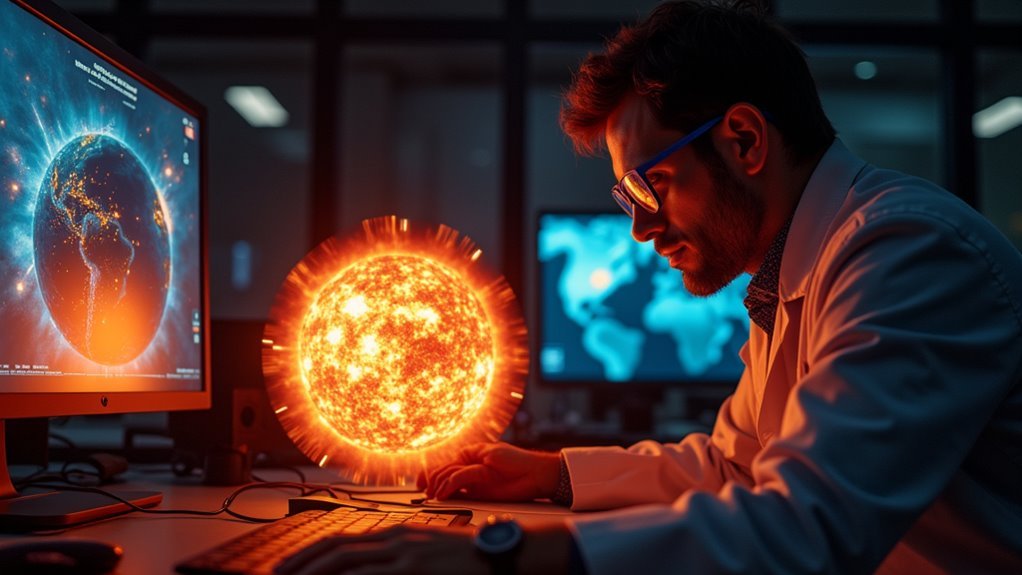

Solar storms are no longer just a curiosity for scientists. They are a growing operational risk for power grid operators, satellite owners, airlines, and anyone who depends on global communication and navigation. As solar activity ramps up in the current cycle, the difference between learning about a major storm from sudden outages and seeing it coming with enough time to prepare has become critical.
How space weather forecasting reached the limits of traditional tools
Space weather forecasting has existed for decades, built largely on physics-based models of the solar wind, the magnetic field, and the way charged particles interact with Earth’s magnetosphere. These models have given researchers a solid understanding of the underlying processes, but they have struggled with real-time accuracy and lead time, especially for complex phenomena like geomagnetic storms and solar flares.
Physics-based space weather models illuminate solar storms yet still struggle with real-time accuracy and lead time
The basic challenge is that solar storms are driven by highly dynamic systems. The solar wind varies from minute to minute, magnetic fields twist and reconnect, and coronal mass ejections travel through an uneven interplanetary medium. Observatories such as solar wind monitors near the Lagrange L1 point and global networks of magnetometers generate continuous data, but turning that torrent of measurements into precise and timely predictions pushes classical models to their limits.
Over the past several years, the heliophysics community has begun to treat space weather as a data-rich forecasting problem as much as a purely physics-driven one. That shift opened the door for deep learning and foundation models to complement traditional simulations with pattern recognition across vast historical datasets.
DAGGER learning how solar wind shakes Earth’s magnetic field
A clear example of this new approach is DAGGER, which stands for Deep leArninG Geomagnetic pErtuRbation. Developed through the Frontier Development Lab program, DAGGER is designed to forecast how Earth’s magnetic field will respond to changes in the solar wind on a global scale. The model combines NASA satellite observations with ground measurements to deliver 30-minute warnings of incoming geomagnetic storms.
Technically, DAGGER ingests several hours of solar wind data at one-minute resolution from the OMNI dataset along with worldwide ground magnetometer measurements, and learns how to map upstream conditions to geomagnetic perturbations on Earth’s surface. The model architecture has three main parts. A time series summarizer compresses the recent history of solar wind measurements. A coefficient generator translates that summary into spherical harmonic coefficients. A spherical harmonic constructor then uses those coefficients to reconstruct the expected global pattern of magnetic field changes.
When new spacecraft measurements indicate an approaching disturbance, DAGGER can produce a global forecast of geomagnetic perturbations in less than a second and refresh those forecasts every minute. Critically, the system provides about thirty minutes of warning before geomagnetic storms, highlighting regions where rapid magnetic field changes are likely to drive geomagnetically induced currents in transmission lines, pipelines, and other infrastructure.
For grid operators, thirty minutes is enough time to reconfigure networks, reduce loading on vulnerable equipment, and prepare for potential anomalies rather than reacting in the dark after protective relays start tripping.
Recent work has continued to refine DAGGER. An updated pipeline integrates more contextual magnetosphere and ionosphere data, extends the forecast horizon by incorporating solar remote sensing, and begins to quantify uncertainty in the predictions, which is essential for operational use. This evolution is a good example of how deep learning models in science rarely arrive fully formed. Instead, they go through careful iteration as researchers discover where the model works well, where it fails, and how to add more physical insight without losing speed.
Surya a foundation model for the Sun
If DAGGER focuses on what space weather will do to Earth, NASA and IBM’s Surya model focuses on what the Sun is about to do next. Surya is a foundation model for heliophysics, built to learn general representations of solar activity from long-term imaging records.
Surya is a large transformer-based model with roughly 366 million parameters trained on full resolution observations from NASA’s Solar Dynamics Observatory, including the Atmospheric Imaging Assembly and the Helioseismic and Magnetic Imager instruments. The training data spans about fourteen years of solar imagery and magnetic field measurements, giving the model exposure to many solar rotations and a broad range of active region evolution and eruptive events.
Unlike earlier flare prediction models that classified activity one snapshot at a time, Surya learns spatiotemporal patterns, watching how active regions grow, twist, and reorganize over time. In downstream tasks, this general solar representation has delivered state-of-the-art performance in solar flare forecasting, active region segmentation, solar wind prediction, and modeling extreme ultraviolet spectra.
For operational forecasting, one of the most striking results is Surya’s ability to visually predict solar flares. In early evaluations, the model generated images that indicate where a flare is likely to occur on the solar disk up to two hours in advance, along with estimates of its intensity and shape. Surya improved the accuracy of flare strength prediction by around sixteen percent compared with previous approaches, a meaningful gain when organizations need to decide whether a flare is likely to threaten satellites or radio communication.
From a reliability standpoint, it matters that Surya’s performance has been documented with standard metrics. In flare forecasting tasks, the model reached a True Skill Statistic of about 0.436, a Heidke Skill Score of about 0.522, and an F1 score around 0.561, outperforming baselines such as AlexNet and ResNet50 trained on the same data. Those numbers do not make forecasts perfect, but they show that the model is learning genuinely useful structure in the data rather than simply memorizing past events.
Another important element for trustworthiness is openness. NASA and IBM have made Surya and its associated datasets available through widely used machine learning platforms and code repositories, inviting independent verification, adaptation, and scrutiny from the broader research community. That kind of transparency is essential when models begin to influence decisions that carry real economic and safety consequences.
Ensemble AI and multi-target space weather prediction
While DAGGER and Surya illustrate focused applications, the direction of travel is toward ensemble and multi-task AI systems that tackle several space weather problems at once. Instead of building entirely separate models for flare classification, coronal mass ejection travel time, solar wind background conditions, and geomagnetic storm indices such as the Kp index, researchers are assembling frameworks that share representations while producing multiple forecasts.
Recent studies show that machine learning models can substantially improve some of these targets. For example, ensemble models that estimate coronal mass ejection kinematics directly from coronagraph images have reduced mean absolute error in arrival time forecasts to roughly eight to twelve hours, representing about a forty to sixty percent improvement over physics-only baselines. In flare forecasting, foundation models like Surya have demonstrated skill improvements on the order of ten to twenty percent versus earlier deep learning architectures.
By fusing solar imagery with in situ measurements of the solar wind and interplanetary magnetic field, these systems can extend lead times from tens of minutes to many hours and even several days for certain parameters, particularly the arrival time of large coronal mass ejections and changes in background solar wind conditions. That extended horizon is where the societal benefits become most significant. A few minutes of warning might help protect specific satellites. Several hours to days can let grid operators adjust maintenance schedules, satellite constellations switch to safer modes, and airlines rethink polar routes ahead of a major storm.
Why this matters for businesses and critical infrastructure
For decades, space weather warnings were treated as a specialized concern. Today, they increasingly sit alongside more familiar operational risks such as extreme terrestrial weather and cyberattacks. The dependence of modern economies on GPS timing, satellite communications, and long-distance high voltage transmission makes severe solar storms a systemic risk rather than a niche problem.
Deep learning models like DAGGER translate upstream solar wind changes into concrete, geographically resolved risk maps for geomagnetic perturbations. That enables utilities to understand which parts of a grid are likely to be stressed, where geomagnetically induced currents may spike, and which transformers or lines deserve the most attention.
Insurance and risk management teams can fold those forecasts into scenario planning rather than relying purely on historical worst cases. Foundation models such as Surya move the alert upstream, telling operators which kinds of solar events are likely to occur, where on the Sun they will originate, and how intense they may be. Satellite operators can use those signals to time sensitive maneuvers, protect critical instruments, and manage the tradeoff between service continuity and hardware safety.
Telecommunications providers and aviation operators can plan for radio blackouts or navigation anomalies when the probability of strong flares or associated particle storms rises. There is also a strategic dimension. Governments rely on resilient space weather forecasting to protect military assets and national infrastructure. The fact that leading models are open and documented, rather than purely proprietary systems, helps build confidence across borders and organizations that depend on shared situational awareness.
Limitations and the risks of overconfidence
Despite the progress, it is important to stay clear-eyed about what these AI systems can and cannot do.
First, they are only as good as the data they see. Surya is trained on Solar Dynamics Observatory records from the past decade plus, which means its understanding of the Sun is shaped by the specific conditions of that period. If future solar cycles produce activity patterns that differ significantly from this training window, performance could degrade until models are retrained with new data.
Second, extreme events are rare. The most dangerous geomagnetic storms and solar flares occur infrequently, so there are relatively few examples in historical datasets. Even sophisticated deep learning models may struggle to generalize to truly exceptional events, precisely the ones that matter most for worst-case planning.
Third, interpretability remains a challenge. DAGGER uses spherical harmonics and a relatively structured pipeline, but the core mapping from time series input to coefficients comes from a neural network, which is not fully transparent to human experts. Surya goes further into the realm of foundation models, where individual predictions emerge from high-dimensional representations that are difficult to interrogate directly. That opacity complicates efforts to debug mispredictions and to build regulatory frameworks around automated warnings.
Fourth, these models depend on a chain of upstream sensors. If spacecraft at L1 experience outages or if ground magnetometer networks go down, even the best AI cannot compensate for missing input data. Building robust forecasting therefore requires investment not only in algorithms but also in redundant and well-maintained observation systems.
Finally, there are governance questions. Open availability of models such as Surya is a strength for scientific progress, but it also means that powerful forecasting tools are accessible to many actors, including those who might use them to game markets or exploit vulnerabilities revealed by precise space weather timing. As AI becomes central to forecasting solar storms, organizations will need clear policies about how alerts are shared, how decisions are escalated, and how accountability is assigned when predictions are wrong.
The road ahead
Taken together, DAGGER, Surya, and the broader ecosystem of ensemble AI models mark a genuine turning point in space weather forecasting. Physics-based models are not disappearing. Instead, they are being augmented by systems that learn directly from data, compress years of observations into fast predictive engines, and expose new ways to think about risk.
Over the next few years, the most credible path forward combines several elements. Continued improvement of deep learning architectures anchored in solid physical understanding. Expanded and diversified datasets from new solar missions and ground networks. Better uncertainty quantification and calibration so forecasts can be trusted not just for their central estimates but for their confidence intervals.
Stronger operational integration, where forecasts flow directly into grid control rooms, satellite operations centers, and aviation planning tools rather than staying inside specialist dashboards. As solar activity continues to fluctuate, organizations that treat space weather forecasting as an integral part of resilience planning rather than an exotic add-on will be better positioned to withstand shocks.
The practical value of AI that predicts solar storms will be measured not only in academic skill scores but in fewer damaged transformers, fewer lost satellites, and fewer cascading outages. For now, this new generation of AI that predicts solar storms is quietly becoming part of the infrastructure that keeps a digital world resilient and prepared.
Conclusion
Artificial intelligence models that can see dangerous solar storms coming before they hit Earth are quietly changing how governments and companies think about risk. The timing is crucial. As the current solar cycle ramps up and our dependence on satellites and power infrastructure deepens, the difference between thirty minutes and several days of warning can mean billions of dollars saved and critical services kept online instead of going dark.
From early space weather forecasts to AI assisted prediction
Space weather forecasting used to be a niche discipline that relied mostly on physics based models and the expert judgment of a relatively small community of scientists. Traditional approaches combined observations of the Sun with rules of thumb and simulations of coronal mass ejections moving through the solar wind. These methods provided useful warnings but with large uncertainty in both timing and intensity of storms.
Over the past decade, researchers began to apply machine learning to this problem, first as experimental tools that sat alongside existing models. Early work focused on classifying solar active regions, predicting whether they might produce flares, and estimating when eruptions would reach Earth using empirical patterns learned from historical data.
The last few years have marked a turning point. A new generation of AI systems now ingests vast streams of solar imagery and in situ measurements and produces operational forecasts that outperform many legacy techniques. These models are no longer curiosities in research papers. They are starting to inform real decisions about how to protect satellites, astronauts, power grids, and communication networks.
What the latest AI models can actually do
Several concrete advances show how quickly this field is maturing.
A team supported by NASA created a model known as DAGGER, short for Deep Learning Geomagnetic Perturbation. It uses AI to analyze spacecraft measurements of the solar wind and then predicts where on Earth an impending solar storm will strike, with about thirty minutes of lead time. The model can update predictions every minute and generate new forecasts in less than a second, which is essential when operators need to decide whether to temporarily reconfigure power systems or move satellites into safer modes.
NASA and IBM have built another cornerstone system called Surya, described as a heliophysics foundation model trained on more than a decade of high resolution solar observation data. Surya is designed to understand the dynamic surface of the Sun and visually predict solar flares, producing images that show where on the solar disk a flare is likely to occur up to roughly two hours ahead. In evaluations, this approach roughly doubled the warning time compared with some leading techniques, while maintaining competitive accuracy in classifying and characterizing flares.
Researchers at NYU Abu Dhabi introduced an AI model that focuses on solar wind speeds rather than flares alone. Their system can forecast solar wind conditions up to four days in advance and delivers about a forty five percent improvement in accuracy compared with current operational models and twenty percent over previous AI based approaches. Longer lead times on solar wind behavior matter because they influence how coronal mass ejections propagate through space and how strongly they will disturb Earths magnetic field when they arrive.
Another striking development comes from Southwest Research Institute and NSF NCAR, which developed a physics informed model known as PINNBARDS. This tool links detailed surface observations of solar active regions with deeper magnetic dynamics inside the Sun, reconstructing subsurface states and using them as starting points for forward simulations of magnetic evolution. By doing so, the system can predict where and when large flare producing active regions are likely to emerge weeks in advance, dramatically extending the forecast window compared with traditional focus on near surface signatures.
European efforts add further evidence that AI is becoming embedded in operational space weather services. At the Space Weather Office in Graz, Austria, the Beacon2Science project uses machine learning to enhance image data from space and deliver near real time predictions of solar storm activity, giving local forecasters better inputs for warning systems.
Other research teams have targeted specific operational problems. A collaboration led by Los Alamos National Laboratory built an AI enhanced model called PreMevE MEO that improves hourly forecasts of high energy electrons in medium Earth orbit, a key factor for satellite radiation exposure. Studies reported in international journals and conferences show that advanced AI models can predict the arrival times of coronal mass ejections with unprecedented precision, in some cases reducing timing uncertainty to about one minute, and outperform traditional methods across multiple stages of geomagnetic storms.
Taken together, these systems show a clear trend. Space weather forecasting is shifting from relatively simple empirical rules and single event predictions toward integrated AI platforms that fuse remote sensing and in situ data and deliver continuous, globally relevant risk estimates.
Why this matters for technology and business
For years, space weather was treated as an abstract hazard. That is no longer possible. Modern economies lean on technologies that are directly vulnerable to geomagnetic disturbances.
Power grid operators have to manage geomagnetically induced currents that can saturate transformers and damage equipment. A model like DAGGER that can pinpoint where a storm will hit gives operators the option to temporarily reroute power flows, adjust voltage levels, or take vulnerable assets out of service before damage occurs, instead of reacting after alarms start to sound. In extreme events, this could be the difference between localized disruption and a wide area blackout.
Satellite owners are equally exposed. High energy particles and radiation belt dynamics influence spacecraft charging, electronics reliability, and orbital drag. Better forecasts of electron fluxes in medium Earth orbit, as provided by systems like PreMevE MEO, allow operators to plan safer operating modes during high risk periods, reschedule critical maneuvers, and protect valuable instruments.
Telecommunications and navigation are also in the line of fire. Surya and related foundation models aim to protect services ranging from GPS and satellite internet to airline communication links by improving the ability to foresee flare activity and its radio effects. If carriers know that a major flare is likely within the next couple of hours, they can adjust flight routes, reallocate bandwidth, or prepare fallbacks ahead of time.
These models are not only tools for specialists. They are beginning to appear in policy conversations about national resilience. Governments are aware that a solar event on the scale of the nineteenth century Carrington Event would today pose systemic risk to finance, logistics, and basic services. AI assisted forecasting offers a way to turn that risk from an unknowable threat into a managed problem with clear playbooks and response triggers.
How reliable are these models really
The tempting story is that AI will simply solve space weather forecasting. Reality is more nuanced.
On the positive side, multiple independent studies now show that AI methods outperform long standing empirical and physics only approaches on key metrics such as flare classification accuracy, timing of geomagnetic disturbances, and prediction of storm recovery phases. Improvements of twenty to forty percent in forecast accuracy are common in recent work and some specialized tasks, such as coronal mass ejection arrival times, have seen even sharper gains.
Lead time is another major benefit. Moving from warning windows of minutes to hours and even days changes how organizations can plan. Surya offers a practical two hour window for many flare predictions, while NYU Abu Dhabi models extend solar wind forecasts to several days and PINNBARDS pushes the horizon to weeks for the emergence of dangerous active regions.
Yet there are important limitations. Many AI models are trained on data from a single solar cycle or a limited set of instruments. That means their performance may degrade when the Sun behaves in ways not well represented in the training set or when key spacecraft experience outages. Physics informed approaches like PINNBARDS reduce this risk by tying predictions back to magnetohydrodynamic principles, but they are still constrained by observational coverage and model assumptions.
Another challenge is interpretability. Foundation models such as Surya and complex deep learning systems can be difficult to understand in detail. Operators need not only predictions but also confidence estimates and clear explanations of why certain events are flagged as high risk. Work is ongoing to combine AI outputs with traditional diagnostics and uncertainty quantification so that decision makers can see when the models agree and when they should be cautious.
False alarms and missed events carry real costs. If forecasts cry wolf too often, grid and satellite operators may start to ignore them, undermining trust. If they miss a major storm, the sense of security that AI was supposed to provide can evaporate quickly. Responsible deployment demands honest reporting of performance metrics, including failure modes, not just headline accuracy improvements.
The broader AI story behind space weather
These advances are part of a larger shift in how AI is used in science. Systems like Surya are essentially digital twins of the Sun. They are trained on enormous volumes of observational data and then used to simulate and forecast solar behavior in ways that complement physics based models.
The PINNBARDS project shows what happens when neural networks are explicitly constrained by physical laws. By embedding knowledge of solar magnetic dynamics into the architecture, the model becomes better at generalizing beyond the training data and maintains consistency with established theory.
Meanwhile, operational tools such as DAGGER and PreMevE MEO demonstrate that AI can move from laboratory experiments into real time services that run continuously and feed into critical infrastructure management systems.
This progression mirrors what has happened in other domains such as weather forecasting and climate modeling. AI starts as an add on that helps interpret data, then becomes a core component of predictive systems, and eventually serves as a foundation that other models and applications build upon.
What organizations should do now
For technology leaders and policymakers, the practical question is how to integrate these new capabilities without overpromising.
Organizations that operate critical infrastructure should begin by mapping which assets are most sensitive to space weather and what kinds of forecasts are most relevant. Power grid operators might prioritize geomagnetic disturbance predictions, while satellite owners focus on radiation belt dynamics and orbital drag. Matching specific AI tools to these needs avoids a superficial adoption that looks modern but does not change decisions.
It is equally important to treat AI space weather models as part of a layered defense. They should complement, not replace, traditional physics based forecasts, operator experience, and hardware protections. When several independent lines of evidence point to elevated risk, response actions can be justified more confidently.
Governments and industry groups can help by supporting open data and transparent benchmarks. Foundation models like Surya are released as open source tools, which allows the scientific community to test, critique, and improve them rather than relying on closed proprietary systems. Shared evaluation frameworks and public performance reports will be essential for building trust.
Finally, training and communication matter. The staff who receive AI generated alerts need clear protocols that translate forecasts into actions. They also need to understand what the models can and cannot do so that they neither ignore warnings nor treat them as infallible.
Key takeaways and what to watch next
The ability of AI to predict hazardous solar activity is no longer speculative. Multiple operational models now offer meaningful lead time on solar storms, from half hour global geomagnetic warnings to multi day solar wind forecasts and even week scale predictions of active region emergence.
These systems are already helping protect satellites, power grids, and communication networks, and they are likely to become standard components of national resilience strategies as solar activity intensifies in the coming years.
At the same time, they raise familiar questions about transparency, reliability, and dependence on complex models. Responsible use will require continued collaboration between heliophysicists, AI researchers, infrastructure operators, and regulators, along with rigorous testing against extreme events that have not yet occurred.
The most useful way to think about this moment is not as AI taking over space weather forecasting, but as AI giving humanity a better chance to stay one step ahead of the Sun, rather than simply hoping that the next major storm does not arrive at the worst possible time. reddit





1 comment
Comments are closed.