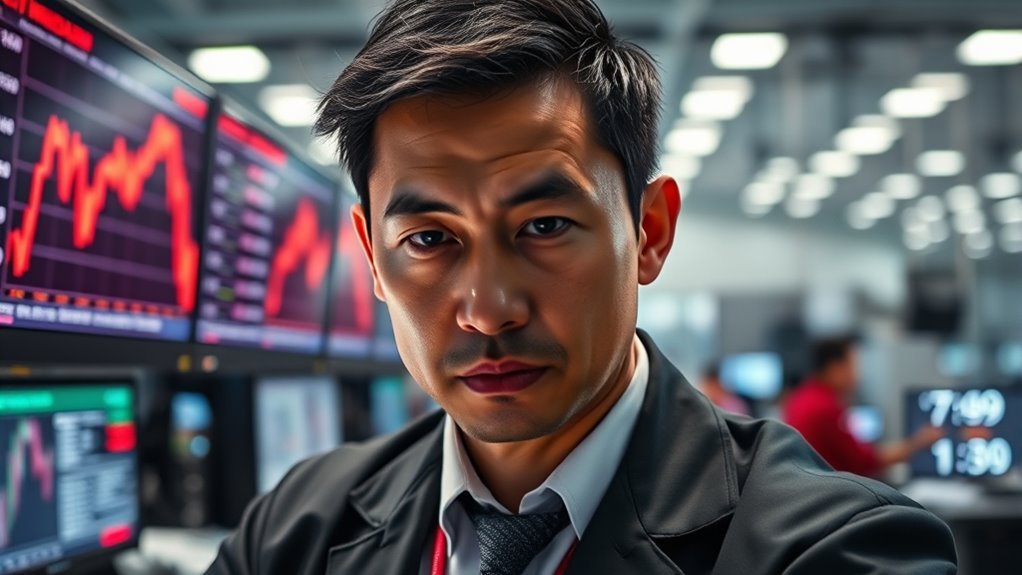
South Korea just learned how brutal an AI driven reversal can be when most of an equity index rests on a few semiconductor giants. The sudden KOSPI plunge that triggered a full market circuit breaker is not just a local story; it is a stress test for the global AI chip boom and for the safeguards meant to stop panic from turning into a crash.
Why this sell off matters now
For months the KOSPI rode a powerful AI semiconductor rally, pushed higher by Samsung Electronics and SK hynix as investors priced in an aggressive global buildout of data centers and AI infrastructure. The index even crossed the nine thousand level intraday for the first time in mid June, a symbolic moment for a market that had long trailed US tech benchmarks.
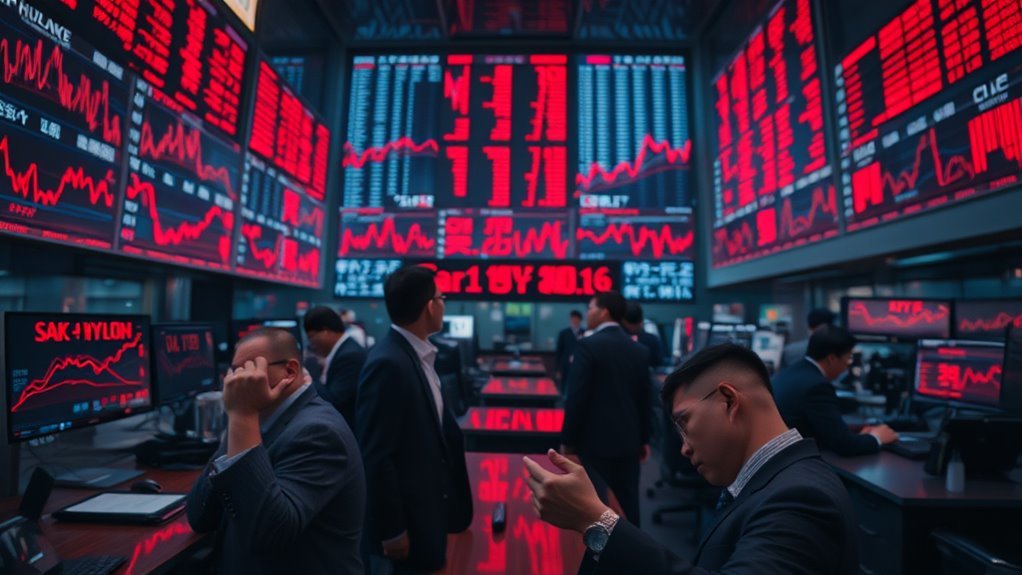
That made the June eight sell off especially jarring. In the opening hour, the benchmark dropped more than eight percent, triggering a level one circuit breaker and freezing trading for twenty minutes. The single day decline of roughly eight and a third percent was the largest in years and abruptly broke the narrative that AI chips could only go up.
How Korean circuit breakers actually work
Korea’s circuit breaker framework is built to pause trading when index moves become so extreme that price discovery breaks down. The rules apply to all KOSPI and Kosdaq listed equities and stock linked derivatives, but not to bonds, which are treated separately and are generally less volatile.
Regulators use three stages tied to the percentage fall from the previous close.
- Stage one is triggered when the KOSPI or Kosdaq index falls at least eight percent from the prior close and stays below that threshold for more than one minute. All stock trading stops for twenty minutes, and when the market reopens, the first trades are matched through a single price auction that collects orders for ten minutes before switching back to continuous trading.
- Stage two would be activated if losses widen to at least fifteen percent and the index drops an additional one percent or more from the level at which stage one was triggered, again for at least one minute. This would prompt another twenty minute halt, although in practice Korea has never reached this stage in modern trading history.
- Stage three would follow at a twenty percent or greater decline and a further one percent drop from the stage two trigger level. That combination would effectively end trading for the session, closing the equity market for the day.
Alongside the main circuit breakers, Korea uses sidecar rules that can temporarily suspend program trading when index futures swing beyond set limits. On days when KOSPI and Kosdaq futures have fallen more than five to six percent, the exchange has activated trading curbs that halted program driven flows, helping to dampen automated selling and arbitrage activity.
This layered design reflects hard lessons from past episodes, including the global financial crisis and the pandemic era sell offs, when sudden air pockets in liquidity magnified volatility. The aim is simple although difficult to execute in real time. Give investors a few minutes to cool off, reassess information, and reenter orders in a more orderly way.
What actually happened on June eight
June eight opened with a shock. Within minutes, Samsung Electronics and SK hynix, the country’s two dominant memory chip makers, fell sharply, dragging the entire index down. Samsung dropped close to ten percent at one point, while SK hynix fell more than six percent in early trading. Together these two names account for a very large share of the KOSPI, estimated at well over forty percent and in some measures more than half of the index’s total market capitalization.
As their prices tumbled, the KOSPI slipped below seven thousand five hundred, breaking through a psychologically important level and widening losses beyond eight percent. That move triggered the level one circuit breaker at around three minutes past nine in the morning, halting trading for twenty minutes. The index eventually closed near seven thousand four hundred eighty, down about eight and a third percent on the day.
The sell off did not happen in isolation. It followed a more than ten percent drop in the Philadelphia Semiconductor Index and a wider slump in US tech shares, driven by concerns that the Federal Reserve might need more rate hikes as US employment data remained strong. Higher discount rates compress valuations, and in a sector priced for years of rapid growth, even a modest shift in interest rate expectations can translate into double digit percentage swings in equity prices.
Domestic analysts quickly linked the Korean rout to this global context. What began as profit taking in AI related semiconductor stocks in New York morphed into a broader rethink of how sustainable current AI capital expenditure plans really are, particularly for memory and advanced packaging suppliers.
The role of Samsung and SK hynix in the AI cycle
To understand why the KOSPI reacted so violently, it helps to look at how central Samsung and SK hynix have become to the AI narrative. Both companies produce high bandwidth memory and advanced DRAM that are essential for training and running large AI models, and they supply leading US chip designers and cloud providers.
Throughout late twenty twenty five and the first half of twenty twenty six, expectations of an AI data center buildout drove a surge in orders for these components. Investors priced in a multiyear super cycle of capital spending on GPUs, memory, networking, and storage, with Korean suppliers positioned as key beneficiaries. That optimism helped the KOSPI climb past eight thousand and then briefly above nine thousand, with semiconductor shares at the forefront.
The June eight drop revealed the flip side of that concentration. When a market hinges on a small number of AI winners, any hint that growth may slow, margins may compress, or capex plans may be postponed can erase months of gains in a single session. The subsequent early July episode, when Samsung and SK hynix again slumped and pushed the KOSPI down nearly eight percent after another overnight rout in US semiconductor stocks, reinforced the sense that this is now a recurring pattern rather than a one off shock.
How investors behaved during the circuit breaker
One of the more instructive aspects of the June eight halt was the split between investor groups. During the halt, individual investors were net buyers of 3.77 trillion won, even as foreign and institutional investors accelerated their selling. Local reporting showed that individual investors stepped in as net buyers during the downturn, while foreign investors accelerated selling. This mirrors a long standing pattern in Korean markets, where domestic retail often sees sharp dips as buying opportunities and tries to average down, whereas foreign institutions tend to focus more on global macro signals and relative valuations across regions.
The mechanics of the halt reinforced that behavior. During the twenty minute pause, orders could still be entered but not executed. Before trading resumed, the exchange collected orders for ten minutes and then matched them in a single auction, which allowed bargain hunters to express demand at lower prices while providing a clearer view of where foreign selling pressure stood.
As trading reopened, some of that domestic bid helped narrow losses. The index recovered part of the early decline and moved back toward the mid seven thousand range rather than closing at the intraday lows. From a stability perspective, this is precisely the sort of outcome regulators hope for. The pause did not erase the shock, but it did convert disorderly selling into a more measured repricing.
What this episode means for AI and for markets
From an AI industry standpoint, the KOSPI circuit breaker is a reminder that financial markets are now deeply intertwined with expectations about AI adoption timelines. When investors build models that assume several years of uninterrupted capex growth for cloud and hyperscale companies, any sign of moderation can trigger rapid pullbacks in supplier stocks.
The June eight shock raises several implications.
- Valuation sensitivity. AI linked chipmakers are now trading in a regime where macro data and central bank messaging can move their stocks more than near term earnings beats or misses. That makes it harder for executives to use guidance alone to stabilize share prices.
- Concentration risk. Indexes where a few AI champions represent a large share of market capitalization are more vulnerable to systemic moves. Korea is an extreme case in this respect, but similar dynamics exist in US and European benchmarks where a handful of AI and cloud names drive most of the performance.
- Policy and infrastructure. Circuit breakers and sidecar rules are becoming part of the basic toolkit for managing AI era volatility. The Korean experience suggests that well calibrated thresholds and short, structured halts can prevent temporary fear from cascading into flash crash style events.
There are also broader societal and business questions. Companies planning long term AI investments must now factor in the likelihood of repeated market swings that do not necessarily reflect real shifts in demand. Workers and policymakers will see headlines about market crashes and may misinterpret them as evidence that AI is a passing fad, even when underlying orders and deployment plans remain intact.
For trust in markets, transparency becomes critical. Regulators need to communicate clearly why circuit breakers were triggered, what rules were applied, and how trading will restart. Investors need to understand that a halt is a feature, not a failure, designed to give the market a chance to regain composure rather than to hide information. Korea’s detailed public documentation of its three stage system and the prompt reporting around recent halts are positive examples in that regard.
Key takeaways and what to watch next
The June eight KOSPI sell off and circuit breaker activation showed how quickly an AI driven boom can tip into a fear driven correction when global macro signals turn and when markets are heavily concentrated in a few semiconductor names. It also demonstrated that Korea’s safeguards, while not eliminating volatility, can turn an outright rout into a more orderly repricing supported by domestic dip buyers.
For technology leaders, investors, and policymakers, several points stand out. Concentration in AI hardware winners magnifies both upside and downside. Interest rate expectations and global liquidity conditions are now as important to AI chip valuations as shipment volumes. And trading infrastructure like circuit breakers and sidecars is no longer a niche regulatory topic, but a core part of how AI era markets function day to day.
The next phase of the AI cycle will likely bring further episodes of sharp volatility as expectations reset, capacity is built, and demand patterns become clearer. Watching how markets like Korea respond, how circuit breaker thresholds are refined, and how investors adjust their behavior will offer valuable clues about whether the AI chip boom is maturing into a more stable growth path or entering a more turbulent stage of its evolution.
Conclusion
South Korea’s latest KOSPI trading halt is more than a headline about a bad day in the market. It is a real time stress test of how much global investors have staked on the AI chip boom and how fragile that trade becomes when sentiment flips. The fact that Samsung Electronics and SK Hynix led a selloff violent enough to trigger a circuit breaker shows just how concentrated Korean equity risk has become in semiconductor momentum and AI expectations.
How Korea became an AI hardware linchpin
To understand why one day of selling can shake global markets, it helps to remember how South Korea arrived at the center of the AI hardware story. For decades the country has been a core supplier of memory chips for personal computers, smartphones, and servers, with Samsung and SK Hynix entrenched as global leaders in DRAM and NAND.
As cloud computing expanded into hyperscale data centers, and now into AI training clusters, that legacy quietly turned into strategic leverage. High bandwidth memory that sits next to advanced AI processors is crucial for training large models, and SK Hynix in particular has become a key supplier of this component to leading AI chip makers. Samsung, meanwhile, sits across memory, logic, and advanced manufacturing, giving investors a way to bet on almost every hardware layer of the AI stack through a few Korean tickers.
This concentration shows up explicitly in the index. One recent analysis noted that Samsung and SK Hynix together now represent roughly half of the KOSPI’s total market capitalization, a level of concentration that leaves the benchmark highly exposed to swings in global chip sentiment. When investors buy the Korean market they are, in practice, taking a leveraged position on the durability of AI related semiconductor earnings.
That concentration was amplified by a powerful rally earlier this year. The KOSPI climbed to record levels above the nine thousand mark, driven largely by AI enthusiasm and strong foreign inflows into semiconductor names. Foreign investors at one point bought billions of dollars worth of Korean shares, often explicitly targeting AI chip exposure. That set the stage for what happened when enthusiasm gave way to doubt.
What actually happened when the circuit breaker flipped
In recent weeks the pattern has been stark. A global wobble in technology shares or a fresh question about AI profitability hits United States markets, and the shock travels overnight into Asia. On several occasions in June and July, the KOSPI has plunged more than eight percent intraday, triggering automatic trading halts as semiconductor heavyweights sold off sharply.
One widely watched episode saw the index fall as much as eight percent in a single session, forcing a twenty minute circuit breaker that froze trading across the benchmark before it recovered part of the loss into the close. Samsung Electronics dropped more than seven to ten percent on different days in the recent stretch, while SK Hynix fell in a range from nine percent to more than fourteen percent, erasing tens of billions of dollars in market value in hours.
On another day described by Reuters, the KOSPI tumbled nearly five percent as chipmakers slumped on doubts over whether record earnings tied to AI could hold up, with circuit breakers kicking in and making it the sixth such halt this year and the twelfth in the index’s history. Other reports, using slightly different counting conventions, described it as the fifth circuit breaker of the year and emphasized that it was only the second time that a sell side trading curb and a full circuit breaker had activated within the same session.
Those small discrepancies in the tally matter less than the underlying picture. The frequency of circuit breaker events has jumped into the mid single digits in 2026, a pace that is unusual for a mature equity market and highlights how AI chip volatility has become systemic rather than sector specific.
Another important detail is that these halts have not been triggered by domestic news alone. In several cases global catalysts were the spark. A sharp overnight slump in the Nasdaq and other technology indices fed directly into selling of Samsung and SK Hynix, dragging the KOSPI lower as investors abruptly repriced AI related valuations. At other times, strong United States employment data raised expectations for higher interest rates, prompting a broad rotation out of growth technology stocks and pushing Korea’s chip heavy benchmark down more than eight percent in a single day.
In some sessions, the selloff came almost literally side by side with positive company news. One Investing.com report noted that the KOSPI slumped and triggered a circuit breaker even as Samsung posted blockbuster earnings, because investors worried that the AI driven semiconductor boom might have already been priced in and could not sustain its current pace. That is a classic late cycle signal.
What this reveals about the AI trade and earnings expectations
From an AI analyst’s perspective, the most revealing aspect of these episodes is not that markets are volatile. It is the combination of record earnings, aggressive investment plans, and sudden valuation stress.
On the positive side, AI workloads are clearly driving genuine demand. Memory prices have recovered from the downturn in the broader semiconductor cycle, high bandwidth memory supply is tight, and leading Korean chipmakers are reporting strong operating results thanks to AI server orders. Samsung has signaled plans for multi decade investment in chip infrastructure worth on the order of one thousand trillion won, a figure that underscores conviction about the long term need for advanced manufacturing capacity in an AI first world.
On the risk side, several episodes of selling have been linked to profit taking after stretched valuations, foreign investors unwinding large positions, and nervousness about whether the incredible pace of AI infrastructure buildouts can translate into equally durable cash flows. One Moneycontrol analysis described how Korea’s hottest AI trade began to unravel after the KOSPI surged more than eight percent in a matter of weeks, only to plunge more than eight percent in a single session as investors locked in gains and questioned sustainability.
This tension between solid near term fundamentals and fragile long term expectations is precisely where experience with earlier technology cycles becomes useful. In previous waves such as the early internet buildout, the initial infrastructure boom produced real revenue for hardware suppliers, but valuations often assumed many years of flawless growth that no complex industry could deliver. When reality inevitably came in below those optimistic paths, even solid companies experienced brutal share price drawdowns.
Today, AI data centers are in a similar place. Demand for advanced memory and compute seems structurally higher than in past cycles, but the exact shape of long term earnings and competitive dynamics is still evolving. Korean chipmakers sit close to the heart of that uncertainty.
A highly concentrated market behaving like a leveraged AI bet
Because Samsung and SK Hynix make up such a large share of the KOSPI, the benchmark behaves like a leveraged expression of global AI semiconductor sentiment. On days when AI valuations expand and foreign investors add risk, the index can rip higher. When worries surface, it can drop fast enough to force mechanical trading halts.
Several recent reports highlight how foreign investors have become both the fuel and the shock absorber for this dynamic. In the June circuit breaker episodes, foreign investors were estimated to have sold around two point six to four trillion won of KOSPI shares in a single day, reversing previous inflows and amplifying downward pressure on semiconductor names. Domestic retail investors, by contrast, often stepped in to buy the dip, effectively taking the other side of global AI sentiment and adding another layer of reflexivity to the market.
This pattern is not unique to Korea, but the country’s concentration in a few AI exposed names makes the effect unusually visible. Similar dynamics exist in United States indices where a handful of mega cap technology stocks drive a disproportionate share of benchmark performance, yet circuit breakers are rarely tested in normal conditions. In Korea, valuation and positioning have combined to push the system close to its mechanical safety limits multiple times in a single year.
Circuit breakers as stress indicators, not just safety valves
Circuit breakers are often described as technical details of market plumbing, but in a concentrated AI trade they are better understood as visible indicators of systemic stress.
The Korean exchange uses a tiered mechanism that pauses trading across the index for a period when losses exceed certain thresholds and can also slow program driven selling through so called sidecar measures. This design aims to give investors time to reassess information, prevent forced liquidations from feeding on themselves, and reduce the risk of a temporary liquidity vacuum turning into a structural crisis.
However, frequent circuit breaker hits carry their own cost. They can erode confidence among long term investors, who may worry that an index that pauses trading several times a year is not offering stable exposure to an economy but to a volatile thematic bet. They can also cluster around periods of news ambiguity, when halts feel less like orderly safeguards and more like signs that the market does not know how to price AI related uncertainty.
The fact that some sessions have seen both a sell side curb and a full circuit breaker in the same day, something described as historically rare, underscores how sharp and program driven these AI chip moves have become. For risk managers, each such event is data about how fast liquidity can dry up when a consensus narrative around AI hardware is questioned.
Implications for technology, business, and policy
For technology companies, the message from this volatility is clear. Capital markets are willing to fund extremely ambitious AI infrastructure plans, but they will not remain patient if clarity around returns fades. Announcements of massive investment programs, like Samsung’s multi decade chip infrastructure spending blueprint, are being priced alongside concern that AI demand might normalize or shift across suppliers more quickly than expected.
For businesses that rely on AI hardware, including cloud providers and large enterprises, the key implication is that supply security and cost visibility could be affected by swings in capital spending. If Korean chipmakers face intermittent market pressure, they may have to balance long term investment against short term shareholder expectations more carefully, which in turn could influence pricing, capacity expansion, and partnership strategies.
For policymakers and regulators, repeated circuit breaker events in a single year raise deeper questions about market structure. A benchmark so heavily tied to a few global AI names may be efficient from a pure capitalization perspective, but it is vulnerable from a financial stability perspective. Authorities may have to think harder about incentives for broader sectoral representation, about how pension and sovereign funds allocate across industries, and about whether current volatility controls are calibrated for an era when algorithmic trading and AI narratives can move capital across borders in minutes.
Globally, the Korean experience is a warning for other markets that are quietly turning into concentrated AI trades. The lesson is not that AI exposure is unhealthy, but that valuations, risk controls, and policy frameworks need to evolve alongside it.
What investors and observers should watch next
From an AI journalist’s vantage point, a few markers will determine whether Korea remains a resilient AI hardware hub or a barometer of unstable global enthusiasm.
First, the visibility of AI driven earnings needs to improve. Markets are currently reacting to quarterly surprises and guidance changes with exaggerated swings, which suggests that the expected trajectory of AI demand is wide and uncertain. As contracts lengthen, customer bases diversify, and product roadmaps stabilize, the volatility around earnings reactions should moderate.
Second, capital intensity and return profiles for the large investment plans deserve close scrutiny. Spending in the hundreds of billions of dollars equivalent over a decade is entirely plausible for leading fabs, but history shows that returns on such scale are tightly bound to utilization, pricing power, and competitive dynamics. The more transparent companies can be about the assumptions behind their AI infrastructure projects, the more durable investor confidence will be.
Third, the interplay between global monetary policy, equity valuations, and AI risk appetite will remain critical. Several of the KOSPI’s worst days have coincided with shifting expectations about United States interest rates and renewed debate about whether AI valuations in major markets have run too far ahead of fundamentals. Korea’s circuit breaker episodes are part of that cross market conversation, not isolated anomalies.
Finally, the reaction of domestic investors is an underappreciated stabilizer. Retail participation during selloffs shows that there is local belief in the long term AI story, even when foreign funds exit. How that domestic conviction evolves as volatility persists will tell us a lot about the social and political acceptability of Korea’s deep integration into the AI semiconductor value chain.
If the KOSPI’s recent halt has made anything clear, it is that AI is no longer just a technological theme but a financial structure in its own right. Korea’s experience reveals both the power and the fragility of building a national stock market around a handful of companies sitting at the core of that structure. The next phase will test whether clearer profitability, smarter policy, and more resilient investor behavior can turn AI driven volatility from a destabilizing force into a manageable feature of modern capital markets reddit