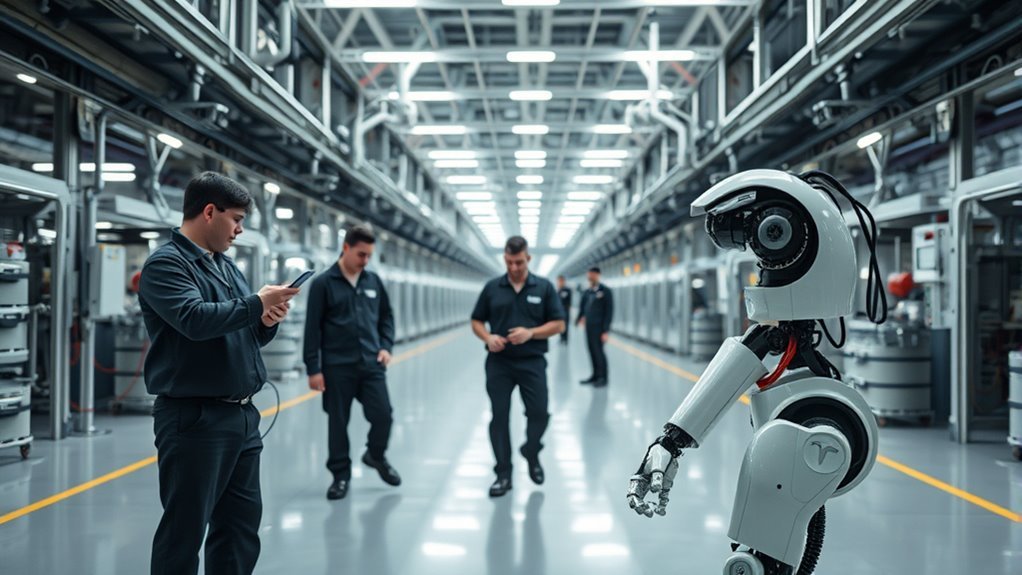
Tesla is quietly turning its factories into training schools for humanoid robots, using human workers as live data sources to teach Optimus how to move, manipulate objects, and eventually take over entire classes of physical work. This matters now because Tesla is fusing modern AI techniques with large scale manufacturing, and the way it trains Optimus could set a template for how future robotic workers learn across many industries. Additionally, AI risks in manufacturing environments are becoming a significant focus for regulatory frameworks.
From motion capture experiments to video driven training
Teaching robots by watching humans is not new, but Tesla is pushing that idea to an industrial scale and combining it with advances in deep learning and simulation. Early work on Optimus leaned heavily on motion capture suits, virtual reality headsets, and direct teleoperation, where human operators drove the robot by moving their own bodies while sensors recorded joint angles and hand poses. This approach produced highly detailed data and allowed the team to bootstrap basic capabilities such as walking, grasping and simple manipulation, but it was slow and labor intensive.
Tesla is industrializing robot training, using human-guided motion capture to bootstrap core humanoid skills
Around twenty twenty four and twenty twenty five, Tesla began shifting away from pure teleoperation toward a more scalable model that relies on video of humans performing tasks, processed by a single end to end neural network similar to the architecture used for Tesla Full Self Driving. Instead of hand coded programs for each behavior, Optimus runs one large neural model trained to map visual input and language instructions directly to motor commands. That architectural shift is crucial because it allows Tesla to reuse ideas from autonomous driving, where massive video datasets and simulation have already replaced traditional rule based software in favor of learned behavior.
How Tesla collects human movement data inside its factories
The most visible part of this strategy is the data collection rigs now used by workers at Tesla sites, including the factory in Grünheide, Germany. Employees wear heavy backpacks connected to custom helmet systems that hold multiple cameras pointed in different directions, capturing their bodies from several viewpoints as they perform routine tasks. At Tesla’s Grünheide plant, selected employees will wear backpack-mounted cameras so their assembly work can be recorded to train Optimus on tool handling and component manipulation. The backpacks can weigh around thirty to forty pounds, and workers often complete eight hour shifts while being recorded, creating large datasets of motion sequences that include sorting parts, working on conveyors, cleaning surfaces, and other standard factory actions.
In parallel, Tesla uses motion capture suits, haptic gloves, and virtual reality setups to obtain fine grained recordings of body and hand movements for tasks that demand precision or dexterity. Motion capture suits track full body joint angles, while haptic gloves measure detailed hand and finger poses, enabling training data that captures subtle aspects of grasping, twisting, and manipulating objects rather than only broad arm trajectories. These systems have also been used in teleoperation mode, where operators directly control Optimus by moving their own bodies, mapping human joint motion one to one onto robot actuators to speed up early skill acquisition.
To complement body worn sensors, Tesla mounts fixed cameras around workstations so that external viewpoints can record how workers move relative to tools, machines, and parts. This third person footage helps reconstruct full body pose and spatial relationships in the environment, which is critical for tasks such as placing items in bins, aligning components, or navigating around obstacles. Together, helmet cameras, stationary cameras, motion capture suits, and hand tracking gloves give Tesla a rich multimodal record of how humans perform both routine and staged tasks across factory floors and lab environments.
The curriculum for Optimus workers and staged tasks
Inside Tesla, designated data collection operators follow detailed manuals that break down tasks step by step so movements are consistent and machine readable. Workers receive documents and evolving guidelines on exactly how to lift objects, wipe tables, reset poses, and repeat actions, often hundreds of times per shift. They are paired with peers to check that motions are executed correctly, reinforcing the idea that these repetitions are not just work routines but deliberate lessons for the robot.
The training curriculum goes well beyond simple industrial gestures. Staff are asked to perform staged movements such as squatting, sprinting short distances, dancing, pretending to vacuum, acting like a gorilla, mimicking a golf swing, and even twerking. These unusual actions may sound frivolous, but they expand the motion vocabulary that Optimus sees, helping the model learn a wide range of body dynamics and balance strategies rather than just static assembly poses.
Over weeks of recording, each category of motion produces robust datasets for specific skill families, from standardized cleaning motions to complex whole body activities. At the Grünheide factory, this training approach is integrated directly into normal production work, so everyday assembly gestures become additional training material. As workers handle battery cells, fasten components, and move parts across stations, the camera systems continuously capture their actions, turning standard manufacturing workflows into a living classroom for Optimus. This combination of lab based demonstrations and real factory recordings gives Tesla a broad spectrum of human behavior for the robot to learn from, anchored in the actual tasks it is expected to perform.
Inside the Optimus learning pipeline
The data collection phase is only the front end of a larger learning pipeline that blends imitation learning, reinforcement learning, and large scale simulation. First, Optimus learns by imitation. Human demonstrations collected through helmet cameras, motion capture suits, and gloves are fed into a single neural network that learns to map visual observations and sensor data to robot control signals. This behavior cloning stage allows the robot to quickly acquire a rough ability to perform tasks like folding laundry, sorting objects, or wiping surfaces by copying what it has seen.
Second, Tesla places Optimus inside a neural world simulator that models physics and environments at scale, a technique that company leaders have described as essential for training humanoid robots and autonomous vehicles. Real demonstrations are used to seed this simulator, which then generates thousands of synthetic variations of each task, sometimes referred to as digital dreams. For example, from a single recorded shirt folding sequence, the system can produce many virtual scenarios with different shirts, table positions, lighting conditions, and minor motion variations, allowing the robot to practice in silico without moving a physical servo.
Third, reinforcement learning is applied in both simulation and the real world for tasks where success or failure can be measured clearly, such as whether an object was placed correctly or a part was assembled without damage. The robot receives reward signals for successful outcomes and penalties for mistakes, gradually refining its policies beyond simple imitation. As more Optimus units are deployed in factories, each robot’s experience becomes part of a fleet learning loop where performance data is uploaded to central training clusters and used to improve the shared model for all units.
Tesla reportedly runs this training on very large compute clusters, including a system at Giga Texas described as having tens of thousands of GPUs equivalent to Nvidia H one hundred, reflecting just how computationally intensive end to end robot learning has become. The same infrastructure also supports training for Tesla driving systems, which means Optimus benefits from a mature ecosystem of data pipelines, simulation tools, and training workflows already in use for vehicles.
Language, internet video, and natural instruction
Visual imitation and simulation are only part of the story. Tesla has begun tying Optimus to language models so the robot can follow natural language instructions and learn from narrated tasks. In public presentations, company leaders have shown Optimus learning kitchen tasks such as operating a microwave or cooking by watching videos and combining them with verbal guidance.
An internal guide for task programming describes three main learning modes. One is video demonstration, where a human performs a task in first person view while wearing a camera rig. A second is reinforcement learning in simulation, and a third involves natural language instructions interpreted by Tesla’s Grok language model.
The long term ambition is for Optimus to learn not only from curated factory recordings but also from large collections of third person videos drawn from the internet, including everyday clips of people performing common household and workplace tasks. That direction mirrors trends in broader AI research, where scaling up multimodal training data from online sources has produced surprisingly general capabilities in vision and language systems.
Why this matters for factories and the labor market
If Tesla succeeds, Optimus will be able to take on a growing share of structured physical work inside factories, starting with repetitive tasks such as battery cell handling, component sorting, and standardized assembly sequences. Humanoid robots that can learn directly from human performance could change the economics of manufacturing, potentially reducing the need for bespoke automation equipment and lowering the cost of reconfiguring lines when products change.
Instead of designing custom machinery for each process, companies could have humans demonstrate tasks and rely on end to end models to transfer those skills to robots. For workers, this shift is more complicated. On one hand, if robots assume the most physically demanding and monotonous roles, human staff can move into higher level supervision, maintenance, quality control, and system design.
On the other hand, the prospect of humanoid robots that can learn broad sets of factory skills raises obvious questions about long term job displacement in roles built around repetitive manual tasks. The fact that workers at Tesla are already spending weeks performing scripted motions to train Optimus underscores that their current jobs may be helping build systems that could partially replace those same roles later.
There are also immediate ergonomic and safety concerns. Carrying thirty to forty pound backpacks during full shifts, repeatedly performing motions like squats or sprints, and being constantly recorded can be physically and psychologically demanding. Reports of workers following AI generated prompts delivered through headsets show how tightly human behavior is being choreographed to optimize robot training, which may feel intrusive or exhausting even before any robots take over tasks. Companies pursuing similar strategies will need serious occupational health oversight to avoid turning data collection into a new kind of workplace strain.
Privacy, ethics, and accountability
Filming workers continually in high resolution, tracking their every movement with suits and gloves, and feeding that data into large models introduces significant privacy and ethical questions. Some Tesla communications have suggested there are efforts underway to protect individual privacy while still using video and sensor data at scale, for example through anonymization and strict access controls inside the training pipelines.
However, the basic tension remains. The more detailed the data, the more powerful the robot training, but also the greater the risk of misuse or unintended exposure of sensitive information about workers and workplaces. There is a broader accountability issue as well. End to end neural networks can be remarkably capable, yet they are difficult to interpret and can fail in surprising ways.
When such systems control humanoid robots in close proximity to humans and expensive equipment, companies need robust safety mechanisms, monitoring tools, and clear procedures for halting operation if behavior looks unsafe or unpredictable. Historical experience with industrial robots and autonomous vehicles shows that rare edge cases, often only visible after deployment, can lead to serious incidents if not anticipated and controlled. Tesla’s reliance on synthetic data and extensive simulation is partly aimed at covering these edge cases, but no simulation can perfectly match reality.
How this fits into the evolution of AI and robotics
From the viewpoint of long term AI development, Tesla’s Optimus program exemplifies a shift away from narrowly programmed robots toward systems that learn general physical skills from vast data streams and simulation. Earlier industrial robots were typically designed for single tasks, with carefully engineered motion plans and guarded work cells, while Optimus is intended to operate in more open environments and to pick up new abilities with relatively little manual engineering.
This approach draws on lessons from self driving cars, where training on millions of miles of video and sensor logs, plus synthetic scenarios, has gradually improved performance enough to replace large portions of hand written logic. Humanoid platforms have always been appealing because they can, in principle, operate in spaces designed for humans, using tools and infrastructure that already exist.
The challenge has been teaching them reliably without years of painstaking programming. By turning human workers into large scale data sources and combining that with powerful simulation, Tesla is betting that the path to truly generalist embodied AI runs through factories and everyday environments rather than exclusively through research labs.
Key takeaways and what to watch next
Tesla is building a comprehensive training system for Optimus that blends factory data collection, motion capture, video based imitation learning, large scale simulation, reinforcement learning, fleet sharing, and language driven instruction. The near term goal is to have the robot handle structured tasks such as battery cell management and repetitive assembly, while longer term ambitions include household chores and basic caregiving.
Over the next few years, several questions will determine how transformative this program becomes. First, can Optimus achieve the reliability and safety required for sustained factory deployment, especially around human workers? Second, will the economics make sense compared with traditional automation and human labor, once hardware costs, maintenance, and training compute are fully accounted for? Third, how will regulators, labor organizations, and society respond to workplaces where humans are both employees and training data for humanoid robots that may eventually take over parts of their jobs?
Whatever the answers, Tesla’s approach is accelerating a broader transition in robotics and AI. As more companies follow this model of learning from human video and simulation, the boundary between human skill and machine capability will continue to blur, and the factory floor may become one of the main proving grounds for the future of embodied intelligence.
Conclusion
Tesla’s decision to train its Optimus humanoid robots using workers at the Grünheide Gigafactory is a clear signal that industrial automation is entering a new phase. This is no longer a distant concept or a glossy demo on stage. It is an experiment unfolding in a real factory, with real workers, real data, and potentially far reaching consequences for manufacturing and labor.
Why Tesla’s Optimus training in Germany matters now
At the Grünheide vehicle plant near Berlin, selected Tesla employees are being asked to wear backpack mounted cameras while they work on the assembly line. These cameras record how workers grip tools, handle components, and move through each step of their tasks. Tesla then uses this motion data as training material for Optimus, so the robot can learn to autonomously perform the same manufacturing operations.
This is important for two reasons. First, it moves Optimus from controlled demonstrations into the messy reality of a high volume automotive plant. Second, it uses human workers not only as operators of automation, but as direct data sources for teaching the system how to do their jobs. That dual role raises questions about efficiency, responsibility, and control that go well beyond Tesla.
How we got here Humanoid robots in factories
Industrial robots have been part of car manufacturing since the second half of the twentieth century, mostly as rigid machines locked behind safety fences that perform welding, painting, or heavy lifting. Over the past decade, collaborative robots emerged that can safely work near humans, but they are still specialized arms rather than general humanoid machines.
Tesla introduced the idea of Optimus as a general purpose humanoid robot several years ago, positioning it as a platform that could eventually take on tasks from factory work to logistics and service environments. Early prototypes focused on basic locomotion and simple manipulation. Over time, Tesla has shifted toward using Optimus in its own operations, especially at sites in the United States, as a way to harden the technology before selling it to external customers.
Data collection has been central from the beginning. At US sites such as Fremont and Palo Alto, Tesla employs dedicated staff known as Data Collection Operators who perform predefined motion sequences specifically to generate training data for Optimus. The project in Grünheide extends this approach into live production work, where the training signals come from actual manufacturing tasks instead of staged routines.
What Tesla is doing in Grünheide today
Reporting from several European outlets indicates that after the factory’s summer break, selected teams at the Grünheide Gigafactory will begin wearing specialized backpacks that house the camera equipment needed for motion capture. The system records fine grained movements, such as how workers pick up tools, align parts, and sequence multiple steps into fluid workflows.
According to internal communications cited by German media, Tesla’s stated goal is to gather large volumes of real movement data to teach Optimus the physical nuances required to handle genuine tools and materials on the assembly line. These recordings become training data for the underlying AI models, which must learn not just where to move, but how to apply force, how to adapt to slight variation in parts, and how to maintain consistency over long repetitive shifts.
The same reports emphasize that for now, only one element is firmly confirmed. Selected employees will contribute to training the robot by performing their normal work while being recorded. How quickly Optimus will be integrated into day to day production, and which stations it will take over first, remain open questions. Some sources point to a start around August following factory holidays, but there is inconsistency in dates and Tesla itself has not provided detailed public timelines. That uncertainty is worth keeping in mind when assessing impact.
In parallel, there are indications that Optimus is already being piloted in repetitive tasks such as battery pack assembly in German factories, suggesting that at least some robots are moving beyond lab conditions into real workflows. This is still early stage deployment, but it is qualitatively different from robots that only exist as prototypes.
How Tesla’s data strategy shifts the game
From a technical perspective, Tesla is betting on a very direct path to teaching robots real world skills. Instead of relying primarily on simulated environments or abstract descriptions of tasks, the company is capturing high fidelity videos of skilled workers doing their jobs and then training Optimus to mimic these performance patterns.
This approach has several advantages.
- It exposes the robot to the full complexity of real assembly work, including small improvisations that workers make to stay efficient.
- It provides a rich dataset of human dexterity, something that is difficult to model purely in simulation.
- It scales with factory size. A workforce that performs the same motions every day becomes an ongoing source of training data for continuous robot improvement.
At the same time, it sharpens some risks.
- Workers’ actions become a form of intellectual capital that is directly harvested to improve automation, which may later be used to reduce the need for human labor.
- The cameras raise privacy and monitoring concerns, even if Tesla frames them as tools for training rather than surveillance.
- The model performance is only as good as the data coverage. Rare tasks, edge cases, and safety critical situations are more difficult to capture and encode reliably.
The move from Data Collection Operators in controlled settings to broad recording of live work at Grünheide underscores Tesla’s goal of mass scaling its training pipeline. This is less a one time experiment and more a template for how the company might roll out Optimus across its global factory network.
Business implications for Tesla and the wider industry
Tesla’s broader strategy suggests that Optimus is not a side project, but a planned pillar of its future business. Reports indicate that the company is already operating hundreds of Optimus units internally at sites such as Fremont and Giga Texas, and is preparing an Optimus Academy program to train operators, technicians, and developers ahead of external commercial deployments. The academy is expected to launch alongside the first commercial customer deployments targeted around late 2026.
If Tesla can prove that humanoid robots like Optimus can reliably work alongside or in place of humans in complex factories, the implications for manufacturing are significant.
1. Cost structure
A successful rollout would allow Tesla to reduce labor variability, potentially lower long term operating costs, and extend production hours with fewer constraints from human fatigue. This could put pressure on competitors to pursue similar automation or risk lagging behind in efficiency.
2. Competitive advantage
Tesla’s integrated approach building both the robot hardware and the AI software, and training them in its own factories, creates a feedback loop that other carmakers may struggle to match quickly. Even if rival robot makers offer humanoid platforms, they might not have the same depth of motion data tied to real automotive production.
3. New product line
Optimus itself is positioned as a commercial product for other businesses, not just an internal tool. If the Grünheide and US deployments succeed, Tesla could begin selling humanoid robots, training programs, and integration services to third parties. The Optimus Academy is structured precisely to prepare external organizations for this stage.
However, these potential advantages depend on factors that are far from guaranteed. The robots must reach high reliability and safety standards. Integration into existing lines must avoid costly disruptions. And regulators and worker councils, especially in countries like Germany with strong labor protections, must accept the deployments.
Workers, privacy, and regulation
Using employees as training data generators raises immediate questions about consent, privacy, and the future of their jobs. In reports from German outlets, commentators note that Tesla’s workforce in Grünheide is effectively the cheapest training source available, because they already perform the exact motions Optimus needs to learn. The cameras are described as tools to document everyday actions such as gripping, sorting, and installing parts, not as instruments of behavior control.
Even with that framing, several issues need careful handling.
1. Informed consent
Workers should understand clearly what is being recorded, how long the data will be kept, and how it will be used. Internal communications reportedly emphasize training goals, but details about retention and secondary uses are not yet transparent in public reporting.
2. Data protection
Germany and the wider European Union have strong data protection laws. Recording identifiable movements in the workplace may trigger requirements around processing, storage, and anonymization. Questions remain about how Tesla will comply with these standards in ongoing training pipelines.
3. Labor relations
Works councils and unions will closely scrutinize any move that appears to transform human skill into automation without adequate safeguards. If Optimus starts to take over large chunks of manual work, discussions around job security, retraining, and fair sharing of productivity gains will intensify.
For regulators, the experiment in Grünheide is an early test case for how humanoid robots fit into existing frameworks for workplace safety and AI governance. Real incidents, even minor ones, will shape policy debates much more than theoretical arguments.
How this changes the trajectory of humanoid robots
Until recently, humanoid robots were treated largely as speculative technology. Many prototypes could walk and grasp simple objects, but they struggled in real industrial settings where tasks are repetitive yet complex and downtime is costly.
Tesla’s approach points to a new trajectory.
1. Direct factory integration
By building training pipelines directly into ongoing production work, Tesla shortens the distance between lab performance and line deployment. The robot learns from the specific motions that matter in context, not generic manipulation tasks.
2. Use of human motion as a core asset
The detailed capture of human movement treats worker expertise as a dataset that can be systematically collected and reused. This reframes human skill as something that can be recorded, modeled, and potentially replicated at scale.
3. Combination with structured training programs
The emerging Optimus Academy suggests that Tesla sees humanoid robots not only as hardware but as part of an ecosystem of standards, certifications, and best practices for deployment. That is exactly the type of institutional structure that tends to accompany technologies that move from experimental to mainstream.
If this pattern holds, factories worldwide could transition from isolated robot arms performing specific tasks to fleets of humanoid machines trained on local worker data, supervised by specialized staff, and updated continuously as processes change. For many industries, that would be a profound restructuring.
Opportunities, risks, and realistic expectations
There is real opportunity here. Properly designed and governed, humanoid robots can take on physically demanding, repetitive, and injury prone tasks. They could allow companies to maintain output despite aging workforces or tight labor markets. In settings where staffing is difficult, they might keep operations viable.
For workers, there is a chance to move away from the most punishing physical roles and into jobs that focus on oversight, maintenance, and process improvement. Programs like Optimus Academy could give technicians and developers new career paths built around managing and improving robot fleets rather than performing the same manual tasks every day.
The risks are equally significant.
1. Job displacement
If robots trained on worker motion become capable and affordable, management will be tempted to reduce headcount in the very roles that generated the training data.
2. Surveillance creep
Even if cameras are currently justified as training tools, there is always a possibility that recorded data could be repurposed for performance monitoring or other uses that workers did not consent to.
3. Safety and reliability
Humanoid robots operating close to humans must meet strict safety standards. Edge cases such as equipment failures, unexpected obstacles, or emergency scenarios are difficult to learn from standard motion capture. A single serious incident could trigger backlash.
Realistic expectations require acknowledging that the technical path is still challenging. Optimus must achieve consistent manipulation, smooth coordination with other systems, and long term durability in a harsh factory environment. None of these can be taken for granted.
Key takeaways and what to watch next
Tesla’s training of Optimus at the Grünheide Gigafactory marks a transition from prototype stage to real experimental coworker in industrial production. By equipping workers with backpack cameras and turning their movements into training data, Tesla is attempting to encode human expertise directly into robot capabilities.
The project demonstrates a clear strategic direction. Tesla is building a full stack ecosystem around Optimus that includes internal deployments, large scale motion data collection, and an education program for future customers. It is positioning humanoid robots as practical industrial tools, not science fiction curiosities.
Over the next months and years, several signals will matter.
- How quickly Optimus takes on specific tasks in Grünheide and how those deployments are evaluated by workers and regulators.
- Whether safety incidents remain rare and manageable as robots and humans share the same space.
- How Tesla structures compensation, retraining, and transparency for workers whose skills are being used to train automation.
- When external customers begin receiving their own Optimus units and what early case studies reveal about performance in non Tesla factories.
For now, the main insight is simple but profound. Humanoid robots are no longer a future promise. In Grünheide, they are being trained step by step on the motions of human workers, edging closer to operational reality. How this experiment unfolds will shape not only Tesla’s factories, but the broader conversation about the role of advanced robotics in everyday work.