
The race to build competent home robots has quietly entered a new phase. Instead of training machines on toy problems and spotless lab scenes, researchers are finally feeding them the kind of data that reflects real apartments, real clutter and real chores. That shift matters because it moves embodied AI closer to the reality of how we actually live and work, and it exposes both the promise and the rough edges of putting robots in our homes.
From controlled labs to lived in homes
For years, most robot learning datasets were tiny by today’s standards and confined to carefully controlled environments. Robots learned to stack blocks on pristine tables, open identical drawers or grasp a small set of familiar objects. Those efforts were important to prove out basic methods for imitation learning and reinforcement learning, but they left a huge gap between benchmark success and what a robot would face in an ordinary kitchen or bedroom.
The new generation of household task datasets is an explicit response to that gap. Instead of a single lab or a handful of curated scenes, these datasets spread across many real homes, offices and apartments, with different layouts, lighting conditions and levels of clutter. The result is a richer picture of what domestic life looks like in practice, and a more honest test of whether an embodied agent can handle long horizon tasks that span rooms, involve many objects and require flexible strategies rather than brittle scripts.
Household datasets now capture real homes, clutter and long-horizon chores, revealing genuine embodied competence.
The DROID dataset and robot centric household corpora
At the center of this shift is the DROID dataset, which is designed specifically as large scale in the wild manipulation data for robots operating in everyday environments. DROID contains around seventy six thousand human teleoperated trajectories, adding up to roughly three hundred fifty hours of interaction across five hundred sixty four scenes and eighty six distinct tasks. It was collected over twelve months by about fifty data collectors in North America, Asia and Europe, using a standardized hardware and teleoperation setup that is documented and open sourced for other groups to reproduce.
What makes DROID noteworthy, beyond its size, is diversity. The scenes span households and offices with different furniture, object distributions and levels of occlusion. The tasks range from simple pick and place to tool use and multistep assembly, and the dataset combines RGB D visual streams, proprioceptive signals and action logs, which is exactly the multimodal input modern policies need. For an analyst who has watched the field evolve from single scene datasets to this scale, DROID is a turning point because it captures the messy side of manipulation that was previously brushed aside as “future work.”
DROID is not alone. Other robot centric household datasets complement it with curated activities such as cleaning, laundry, dishwashing and organization tasks, broadening the distribution of behaviors available for training. Together, they give researchers enough coverage to start thinking about generalist home robots rather than single skill appliances. The aim is less “a robot that folds one particular towel” and more “an embodied agent that recognizes a variety of textiles, surfaces and tools and adapts a learned strategy to whatever it finds.”
Real home datasets collected with systems such as Dobb E extend this realism further. Volunteers operate doors, drawers, light switches and trash tools across many apartments, creating trajectories that embed real domestic layouts, object placements and clutter. Those recordings capture the nuance that pure lab scenes miss, such as narrow hallways, awkward cabinet heights or overfilled trash bins, all of which affect how a robot should move, reach and plan.
Human first person datasets that teach robots what competence looks like
Robot demonstrations show how a capable teleoperator controls a specific platform, but they do not fully explain what skillful human behavior in homes looks like. That is where large scale egocentric human datasets come in.
The 100000 Hours dataset records one hundred thousand hours of high resolution residential chores in Brazilian homes from a first person viewpoint, with structured annotations for tasks, actions, objects and hand object interactions. Instead of isolated clips, it captures long stretches of daily life, showing how people interleave tasks, respond to interruptions and manage limited time and space.
HomER v2 adds several hundred egocentric videos amounting to about one hundred hours across ten domains, including food preparation, cleaning, laundry, organization, desk work, repair, personal care, indoor plants and crafts. A reviewed Human Motion Data Catalog organizes approved residential activities into a taxonomy of fifty seven tasks, giving industry and academic teams a consistent label space and a legal path for commercial use of everyday motion data.
As someone who has watched early imitation learning systems struggle with sparse or inconsistent labels, this level of structure matters. When human activities are aligned under a shared taxonomy and annotated at the level of hands, objects and actions, it becomes possible to train policies that understand not just “wipe the table” but “move clutter aside, choose a cleaning tool, adjust pressure based on the surface and avoid knocking over items.” Those are the details that separate a demo reel from a trustworthy product.
Crucially, robot trajectories such as those in DROID can be aligned with egocentric human video and motion taxonomies. That alignment lets researchers train embodied agents to imitate human level strategies for chores like bed making, sheet changing, garment folding, sweeping, mopping, bathroom cleaning, dishwashing and living room organization, instead of copying narrow motion scripts. The multimodal signals support learning of fine grained hand object interactions and temporally extended action sequences, improving generalization beyond specific setups or objects.
Simulation benchmarks that scale experimentation
Physical data from real homes is indispensable, but it is expensive and slow to collect, and it can be hard to stress test rare edge cases. Simulation benchmarks provide the other half of the story by offering controlled yet realistic reconstructions of homes and their activities.
The BEHAVIOR family of benchmarks was one of the first to articulate this vision clearly. Early BEHAVIOR work defined around one hundred everyday household activities such as cleaning, maintenance and food preparation inside interactive environments built on iGibson scenes and a large object dataset annotated with physical and semantic properties.
Later, BEHAVIOR 1K expanded to one thousand household activities that people actually spend significant time on and want help with, based on careful time use and preference surveys. These activities are instantiated in fifty fully interactive scenes populated with more than ten thousand object models, and they are supported by a modern simulation stack capable of handling rigid bodies, deformable objects and fluids.
On top of that environment, the BEHAVIOR challenge offers around ten thousand human demonstrated trajectories, accounting for over one thousand hours of behavior, covering tasks such as rearrangement, cleaning, cooking, painting, hanging, slicing, baking and doing laundry. This combination of human grounded task definitions, rich physics and expert trajectories creates a laboratory where teams can systematically test long horizon policies that must navigate entire homes while coordinating locomotion and dexterous manipulation. Complementing these simulations, the BEHAVIOR Robot Suite (BRS) offers 250 GB of robotic trajectories for five household tasks collected in real-world household environments and released under an MIT license, providing a direct conduit from household-scale virtual benchmarks to deployable policies.
Frameworks like RoboCasa add a more focused perspective. They center on kitchen scenes and hundreds of cooking and cleaning tasks, blending human demonstrations with automated trajectory generation to produce large scale training corpora tailored to common domestic scenarios. These platforms let researchers iterate quickly on policy architectures, reward shaping and curriculum design before deploying to physical robots in spaces that have privacy and safety constraints.
From an industry standpoint, these simulation benchmarks are invaluable. They reduce the cost of experimentation, support reproducible evaluation across organizations and provide a relatively safe way to explore failure modes that would be risky to test with human users in real homes.
What this means for technology and businesses
When you connect robot centric datasets like DROID with human egocentric corpora and simulation benchmarks such as BEHAVIOR 1K and RoboCasa, a clear pattern emerges. The field is moving from single skill robotics to generalist embodied agents that can operate across many tasks and environments.
For technology leaders, this shift has concrete implications. Model architectures are evolving toward policies that consume multimodal input, including images, depth, proprioception and language, and that output both low level control signals and higher level plans. Training these models requires large diverse datasets with consistent annotation standards. That favors organizations that invest early in data infrastructure, privacy practices and legal frameworks for collecting and sharing home centered activity data.
For businesses, the payoff is the prospect of reliable home service robots in areas such as cleaning, eldercare support, hotel housekeeping and warehouse micro fulfillment. A robot trained on DROID style trajectories and BEHAVIOR 1K scenarios is more likely to cope with narrow hallways, varied lighting and unexpected clutter, reducing the amount of onsite customization needed before deployment. At the same time, access to realistic simulation environments lowers engineering risk by making it easier to test policies under heavy load or unusual conditions.
The economics are still evolving. Collecting and maintaining these datasets is expensive, and most are produced by research consortia or well funded labs. Commercial players will need to decide whether to rely on open datasets, license proprietary corpora or build their own. There is also an emerging market for evaluation as a service, where teams validate policies against shared benchmarks like BEHAVIOR 1K before shipping products.
Societal impacts, risks and open questions
The move into real homes raises serious questions about privacy, consent and bias. Recording one hundred thousand hours of residential chores or collecting teleoperation data in apartments is not a purely technical exercise. It involves families, caregivers and tenants whose routines and spaces are captured in detail. Strong anonymization, data minimization and transparent governance are essential if the public is to trust this ecosystem.
Bias is another concern. Datasets concentrated in specific regions or socioeconomic groups risk encoding narrow norms about how homes are organized, what chores look like and who performs them. The 100000 Hours dataset focuses on Brazilian homes, which is valuable for geographic diversity but also a reminder that other regions must be represented if robots are to serve global markets fairly. Motion taxonomies that reflect only one cultural context can lead to policies that misinterpret or mishandle activities elsewhere.
There are technical risks too. Large datasets do not automatically translate into robust behavior. If policies are trained to optimize benchmark scores rather than user satisfaction, they may exploit quirks of simulation or annotation rather than genuinely understanding tasks. Long horizon chores are especially prone to compounding errors, where a small mistake early in a sequence leads to larger problems later. Embodied AI systems must be evaluated not only on completion rates but on safety, reliability, interpretability and human comfort.
Finally, there is the question of labor and automation. Home robots that can clean, organize and assist with daily tasks have clear benefits for people who are aging, have disabilities or are overloaded with responsibilities. At the same time, they may change the nature of work for professional cleaners, hotel staff and home health aides. Honest analysis requires acknowledging both the opportunity to reduce drudgery and the potential for displacement, and it calls for policy conversations that keep affected workers at the table.
What to watch next
Taken together, these datasets and benchmarks mark a real inflection point for embodied AI. The field is finally confronting the complexity of real homes rather than retreating to simplified tasks. As someone who has followed this progression from lab scale experiments to continent spanning data collection, the trajectory is clear but not yet guaranteed.
Over the next few years, several developments will be worth watching. First, how well policies trained on DROID and BEHAVIOR 1K style data transfer to new homes without further fine tuning. Second, whether new datasets broaden coverage beyond current regions and household types, including rural settings, multifamily dwellings and nontraditional living spaces.
Third, how companies and researchers handle privacy, consent and governance as they expand collection efforts. Most importantly, success should be measured not only in benchmark metrics but in concrete improvements to everyday life. A trustworthy home robot is one that people feel comfortable inviting into their personal spaces, that respects their preferences and routines, and that augments rather than replaces human care.
These new datasets provide the raw material to pursue that vision. The way we use them will determine whether embodied AI becomes a reliable partner in domestic life or just another short lived wave of hype.
Conclusion
Robots are finally starting to learn in the same kinds of homes where they are expected to work. A new generation of embodied AI datasets captures everyday human activity directly inside real apartments and houses, rather than pristine lab spaces or purely simulated kitchens, and that shift matters for anyone who cares about practical household robotics today.
From lab floors to real homes
For most of the past decade, robot learning for domestic tasks has depended heavily on simulation and carefully staged experiments. Frameworks such as BEHAVIOR and RoboCasa created richly detailed virtual homes and kitchens where robots could practice opening doors, loading dishwashers, and preparing simple meals, all inside photorealistic but ultimately synthetic environments. These platforms offered scale and control, but the data they produced inevitably reflected the assumptions of their designers more than the messy reality of ordinary human living spaces.
In parallel, language driven datasets such as TEACh focused on teaching robots to follow natural language instructions for household tasks in simulation. TEACh includes thousands of dialogues in which humans guide embodied agents through cleaning or organizing tasks while the system records both conversation and visual context. This work helped bridge robotics and conversational AI, but again the setting remained virtual with carefully defined objects and layouts.
Researchers soon realized that simulation alone would not be enough. Studies from Carnegie Mellon and others began using large egocentric video corpora such as Ego4D and Epic Kitchens to teach robots to imitate human actions like opening an oven door or lifting a pot. These datasets contain thousands of hours of first person recordings from people moving through their own homes and kitchens, offering rich visual cues about clutter, lighting, and human motion. However, turning those videos into reliable instructions for physical robots still required careful adaptation and often additional data collection.
The next step has been to bring data collection directly into real homes with robotics in mind from the start. That is the context for the latest household activity datasets and the new AI dataset that centers on everyday human skills in domestic environments.
What makes this new generation of home datasets different
Several recent datasets illustrate how quickly the field is moving toward realistic domestic settings.
HomER v2 compiles hundreds of egocentric videos of real household activities recorded from a first person perspective in actual homes. It covers domains such as food preparation, cleaning, laundry, organization, table setting, desk work, repair, personal care, and indoor plant maintenance, all annotated with natural language descriptions and activity labels. The result is roughly one hundred hours of richly annotated home life that captures how people really move, reach, and manipulate objects in confined spaces, under varied lighting, and around other people.
The Robotic Household Activities Dataset from Unidata goes further in scale and modality. It includes one thousand hours of cleaning, laundry folding, and dishwashing tasks recorded with head mounted cameras and multiple motion sensors attached to the body, providing synchronized video and inertial data for each activity. This multimodal structure lets models learn not only what an action looks like but also the underlying motion patterns, forces, and trajectories associated with human performance.
BRMData focuses on bimanual and mobile manipulation for household applications. It offers demonstrations of ten different household tasks that range from simple single arm interactions to complex dual arm and mobile tasks, all recorded to support embodied manipulation research. These tasks show robots how to coordinate multiple arms while moving through a domestic environment, which is crucial for more advanced chores such as carrying a loaded tray or rearranging furniture.
There are also pragmatic efforts such as the Dobb E system that show how little real home data may be needed when the collection process is clever and focused. In that project, volunteers in more than twenty homes in New York performed simple tasks using an extended stick with a phone attached, recording video along with sensor data on depth and motion. Roughly thirteen hours of data was enough to train a robot that later completed more than one hundred household tasks across ten homes with a success rate over eighty percent, typically learning each new task in about twenty minutes. This is a striking example of how targeted, carefully structured data from real homes can produce practical robotic skills without requiring huge amounts of collection effort.
At the same time, catalogs such as OpenBot and Claru list hundreds of datasets for embodied AI and household manipulation, from synthetic renders of homes to small collections of annotated manipulation clips recorded in real apartments. Together these resources show a clear trend. The field is shifting from visualizing domestic life in simulation to measuring and recording it directly in real homes, with sensors and cameras tuned to the needs of robot learning.
Why grounding robots in real homes matters
By grounding training data in actual homes, researchers are giving robots access to the true visual and physical context of everyday routines. The dishes are not neatly spaced for easy grasping. The floor has clutter. Cabinets vary in size and stiffness. Lighting is uneven. Pets and children move unpredictably. These details are exactly what simulation struggles to capture but what define success or failure when a robot tries to clean a kitchen or fold laundry.
Historically, robots that performed well on lab benchmarks or simulated challenges often failed when moved into real homes. Sensors encountered reflections and shadows they had not seen before. Grippers misjudged soft or deformable objects. Objects appeared in unexpected locations or under partial occlusion. Datasets like HomER v2 and the Robotic Household Activities collection help confront those issues by exposing models to the range of motion patterns, object configurations, and environmental conditions that genuinely occur in domestic life.
There is also a cultural dimension. Earlier datasets tended to reflect a narrow slice of living arrangements, often single family homes or research apartments near universities. As more data is collected in diverse homes, across different cities and regions, models encounter a wider variety of layouts, tools, and social practices around cleaning and cooking. That diversity matters for any company that hopes to deploy household robots globally rather than tailoring them to one specific culture or style of housing.
Implications for technology and business
From a technical perspective, data from real homes can accelerate progress toward generalist household robots. Models trained on egocentric video and multimodal sensor traces can learn richer representations of human actions, including fine grained hand trajectories and coordination between limbs. When combined with large scale simulation frameworks like RoboCasa and BEHAVIOR, which already offer thousands of tasks and object categories for kitchen and household manipulation, this creates a powerful loop. Simulation can generate breadth and controlled variation, while real home datasets provide depth, realism, and grounding for fine tuning and evaluation.
For businesses, the emergence of robust domestic datasets changes the calculus around household robotics. Companies no longer need to build all data collection infrastructure from scratch. They can leverage public resources like HomER v2, the Robotic Household Activities dataset, BRMData, and TEACh as starting points for perception and planning models. That reduces development cost and risk, while still leaving room for proprietary data gathering in target markets and customer homes.
It also opens opportunities beyond classic home cleaning robots. Service providers could use such datasets to design systems that assist with elder care, disability support, and repetitive office tasks in small workplaces that resemble homes in layout and complexity. Retailers and appliance manufacturers might co design robots with smart kitchens and laundry rooms, tuning both layout and machine capabilities to match the motion patterns captured in these datasets. Insurance and real estate sectors could even use insights from household activity data to better understand how people actually use spaces and devices, though this raises important privacy considerations.
At the same time, there are limits and risks. Many of the current datasets still concentrate on particular regions and home types, such as New York apartments or houses accessible to volunteer networks near research institutions. Residents must consent to recording, which can skew samples toward more technology friendly households. Data collection may avoid certain sensitive rooms or activities, leaving gaps in coverage. Models trained on such data may perform well in similar homes but struggle in rural housing, informal settlements, or highly crowded living arrangements that are underrepresented in the training corpus.
There are also unresolved questions about ownership and control of domestic activity data. While some datasets are released under permissive licenses such as CC BY, others are governed by stricter terms that may limit commercial use or require explicit attribution. Businesses need clear governance frameworks to ensure that robotics products built on these datasets respect both legal requirements and social expectations around privacy and informed consent.
How this changes the vision of household robots
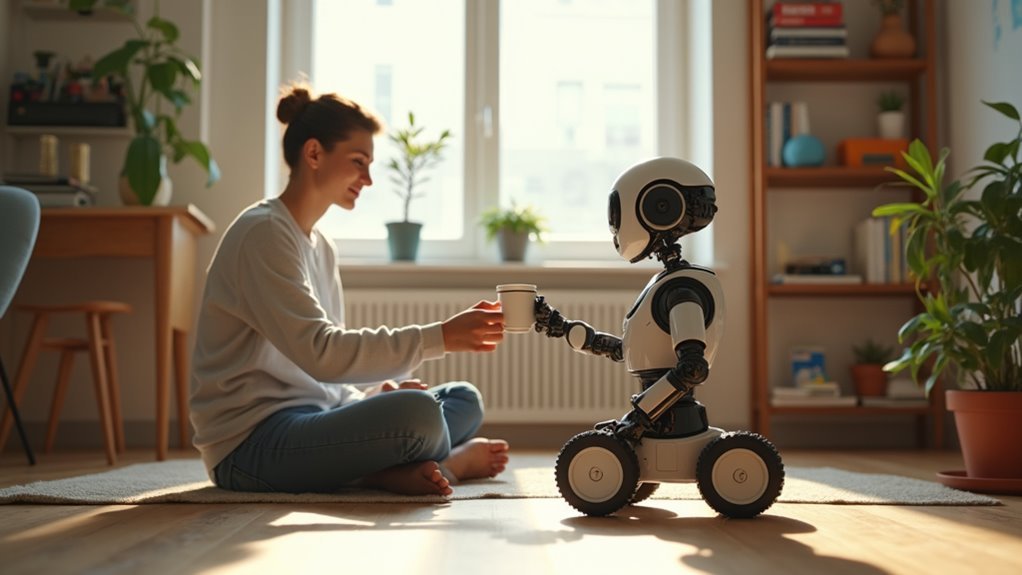
When people imagine household robots, they often think of speculative machines that live in the future rather than practical tools that integrate into existing homes. A sustained shift in training data can quietly change that perception. As robots learn from footage and sensor data collected in ordinary environments, they start to inherit the rhythms, constraints, and improvisations of real domestic life.
In practical terms, this means robots that do not simply execute a fixed script for cleaning or cooking but adapt around the way a particular household actually operates. A robot might learn to clean around the preferred clutter in a home office rather than enforcing minimalism. It could understand that dishes pile in a specific sink or that laundry tends to accumulate on one chair. With enough diverse data, models can move beyond idealized workflows and begin to offer assistance that feels intuitive and respectful rather than intrusive.
The evolution of datasets also supports better evaluation. Instead of measuring success only by simulated task completion, researchers can test robots across real homes with different layouts and habits, using standardized benchmarks derived from datasets like BRMData and the Robotic Household Activities collection. That makes claims about robustness more meaningful and gives buyers clearer signals about how systems are likely to perform in their own spaces.
Yet it is important to remain realistic. Collecting high quality data in real homes is difficult and intrusive. Even large efforts today measure hundreds or thousands of hours of activity, which is tiny compared with the diversity of domestic life across cultures and climates. Robots trained on these datasets will still encounter situations they have never seen before. They will need fallback strategies, human in the loop assistance, and conservative safety constraints to avoid causing harm or violating privacy.
Looking ahead
Over the next few years, the most credible path toward capable household robots will likely combine three ingredients. Large scale simulation, as represented by systems such as RoboCasa and BEHAVIOR, will continue to provide a sandbox for learning broad skills and testing algorithms quickly. Targeted datasets from real homes like HomER v2, the Robotic Household Activities dataset, BRMData, and focused collection projects such as Dobb E will supply realistic context and fine tuning signals. Finally, careful governance and user centric design will determine whether these technologies become trusted infrastructure or remain niche curiosities.
For technology leaders and policymakers, the message is quite direct. Real progress in household robotics now depends less on exotic hardware and more on thoughtful data practices inside ordinary homes. The new generation of embodied AI datasets marks a clear shift from controlled lab experiments to the messy realities of domestic life, giving robots access to the visual and physical context of everyday human routines. By grounding learning in real homes, these resources offer a path toward more robust and adaptable assistance with common tasks, from cleaning to cooking, and over time they can turn household robots from speculative technology into practical infrastructure quietly embedded within ordinary environments across cultures. reddit