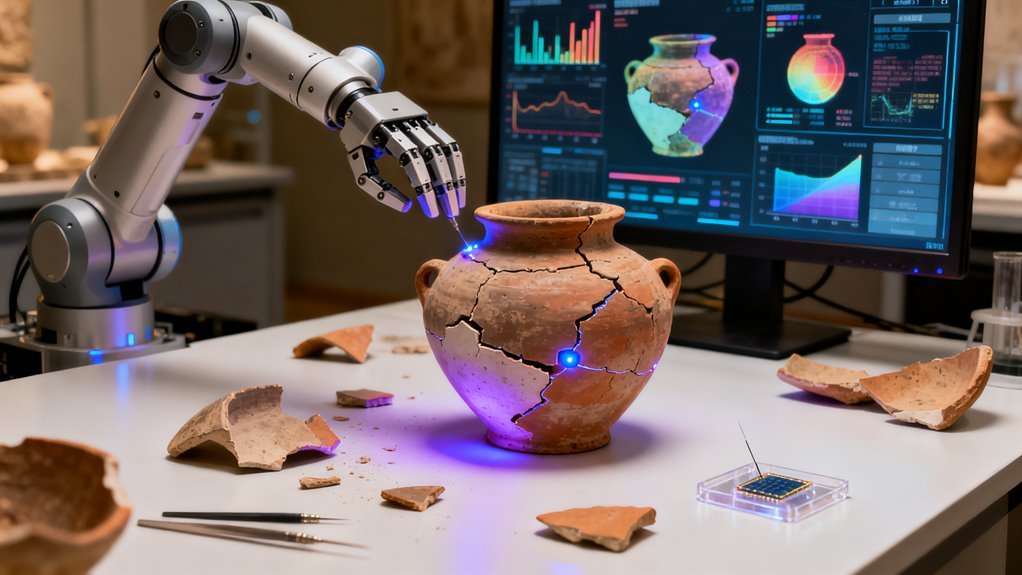

Somewhere in the back rooms of museums from Athens to Xi’an, tens of thousands of ceramic fragments sit in drawers and boxes, waiting. Some have been waiting for decades. The bottleneck was never a lack of interest. It was always a lack of hands, time and money. Now artificial intelligence is dissolving that bottleneck in ways that would have seemed implausible five years ago, and the implications stretch well beyond archaeology.
What Actually Changed
The restoration of ancient pottery has historically been painstaking, deeply manual work. A trained conservator might spend weeks puzzling over how fragments fit together, then months reconstructing missing painted motifs by studying stylistic parallels. The arrival of deep learning has compressed parts of that timeline from months to hours.
The most striking recent development involves the use of Stable Diffusion models, fine-tuned with Low Rank Adaptation, to digitally inpaint missing decorative regions on damaged ceramics. Research teams working with Yangshao culture pottery (Neolithic China, roughly 5000 to 3000 BCE) have built pattern-specific training datasets that teach generative models the design vocabulary of a particular tradition. The results are not generic gap fills. They are context-aware reconstructions that respect both the structural geometry and the chromatic palette of the original work.
Conservators load variational autoencoder models, apply mask-based editing tools, and can generate multiple restoration hypotheses without ever touching the physical artifact. Everything stays nondestructive and reversible.
Parallel efforts address three-dimensional reassembly. Deep learning models trained on large fragment datasets learn both global shape priors and local edge compatibilities, effectively solving a jigsaw puzzle where most of the pieces are missing and the box lid was lost three thousand years ago. Some pipelines now integrate photogrammetric 3D scanning, pose normalization, and automated grouping of sherds into coherent vessel candidates. The most practical workflows go a step further, using AI-guided reconstructions to 3D print synthetic sherds that physically complete fragmented objects for display.
Classification has advanced just as quickly. Convolutional neural networks can now identify amphorae in underwater survey imagery at roughly 90 percent accuracy. The ArchAIDE platform lets a field archaeologist photograph a potsherd with a phone and receive ranked matches against comparative typological collections in seconds. Systematic reviews confirm that deep learning consistently outperforms traditional feature engineering approaches for ceramic identification, using texture, chemical composition, and morphological data to support provenance research at scale.
Why This Matters Beyond the Museum
It would be easy to file this under “interesting but niche.” That would be a mistake.
What is happening in archaeological conservation is a live demonstration of how generative AI and computer vision perform when applied to domains with extremely small, highly specialized datasets. The Yangshao pottery work is a case study in domain adaptation. You cannot train a foundation model on millions of Yangshao painted motifs because those motifs do not exist in millions. The researchers had to make Low Rank Adaptation and mask-based inpainting work with limited, carefully curated data.
That problem, making powerful models useful in low data, high expertise domains, is precisely the challenge facing sectors from rare disease diagnostics to industrial quality control.
The 3D reassembly work carries its own transferable insights. Fragment matching algorithms that learn shape priors and edge compatibilities have obvious parallels in manufacturing (matching broken components), forensics (reconstructing shattered evidence), and even satellite imagery (piecing together partially obscured terrain). The underlying mathematics is domain agnostic. The pottery just happens to be one of the oldest and most visually compelling test beds.
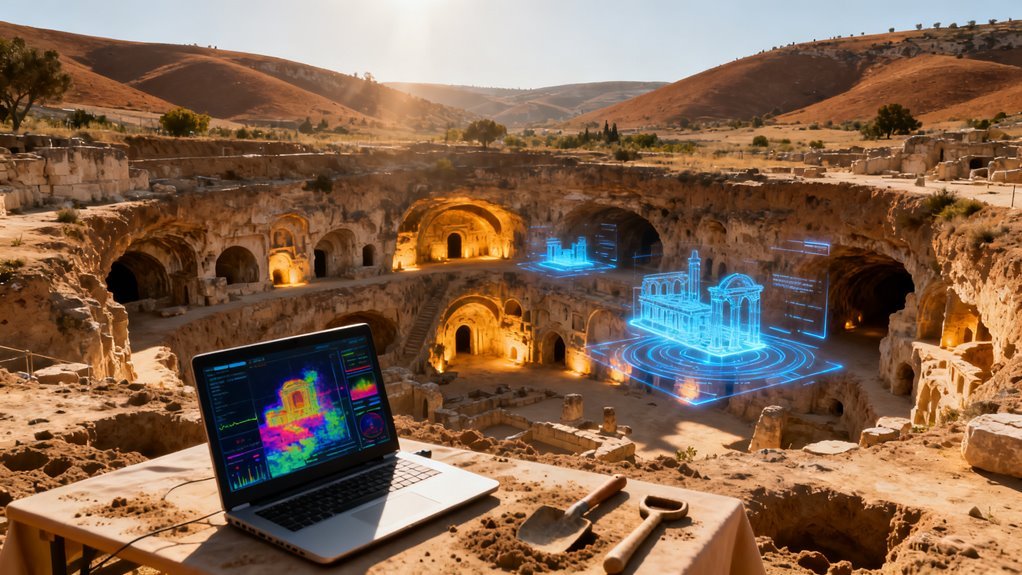
There is also a preservation dimension that deserves more attention. High-resolution digital twins generated during restoration are not disposable byproducts. They serve as baselines for continuous monitoring. Future scans can be compared against these baselines to detect microcracks, pigment degradation, or surface erosion before any damage becomes visible to the naked eye. In effect, AI is not just reconstructing the past. It is building an early warning system for the future.
Who Benefits, Who Loses
The most immediate beneficiaries are mid-tier museums and university collections that lack the budgets for large conservation teams. A single trained operator with the right software pipeline can now accomplish preliminary classification and digital reconstruction work that previously required a team of specialists.
This does not eliminate the need for expert conservators. It dramatically amplifies what each conservator can accomplish.
Archaeologists working in the field gain speed. The ability to classify sherds on-site, in real time, using a phone camera and a platform like ArchAIDE, changes excavation logistics. Decisions about which contexts to prioritize can be informed by typological data that used to take weeks to produce back in the lab.
The losers, to the extent there are any, may be commercial restoration firms that have built business models around the sheer volume of manual hours required. As AI tools mature, the economics of conservation shift. The value moves from labor toward expertise in configuring, validating, and interpreting AI outputs. Conservators who adapt will find their skills more in demand, not less, because someone still needs to judge whether a machine-generated reconstruction is plausible or merely statistically confident.
What People Are Overlooking
Three things deserve more scrutiny than they are currently getting.
First, the epistemic risk. When a generative model fills in a missing painted motif, it produces something that looks right. It may even be right. But there is no ground truth to check against. The original is gone. If AI restorations are presented without clear labeling, future scholars may mistake generated content for recovered evidence. The archaeological community is generally careful about this, but as these tools become more accessible, the risk of confusion grows. Standards for documenting which elements are original and which are computationally inferred need to be established now, before the tools outrun the protocols.
Second, the data pipeline problem. These models are only as good as their training data. For well-documented traditions like Greek black figure pottery or Chinese Neolithic ceramics, reasonable datasets can be assembled. For less studied traditions, particularly those from sub-Saharan Africa, Southeast Asia, or pre-Columbian South America, the data simply does not exist in digitized form at the scale these models need.
There is a real danger that AI restoration reinforces existing biases in which cultures get studied and preserved.
Third, the question of ownership and access. Who controls the digital twins? Who gets to run reconstructions? If the most capable models require expensive GPU infrastructure or proprietary software, the democratizing potential of this technology could be undercut by familiar access inequalities. Open-source efforts in this space deserve support precisely because the cultural heritage they address belongs, in a meaningful sense, to everyone.
Where This Is Heading
The trajectory is clear enough to sketch with reasonable confidence.
Within two to three years, expect integrated platforms that combine classification, 3D reassembly, and decorative inpainting in a single workflow. The current landscape is fragmented: one tool for scanning, another for fragment matching, another for surface restoration.
Consolidation will come, likely driven by a combination of academic consortia and at least one well-funded startup spotting the broader industrial applications of the underlying technology.
Multimodal models will accelerate things further. As vision-language models improve, conservators will be able to describe what they expect a missing section to contain and have the system generate constrained hypotheses accordingly. This is not far-fetched. It is a straightforward application of the kind of conditioned generation that GPT-4o and Gemini already demonstrate in other contexts.
The monitoring use case may ultimately prove more consequential than the restoration use case. Museums and heritage sites worldwide face accelerating environmental threats, from climate change-induced humidity shifts to pollution-driven surface degradation.
An AI system that continuously compares current scans to baseline digital twins and flags emerging damage could be deployed not just for pottery but for stone sculpture, frescoes, textiles, and architectural surfaces. The pottery work is a proving ground for a much larger ambition.
The Bigger Picture
Step back far enough and what you see is AI doing something genuinely useful in a domain where the stakes are cultural memory itself. This is not another chatbot. It is not another image generator making art that no one asked for.
It is a set of tools that helps humans recover and protect things that would otherwise be permanently lost. This aligns with the broader trend of AI evolving from a conversational layer to integral workflows in scientific research.
That framing matters because the AI industry is spending enormous energy right now debating safety, regulation, and economic disruption. Those debates are necessary. But they tend to crowd out stories where the technology is doing exactly what its proponents always promised: augmenting human capability in domains where human effort alone cannot keep pace with the scale of the problem.
There are more pottery fragments in storage than all the conservators on earth could process in a lifetime. AI does not replace the expertise needed to interpret those fragments. It makes that expertise go further.
The ancient potters who shaped and painted these vessels thousands of years ago could not have imagined the tools now being used to reconstruct their work. But they would probably recognize the impulse behind it. Some things are worth the effort of putting back together.