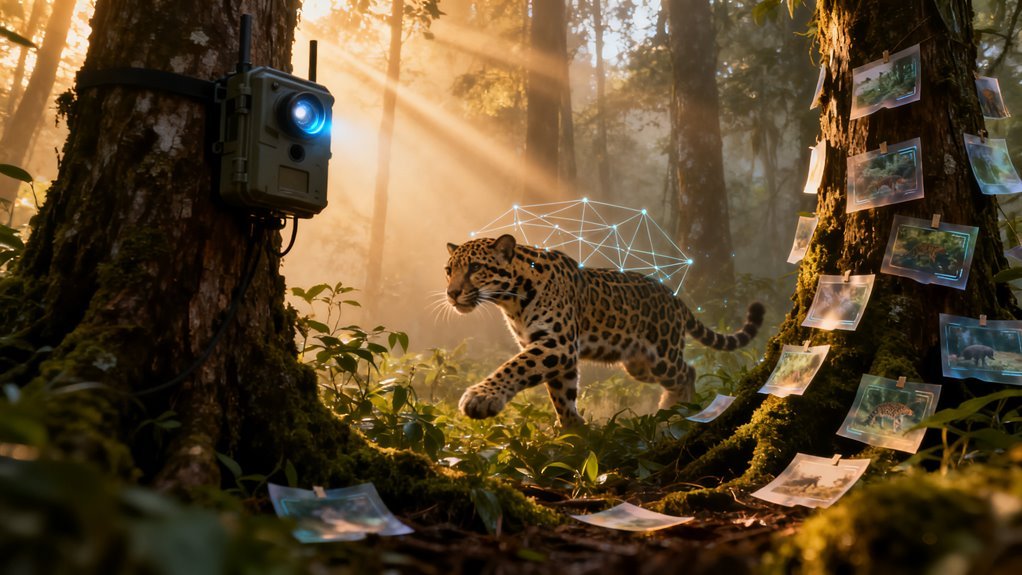

Somewhere in a Tanzanian forest right now, a camera trap just fired. The image probably shows nothing. A swaying branch, a shadow, maybe a common impala passing through. Multiply that single trigger by several million times across monitoring networks worldwide, and you start to understand the scale of the problem conservation scientists have been drowning in for years.
But something has shifted. A pipeline of AI tools, none of them individually groundbreaking but collectively transformative, is turning those mountains of visual noise into something that actually works. And the implications reach well beyond wildlife conservation into fundamental questions about how AI handles extreme class imbalance, rare event detection, and real world deployment at scale.
The Needle in Three Million Haystacks
The Snapshot Serengeti dataset offers a useful lens here. It contains 3.2 million images covering 48 species. The species that matter most to conservation, the rare and elusive ones, show up in a tiny sliver of those frames.
Anyone who has worked with severely imbalanced datasets knows what happens next. Standard models optimize for the majority class. The rare stuff gets buried. And manual review of millions of images to find those critical captures is the kind of task that burns through research budgets and graduate student morale in equal measure.
This is not a new problem in machine learning. Fraud detection, medical diagnostics, manufacturing defect identification all face versions of the same imbalance challenge. What makes the camera trap domain interesting is the combination of extreme data volume, severe class skew, and the fact that the cost of a false negative is not a missed transaction but a missed opportunity to document a species that might be sliding toward extinction.
MegaDetector and the Two Stage Architecture
The backbone of the current approach is MegaDetector, an open source object detector that has quietly become one of the most widely deployed conservation AI tools on the planet. More than 60 organizations use it.
The model does not try to identify species. It simply draws bounding boxes around animals, people, and vehicles, assigning confidence scores to each detection. Version 5 hits precision around 0.96 and recall around 0.73 for animal detection. AI systems can reflect and amplify biases, which makes ongoing adjustments crucial.
That recall number deserves attention. At 0.73, roughly one in four animal appearances gets missed at default thresholds. For common species, that is tolerable. For a rare cat or pangolin that might appear in five frames out of a million, missing 27% of detections is a significant problem.
This is where threshold tuning becomes critical. Conservation teams push confidence thresholds down into the 0.15 to 0.3 range, deliberately accepting more false positives to avoid missing the rare detections that justify the entire monitoring program. It is a textbook precision recall tradeoff, but the stakes make the calibration decisions genuinely consequential.
The second stage is where species identification happens. MegaDetector crops the detected animals, and those crops feed into specialist classifiers like SpeciesNet or custom convolutional neural networks trained on labeled camera trap libraries.
The Snapshot Serengeti pipeline automates species labeling for 99.3% of images across its 48 mammal classes. Other frameworks report roughly 98% binary classification accuracy and around 90% accuracy when sorting across multiple species categories.
These numbers look impressive in isolation. In practice, they mean something more specific. The 0.7% of images that still need human review, and the gap between 90% and 100% in multiclass settings, is precisely where the rare species tend to concentrate. The AI does not eliminate human expertise. It redirects it.
Why This Matters Beyond Conservation
The architecture pattern here, a general detector feeding into specialized classifiers with tunable confidence thresholds, is not unique to wildlife monitoring. It mirrors what is happening across industrial AI deployment.
Think of how autonomous vehicle stacks separate object detection from object classification from decision logic. Or how content moderation systems use coarse filters before fine grained analysis.
What the conservation use case demonstrates particularly well is how to handle deployment constraints that enterprise AI teams often face but rarely discuss publicly. These camera trap networks operate in remote locations with limited connectivity.
Models need to run efficiently. Labeling budgets are minimal. Domain experts are scarce. And the cost of failure is not measured in revenue but in irreversible ecological loss.
The fact that deep learning systems now process more than 99% of large camera trap datasets while maintaining roughly 96.6% accuracy, comparable to crowdsourced volunteer labeling, tells us something important about where AI sits on the deployment maturity curve.
We have moved past the proof of concept phase. The question is no longer whether these systems work. It is how to optimize them for the long tail of rare events that carry the most value.
What People Are Overlooking
Most coverage of AI in conservation focuses on the feel good narrative. Technology saves endangered species. That framing, while not wrong, obscures several harder questions.
First, the models are only as good as the training data. Camera trap datasets are geographically biased toward well funded research sites in East Africa, North America, and parts of Southeast Asia. Species that live in undermonitored regions, which often overlap with biodiversity hotspots, remain poorly represented in training sets.
Transfer learning helps, but it does not solve the fundamental data gap.
Second, there is a governance vacuum. Who owns the detection data? Who decides which species get priority in model fine tuning? When a government agency and an NGO disagree about whether to publicize the location of a newly detected rare species, the AI pipeline has already made that information extractable.
The technology outpaces the policy framework, which should sound familiar to anyone following AI governance debates in other sectors.
Third, the economic model is fragile. MegaDetector is open source. The specialist classifiers often depend on academic labs with uncertain funding. If the key maintainers move on or funding dries up, the conservation community could find itself dependent on infrastructure that nobody is maintaining.
This mirrors the broader open source sustainability problem that the tech industry has been grappling with for years. Anyone encountering issues or needing support can engage with the community through Discord and GitHub issues, but the long term continuity of that support structure remains an open question.
The Competitive Landscape and What Comes Next
The major AI labs have shown intermittent interest in conservation applications. Google has funded wildlife detection projects through its AI for Social Good program.
Microsoft’s AI for Earth initiative, which originally supported MegaDetector’s development, has shifted focus. Meta and OpenAI have not made meaningful moves in this direction.
The more interesting dynamic is happening at the edge. Companies building embedded AI for camera hardware, sensor fusion platforms, and satellite imagery analysis are beginning to converge with ground level camera trap networks.
The logical next step is real time detection on device, where a camera trap runs inference locally and only transmits frames containing high confidence rare species detections. This would slash data transmission costs and enable near real time alerts for anti poaching teams.
Foundation models for ecology are also emerging. The same architectural principles behind GPT and CLIP are being adapted for biodiversity monitoring, training large models on diverse ecological datasets that can then be fine tuned for specific species or regions.
If this approach matures, it could reduce the labeled data requirements that currently bottleneck deployment in undermonitored areas.
For the investment community, conservation AI sits at an awkward intersection. The social impact is clear. The commercial model is not.
Most current deployments are funded through grants, government contracts, or philanthropic capital. Until someone builds a sustainable business around wildlife monitoring AI, or until carbon credit and biodiversity credit markets create reliable revenue streams tied to monitoring data, the sector will remain dependent on goodwill and academic momentum.
The Bigger Picture
What camera trap AI really demonstrates is something the broader AI industry is still learning. The hardest problems are not about building bigger models.
They are about deploying capable systems in constrained environments where the most important signals are the rarest ones. The conservation community, working with limited budgets and enormous stakes, has built a pragmatic, modular, threshold aware pipeline that outperforms what many well funded enterprise teams have managed in analogous domains.
The species hiding in those millions of frames are not going to find themselves. But the gap between what AI can detect and what remains invisible is narrowing. For rare wildlife, that narrowing gap is not incremental improvement. It is the difference between documented existence and silent disappearance.