
Propelling industrial automation forward, Gritt has raised $34 million to scale its AI-driven robotic systems for utility-scale solar construction. The funding combines a $26 million Series A with earlier seed and pre-seed capital, reflecting investor confidence in automated infrastructure. Obvious Ventures led the Series A, joined by Union Square Ventures and Active Impact Investments, while First Round Capital, Climactic, Congruent Ventures, VSC Ventures, and others backed the company’s formative rounds. A separate launch announcement described the financing as $32.4 million in pre-seed and Series A capital, underscoring minor reporting variance but the same core outcome: substantial resources to commercialize Gritt’s platform. The company also secured non-dilutive support through the U.S. Department of Energy’s American-Made Solar Prize Round 7, adding $500,000 in cash and $75,000 in vouchers to accelerate deployment.
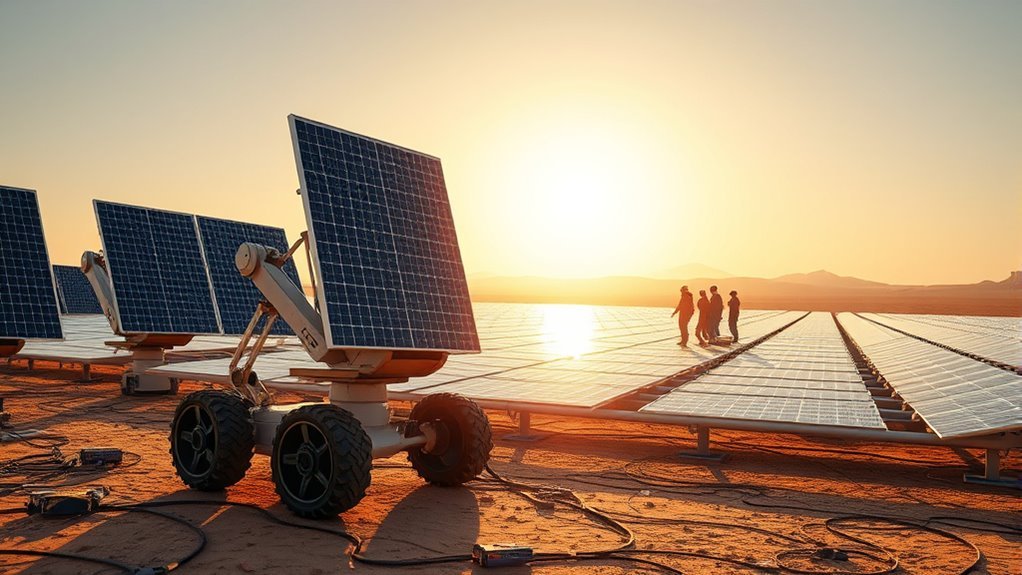
At the center of Gritt’s approach is an intelligent system that fuses robotics and artificial intelligence to speed up the construction of critical infrastructure. Rather than designing bespoke hardware, the company converts off-the-shelf equipment such as skid steers, forklifts, and rented skidders into autonomous, AI-enabled robots. These machines perform pick-and-place, transport, and assembly tasks across solar, concrete, and rebar work, maintaining precision in unstructured environments. Gritt’s model is designed to support agentic task capabilities, which enhances its effectiveness in complex workflows.
Intelligent robotics and AI transform skid steers and forklifts into precise autonomous builders for chaotic solar sites
The architecture is built for harsh outdoor conditions, including mud, dust, wind, and extreme temperatures typical of large solar farm sites. According to Gritt, its systems have already autonomously placed tens of thousands of solar panels without breakage, demonstrating controlled handling at scale.
Gritt’s initial focus is utility-scale solar construction, where delays, labor constraints, and material handling risks can derail project economics. Its systems are already deployed on active solar plants and farm sites, executing foundation preparation, mounting structure assembly, and panel installation. The company reports contracted work to install 2.8 gigawatts of solar capacity over the next 18 months, a pipeline that validates demand from large project owners. Customers include three of the top ten U.S. power construction firms, which use Gritt’s platform to increase throughput while maintaining strict safety and quality standards. On typical sites, a human crew might install around 800 panels per day, while Gritt’s systems can place 3,000-4,000 panels daily, highlighting the throughput gains its automation delivers.
By targeting industrial solar farm construction first, the company positions itself to expand later into adjacent infrastructure segments that rely on similar heavy equipment and repetitive field operations.
Commercially, Gritt follows a deployment model that integrates with existing workflows rather than replacing them outright. Its robotic arms and control systems attach to familiar jobsite equipment, allowing crews to keep proven hardware while layering in autonomy. This retrofit strategy reduces adoption friction for engineering, procurement, and construction firms and large power contractors, who can treat the platform as an upgrade to known machines.
Revenue is driven by projects where customers seek faster installation, lower unit costs, and predictable schedules on solar builds. As the system gathers real-time data on material movement, completed work, and site conditions, it can also provide operational visibility that informs planning and coordination decisions.