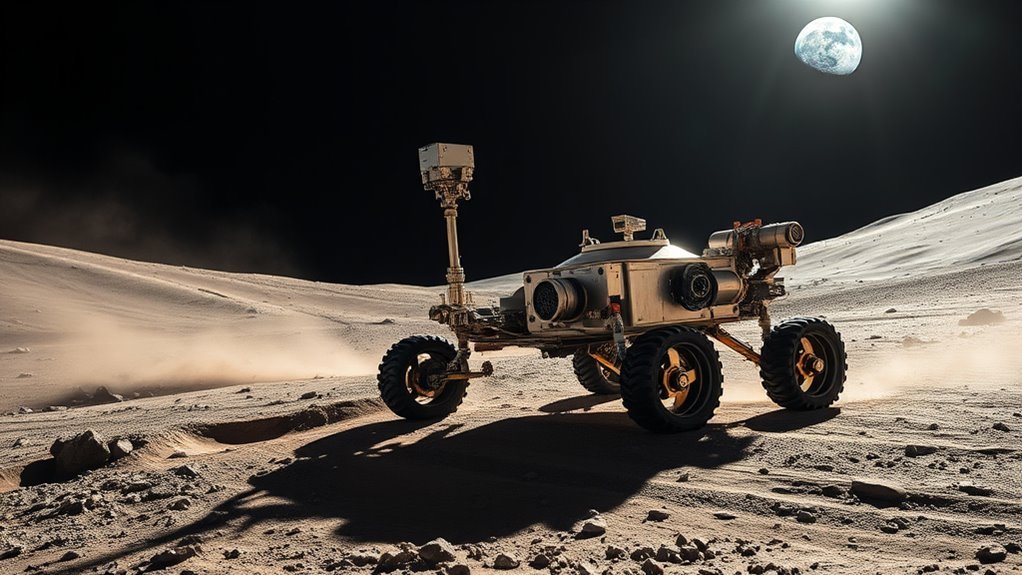

NVIDIA’s Jetson AI platform is about to make a small but consequential leap: from factory floors and warehouse robots to a lunar rover operating hundreds of thousands of kilometers from Earth. If the upcoming Lunar Outpost mission performs as planned, Jetson will likely become the first GPU family to run on the Moon’s surface, turning a commercial edge‑AI module into a test case for the future of autonomous exploration in the Artemis era.
From Rad‑Hard CPUs to Commercial Edge AI
For decades, spacecraft have relied on radiation‑hardened processors that lag far behind terrestrial chips in performance—safe and predictable, but slow, power‑hungry and difficult to program for modern AI workloads. The rise of commercial off‑the‑shelf (COTS) GPUs in orbit has quietly started to change that equation, driven by the need for onboard data processing and real‑time autonomy. The increasing reliance on AI agent security within organizations highlights the critical need for robust systems in challenging environments.
Radiation-hardened CPUs once ruled space; now agile COTS GPUs bring real-time autonomy to orbit.
NVIDIA’s Jetson family was originally built for terrestrial edge AI: robots, drones and industrial systems that need to process sensor data locally under tight power and thermal budgets. Jetson modules combine CPUs, CUDA‑programmable GPUs and dedicated AI accelerators in a compact, energy‑efficient package, making them a natural candidate for embedded autonomy—even if they were never designed with space radiation in mind.
Over the last few years, space companies and researchers have systematically pushed Jetson into progressively harsher environments. A space‑hardened Jetson Orin NX flew on a cubesat aboard SpaceX’s Transporter‑11 in 2024, wrapped in specialized shielding to validate whether an automotive‑grade GPU could survive radiation with acceptable error rates. Heavy‑ion and total‑ionizing‑dose campaigns on Jetson Orin and Xavier modules found that modern Jetsons typically tolerate tens of kilorad of dose, with failures dominated by recoverable single‑event effects rather than catastrophic latch‑up.
Firefly Aerospace then operated Jetson in lunar orbit on the Blue Ghost Mission 2 Ocula imaging payload, processing ultraviolet and visible imagery onboard and streaming results back to Earth over a multi‑year mission. Taken together, those tests established a credible baseline: with sufficient shielding, error‑correcting memory and watchdog logic, Jetson‑class GPUs can survive beyond low Earth orbit and handle the radiation environment around the Moon.
Lunar Outpost is now stepping from “Jetson in lunar orbit” to “Jetson on the lunar surface”—a more demanding environment for dust, temperature cycling and mission operations, but one that benefits from relatively short mission durations and well‑characterized radiation doses.
Inside the Lunar Outpost–NVIDIA Collaboration
Lunar Outpost and NVIDIA have formalized their partnership around a series of Moon missions that explicitly treat edge AI as a core capability rather than an add‑on. According to Lunar Outpost’s latest mission roadmap, the NVIDIA Jetson platform and CUDA‑X libraries will support onboard data processing, lunar mapping, autonomy and communications across multiple upcoming rovers, starting with Lunar Voyage 2 (LV2) and extending to LV3 and LV5.
LV2 is slated to launch later this year to the Reiner Gamma region, a lunar swirl with a mysterious magnetic anomaly that has puzzled scientists for decades. On LV2, Jetson modules will command and control the rover’s LiDAR system, handle post‑processing of sensor data, and compress large data products for downlink—a critical function when communications bandwidth from the lunar surface is limited and intermittent.
Later missions, including LV3 and LV5, are planned to use higher‑performance, space‑qualified NVIDIA hardware such as the Space‑1 Vera Rubin Module, enabling more sophisticated autonomy and even the first human‑robot interaction on another planetary body. That roadmap effectively positions Jetson‑derived hardware as the computational backbone for a growing fleet of robotic vehicles and infrastructure systems both before and after astronauts arrive.
How Jetson Changes a Lunar Rover’s Capabilities
Historically, lunar rovers have depended heavily on ground control, with most high‑value data shipped back to Earth for analysis and most navigation decisions made by human operators reviewing imagery and telemetry. That approach limits responsiveness and constrains what the rover can safely attempt in complex terrain, especially when it needs to move quickly, explore hazardous areas or operate when Earth‑based teams are offline.
Jetson’s role on Lunar Outpost’s rover is to shift that balance decisively toward local autonomy. The GPU will ingest LiDAR point clouds and other sensor streams onboard, building high‑resolution three‑dimensional maps of the surrounding lunar terrain in real time. From those maps, the rover can infer surface features, estimate slopes, classify soil and rock structures, and detect obstacles swiftly enough to adjust its path without waiting for instructions from a control room in Colorado or Houston.
The AI stack running on Jetson supports several interconnected functions:
- Localization: Estimating the rover’s position and orientation using LiDAR, inertial sensors and visual landmarks, even in areas with limited direct line of sight to Earth or orbital assets.
- Route planning: Computing traversable paths that account for slopes, rock fields and craters, while managing energy reserves and thermal constraints.
- Obstacle detection and avoidance: Identifying hazards and rerouting in seconds rather than minutes or hours, a crucial capability near crater rims or boulder fields.
- Data triage and compression: Deciding which sensor products are worth downlinking at full fidelity, which can be compressed, and which can be summarized or discarded, so scarce bandwidth goes to the most valuable science and engineering data.
This integrated perception‑and‑navigation pipeline lives entirely onboard the rover, turning the mission into a focused technology demonstration for GPU‑accelerated mapping and autonomy on the lunar surface. It simultaneously provides actionable science—high‑resolution terrain datasets around Reiner Gamma—and system‑level data about how a commercial AI stack behaves off‑world, from bit‑flip rates to thermal margins.
Mission Architecture and Commercial Ecosystem
Lunar Outpost’s Jetson‑equipped rover is packaged on a lander built by Intuitive Machines, the Texas‑based company that already achieved the first successful private lunar landing and flew Lunar Outpost’s earlier MAPP rover. The mission will launch on a SpaceX Falcon 9 as part of a commercial lunar delivery flight aligned with NASA’s Artemis objectives, extending the model pioneered under NASA’s Commercial Lunar Payload Services (CLPS) program.
In this architecture, the lander delivers the rover and its AI payload to the lunar surface, after which the rover separates and begins largely autonomous operations in its target region. The arrangement demonstrates a layered commercial ecosystem:
- Launch: SpaceX provides the Falcon 9 ride to translunar injection.
- Lander: Intuitive Machines supplies Nova‑C‑class landing capability and surface deployment.
- Mobility and autonomy: Lunar Outpost designs and operates the rover, including the perception and navigation stack.
- AI hardware and software: NVIDIA contributes Jetson modules and CUDA‑X libraries, plus a roadmap to more specialized space‑qualified GPUs.
That stack allows NASA and other customers to purchase increasingly capable lunar services—from terrain mapping to resource prospecting and crew transport—without owning every subsystem themselves. For Lunar Outpost, the mission sits alongside its broader portfolio, which includes the Lunar Voyage 1 MAPP rover (the first American robotic rover on the Moon and the first private rover on a planetary body) and the crew‑capable Lunar Dawn vehicle selected by NASA for Artemis lunar terrain operations.
Surviving Radiation and Lunar Extremes
The most credible criticism of using Jetson in deep space is that it is not radiation‑hardened by design. Space environments expose electronics to total ionizing dose (TID), high‑energy particles that can flip bits or induce latch‑up, and extreme temperature swings—all of which can undermine commercial silicon that performs flawlessly on Earth.
Multiple independent campaigns have tackled that concern. Total‑dose testing of Jetson Orin NX boards found that both 8 GB and 16 GB variants survived TID levels beyond roughly 36 krad(Si) without significant performance degradation, showing “considerable resilience” under controlled irradiation. Heavy‑ion tests at facilities such as GANIL showed that Orin and Xavier modules predominantly experience correctable single‑event upsets rather than destructive failure modes, with built‑in reliability features masking around 80% of events and no unrecoverable latch‑up at tested energy levels.
At the system level, feasibility studies for COTS GPU‑based AI platforms in orbit have documented how aluminum shielding, error‑correcting memory and fault‑tolerant system design can keep mission‑average TID far below Jetson’s tested tolerances. Simulations for representative orbits indicate that a 10 mm aluminum shell can reduce the mission‑average TID to around a few hundred rad(Si), orders of magnitude below the tens‑of‑kilorad levels Jetson has already endured in tests.
For lunar missions, radiation exposure depends heavily on mission duration. Technical assessments for other Moon rovers show that a short surface campaign—on the order of a single lunar day (~14 Earth days)—incurs only a fraction of the dose that long‑lived satellites accumulate, making survival more likely even for relatively modest shielding. Research into memory protection for Jetson‑class platforms in lunar orbit has also highlighted how onboard ECC and single‑error correction/double‑error detection (SECDED) schemes can efficiently correct bit flips without sacrificing too much usable memory.
None of this turns Jetson into a rad‑hard component, and mission designers remain candid that commercial GPUs carry higher risk than traditional space processors. What it does show, however, is a repeatable toolkit: metal shielding, ECC memory, rad‑hard watchdogs that reset hung systems, fault‑tolerant board layouts, and software mitigations that detect and replay corrupted computations. Lunar Outpost’s mission will put that toolkit to the test under real operational conditions on the Moon, providing data that the broader community can use to refine design margins and mitigation strategies.
Why This Matters for Artemis and the Space Economy
The timing of NVIDIA Jetson’s lunar deployment lines up with a turning point in human spaceflight. NASA and its partners are targeting the late 2020s for renewed crewed landings, with some estimates pointing to human missions to the Moon around 2028 and long‑term stays thereafter. As operations shift from one‑off landings to sustained presence—outposts, mining, power infrastructure—autonomous robots will become the everyday workforce of the lunar economy.
From a technology perspective, demonstrating that off‑the‑shelf, power‑efficient GPUs can serve as reliable compute for lunar rovers is a major step toward standardizing edge AI in space systems. It lowers the barrier for future missions to carry sophisticated onboard models: hazard classification, multi‑sensor fusion, dynamic route planning, health monitoring, and even collaborative behaviors among fleets of robots and orbiting assets. Once those capabilities are proven on one rover, they can rapidly propagate to orbiting imagers, surface infrastructure robots and crewed vehicles.
For businesses, this mission showcases how commercial AI vendors can participate directly in space architectures rather than remaining “downlink‑only” providers. NVIDIA’s presence spans lunar surface rovers via Lunar Outpost and lunar‑orbit imaging via Firefly’s Ocula, brokered through partnerships instead of bespoke space hardware. At the same time, Firefly Aerospace is building a Jetson‑enabled Ocula lunar imaging service on its Elytra spacecraft in lunar orbit to deliver continuous mapping and mineral‑detection data to government and commercial customers. That creates a pathway for other AI hardware and software companies to enter the market, offering optimized models, toolchains and support for off‑world deployments while leveraging terrestrial product lines.
There are broader societal implications as well. Jetson‑powered rovers capable of real-time video and terrain analysis from the Moon will offer unprecedented transparency into lunar activities, giving the public what amounts to a front‑row seat to exploration. At the same time, robots that can autonomously coordinate, manage resources and support human crews with minimal ground intervention force policymakers to confront new questions about liability, safety standards and governance when increasingly intelligent machines operate far from Earth.
Risks, Limitations and Open Questions
A credible analysis needs to surface the downsides and uncertainties:
- Reliability vs. novelty: Jetson is powerful, but it is still relatively new to deep‑space missions compared with legacy rad‑hard processors. The sample size of flights is small, and long‑duration behavior under rare radiation events is not yet fully characterized.
- Software complexity: Running advanced AI stacks on constrained, radiation‑prone hardware increases the surface area for bugs and failure modes. Robust software engineering, fault injection testing and conservative model choices are just as important as hardware resilience.
- Vendor dependence: Jetson locks missions into a specific GPU architecture and CUDA ecosystem. While that brings a mature toolchain, it also introduces supply‑chain and lifecycle risks if space‑qualified variants diverge from commercial roadmaps.
- Mission design constraints: To keep risk acceptable, early Jetson‑based missions are likely to limit duty cycles, mission lengths and operating modes. High‑stakes systems—life support, critical power—will still rely on proven rad‑hard platforms until commercial GPUs earn much deeper flight heritage.
There is also some ambiguity around the exact lander mission configuration for Lunar Outpost’s Jetson rover. Public documentation from Intuitive Machines and Lunar Outpost does not conclusively establish that the GPU will fly on a specific numbered mission like IM‑3, and careful analysts have flagged that mismatch as an uncertainty rather than a settled fact. Treating those gaps transparently is part of building trust: the overall trend is clear, even if individual mission designations remain fluid as schedules and payload manifests evolve.
Key Takeaways and What to Watch Next
Several clear themes emerge from this moment:
- Commercial edge‑AI hardware has crossed a threshold from lab tests to real deep‑space applications, with Jetson now proven in lunar orbit and moving to the lunar surface.
- Lunar Outpost’s rover turns Jetson into more than a payload computer; it is the linchpin for LiDAR‑driven autonomy, onboard mapping and intelligent data triage in a communications‑constrained environment.
- The mission exemplifies a new space stack: commercial launch, commercial landers, commercial rovers and commercial AI platforms working together under Artemis‑aligned objectives.
- Radiation remains the central technical challenge, but accumulated test data and shielding strategies suggest that COTS GPUs can be made robust enough for short‑ to medium‑duration missions when combined with ECC, watchdogs and careful system design.
- Success would accelerate the adoption of onboard AI across the lunar ecosystem—rovers, orbiters, infrastructure—shifting intelligence from Earth to the edge and enabling more ambitious, less supervised operations.
Over the next few years, several signals will show how fast this transition is happening: the performance of Lunar Outpost’s Jetson rover on the surface; the long‑term stability of Jetson in Firefly’s multi‑year lunar‑orbit mission; the introduction of space‑specific NVIDIA modules like Space‑1 Vera Rubin onto higher‑stakes missions; and the degree to which Artemis‑era rovers and infrastructure vehicles standardize on GPU‑accelerated autonomy.
If those milestones break the right way, accelerated edge AI will move from an experimental feature to a default expectation for planetary surface operations—making the “first Jetson on the Moon” not an isolated headline, but an early chapter in how intelligent machines and humans will share work beyond Earth.
Conclusion
Jetson-powered autonomy on and around the Moon is not just a clever engineering milestone; it is a quiet but decisive shift in how space missions will be run from now on. By moving artificial intelligence out to the lunar edge—directly into landers, orbiters, and rovers—mission teams are starting to rely on machine decision-making in places where a wrong call can cost hundreds of millions of dollars and years of work.
Why Nvidia’s Jetson Going Lunar Matters Now
Over the next few years, several missions will test real-time AI and edge computing on and around the Moon, and Nvidia’s Jetson platform is emerging as one of the key building blocks for that shift. Firefly Aerospace’s Blue Ghost Mission 2, slated for launch in late 2026, will carry the Ocula lunar imaging service powered directly by a Jetson edge AI module in lunar orbit.
Instead of shipping vast amounts of raw telescope data back to Earth and waiting weeks or months for analysis, Ocula will run AI algorithms on orbit, sift through ultraviolet and visible-spectrum imagery, and transmit only the most relevant insights. That is a fundamental change: intelligence is no longer just on the ground, it is co-located with the sensors, in space.
At the same time, lunar missions are pushing toward fully autonomous science operations—systems that analyze terrain, select targets, coordinate multiple robots, and decide what to send home, often without human intervention in the loop. In that context, sending Jetson-class hardware to the Moon is less about a single rover and more about establishing a general pattern: commodity edge AI running mission-critical software off Earth.
From Ground-Controlled Robots to Edge AI
For most of the space age, planetary rovers were essentially remote-controlled scientific instruments. They had basic hazard avoidance, but humans on Earth made almost every meaningful decision about where to drive and what to study.
That model has been evolving steadily:
- Mars rovers such as Perseverance already use edge AI to navigate autonomously, analyze local environments, and identify areas of scientific interest without waiting for Earth-bound instructions.
- NASA’s VIPER rover—its first robotic explorer dedicated to mapping water ice near the lunar South Pole—relies on AI tools to help plan safe and scientifically valuable paths through difficult terrain.
- The Lunar Node-1 experiment, riding on Intuitive Machines’ Nova-C lander, demonstrates an autonomous navigation payload that uses radio beacons and the Deep Space Network to support precise geolocation for orbiters, landers, and surface crews.
Together, these missions laid the groundwork: they proved that autonomy can work in harsh environments and that edge AI can share the decision-making load with human controllers. Jetson-class systems are the next step—bringing more powerful, general-purpose AI accelerators into that same environment.
Jetson in Lunar Orbit: Firefly’s Blue Ghost Mission 2
Firefly Aerospace’s Blue Ghost Mission 2 is the clearest example of Jetson moving from terrestrial edge deployments into true space computing. The mission includes:
- A lunar lander descending to the far side of the Moon with science instruments, including a radio telescope designed to detect faint signals from the cosmic “Dark Ages” shortly after the Big Bang.
- The Elytra spacecraft, which will remain in lunar orbit for a five-year mission running the Ocula imaging service and its Jetson-powered processing chain.
High-resolution telescopes built by Lawrence Livermore National Laboratory will be embedded with a Jetson module and mounted on Elytra, collecting imagery across ultraviolet and visible spectrum bands. The data will be rapidly processed on board using Firefly’s AI software and Jetson, then autonomously filtered so that only the most relevant information—based on customer needs—gets transmitted to Earth.
This shift matters for two reasons:
- Bandwidth and latency: By processing data in lunar orbit, the mission reduces both the amount of data that must be downlinked and the time between observation and insight, which is crucial when science teams need rapid feedback to adjust follow-up observations.
- Commercialization of lunar data: Ocula is designed as a lunar imaging service, not just a one-off research experiment, signaling that commercial customers may soon expect customizable, AI-curated lunar data streams.
Firefly has also indicated plans to fly Ocula sensors on subsequent Blue Ghost missions, iterating with newer Nvidia platforms such as a Space-1 module optimized for space environments as they become available. That roadmap suggests Jetson-based systems will not be a one-off in space, but a platform that evolves across missions.
Autonomous Rovers: The Moon as an AI Testbed
When people imagine AI on the Moon, they usually picture rovers learning to drive themselves, scanning for resources, and making local decisions about where to go next. That vision is starting to materialize through several converging efforts, even if the exact role of Jetson on specific rovers is still emerging.
NASA’s Cooperative Autonomous Distributed Robotic Exploration (CADRE) mission, targeting a landing in the Reiner Gamma region in 2026, is a technology demonstration explicitly focused on multi-robot cooperative autonomy. CADRE will deploy:
- Three small rovers and a base station on the lunar surface.
- High-level commands from Earth—such as “explore this region”—which the robots translate into detailed mobility and instrument actions autonomously.
- Coordinated collection of imagery for 3D surface reconstruction and multi-static ground-penetrating radar data to build 3D maps of the subsurface.
The goal is to show that a team of autonomous agents can coordinate, share data, and accomplish complex science goals with minimal human intervention, using the Moon as a realistic proving ground.
In parallel, NASA has approved the deployment of fully autonomous AI systems to manage lunar science operations starting in 2026. These systems are designed to handle:
- Real-time terrain analysis and hazard detection.
- Robotic coordination and task delegation across multiple units.
- Intelligent data prioritization and compression, sending home only the most valuable findings.
- Anomaly detection and resource management in near real time.
This is a significant governance shift: machines will not just assist teams; they will operate missions themselves under broad objectives, translating human intent into detailed task sequences and resolving conflicts between robotic units.
On the commercial side, Astrolab’s FLIP (FLEX Lunar Innovation Platform) rover offers another glimpse of lunar autonomy. The smaller test rover, weighing around half a ton and carrying 30–50 kilograms of payload, is being outfitted with a Spaceborne Computer developed by Hewlett Packard Enterprise, effectively giving the rover a real-time “AI brain.” Its mission is to validate key subsystems—hyper-deformable Venturi wheels, batteries, avionics, sensors, and software—under genuine lunar conditions. FLIP is scheduled to land at the lunar South Pole in summer 2026 aboard Astrobotic’s Griffin-1 lander, with follow-on FLEX missions potentially riding larger launch vehicles.
In this broader environment, Nvidia’s Jetson becomes one of several edge-compute platforms competing to power autonomous lunar operations. The exact pairing of Jetson hardware with specific rovers will evolve, but the pattern is clear: these missions all rely on compact, efficient, and increasingly general-purpose AI compute systems operating far from Earth.
How Edge AI Changes Mission Design
Putting AI directly on rovers, orbiters, and landers changes how missions are conceived long before launch. There are several direct impacts:
1. Mission architecture and risk
When AI systems are allowed to make high-level decisions—such as which samples to prioritize or which regions to map in detail—mission designers must think in terms of objectives and constraints rather than scripted timelines. Human teams become more like supervisors and auditors than step-by-step controllers. This increases resilience but also introduces new failure modes if the AI misinterprets goals or fails under unexpected conditions.
2. Communications and data strategy
The traditional model of “collect everything, send everything” is untenable when bandwidth is limited and instruments generate huge data volumes. Jetson-powered processing chains like Ocula’s demonstrate a more selective pipeline: extract critical insights on the Moon, then send compressed, high-value data tailored to customer or science objectives. Similar logic underpins NASA’s autonomous systems that compress and relay only the most relevant findings back to Earth.
3. Operations tempo and flexibility
Edge AI can adjust plans on timescales that human operators simply cannot match, especially when constrained by communication delays and limited ground-station availability. Missions can react to transient phenomena, unexpected terrain, or novel signals—like faint cosmological signatures—without waiting for a daily uplink session.
4. Cost and commercial access
Using platforms such as Jetson or commercial spaceborne computers reduces the need to design fully custom, radiation-hardened chips from scratch. This can lower development costs and shorten time-to-launch for startups and research institutions, although significant engineering is still required to protect commercial hardware from radiation, temperature extremes, and power fluctuations.
Opportunities and Risks for the Space–AI Ecosystem
From a technology and business perspective, several opportunities stand out:
– New markets for lunar data and services
Ocula positions lunar imagery as a service, with AI used to curate and deliver information according to customer priorities rather than just scientific curiosity. Similar models could emerge for prospecting resources, mapping infrastructure sites, and monitoring assets on the lunar surface.
– Standardized space computing platforms
As Nvidia and others introduce dedicated space modules and iterate across missions, a de facto standard stack for space AI may emerge. That would allow mission planners to reuse software components, testing frameworks, and safety mechanisms across different lunar and planetary missions.
– Scaling to Mars and beyond
The Moon is a natural testbed: it is close enough for frequent launches and relatively quick feedback, yet harsh enough to expose real edge-AI failure modes. Success with Jetson-powered autonomy and other edge platforms around the Moon will strongly influence how future Mars rovers, asteroid miners, and deep-space probes are designed.
However, the risks and limitations are equally important:
– Reliability and safety
Commercial AI accelerators like Jetson were not originally designed for multi-year missions in high-radiation environments. They require additional shielding, redundancy, and fault-tolerant software, and even then, long-term reliability data in deep space is limited.
– Opacity and accountability
As AI systems begin to make operational decisions—choosing which samples to analyze or how to coordinate multiple robots—understanding and auditing those decisions becomes critical. Space agencies and regulators will need clear frameworks for responsibility when AI-driven choices lead to the loss of hardware or missed scientific opportunities.
– Security and robustness
Edge AI systems are, by design, autonomous and networked. If they are compromised or misconfigured, they could misallocate resources or corrupt scientific datasets. Robust anomaly detection, adversarial resilience, and fail-safe mechanisms are essential, particularly as commercial and government missions share lunar infrastructure.
How This Compares to Earlier Generations
Earlier generations of space robotics did have autonomy, but it was narrow and highly constrained: hazard avoidance, limited path planning, simple instrument sequencing. The new era introduces:
- General-purpose compute platforms like Jetson and other spaceborne computers running complex AI stacks, rather than small, fixed-function systems.
- Multi-agent coordination, where teams of rovers and orbiters share tasks and data autonomously, as CADRE will attempt on the lunar surface.
- AI-led mission operations, in which systems manage resource budgets, prioritize science targets, and compress data streams with minimal human guidance.
In other words, edge AI is moving from “safety feature” to “mission brain.” The Moon is where this transition is being tested first at scale.
The Quiet Turning Point
Jetson-powered autonomy on the lunar frontier marks a quiet turning point for space exploration. As AI systems learn to navigate, sense, and decide without constant human oversight, the Moon is becoming a proving ground for resilient edge intelligence rather than just a distant destination.
In the near term, fleets of intelligent robots will extend scientific reach, build and inspect early infrastructure, and operate far from Earth, supported by compact, efficient computing platforms that can live with the constraints of lunar power and communications. Over time, this pattern will likely spread to Mars and deep-space missions, reshaping how humanity explores and understands hostile worlds.
The key takeaway is that autonomy is no longer a peripheral capability. With systems like Nvidia’s Jetson now part of lunar missions, AI is moving into the core of mission design. The organizations that learn to trust, audit, and responsibly deploy these edge AI systems on the Moon over the next decade will define what “intelligent exploration” looks like for generations of missions to come.