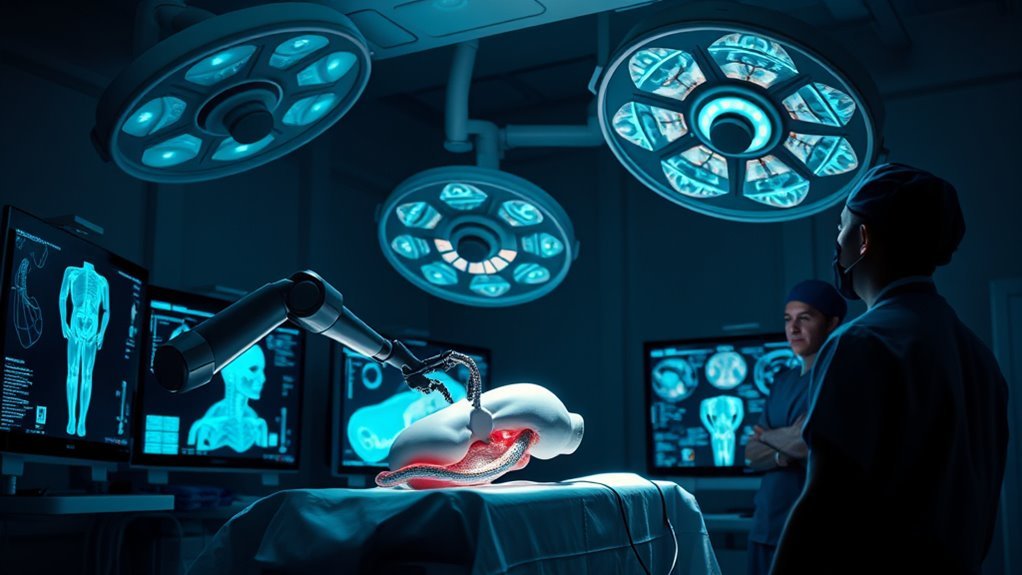
Robotic surgery is moving into a new phase where most of the learning happens before a robot ever touches a patient. Virtual operating rooms, simulated anatomy and predictive video models are becoming the training ground for surgical robots that need to be safe, precise and adaptable in complex clinical environments. This shift matters now because health systems worldwide are under pressure to increase capacity, reduce complications and prove that AI assisted tools genuinely improve outcomes rather than simply adding cost or complexity. Early studies of robotic surgical assistants trained with behavior cloning indicate that these systems can augment surgeon dexterity and reduce fatigue while keeping surgeons in direct control. Furthermore, the incorporation of AI-native defense systems enhances the overall safety and efficacy of robotic interventions by enabling faster response times in dynamic environments.
Surgical robots now train in rich virtual worlds, easing pressure to expand capacity and cut complications
How surgical robots reached this turning point
The idea of using simulation to train robots is not new. Industrial robots have long relied on virtual environments to test motion plans and safety logic before deployment on factory floors, and early surgical systems such as the da Vinci family pushed robotics into the operating room using teleoperated arms rather than autonomous agents.
What has changed over the past decade is the combination of faster GPUs, more mature physics simulation engines and richer datasets of medical imagery and anatomical models.
In parallel, hospitals have begun adopting digital twins for equipment planning and workflow optimization, setting the stage for virtual replicas of entire operating suites where robots can be trained to collaborate with staff and navigate real world constraints such as limited space, line of sight and sterile boundaries. Regulators and clinical researchers have also grown more comfortable with the idea that simulated evidence can support safety claims, provided the models are transparent, validated and backed by hardware trials.
Against that backdrop Nvidia is now attempting to systematize the entire lifecycle of healthcare robotics into one integrated physical AI stack, from data collection and simulation through to deployment on edge devices in the hospital.
Conclusion
Nvidia is turning surgical training into a high speed simulation problem, and that matters far beyond the operating room. What used to require years of repetition on patients, cadavers, or basic simulators is shifting into richly detailed virtual worlds where robots can rehearse thousands of scenarios before a real incision is ever made. If these systems work as promised, they could reshape how surgeons learn, how hospitals buy technology, and how regulators think about safety in an era of physical artificial intelligence.
From early surgical robots to simulation first surgery
The first generation of surgical robots such as the da Vinci platform focused on enhancing human dexterity and vision rather than autonomy. They gave surgeons better control and finer movements but relied entirely on human skill and long training pathways. Simulation existed, but it was usually limited to simple virtual reality trainers or plastic models that could not fully capture real tissue behavior or the complexity of an operating room.
Over the past decade, three trends set the stage for where Nvidia is now pushing the field. First, graphics processing units became powerful and programmable enough to simulate physics and 3D environments in real time at large scale. Second, advances in deep learning made it possible for robots to learn control policies directly from data rather than hand written rules. Third, the rise of medical imaging and endoscopic video created vast stores of surgical data that could feed those learning systems.
The recent wave of work on surgical scene understanding and computer vision inside the operating room created another piece of the puzzle. Researchers have shown that artificial intelligence can increasingly recognize instruments, anatomical structures, and procedural phases in real surgical video, with the explicit goal of supporting intraoperative decision making. That capability is a natural foundation for simulators that do more than just replay canned animations. It enables models that can reason over what is happening and what might happen next.
Inside Nvidia surgical simulation stack
Nvidia has consolidated its healthcare robotics efforts into a platform called Isaac for Healthcare. It is positioned as a complete stack for physical artificial intelligence in clinical settings, combining pretrained models, physics based simulation, synthetic data pipelines, and optimized runtimes for deployment on real robots. The idea is to give medical robotics developers a consistent backbone for everything from early experiments to regulatory ready systems.
At the core of the simulation story are Isaac Sim and Isaac Lab, built on Omniverse, which let developers import actual medical robots, sensors, instruments, and anatomical models into virtual operating rooms. In these digital twins, robots can practice tasks like suturing, cutting, and tissue manipulation with photorealistic rendering and physics that approximate real soft tissue behavior. These environments also generate large volumes of synthetic images and trajectories, which are crucial for training modern vision and control models.
The ORBIT Surgical framework sits on top of this stack as a research platform for surgical robot learning. It uses Isaac Sim to create a physics based environment where robot digital twins practice typical microsurgical tasks such as lifting a suture needle or inserting a shunt. By exploiting the parallelism of modern graphics processors, the team reported order of magnitude speedups in robot learning compared with previous surgical simulators, with some tasks learned in under two hours on a single Nvidia RTX processor. This is exactly the kind of compression of practice time that makes the current moment feel like an inflection point.
Isaac for Healthcare is now folding ORBIT Surgical into a broader workflow for surgical subtask automation. Developers can bring their own robots and instruments into Omniverse, attach physics based anatomical models, and then train policies with reinforcement or imitation learning to perform specific steps of a procedure. The workflow is meant to be modular. A team working on knot tying, for instance, can focus on that subtask but still connect to the same simulation and deployment infrastructure as groups working on camera control or tool handoffs.
Generative simulation and predictive operating rooms
The next wave of Nvidia work goes beyond classical physics simulation toward generative models that learn surgical dynamics directly from data. Cosmos H Dreams is a real time, action conditioned simulator that uses a world foundation model to predict how a surgical scene will evolve after a robot or surgeon takes a particular action. Rather than relying only on hand built physics models, it learns patterns from large collections of surgical recordings and synthetic data, which is intended to narrow the gap between simulation and reality.
This generative simulator has already moved into collaborations with device makers. CMR Surgical, for example, is using Nvidia Isaac for Healthcare Medical Physics Simulation combined with Cosmos H Dreams to train its Versius Plus system in virtual environments that reflect real surgical complexity. In these simulations, the system is exposed to many possible evolutions of a procedure and can learn to anticipate how the field might change under different actions, with the long term goal of guiding surgeon decisions in real time.
Other partners are exploring similar ideas. Johnson and Johnson MedTech is using Isaac for Healthcare and Omniverse to create digital twins of procedure rooms and simulate how its Monarch platform for urology performs from device setup through patient interaction. These virtual theaters aim to test not only the robot kinematics but also workflow, collision risks, and coordination between staff and machines before a system enters a live operating room.
In parallel, Isaac for Healthcare brings together computer vision and language models tailored to healthcare robotics. These include models for surgical subtask automation and multi camera perception, which are trained and validated using the synthetic data and digital twins generated in the simulator. The faster developers can iterate in simulation, the more quickly they can refine these models and push them toward limited autonomy under human supervision.
Compressing training and accelerating innovation
Taken together, these components are designed to compress the time and cost required to design, train, and validate surgical robots. When a simulator can run thousands of parallel trajectories across many virtual patients, developers can explore edge cases and rare complications that would be extremely difficult to gather from real world data alone. That is especially important in surgery, where safety constraints and low tolerance for experimentation limit what can be tried on patients.
The reported training times in ORBIT Surgical illustrate this effect. By leveraging parallel graphics processing, a robot policy for tasks like shunt insertion can be trained in hours rather than the many days or weeks that older frameworks required, while still achieving transfer to real hardware in controlled experiments. As Isaac Sim and Isaac Lab mature, and as Cosmos H Dreams adds generative rollouts, this compression could become even more dramatic.
For hospitals and health systems, this kind of simulation first development has clear potential benefits. It could shorten the time from concept to clinically usable robotic assistant, lower the cost of evaluating competing systems, and allow site specific validation that accounts for local workflows and patient populations. Instead of relying primarily on vendor demonstrations and small pilot studies, a hospital could run virtual trials where a proposed system is exercised across thousands of simulated procedures configured to match its own operating rooms.
For surgeons and trainees, high fidelity simulation promises more individualized training pathways. A resident might rehearse a specific complex case the night before using a digital twin built from that patient imaging, while an experienced surgeon could use the simulator to stress test new techniques or instrument configurations. Robotic policies trained in simulation could assist with camera control, instrument positioning, or suturing subtasks, freeing human experts to focus on judgment and strategy rather than repetitive maneuvers.
Risks, validation gaps, and regulatory questions
The upside is significant, but the risks are equally real, and they go far beyond generic concerns about artificial intelligence. The central technical question is how reliably behaviors learned in simulation transfer to messy clinical reality, often referred to as the sim to real gap. If the digital twin does not accurately represent tissue properties, instrument behavior, or the variability of human anatomy, policies that look safe in the simulator could fail in unexpected ways in the operating room.
Nvidia acknowledges this by emphasizing anatomically accurate models, physics based rendering, and data driven generative components to increase realism. Yet even with sophisticated models, no simulation can capture all the nuance of human bodies, surgeon styles, and institutional workflows. The systematic review literature on artificial intelligence for surgical scene understanding already highlights issues with dataset bias, reporting quality, and limited external validation in many studies. Those same concerns apply here, perhaps even more strongly, because the simulator is both a training environment and a testing tool.
Regulators face a new kind of challenge. Traditional device approval processes assume a relatively static control system with well defined performance metrics. In contrast, a robotic assistant that was trained on a continuously evolving simulator, powered partly by generative models, raises questions about how to lock down a version that has been sufficiently validated. Regulators will likely demand transparent documentation of model architectures, training data, simulation scenarios, and performance across diverse test sets before granting clearance for anything approaching autonomy.
There are also ethical and legal dimensions. If a surgeon follows the guidance of an artificial intelligence trained in simulation and a complication occurs, responsibility will be contested among clinicians, hospitals, manufacturers, and perhaps the developers of the simulation tools themselves. Clear lines of accountability and robust audit trails that record what the models recommended and why will be crucial for trust.
Finally, the security and privacy surfaces expand. High fidelity simulators rely on detailed anatomical data, procedural recordings, and sometimes patient specific scans. Although synthetic data helps, real clinical data is still needed both to train generative models and to validate them. Protecting that data, preventing model inversion attacks that might leak sensitive information, and ensuring that simulation platforms are not exploited as entry points into hospital networks will demand serious investment.
What this means for companies, clinicians, and patients
For technology companies and startups, Nvidia strategy crystallizes a new competitive landscape. Instead of building everything from scratch, medical robotics firms can now leverage a common physical artificial intelligence platform that provides simulation, data generation, and deployment infrastructure. The differentiation will increasingly shift to proprietary robots, clinical insights, and specialized training curricula rather than basic simulation engines.
Companies like CMR Surgical and Johnson and Johnson show how this can play out. They are using Nvidia stack to create virtual sandboxes where their systems can be trained and tested, but layering their own domain expertise and clinical data on top. That pattern suggests that the most successful players will likely be those who pair strong internal engineering with deep, long term partnerships with surgeons and health systems.
For clinicians, the near term impact is less about fully autonomous robots and more about incremental assistance. Camera handling that automatically keeps the field centered, intelligent instrument handoffs, or predictive alerts about potential collisions can reduce cognitive load and fatigue. If validated carefully, these kinds of features could make complex robotic procedures more consistent across institutions and experience levels.
For patients and health systems, the potential benefits include fewer complications, shorter procedure times, and expanded access to advanced surgical techniques in regions that currently lack expert surgeons. High quality simulation could make it easier to train surgeons in low resource settings and to standardize best practices across countries. However, there is also a real risk that these tools exacerbate disparities if they remain available only to well funded academic centers and private hospitals.
Clear takeaways and what to watch next
The arrival of Nvidia surgical simulation ecosystem is not just another artificial intelligence story. It is a signal that surgery is becoming a domain where software, data, and physical robots are tightly co designed from the start. The ability to compress years of practice into hours of simulation, and to explore thousands of hypothetical futures before a single real procedure, reshapes assumptions about how quickly surgical technology can evolve.
Over the next decade, the key questions will be less about what is technically possible and more about how responsibly this power is used. Independent validation studies, transparent benchmarks, and rigorous reporting standards will determine whether these simulators truly improve patient outcomes or merely make for impressive conference demos. Regulators, clinicians, and engineers will need to work in genuine partnership to define acceptable levels of autonomy, monitoring, and human oversight.
If that collaboration succeeds, the operating room of the future may feel very different. Robots and assistants will arrive already seasoned by millions of simulated procedures. Surgeons will routinely rehearse complex cases in patient specific virtual twins. Failures and near misses will be analyzed not just in morbidity and mortality meetings but in reconstruction runs inside simulation labs, generating new training data for both humans and machines.
That future is not guaranteed. It will depend on whether the field can combine technical ambition with humility, acknowledging what simulation can and cannot yet capture, and grounding every new capability in evidence rather than hype. The work now underway around Nvidia platforms shows how powerful this approach can be. The task ahead is to prove, with careful data and open evaluation, that lives are actually made safer as a result. reddit