OpenAI is commencing an unprecedented cloud and data center spending program, lifting its projected compute outlay to about $750 billion through 2030, up from roughly $600 billion it had guided investors to earlier in 2026. The escalation underscores how quickly expectations for AI demand, model complexity, and revenue potential have risen within a short period. Earlier internal guidance and public commentary had floated compute and infrastructure commitments approaching $1.4 trillion over roughly eight years before the company reduced those figures to reassure investors about capital intensity and financing risk.
Current plans segment spending across several overlapping time frames and categories. Over 2025–2030, various analyses point to more than $150 billion in direct computing costs alone, capturing immediate capacity additions and near‑term cloud consumption. Additionally, this growing demand for AI resources reflects the expansion of AI capacity in Europe as seen in partnerships like that of Microsoft and Mistral.
Longer range models, covering 2025–2035, estimate around $1.15 trillion in combined hardware and cloud infrastructure obligations, reflecting multi‑year contracts, pre‑purchased capacity, and extended build‑out of AI‑optimized facilities. Across its full 2025–2035 horizon, OpenAI’s infrastructure commitments now total $1.15 trillion, spanning both owned hardware and rented cloud capacity.
Vendor concentration is a defining feature of the program. Aggregate commitments across seven key partners are estimated at $1.15 trillion, distributed among Broadcom, Oracle, Microsoft, Nvidia, AMD, Amazon Web Services, and CoreWeave. Within that total, projected spending includes about $350 billion with Broadcom, $300 billion with Oracle, and $250 billion with Microsoft for chips, networking hardware, and cloud infrastructure. Additional allocations are roughly $100 billion with Nvidia, $90 billion with AMD, $38 billion with Amazon Web Services, and $22.4 billion with CoreWeave.
The Oracle relationship is particularly large and time‑bounded. Contracts reportedly involve $60 billion per year for five years between 2027 and 2031, totaling $300 billion of cloud infrastructure payments concentrated in that window. CoreWeave agreements, by contrast, are smaller but notable for their specialized GPU‑heavy footprint, amounting to $22.4 billion in committed data center usage rights through 2029 when initial and expansion deals are combined.
Strategically, OpenAI has shifted toward a cloud‑first posture rather than attempting to own the entire stack of hyperscale data centers. Capacity is increasingly sourced from Oracle, Microsoft, and Amazon, with those platforms shouldering the burden of construction, operations, and power procurement. OpenAI has also entered multibillion‑dollar arrangements with Nvidia, AMD, and Broadcom to secure accelerators and networking technologies that underpin these environments.
Earlier in the planning cycle, internal roadmaps included aggressive investment in proprietary data center facilities and custom server chips designed to reduce reliance on rented cloud capacity. Those more expansive build‑out concepts have been scaled back. The company now positions itself primarily as a massive consumer of cloud resources, while still pursuing selective ownership of flagship sites where it sees strategic or economic advantage.
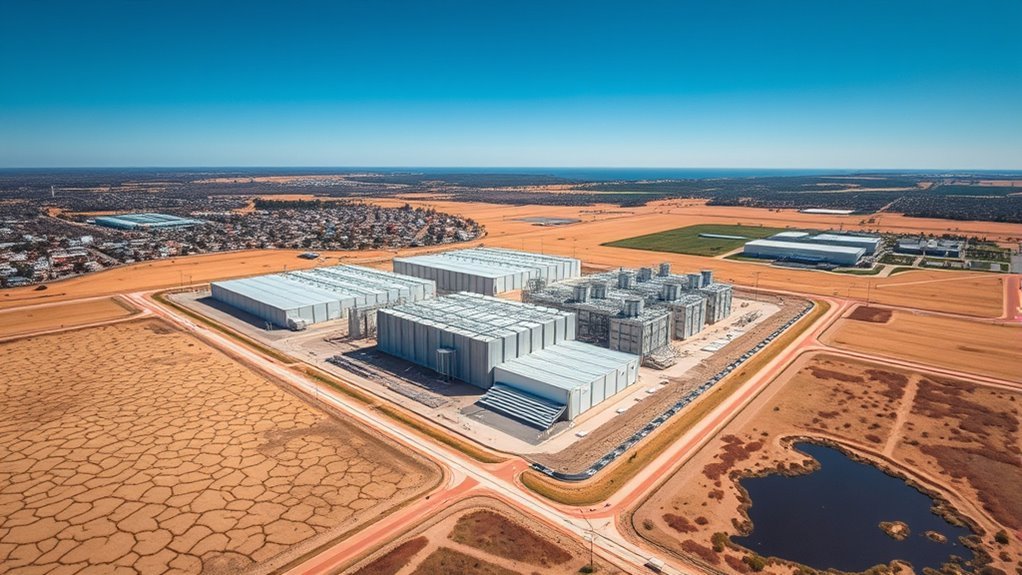
A $20 billion data center initiative in Georgia illustrates this hybrid stance. The project marks a major step toward direct infrastructure ownership while coexisting with large‑scale cloud contracts that guarantee geographic diversity and flexible capacity. To manage volatility in model launches and usage, OpenAI expects to devote about $100 billion over five years to renting backup servers from cloud providers solely for peak demand coverage.
Separate projections indicate roughly $350 billion in broader cloud services spending, highlighting how central external platforms remain to the company’s expansion plans. Beyond these specific commitments, OpenAI’s revised trajectory has also been framed as a response to market concerns triggered when earlier projections approached $1.4 trillion, prompting leadership to moderate formal guidance while still signaling an extremely capital‑intensive path for advanced AI development.