For most of the past decade, advanced robots have lived in a strange space. They attracted global attention through viral videos and trade show demos, yet stayed locked behind research partnerships, pilot programs, and bespoke sales contracts. Consumer-facing robots tended to be simple vacuum cleaners or novelty toys, while industrial robots stayed inside factories.
Unitree and AgiBot are pushing against that boundary by placing capable humanoid and quadruped platforms directly inside mainstream shopping malls and commercial districts in Beijing, Hangzhou, and other cities. Their strategy is to normalize robots as stocked inventory with clear prices, visible performance, and straightforward purchase paths, much like the early years of the smartphone boom when high-end devices first appeared on retail shelves instead of enterprise catalogues. This shift aligns with the growing employment trends observed in sectors adapting to AI integration.
How Unitree built a robot presence in Beijing malls
Unitree’s most visible move was to open what local authorities describe as its first world-facing offline retail store at JD Mall Beijing Shuangjing in the Chaoyang district. The store operates as an experience center and sales outlet, with service hours that align with conventional mall opening times and a location reachable by standard metro lines.
It is not a lab or a demo booth tucked into a tech expo. It is deliberately situated as a regular tenant in a busy urban shopping complex.
Coverage from Chinese media and retail partners shows that the Shuangjing store showcases the Go series robot dogs and G1 humanoid robots as primary attractions. The quadruped Go2 robot dogs generally carry price tags around 10,000 to 20,000 yuan, which converts roughly to 1,400 to 2,800 United States dollars depending on exchange rates.
The G1 humanoid robots are positioned higher, typically in the 80,000 to 100,000 yuan bracket, or roughly mid five figures in United States dollar terms. Additional models such as the R1 humanoid and the larger H1 platform appear online and in some promotional material with higher ticket prices that move further into the professional or enterprise market.
A later report from Global Times notes that across Unitree’s directly operated Beijing outlets, including the Wangfujing Intime in88 location, the robot offerings span roughly 10,000 to more than 130,000 yuan. That range covers entry-level robot dogs through more complex humanoid platforms and suggests a deliberate ladder from enthusiast and educational buyers up to corporate and institutional customers.
One local customer quoted in that report recalls that early robot dogs cost 60,000 to 80,000 yuan, while current entry units start just above 10,000 yuan, indicating a sharp price drop as manufacturing scales and component costs fall. Historically, similar price compression marked the path from early industrial machines and advanced cameras to mainstream consumer electronics.
AgiBot and the humanoid focused flagships
While Unitree anchors the robot dog narrative, AgiBot and partner outlets take a more humanoid focused line. Robotics trade coverage describes Lakeside and Jing’an flagship stores that stock multiple humanoid models with price tags roughly in the 90,000 to 180,000 yuan range, equivalent to about 12,400 to 24,800 United States dollars at recent exchange rates.
This pricing clearly targets an upper mid-market segment that includes advanced hobbyists, educational institutions, logistics firms, and service businesses rather than casual gadget shoppers.
These stores are not simple product displays. The reported layouts include raised platforms where humanoid robots perform choreographed motions and dynamic routines such as boxing style combinations that highlight balance, responsiveness, and actuator control for passersby.
They also maintain technical consultation areas where staff discuss custom programming, integration with existing systems, and use case design with potential buyers. In practice, these zones function like solution desks in cloud computing showrooms, but focused on physical intelligence rather than software platforms.
Retail as an immersive robot testbed
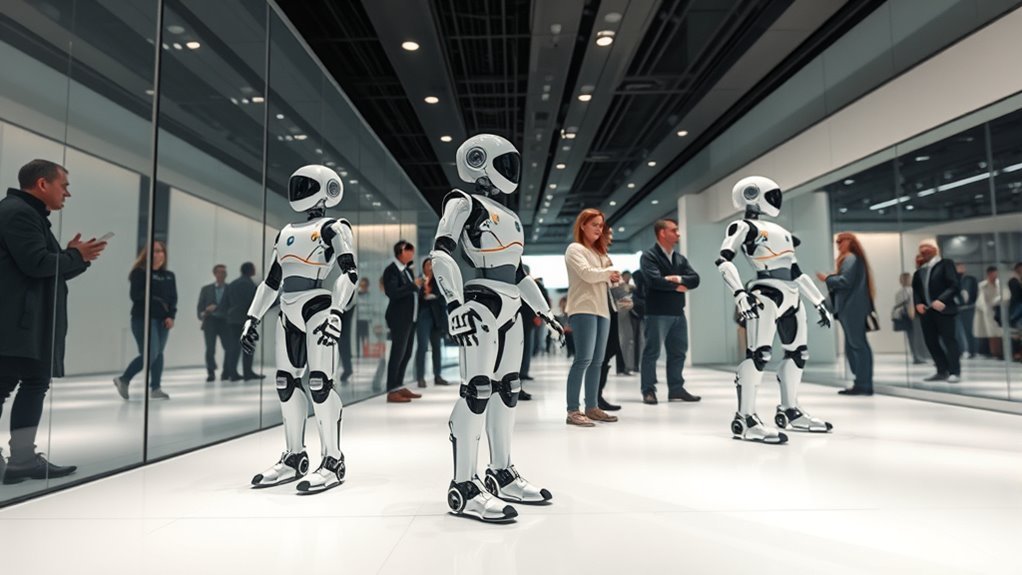
The specific retail concept used by Unitree and AgiBot relies heavily on live demonstrations and hands-on interaction to turn abstract specifications into intuitive experiences. At JD Mall Beijing Shuangjing, reports describe Go2 robot dogs and G1 humanoid robots navigating the open floor, maintaining balance, and responding to simple commands while shoppers gather to watch.
This shifts robots from carefully staged videos to unpredictable public space, a necessary test of robustness and safety before broader deployment in real-world environments.
An adjacent interactive zone lets visitors operate robot dogs under the guidance of professional engineers, effectively turning part of the store into a low-stakes training and evaluation environment. This matters because controlling a legged robot is non-trivial.
Experiencing gait, obstacle negotiation, and remote control latency in person builds realistic expectations about capabilities and limitations.
Unitree extends similar experiential setups to Wangfujing Intime in88, a historic commercial street that has long been associated with traditional retail and tourism. At this site, Unitree has opened its first directly operated store in China, occupying the first floor of the Yintai In88 mall and highlighting consumer-oriented robot dogs and humanoids. Introducing mobile robots there is both a branding move and a stress test, exposing the machines to dense foot traffic, diverse demographics, and a wide range of ambient conditions.
According to retail news, these outlets present humanoid robots performing sequences on elevated platforms, providing a quick visual summary of dexterity for shoppers who may have no prior exposure to advanced embodied intelligence.
Discovery to purchase as a single loop
A key part of the strategy is the integration of discovery, purchase, and after-sales support into one physical environment. At JD Mall Beijing Shuangjing, customers can reportedly complete transactions by scanning QR codes attached to each robot, which launches an official mobile mini program that handles configuration selection, payment, and order submission.
This mirrors established e-commerce flows but anchors them in physical interaction, bridging online convenience with in-person evaluation.
JD and Unitree have also introduced a self-operated rental service linked to the store network, allowing users to access quadruped robot dogs and humanoid platforms for daily or longer-term rental periods at lower upfront costs.
Renting robots reduces financial friction, encourages experimentation in domains such as education, events, and hospitality, and creates a path for organizations to pilot use cases before committing to full purchases. Historically, equipment rental has played an important role in the adoption of industrial robots, cameras, and specialized machinery, and the same pattern is now emerging for embodied AI.
Both Unitree and AgiBot frame these outlets as pilots for what they sometimes describe as full loop robot commerce. The goal is to make robots feel like tools that can be bought, configured, maintained, and upgraded through familiar retail processes rather than bespoke negotiations.
Over time, this could support broader distribution across homes, offices, and public venues as reliability improves and costs fall.
Pricing signals and market positioning
The price ranges offered in these stores send clear signals about where the early market is heading. Robot dogs at 10,000 to 20,000 yuan sit above mass-market consumer gadgets but within reach for affluent consumers, research labs, and schools that treat them as educational or experimental platforms.
Humanoid robots in the 80,000 to 180,000 yuan range remain firmly in the high-end category yet are now presented as shelf-ready items that can be quoted and ordered without custom negotiation.
Unitree’s G1, for example, is described in trade coverage as roughly 1.32 meters tall, weighing around 35 kilograms, and retailing near 99,000 yuan in some store configurations.
That combination of size, mass, and price makes it suitable for environments where human-scale interaction is useful but full industrial strength load handling is not required, such as research institutes, training centers, or indoor service environments.
From an economic standpoint, these price bands resemble early professional drone markets and high-performance mirrorless cameras. They hint at a future in which more capable robots follow similar curves, with cost declines driven by volume manufacturing, standardization of components, and better supply chains.
The presence of tiered offerings from roughly 9,000 yuan up to near 130,000 yuan across Unitree’s network reinforces the idea of a stratified product portfolio rather than a single flagship device.
Why this matters for technology and business
Placing humanoid and quadruped robots inside mainstream retail venues is more than a marketing stunt. It changes how engineers, product managers, and investors must think about embodied AI.
Technically, persistent live demos in crowded malls force rapid iteration on safety, robustness, and user-friendly interfaces. A robot that performs well in a lab but fails in a shopping center is visibly failing in front of potential buyers.
The pressures resemble the shift from demo-friendly AI models to systems that must handle messy real-world queries at scale.
For businesses, retail-accessible robots open up new categories. Security firms can consider patrol robots as part of their service mix. Logistics and warehousing operations can test robots for inventory checks or simple pick-and-place tasks.
Hospitality spaces can experiment with interactive guides or entertainers. The rental programs and consultation areas lower the barrier to exploring these possibilities.
This also affects the ecosystem around robotics. Integrators, software developers, and training providers can build on standardized platforms that are available off the shelf rather than bespoke prototypes.
Over time, this may lead to app-like ecosystems for robot behaviors, similar to how mobile platforms enabled third-party software businesses once hardware became stable and widely distributed.
Societal implications and risks
The societal implications are significant and not entirely comfortable. Seeing humanoid robots as purchasable products in everyday malls slowly resets public expectations.
The more often children watch robot dogs perform routines on a weekend outing, the more normal embodied AI becomes as part of everyday life. That normalization can help society prepare for future deployments in elder care, education, and public services.
At the same time, the move raises questions around safety, regulation, and labor. Legged robots navigating public spaces must be designed to avoid collisions and handle unpredictable behavior.
Humanoids operating in stores need clear operational boundaries and human supervision. Regulatory frameworks in most countries are still evolving for outdoor robot operations, privacy concerns related to onboard cameras, and accountability when autonomous systems make mistakes.
There is also a risk of hype and disappointment. If early retail robots are oversold as general-purpose helpers but in practice remain limited to simple routines, customers may lose trust.
Maintaining realistic communication about capabilities is crucial, especially when devices carry price tags comparable to cars or small business equipment. The presence of technical consultation areas in AgiBot and Unitree-related stores is a positive sign, as it encourages more thoughtful discussion of use cases rather than one-size-fits-all promises.
Finally, the labor dimension cannot be ignored. These robots are still far from replacing skilled workers at scale, but they may begin to augment or substitute in specific roles such as patrol, basic delivery, and repetitive demonstration tasks.
Businesses and policymakers will need to think ahead about retraining, human-robot collaboration frameworks, and ways to share productivity gains.
What to watch next
The Unitree and AgiBot retail pilots mark an inflection point in the commercialization of embodied intelligence. They show that humanoid and quadruped robots can be productized enough to sit on price tags in ordinary shopping districts, supported by integrated purchase and rental workflows.
Several questions will define what happens next.
First, will the economics work at scale? If manufacturing costs and maintenance burdens remain high, the market may stay confined to a small niche. If costs fall and reliability rises, robots could move downmarket over the next five to ten years, just as drones and high-end cameras did.
Second, will compelling use cases emerge beyond entertainment and simple demonstrations? The more these platforms prove themselves in security, logistics, and education, the stronger the business case becomes.
The availability of standard models like the Go2 and G1 in multiple stores makes experimentation more practical.
Third, how will regulation and public sentiment evolve? Comfortable exposure in controlled retail environments may ease adoption, but real acceptance will depend on transparent safety standards, clear rules, and evidence that robots complement rather than undermine human workers.
The current wave of Unitree and AgiBot retail stores is best understood as a bridge. On one side lies a world where humanoid robots are rare research devices. On the other side lies a future where embodied AI platforms are everyday tools.
Conclusion
Humanoid robots are quietly moving from research labs and tech conference stages into ordinary shopping malls in China, and that shift is more than a marketing stunt. Storefronts from Unitree and AgiBot put embodied intelligence in front of everyday shoppers, treating robots like consumer electronics rather than distant science projects. It is an early but important test of how people respond when robots are presented as normal retail products and potential companions rather than future promises.
From lab curiosities to mall neighbors
For most of the past decade, humanoid robots have been symbols of advanced research and national ambition, not items you could browse between a phone store and a fashion brand. Competitive focus revolved around laboratory benchmarks, such as walking stability, manipulation skills, and leaderboard rankings on standard tasks. Demonstrations happened at trade shows and tech expos, then disappeared back into engineering facilities.
Several milestones in China hinted that this laboratory phase was ending. In early 2025, Unitree put its H1 and G1 humanoid robots on sale through the ecommerce platform JD, and the initial batches sold out almost immediately. Around the same time, Beijing saw the launch of a Robot Mall that stocked more than one hundred robots from over forty Chinese brands, including humanoid models and consumer focused devices. That store offered sales, spare parts, maintenance, and consulting services in a format explicitly compared to an automobile dealership. These experiments demonstrated two things. There was enough public curiosity to drive early demand, and companies were already thinking about full life cycle service for robots, not just one time purchases.
The new Unitree and AgiBot storefronts extend that progression. They move from online presales and multi brand showrooms to branded retail spaces where humanoid robots are the main attraction.
What these stores look like
Unitree has begun opening company owned experience centers in prime commercial districts, including a location at Beijing Wangfujing Yinxin and a store within Jiuguang Department Store on Nanjing West Road in Shanghai. These are the kinds of places where shoppers normally encounter flagship smartphone stores and luxury fashion labels, so robots are now sharing floor space with mainstream consumer brands. In Hangzhou, Unitree operates a flagship store of roughly four hundred square meters in the Lakeside shopping district, positioned on the ground floor between high profile retail neighbors.
AgiBot has taken a similar step with a global first store at a JD Mall in Shanghai Minhang, again placing humanoid robots in a standard shopping center environment rather than a specialized tech park. Other leases for both companies are under discussion in cities such as Beijing, Shenzhen, and Chengdu, contingent on how the initial locations perform.
Inside these stores, robots are displayed and sold in a way that feels close to consumer electronics. Unitree locations showcase quadruped robot dogs starting around eight thousand yuan and humanoid robots that can reach roughly one hundred seventy thousand yuan. Detailed pricing at specific stores varies, but typical humanoid models are listed from about ninety thousand to one hundred eighty thousand yuan, roughly twelve thousand to twenty four thousand United States dollars. The Unitree G1 humanoid, for instance, stands about one point three two meters tall, weighs around thirty five kilograms, and retails near ninety nine thousand yuan in some stores.
Showrooms are designed for interaction as much as display. Demonstration units perform tasks on raised platforms, immersive zones invite customers to try control interfaces, and technical consultation areas allow potential buyers to discuss software integration and custom programming. Staff counts are closer to what you would see in a car dealer showroom than in a typical electronics store. Each location employs around eight to twelve people, including trained robotics engineers who can provide same day service appointments.
Importantly, these stores are not simply promotional exhibits. Employees can execute immediate sales, help customers scan codes to place orders via mini programs, arrange delivery, and schedule follow up support. That completes the loop from first contact to ownership and maintenance, which is essential if humanoid robots are to be treated as normal commercial products.
Why this is happening now
Several forces are converging to make physical retail for humanoid robots feasible.
First, hardware and manufacturing have progressed to the point where companies can produce small batches of reasonably capable robots at prices that, while still high, are within reach for businesses and affluent early adopters. Unitree has built a portfolio from quadruped robot dogs to more advanced humanoids, and its ability to sell models like the H1 and G1 through mainstream ecommerce platforms shows that production and logistics are no longer purely experimental. AgiBot follows a similar path, focusing on embodied intelligence platforms with modular configurations.
Second, prior experiments with multi brand robot stores revealed that shoppers are willing to visit and engage with robots as a retail category. The Beijing Robot Mall, with more than one hundred robots and four service functions similar to an automobile dealer, demonstrated that a physical environment dedicated to robots can attract visitors and media coverage. That experience likely lowered the perceived risk of creating branded stores focused on single manufacturers.
Third, consumer familiarity with AI systems has increased. People already interact with virtual assistants, recommendation engines, and generative AI tools on their phones and laptops. The move from software agents to physical robots represents a change in form more than a complete break in concept. When shoppers can watch a humanoid robot walk across a showroom, pick up objects, or respond to spoken instructions, they see a tangible extension of intelligence they already use in digital form.
Finally, the strategic context matters. China has made leadership in AI and robotics a clear priority, and the presence of robot stores with dozens of domestic brands aligns with that ambition. Retail storefronts serve as visible markers of progress for policymakers, investors, and the public.
Business model experiments
Underneath the polished floors, these stores are experiments in how humanoid robots might be sold and supported.
Two distinct retail models are emerging. One is brand direct. Unitree is leading that approach by placing company owned stores in luxury and high traffic malls, controlling every aspect of the customer experience from demonstration to purchase to after sales service. Prices in these stores span a wide range, with quadrupeds in the low five figure yuan segment and humanoids in the mid to high five figure range. This strategy resembles consumer electronics specialists, where the manufacturer invests heavily in physical presence to shape brand perception and gather real world feedback.
The other model is multi brand aggregation. Robot Mall in Beijing and similar locations stock machines from many manufacturers, offering what amounts to a category showroom. Customers can compare different robots side by side, discuss use cases with staff, and select models based on budget and capability rather than brand loyalty alone.
Early sales figures suggest that transactions remain modest. Reporting from initial Unitree and AgiBot locations points to single digit daily sales of humanoid robots, a volume that is commercially small but meaningful for learning. For businesses at this stage, the stores function as live laboratories to test pricing, support requirements, and real customer behavior. The financial calculus likely assumes that insight gained now will inform future models and channels.
At the same time, both companies are working to build service infrastructures that resemble those around cars or industrial equipment. The inclusion of robotics engineers in store staff, the offer of same day service, and the availability of spare parts and integration advice are signals that they know hardware alone is not enough. Buyers need confidence that these machines can be maintained and upgraded over time.
What it means for society
From a societal perspective, the most important effect of these storefronts is normalization. When a humanoid robot stands between a phone retailer and a clothing boutique, it sends a subtle message that robots belong in everyday spaces. Shoppers can watch children wave at them, see adults ask staff about practical uses, and notice robots performing tasks that look incremental rather than spectacular.
This pattern mirrors earlier technology waves. In the early days of personal computers and smartphones, specialized stores served as transition points between niche computing communities and mass market adoption. People went in to satisfy curiosity and left with a clearer understanding of what the devices could and could not do. Robot stores seem poised to play a similar role.
The potential benefits are considerable. For small businesses, humanoid robots could eventually handle repetitive tasks in warehouses, retail settings, and light manufacturing. For education, classroom visits to robot stores offer a tangible way to teach robotics and AI, especially in countries pushing STEM skills. For elderly care and companionship, companies such as UBTECH are already positioning humanoid robots as social partners that can remember conversations and provide a sense of presence at home. The presale of the UBTECH U1 humanoid on JD, with deposit structures and adult focused positioning, illustrates how companionship oriented robots are entering the consumer narrative.
Yet serious challenges remain. The high purchase price and ongoing maintenance costs restrict access to a narrow band of customers. That raises equity questions about who benefits from embodied AI in the near term. Reliability is another concern. Robots that operate in uncontrolled public environments need to handle unexpected interactions, hardware wear, and software updates without failure that could cause injury or legal exposure.
Privacy and data governance also matter. Humanoid robots with cameras, microphones, and network connectivity will capture rich information about homes, workplaces, and public spaces. If these devices become common, questions about data ownership, surveillance, and consent will sharpen. Retail stores create the opportunity to explain these issues clearly, but they also create pressure to sell.
Culturally, everyday exposure to humanoids may change how people think about work and relationships. Some will see robots as helpful tools or fascinating machines. Others will worry about replacement of human jobs or erosion of face to face interaction. Societal acceptance will depend on whether these robots are seen as augmenting human capabilities or undermining them.
Global context and comparison
China is currently at the forefront of making humanoid robots visible in ordinary retail settings. The Beijing Robot Mall, with more than forty domestic brands and over one hundred robots on display, is among the first stores globally to treat humanoids as a consumer category rather than a niche industrial product. Unitree and AgiBot stores deepen that presence by focusing on single manufacturers and higher end models in prime commercial districts.
Other countries have robotics showrooms and demo spaces, but dedicated humanoid robot stores aimed at walk in consumers are still rare. That gives Chinese companies a chance to shape early expectations about what humanoid robots look like, how they are sold, and what support structures accompany them. It also means that the rest of the world is watching these experiments closely to see which approaches succeed.
Takeaways and what to watch next
Unitree and AgiBot storefronts mark a quiet turning point. Humanoid robots are shifting from lab curiosities to items that people can encounter, evaluate, and purchase in busy shopping districts. Whether sales volumes grow fast or stay modest, these stores operate as experiments in normalization, testing how readily society accepts robots as commercial goods and everyday companions.
Several signals will be worth tracking over the next few years.
- Sales velocity and customer profiles. Single digit daily transactions provide learning data today, but sustained adoption will require broader business and consumer uptake. Understanding who buys these robots and why will reveal real demand.
- Service and reliability records. The presence of robotics engineers and same day service is encouraging, yet long term performance in real environments will determine trust.
- Regulatory and ethical frameworks. As humanoid robots capture data and perform tasks in public and private spaces, rules around safety, privacy, and accountability will need to evolve.
- Product evolution driven by retail feedback. Direct contact with customers will likely shape future generations of robots, from ergonomics and interface design to pricing and business models.
In that sense, these early storefronts are less about immediate revenue and more about learning. They foreshadow a future in which robots become domestic and commercial fixtures, and they give society a chance to negotiate that future in a familiar setting: the mall aisle between everyday products and the next generation of machines.