AI Is Quietly Becoming the Most Important Tool in Ecology, and Almost Nobody in Tech Is Talking About It
While the AI industry obsesses over chatbots, code generation, and image synthesis, a less glamorous but arguably more consequential application has been accelerating in the background. Artificial intelligence is fundamentally reshaping how scientists understand ecosystems, track biodiversity, predict disease outbreaks, and monitor the health of the planet itself. The implications stretch far beyond academic research. They reach into public health, agriculture, insurance, defense, and the multi-trillion dollar global economy that depends on functioning natural systems.
AI’s ecological revolution may matter more than chatbots — reshaping how we monitor biodiversity, predict outbreaks, and safeguard natural systems.
What makes this moment different from earlier computational ecology efforts is scale and accessibility. The convergence of cheap remote sensing hardware, massive open ecological datasets, and increasingly capable machine learning frameworks has created conditions where AI can now surface connections in natural systems that decades of fieldwork and statistical modeling never revealed. And the pace is picking up fast.
Why Ecology Became an AI Problem
Ecosystems are, by nature, high-dimensional. A single forest contains thousands of interacting species, each responding to soil chemistry, weather patterns, neighboring organisms, pathogens, and human activity simultaneously. Traditional ecological methods handled this complexity through reductionism. Researchers studied one species, one interaction, one variable at a time. The approach worked well enough to build foundational knowledge, but it systematically missed the emergent behavior that arises when thousands of variables interact.
Machine learning thrives in exactly this kind of environment. Neural networks and ensemble methods excel at identifying nonlinear relationships in noisy, high-dimensional data. The same properties that make large language models effective at predicting the next token in a sentence turn out to be remarkably useful for predicting which species will move where as temperatures shift, or which animal populations are most likely to harbor the next zoonotic pathogen.
Some researchers have started comparing AI’s potential impact on ecology to the revolution that formal statistics brought to the biological sciences in the twentieth century. That comparison deserves scrutiny. Statistics gave ecologists a shared language for quantifying uncertainty and testing hypotheses. AI is doing something different. It is generating hypotheses. It is identifying patterns that no human researcher would think to look for, because no human can hold thousands of interacting variables in their head simultaneously.
The Disease Connection Nobody Should Ignore
Perhaps the most immediately consequential application involves emerging infectious diseases. COVID reminded the world, painfully, that ecological disruption and human health are not separate domains. AI systems analyzing ecological networks can now identify potential reservoir species and map probable transmission pathways for pathogens before outbreaks occur.
This matters for the tech industry and investors specifically because pandemic preparedness is becoming a major government spending priority worldwide. The organizations building AI tools that connect ecological surveillance to public health early warning systems are positioning themselves at the intersection of two enormous funding streams: climate adaptation and biosecurity. Companies like Planet Labs, which provide satellite imagery, and conservation tech startups building acoustic monitoring networks, stand to benefit as these AI pipelines mature.
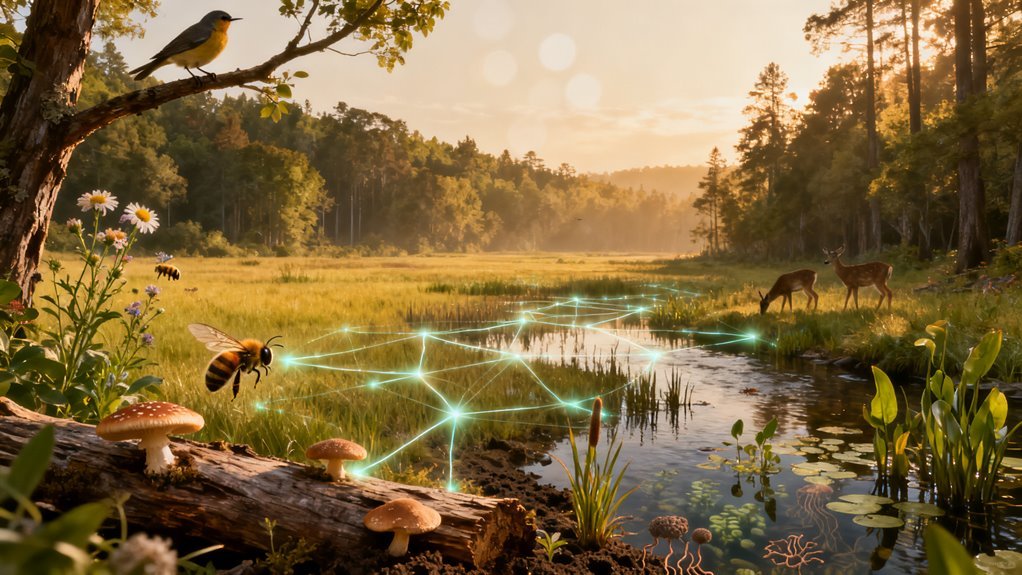
The nested relationships that AI is uncovering across species, biomes, and microbiomes also reframe how we think about disease ecology. An ecosystem is not a backdrop against which pathogens happen to exist. It is the machinery that governs pathogen evolution, transmission, and spillover. AI makes this machinery visible in ways that were previously impossible, and that visibility has direct policy implications for land use decisions, wildlife trade regulation, and agricultural practices.
Democratization of Ecosystem Modeling
One of the more underappreciated shifts underway involves who gets to build ecological models. Historically, ecosystem modeling required deep expertise in differential equations, Bayesian statistics, and domain-specific ecological knowledge. The barrier to entry was enormous. A handful of well-funded research groups at major universities dominated the field.
Generative AI and automated pipeline tools are changing that equation. New platforms allow researchers with moderate technical skills to construct, calibrate, and deploy ecosystem models using natural language interfaces and automated model selection. Think of it as the ecological equivalent of what no-code platforms did for software development, or what Midjourney did for image creation.
The models are not toys. They integrate multiple data streams including satellite imagery, climate records, species occurrence databases, and sensor networks to produce predictions at scales that would have required a full research team just five years ago.
This democratization creates both opportunity and risk. More modelers means more hypotheses tested, more local knowledge incorporated, and faster iteration. But it also means more poorly validated models circulating, more overconfident predictions, and greater potential for AI-generated ecological assessments to influence policy without adequate scrutiny. The guiding principles emerging from the research community emphasize human oversight, transparency, modeling diversity, and ethical integration. Whether those principles will hold as the tools become more accessible remains an open question.
Remote Sensing and the Real-Time Earth
The combination of AI with remote sensing data has effectively created a near-real-time monitoring system for planetary health. Machine learning models processing satellite and drone imagery can now quantify land cover changes, vegetation productivity shifts, and ecosystem boundary movements with a precision and temporal resolution that manual analysis never approached.
For context, the European Space Agency’s Copernicus program alone generates petabytes of Earth observation data annually. Without AI, most of that data would sit in archives, too voluminous for human analysts to process meaningfully. With AI, it becomes a continuous diagnostic tool for the planet’s surface.
Species distribution tracking has reached a similar inflection point. AI models trained on occurrence records, environmental variables, and climate projections can detect range shifts linked to warming temperatures or habitat loss almost as they happen. Early detection matters enormously because conservation interventions are far more effective and far cheaper when they begin before a population crosses critical thresholds.
This capability intersects with the growing corporate interest in natural capital accounting and biodiversity credits. As regulatory frameworks like the EU’s Corporate Sustainability Reporting Directive and the Taskforce on Nature-related Financial Disclosures gain traction, companies will need verified, data-driven assessments of their ecological impacts. AI-powered monitoring is likely to become the backbone of that verification infrastructure. The market opportunity here is substantial, and it is still largely untapped by mainstream tech companies.
Behavioral Ecology Gets Granular
At the other end of the scale spectrum, deep learning and pose estimation techniques are transforming how scientists study individual animal behavior. Systems originally developed for human motion capture and sports analytics are being repurposed to track animal movement, social interactions, and habitat use from camera trap and video data.
Tools like DeepLabCut, which uses transfer learning to track animal body parts without markers, have already become standard in laboratory settings. The frontier now is deploying similar capabilities in the wild, processing camera trap networks and acoustic sensors to build continuous behavioral profiles of wildlife populations across entire landscapes.
The practical value extends beyond pure science. Understanding how animals use habitat, where they move, and how their behavior changes in response to disturbance is essential for designing effective wildlife corridors, managing human-wildlife conflict, and predicting how populations will respond to infrastructure development.
For developers and startups, the combination of edge computing, low-power sensors, and lightweight ML models creates a growing market for purpose-built ecological monitoring hardware and software.
What the Tech Industry Is Missing
Despite all this progress, ecological AI remains a backwater in terms of venture funding and mainstream tech attention. Compare the billions flowing into AI chatbots and enterprise automation with the relatively modest investment in ecological intelligence, and the disparity is striking.
This gap exists partly because ecology lacks the obvious, near-term revenue models that enterprise software offers. But it also reflects a persistent blind spot in how the tech industry values intelligence about natural systems.
That blind spot is becoming increasingly expensive. The economic costs of biodiversity loss, ecosystem degradation, and climate-driven ecological disruption are measured in trillions of dollars annually by organizations like the World Economic Forum. Insurance companies, agricultural conglomerates, and sovereign wealth funds are starting to price these risks into their portfolios. The organizations that can provide reliable, AI-driven ecological intelligence at scale will occupy a strategically important position in the emerging green economy. Collaborative ecosystems that bring together startups, research centers, and enterprises to co-design shared AI models could accelerate the development of these ecological intelligence platforms far more effectively than any single organization working in isolation.
There is also a competitive dimension. China has invested heavily in ecological monitoring AI as part of its broader environmental surveillance infrastructure. The European Union is embedding ecological data requirements into its regulatory frameworks. The United States, despite its dominant position in AI research, has been slower to connect its AI capabilities to ecological applications at a national scale. This could become a meaningful gap in the years ahead.
What Comes Next
The trajectory points toward ecological AI becoming infrastructure rather than novelty. Within the next three to five years, expect to see AI-driven ecological assessments embedded in environmental impact reviews, corporate sustainability reporting, insurance underwriting, and public health surveillance as standard practice rather than experimental additions.
The biggest remaining challenge is not technical. It is institutional. Ecological datasets are fragmented across government agencies, research institutions, NGOs, and private companies. Standards for data sharing, model validation, and uncertainty communication are still immature.
The AI tools are increasingly capable, but the data governance frameworks needed to deploy them responsibly at scale lag behind.
For technology professionals watching this space, the opportunity is clear but requires patience. Ecological AI will not produce the overnight returns of consumer AI applications. What it will produce is durable value tied to some of the most consequential challenges facing civilization.
The connections AI is revealing within ecosystems are not abstract scientific curiosities. They are the operating manual for a planet under stress, and reading that manual correctly may turn out to be the most important thing artificial intelligence ever does.