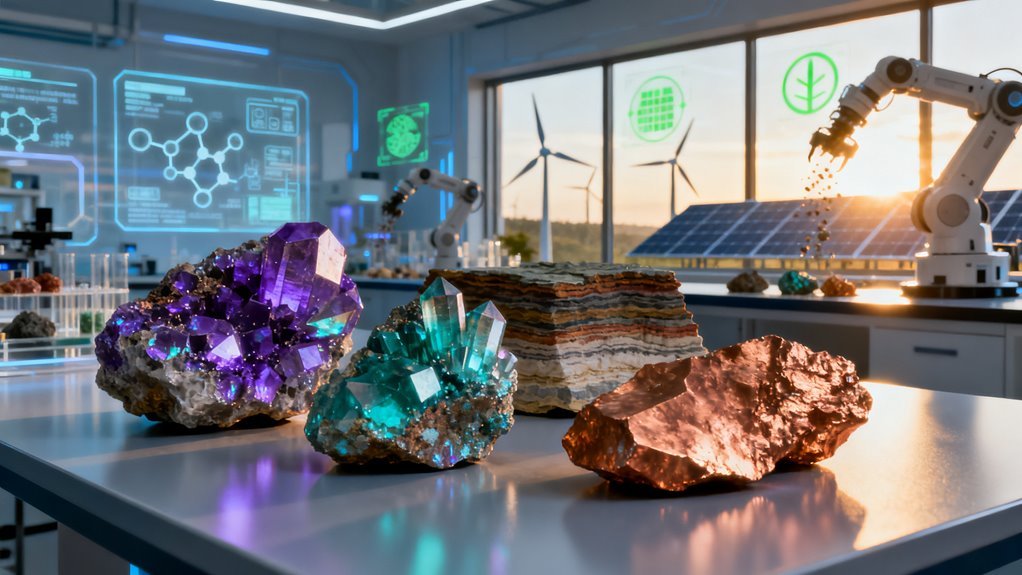
The clean energy transition has a supply problem that rarely gets the attention it deserves. For all the political focus on solar panels, wind farms, and electric vehicles, the entire buildout depends on a handful of minerals that are geographically concentrated, environmentally costly to extract, and increasingly subject to geopolitical leverage.
Neodymium and praseodymium sit inside the permanent magnets that make wind turbines and EV motors viable. Lithium, cobalt, nickel, manganese, and graphite form the electrochemical core of every battery powering vehicles and grid storage. Iridium and platinum are essential to the hydrogen economy. Gallium enables efficient LEDs and advanced power electronics across renewable systems.
None of this is news to anyone tracking the energy transition. What is genuinely new is that artificial intelligence is beginning to reshape the entire pipeline from discovery to processing, and the early results are concrete enough to take seriously.
Why the Mineral Bottleneck Matters More Than Most People Realize
Western governments have spent the past three years scrambling to reduce dependence on Chinese rare earth processing, which still handles roughly 60% of global mining output and closer to 90% of refined rare earth materials.
The Inflation Reduction Act, the European Critical Raw Materials Act, and similar policy frameworks in Canada, Australia, and Japan all reflect the same anxiety. But policy alone does not put minerals in the ground, and traditional geological exploration is expensive, slow, and hit or miss.
This is where the timing of AI’s maturation becomes relevant. The convergence of large scale machine learning with decades of accumulated geological data creates an opportunity that simply did not exist five years ago.
Legacy datasets from government surveys, academic research, and commercial exploration programs represent enormous volumes of information that were never designed to be analyzed together. AI systems can now synthesize these fragmented records alongside satellite imagery, geochemical assays, and real time sensor data to identify mineral targets that human geologists and conventional methods would overlook entirely. This approach exemplifies the shift from conversational AI to integral workflows in scientific research.
The pattern recognition capabilities involved here are not speculative. They follow the same logic that has made AI effective in drug discovery and materials science: train models on known examples of what you are looking for, then let them search through vast datasets for signatures that match.
A Case Study That Goes Beyond the Press Release
The partnership between US Critical Materials and VerAI Discoveries at the Sheep Creek rare earth properties in Montana offers a useful window into what AI driven exploration actually looks like in practice.
VerAI’s technology is designed to identify mineralized zones beneath covered terrain, a scenario where traditional surface sampling and geological mapping simply cannot reach.
The numbers are worth examining closely. AI guided targeting at Sheep Creek has flagged zones with total rare earth element concentrations reaching 20.1% and neodymium plus praseodymium grades up to 3.3%. Those are not modest readings.
For context, many operating rare earth mines globally work with total rare earth oxide grades between 1% and 5%. A 20% reading, if confirmed through drilling and assay work, would represent an exceptionally rich deposit by any standard.
Perhaps more interesting is the gallium story. Concentrations at Sheep Creek have registered as high as 348 parts per million, roughly seven times the threshold generally considered economically viable for extraction.
Gallium has received less public attention than lithium or cobalt, but it is critical to power electronics, LEDs, and certain semiconductor applications. China currently dominates gallium production and has already used export restrictions as a trade weapon. Domestic gallium sources of this quality would carry strategic significance well beyond the energy sector.
There is a subtler advantage at play here as well. Deposits containing multiple valuable minerals simultaneously change the economics of development fundamentally.
A site yielding both rare earths and gallium from the same ore body requires less infrastructure, fewer permits, and a smaller environmental footprint than developing separate deposits for each. AI’s ability to detect colocation patterns among different minerals within known geological formations is what makes multi-element targeting possible at this level of precision.
It is also worth noting that VerAI’s approach explicitly prioritizes minimizing surface disturbance during exploration. This is not just good optics.
Permitting timelines for new mining operations in the United States routinely stretch beyond a decade, and environmental objections are one of the primary causes of delay. An exploration methodology that demonstrably reduces surface impact could accelerate the regulatory path from discovery to production, which is ultimately what matters for supply chain timelines.
From Finding Minerals to Actually Processing Them
Discovery is only the first problem. The rare earth supply chain has a processing bottleneck that is arguably more severe than the exploration gap.
Separating individual rare earth elements from ore is a chemically complex, energy intensive process that generates significant waste streams. China invested decades and absorbed substantial environmental costs building the infrastructure and expertise to dominate this step.
Replicating that capacity elsewhere is not a simple matter of building new facilities.
AI is beginning to address this challenge on multiple fronts. Upstream research is exploring the recovery of critical minerals from coal mine waste streams, a particularly clever approach because it leverages existing industrial sites and waste material rather than requiring new mining operations.
The United States has enormous volumes of coal waste containing meaningful concentrations of rare earths. If AI driven processing can make extraction from these sources economically viable, it would create a domestic supply channel with relatively low additional environmental impact and significantly faster permitting pathways.
Midstream, machine learning models are being applied to optimize separation and purification processes for complex feedstocks containing multiple elements.
The challenge here is that every ore body has a different chemical profile, and processing parameters that work for one deposit may fail entirely for another. AI models trained on evolving processing technologies can propose optimized configurations and processing routes tailored to specific feedstock characteristics, market conditions, and transportation logistics.
This mirrors what we have seen AI accomplish in manufacturing optimization and chemical process engineering more broadly. The difference is that the stakes in critical mineral processing are tied directly to national security and climate goals, which creates both urgency and funding that pure commercial optimization rarely enjoys.
What the Big Tech Players Are Missing
It is striking how disconnected the AI industry’s own mineral dependency is from its investment priorities.
NVIDIA, Microsoft, Google, and Amazon are collectively spending hundreds of billions on data center infrastructure, all of which requires rare earth magnets, gallium based semiconductors, and the same battery materials needed for grid storage. Yet none of these companies has made significant public investments in AI driven mineral exploration, despite the fact that their own supply chains are vulnerable to exactly the same bottlenecks threatening the energy transition.
This gap represents both a risk and an opportunity. The risk is that hyperscaler demand for data center components competes directly with clean energy deployment for the same constrained mineral supply.
The opportunity is that companies like VerAI and the research groups working on AI driven processing could become strategically important far beyond the mining sector. If the major AI companies eventually recognize their own exposure to critical mineral supply, the startups and research programs building AI exploration and processing capabilities today could find themselves in a very strong negotiating position.
Regulatory and Geopolitical Dimensions
The geopolitical implications here deserve direct attention. China’s dominance in rare earth processing has already been weaponized through export controls on gallium and germanium, and Beijing has signaled willingness to escalate restrictions further.
Every month that Western nations remain dependent on Chinese processing capacity is a month of strategic vulnerability.
AI driven exploration and processing do not eliminate this vulnerability overnight. Even the most promising discoveries require years of development before producing commercially relevant volumes.
But they do compress timelines in meaningful ways. Traditional exploration campaigns can take a decade or more from initial survey to deposit confirmation. AI targeting can narrow the search space dramatically, reducing both the cost and duration of the exploration phase.
Regulatory frameworks have not yet caught up to the pace of AI driven mineral discovery. Environmental review processes in the United States and Europe were designed around traditional exploration methodologies.
There is no established framework for evaluating AI guided subsurface targeting, which raises questions about how quickly regulatory bodies can adapt. Streamlining permitting for AI discovered deposits, particularly those identified using methods that reduce surface disturbance, could become a significant policy lever for governments serious about building domestic mineral supply chains.
What Comes Next
The trajectory here points toward a future where AI does not just assist mineral exploration but fundamentally redefines how supply chains for critical materials are designed.
The combination of better discovery, optimized processing, and intelligent logistics planning creates the potential for vertically integrated, AI managed mineral supply chains purpose built for the clean energy transition.
Whether that potential is realized depends on several factors. Funding for AI mineral startups needs to move beyond early stage exploration into sustained investment in processing technology and infrastructure.
Government policy needs to accelerate permitting for responsibly discovered deposits. And the AI industry itself needs to recognize that its own growth is tied to the same mineral constraints it is uniquely positioned to solve.
The results from Sheep Creek and similar projects are still early. Drill results need to confirm what AI models have predicted. Processing economics need to be validated at scale. It is worth remembering that all current AI systems, including those driving mineral exploration, still fall under the category of artificial narrow intelligence, designed for specific complex tasks rather than possessing broad, human-level understanding.
But the direction is clear, and the early data is genuinely impressive. In a world where the clean energy transition and the AI revolution are competing for the same finite mineral resources, AI driven mineral discovery is not just a nice efficiency gain. It is becoming a strategic necessity.