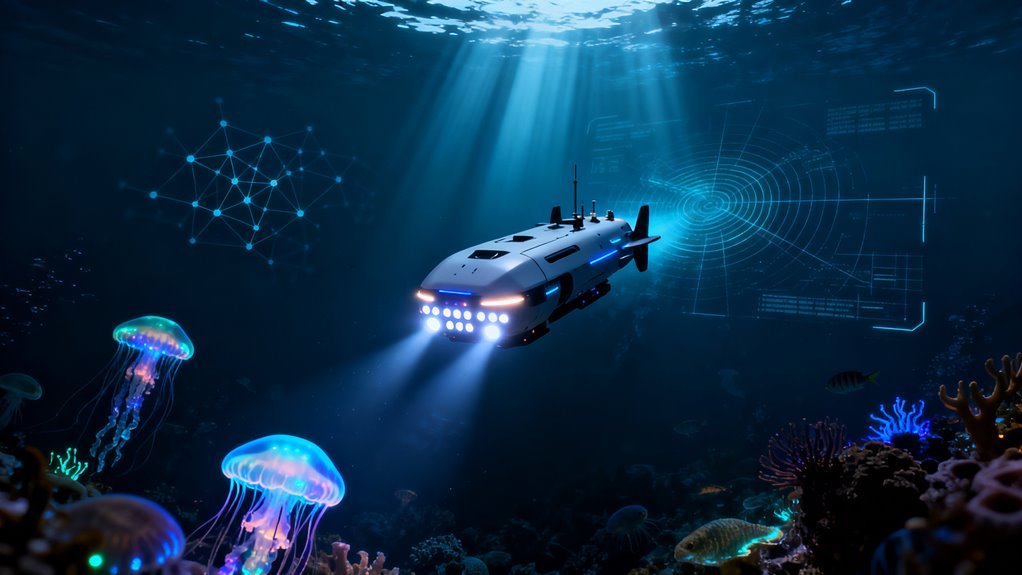

We have better maps of Mars than we do of our own ocean floor. That fact has been repeated so often it risks becoming background noise, but the underlying reality remains striking: more than 80 percent of the deep ocean has never been mapped at high resolution, and the biological communities living there are even less understood.
What is changing, and changing quickly, is that a convergence of autonomous robotics, onboard edge computing, and increasingly capable machine learning models is compressing decades of expected exploration timelines into years. The deep sea is becoming legible in ways that carry real consequences for climate science, mineral extraction policy, biodiversity protection, and the broader trajectory of AI itself.
Autonomous robots and AI are compressing decades of deep sea exploration into years — with consequences we’re only beginning to grasp.
Why the Deep Ocean Became an AI Problem
Traditional deep sea research has always been constrained by three bottlenecks: getting there, staying there, and making sense of what you find. Crewed submersibles can only dive for hours at a time. Remotely operated vehicles require a surface ship and a tether.
Every expedition generates terabytes of imagery and sensor data that research teams historically annotated frame by frame, sometimes taking years to process a single cruise’s footage.
AI addresses all three bottlenecks simultaneously, which is why progress has accelerated so sharply. Autonomous underwater vehicles now carry compact onboard processors running real-time inference models that can detect, classify, and track organisms in the water column and on the seafloor without waiting for a human operator to intervene. Recent findings suggest that water’s dual structure may also influence the behavior of marine organisms.
That shift from “collect now, analyze later” to “analyze on the fly” is not incremental. It changes the fundamental economics of ocean science. A vehicle that can decide where to look next based on what it just found can accomplish in one deployment what previously required multiple expensive expeditions.
The practical upshot is that uncrewed platforms can now remain submerged for months or even years, surveying continuously. Risk to human life drops. Cost per square kilometer of mapped seafloor drops.
And the data pipeline, once the slowest link in the chain, is starting to keep pace with collection for the first time.
From Raw Pixels to the Largest 3D Seafloor Model Ever Built
The scale of what is already possible deserves attention. At Hydrate Ridge, off the coast of Oregon, AI-equipped robots captured roughly 1.3 million high-resolution images and stitched them into what is currently the largest known high-resolution color 3D model of the seafloor.
That is not an incremental improvement over previous bathymetric surveys. It is a different category of data product, one that lets researchers study geological and biological features at centimeter scale across a broad area.
Convolutional neural networks are doing the heavy lifting for classification tasks that once consumed enormous human labor. Distinguishing rock from sediment from coral in sonar returns, for example, is exactly the kind of pattern recognition problem where deep learning excels.
Automated classification is not just faster than manual annotation. It is more consistent, which matters enormously when you are trying to track environmental change over time and need comparable measurements across years and locations.
The parallel to what happened in satellite Earth observation over the past decade is instructive. Once AI pipelines could process satellite imagery at scale, entirely new industries emerged around agricultural monitoring, supply chain tracking, and climate risk assessment.
The deep ocean is following a similar curve, just later and with harder logistics.
FathomNet, Ocean Vision AI, and the Infrastructure Layer
Raw capability means little without shared infrastructure, and several initiatives are building the connective tissue that will determine how broadly these advances diffuse beyond a handful of elite research groups.
FathomNet operates as an open-source image database purpose-built for marine species recognition. Think of it as an ImageNet for the deep sea.
By aggregating and labeling undersea imagery at scale, it provides the training data foundation that any research team or company can build on. The strategic importance of this kind of shared dataset cannot be overstated.
In terrestrial computer vision, the availability of large labeled datasets was the single biggest accelerant of progress. FathomNet is playing the same role for ocean AI. AI algorithms trained on FathomNet data have reduced human effort by 81% in video annotation, demonstrating the concrete gains that shared infrastructure can deliver.
The Ocean Vision AI program, backed by approximately five million dollars from the National Science Foundation, is tackling the next layer up: applying machine learning to speed the processing of ocean video and imagery and making the results accessible for conservation and stewardship.
Five million dollars is modest by AI industry standards, but government-funded infrastructure projects often punch above their weight because they create public goods that private investment alone would not produce.
Systems like Fathom push further into automated analysis, scanning long video records to identify species, flag unusual behavior, and count populations without human review.
For context, a single deep sea camera deployment can generate thousands of hours of footage. Manual review of that volume is not slow. It is effectively impossible at the pace new data is arriving.
Automated pipelines are not a convenience here. They are a prerequisite for the science to function at all.
Multimodal Models Enter the Deep
Perhaps the most technically ambitious development is DePTH GPT, a large-scale AI model designed specifically for deep sea environments.
What sets it apart is its multimodal approach: it ingests bioacoustic data, video, topographic surveys, hydrodynamic measurements, and sediment composition data to build integrated characterizations of habitats like seamounts and hydrothermal vent fields.
This mirrors a broader trend across AI where the most capable systems are moving beyond single data modalities. Just as frontier language models are absorbing text, images, audio, and video, ocean AI is combining every available sensor stream into unified representations.
The reasoning is the same in both cases. Real-world understanding requires synthesizing information from multiple sources, and models that can do so discover patterns invisible to any single sensor.
DePTH GPT’s combination of computer vision with knowledge reasoning to analyze imagery from diverse habitats is notable because it suggests the model is not merely classifying what it sees but building something closer to a cognitive map of the environment.
If that approach matures, it could enable autonomous vehicles to make far more sophisticated decisions about where to explore, what to sample, and when to flag anomalies for human review.
The Strategic and Commercial Stakes
It would be naive to discuss deep ocean AI purely through the lens of scientific curiosity. Enormous commercial and geopolitical interests are converging on the deep sea.
Deep sea mining is the most obvious flashpoint. The Clarion Clipperton Zone in the Pacific alone contains trillions of dollars worth of polymetallic nodules rich in cobalt, nickel, manganese, and rare earth elements critical to battery manufacturing and electronics.
Before extraction can proceed responsibly, or before regulators can credibly block it, someone needs a detailed understanding of what lives on and around those deposits. AI-powered surveys are the only realistic way to generate environmental baselines at the necessary scale and resolution before mining interests move forward.
Pharmaceutical bioprospecting is another area where deep sea AI could reshape the playing field. Organisms living in extreme conditions near hydrothermal vents and cold seeps produce novel biochemical compounds.
The ability to detect and catalog these organisms efficiently creates commercial optionality that did not previously exist.
Carbon sequestration research also depends on understanding deep ocean processes. The biological carbon pump, the mechanism by which marine organisms transport carbon from the surface to the deep ocean, is one of the least constrained variables in climate models.
Better observational data from AI-driven platforms could meaningfully improve climate projections.
Governments are paying attention. The United Nations Decade of Ocean Science for Sustainable Development runs through 2030, and multiple national programs are investing in autonomous ocean observation.
Countries that develop leading capabilities in deep sea AI will have significant advantages in shaping the rules around deep sea resource extraction and conservation.
What People Are Overlooking
Three things deserve more scrutiny than they are currently receiving.
First, the energy and navigation challenge. AI systems under development that allow remotely operated vehicles to exploit ocean currents for navigation rather than relying entirely on onboard propulsion could be transformative.
Energy is the binding constraint on mission duration for autonomous underwater vehicles. If current riding works reliably, it extends operational envelopes dramatically and changes the calculus on what missions are feasible.
Second, the data governance question. As open-source databases like FathomNet grow, questions about who controls deep sea biological data, who can access it, and under what terms will become contentious.
The precedent set by genomic databases and satellite imagery markets suggests these issues are easier to address early than after entrenched interests form.
Third, the risk of premature confidence. Machine learning models trained on limited deep sea datasets will inevitably make classification errors, and the consequences of those errors in regulatory contexts could be significant.
If an AI system underestimates biodiversity in a proposed mining zone because its training data did not include sufficient examples of cryptic species, the environmental cost could be irreversible. Validation and uncertainty quantification will need to keep pace with deployment.
What Comes Next
The trajectory is clear even if the timeline is not. Within the next three to five years, expect persistent autonomous observation networks in key deep sea regions, generating continuous data streams analogous to what weather satellites provide for the atmosphere.
Expect multimodal foundation models for ocean environments to improve rapidly as training data accumulates. Expect commercial players, particularly in mining and energy, to become major funders and users of deep sea AI.
The deeper question is whether the scientific and regulatory apparatus can absorb and act on the flood of new information fast enough.
AI is solving the observation problem. The governance problem is another matter entirely. The gap between what we can now see in the deep ocean and what we are prepared to do about it is likely to become one of the defining tensions in ocean policy over the coming decade.
For the AI industry more broadly, the deep ocean represents something valuable: a domain where the technology is not competing with existing human capability but enabling something genuinely new.
That is increasingly rare in a landscape dominated by chatbot wars and productivity tool comparisons. The organizations building ocean AI infrastructure today are positioned at the intersection of scientific discovery, environmental regulation, and resource economics.
That intersection is where some of the most consequential applications of artificial intelligence will play out.




1 comment
Comments are closed.