
Most of the conversation around AI and music focuses on what comes next: text prompts that spit out pop tracks, soundtracks composed at silicon speed, endless synthetic playlists. The quieter story is that the same technologies are now reaching backward, into centuries and even millennia of silence, and turning archaeological fragments into something closer to living musical traditions. That shift matters because it shows AI evolving from a tool that floods the world with new content into an instrument for recovering and interrogating the cultural past.
What is emerging is a new kind of musicology that treats ancient music not as a handful of heroic reconstructions, but as a large-scale data problem. Visual models trained on modern scores are being adapted to read damaged manuscripts, clay tablets, and carved instruments. Convolutional and transformer architectures that once powered optical music recognition of printed notation are now tasked with far messier input. They learn to spot staves, clefs, neumes, and mensural note shapes on crumbling parchment, and just as importantly, to distinguish meaningful marks from stains and tears. In projects such as REPERTORIUM, that kind of pipeline has already produced hundreds of thousands of indexed medieval chants from previously opaque archives. The payoff is not only speed. Once manuscripts become machine-readable, they are no longer isolated curiosities. They become corpora, enabling a coalition for health AI to analyze vast datasets in innovative ways. Furthermore, the emergence of AI governance frameworks will play a critical role in ensuring the responsible use of these technologies in cultural heritage projects.
For historians, that scale changes the questions you can ask. Instead of debating the meaning of a single damaged line of chant, you can map how a particular cadence spreads geographically, how a melodic formula shifts as it crosses linguistic boundaries, or how a mode falls out of fashion over a century. Neural networks that were built to mine patterns in commercial music catalogs are now applied to these datasets to identify recurring interval successions, phrase shapes, and text melody alignments that define a tradition or a scriptorium. It is essentially the same trick that language models perform when they induce grammar from text, except here the “grammar” governs how music carries theology, ritual, and politics. This approach mirrors the way AI distinguishes handwriting among ancient scribes to uncover hidden connections in historical records.
The analytic value is obvious. Less obvious is the strategic value for AI itself. Ancient and medieval music are hostile environments for the average model. Data is sparse, notation is inconsistent, artefacts are damaged, and the ground truth is never fully certain. Systems that can cope with that kind of ambiguity are useful far beyond musicology. The ability to learn from partial, noisy evidence and still produce constrained, defensible hypotheses is exactly what enterprises want from AI in domains such as law, medicine, and finance. Heritage projects become testbeds for robust multimodal reasoning: combining visual analysis of artefacts, symbolic music representations, linguistic context in liturgical texts, and even architectural models of performance spaces.
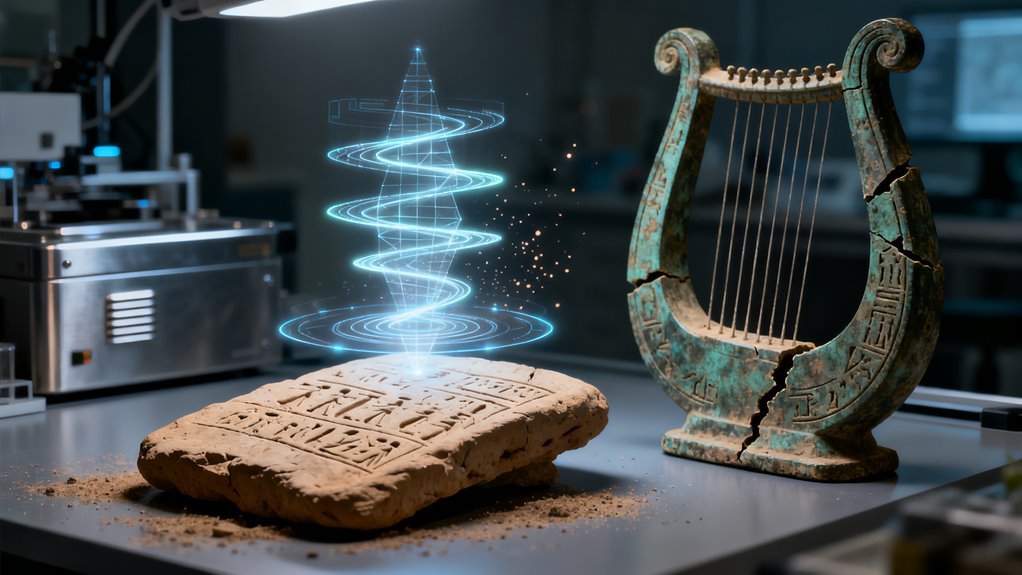
The generative side of the story is more controversial and more interesting. Once researchers decode tunings from a Sumerian lyre or extract a plausible scale from a tablet, they can feed those constraints into generative models. Instead of asking a system to “compose a new track in the style of X,” they ask it to explore the space of melodies that respect an ancient tuning system, a reconstructed rhythmic pattern, and the fragmentary notational hints on an artefact. The result is not an exact recovery of lost songs. It is a set of plausible sequences that sit inside the narrow corridor defined by what survives and what we know.
Used carefully, this is a powerful way to reason about the past. If you generate thousands of candidate melodies that all fit the carved indications on a tablet, and then analyze them statistically, you can ask what kinds of motion are implied by the notation, or which cadences best align with the prosody of surviving texts. Generative models become exploratory tools, not authoritative composers. They help scholars understand what a music could have been, rather than pretending to tell us what it was.
The risk is that audiences rarely carry that distinction in their heads. Museums and media organizations will be tempted to present AI reconstructed music as “the sound of ancient Babylon” rather than “a research-based conjecture built on limited evidence.” As immersive technologies evolve, that temptation will grow stronger. Acoustic simulation already uses detailed geometry, material properties, and spatial layouts to reconstruct reverberation and sound diffusion in historic spaces. Machine learning can refine those simulations further, learning how different audiences, furnishings, and weather conditions would have changed the experience of sound. Combine that with generative melodies and you can put visitors “inside” a temple performance that feels astonishingly real. Addressing these risks requires respectful discourse that prioritizes understanding and transparency over harassment or personal attacks, so audiences are less vulnerable to manipulation.
For cultural institutions, that is an opportunity and a headache. On the opportunity side, AI-assisted reconstructions can make archives legible to a much wider public. Instead of displaying undeciphered notation behind glass, a museum can offer interactive experiences where visitors hear multiple interpretations and see how they emerge from the underlying artefacts. That supports education, tourism, and funding, and it keeps heritage relevant. Governments that invest in this work strengthen soft power by showcasing their history through compelling digital experiences.
On the headache side, institutions must decide how to label and govern synthetic heritage. There is a difference between digitizing an existing recording and generating a speculative chant in a reconstructed style. Regulators already wrestle with disclosure norms for synthetic media. Applying similar principles to historical reconstruction will require collaboration between technologists, historians, and cultural bodies. Expect arguments over what counts as misrepresentation and whether highly plausible but unverifiable reconstructions should ever be treated as official.
There is also a quieter economic angle. Large tech companies are not racing to monetize Mesopotamian lyres. Yet the same pipelines that read medieval notation or simulate ancient acoustics can be repurposed. Models that segment faint lines and symbols on a fragile manuscript are directly transferable to tasks such as reading degraded engineering drawings or medical scans. Techniques for reconstructing plausible sound in a half-ruined amphitheater map to simulation of office acoustics or automotive cabins. As vendors search for enterprise-ready applications beyond generic chatbots, these project-level innovations matter.
At the same time, the rise of AI in ancient music offers a counter-narrative to current fears about generative systems erasing human creativity. In this space, AI does not replace composers or performers. It gives living musicians material to interpret. Once a chant is transcribed and analyzed, singers still decide how to phrase it, which pronunciation to use, what tempo, and what vocal color. Acoustic simulations offer possibilities, not prescriptions. The human choices become more visible because the underlying structures are better understood. In a sense, AI is pushing some parts of music practice back toward craft, away from default reliance on canonical scores.
For developers and startups, this domain suggests several near-term opportunities. One is tooling. Most heritage projects still require bespoke pipelines stitched together by research groups. There is room for platforms that package multimodal models into workflows that historians, archaeologists, and curators can use without deep ML expertise. Another is content. High-quality, clearly labeled reconstructions can feed streaming services, games, and educational platforms that want distinctive, historically informed soundscapes. A third is consultation. As governments and cultural institutions confront questions about synthetic heritage, specialized firms will be needed to audit methods, set standards, and explain risks.
The biggest oversight in current discussion is that these experiments are also shaping how AI itself thinks about time. Early consumer systems treated training data as an undifferentiated mass. Here, chronology matters. Models are forced to respect the order in which styles emerged, adapted, and declined. They have to account for the fact that a fifteenth-century chant and a twentieth-century hymn inhabit entirely different worlds, even if both are tagged as “sacred music.” That temporal sensitivity is exactly what we need if AI is ever to make sense of legal histories, scientific lineages, or corporate records.
We are still at the beginning. Most recovered music comes from relatively recent periods with richer notation, such as medieval Europe. As techniques improve, they will reach deeper into antiquity and broader across cultures. Each new corpus will bring surprises and new tensions. Some reconstructions will challenge national narratives. Others will expose just how much of the past is gone beyond any plausible recovery.
Yet even in this early phase, the pattern is clear. AI is moving from being a universal synthesizer of the present into a set of specialized instruments for exploring the past. Ancient music is simply one of the most evocative places where that transformation is visible. For anyone building or investing in AI, it is a reminder that the real story is not only about generating more content. It is about learning how to use computational power to see, and increasingly to hear, what was always there but never fully understood.
Conclusion
By tracing hidden structures within ancient melodies, AI powered analysis is starting to show that early civilizations wrote music according to stable, learnable rules rather than isolated flashes of inspiration. Those rules look less like local quirks and more like shared musical grammars that cross geographic boundaries, connecting temple ritual, oral storytelling and collective memory into a single compositional language. When we rebuild long fragmented songs from these patterns, the pieces stop behaving like static museum objects and instead become evidence of deliberate design choices by composers who understood how to shape emotion and community through organized sound. At the same time, this work quietly turns AI into a new kind of archaeological instrument, one that exposes structure while inevitably layering its own assumptions on top of the past, a reminder that every model trained on cultural data is not only a tool for discovery but also a powerful interpreter of what we choose to remember next.