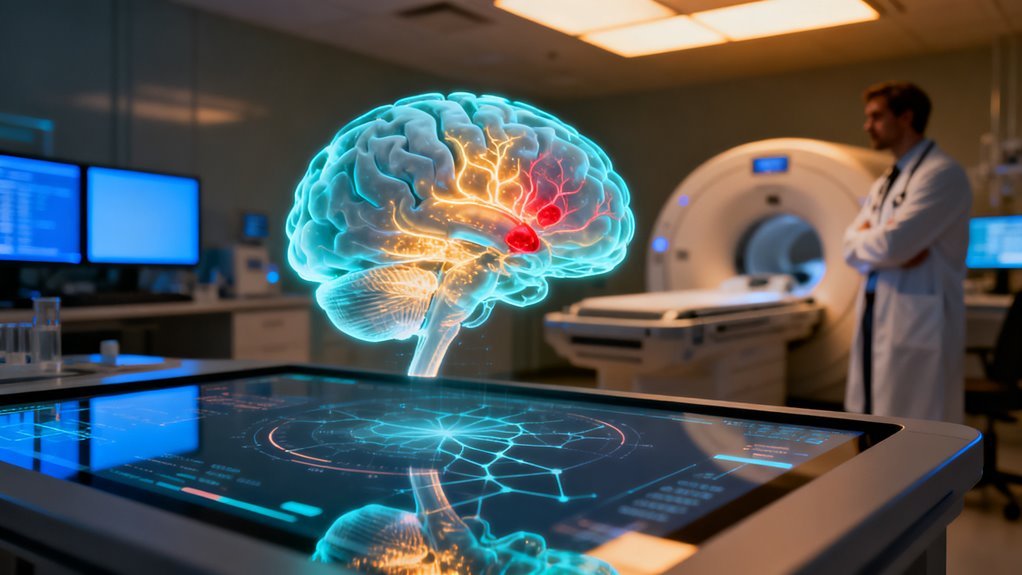

Alzheimer disease is notoriously cruel in its timing. By the time a patient notices memory slipping, the underlying pathology has been building for a decade or more. That gap between biological onset and clinical diagnosis has long been one of medicine’s most frustrating blind spots. Now a convergence of machine learning techniques, large clinical datasets, and increasingly powerful neuroimaging is closing that gap in ways that would have seemed aspirational even five years ago.
What makes this moment different from earlier waves of AI in healthcare is the sheer breadth of signals that algorithms are learning to read. We are no longer talking about a single breakthrough model or a narrow proof of concept. Researchers are pulling predictive value from electronic health records, structural brain MRI, sleep EEG recordings, speech patterns, movement data, and amyloid PET scans, often years before any clinician would raise a flag. The question is no longer whether AI can spot early dementia risk. It is whether the healthcare system is ready to act on what AI finds.
The Numbers Behind the Predictions
Consider the range of lead times now being reported. Machine learning models trained on electronic health records have predicted Alzheimer diagnoses up to five years out, with area under the curve values above 0.85 even at the five year mark. Other approaches claim detection windows of seven years in people showing no symptoms at all, though with more modest accuracy in the 70 to 72 percent range. Risk models that layer in genetic data like APOE genotype alongside amyloid PET imaging have pushed the forecasting horizon to a decade or even lifetime risk estimation.
These are not academic curiosities. An AUC of 0.906 at one year means the model is correctly ranking patients by risk with high reliability. That kind of performance, if validated across diverse populations, could fundamentally reshape how primary care physicians screen older adults. The practical difference between catching Alzheimer risk at 55 versus confirming a diagnosis at 62 is enormous, both for the patient and for the healthcare economics surrounding the disease.
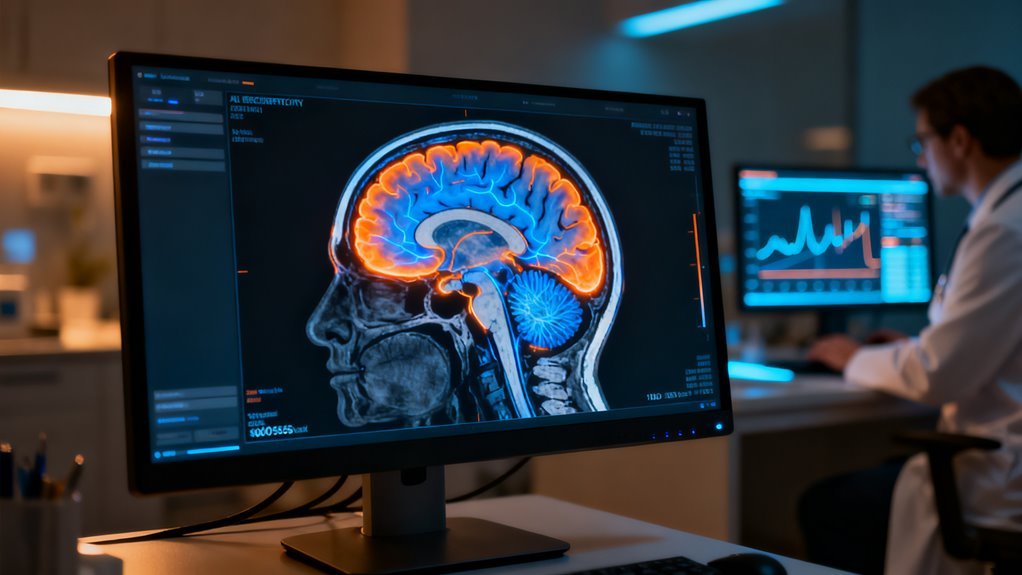
Deep learning applied to structural brain MRI has proven especially productive. Models are now classifying Alzheimer disease, mild cognitive impairment, and normal aging with weighted average accuracy near 89 percent by detecting subtle patterns of neurodegeneration that no radiologist would catch on visual inspection. More striking, MRI based deep learning has started predicting ATN biomarker status from routine scans, essentially inferring the presence of amyloid, tau, and neurodegeneration without requiring a lumbar puncture or an expensive PET tracer. The ROC AUC values of 0.79, 0.73, and 0.86 for those three biomarkers respectively are not perfect, but they suggest a future where a standard brain MRI carries far more diagnostic weight than it does today.
Multimodal fusion pushes accuracy higher still. When researchers combine MRI with FDG PET, cerebrospinal fluid biomarkers, and cognitive test scores, support vector machine models have reached roughly 90.7 percent accuracy in distinguishing Alzheimer patients from cognitively normal individuals. Foundation models trained on large brain MRI datasets are extracting brain age estimates and dementia risk signals from scans that were ordered for entirely different reasons, essentially turning routine clinical imaging into an opportunistic screening tool.
Beyond the Brain Scan
What should catch the attention of anyone tracking AI in healthcare is how far beyond traditional neuroimaging these predictive signals now extend. Sleep EEG analysis in older adults has identified subtle brainwave differences that predict future cognitive impairment, correctly flagging about 85 percent of eventual cases. Algorithms combining brain scans with movement data from roughly 20,000 participants have detected early signatures of both Alzheimer and Parkinson disease years before formal diagnosis. Speech and linguistic analysis models have predicted Alzheimer onset approximately seven years before clinical confirmation.
Each of these modalities on its own might look like a promising research project. Together, they represent something more significant: the emergence of a multi-sensor early warning system for neurodegeneration. The parallel to what happened in cardiovascular risk modeling over the past two decades is instructive. Heart disease prediction moved from a single cholesterol number to composite risk scores incorporating dozens of variables, and that shift changed clinical practice. Dementia prediction appears to be on a similar trajectory, but compressed into a much shorter timeline because the computational tools are already mature.
Why Now, and What Changed
Several forces are converging to accelerate this work. First, the availability of large longitudinal datasets, particularly from projects like the UK Biobank and ADNI, has given researchers the training data that machine learning demands.
Second, the transformer architectures and foundation models that drove progress in natural language processing and computer vision have proven surprisingly transferable to medical imaging.
Third, the approval and commercial rollout of anti amyloid therapies like lecanemab and donanemab has created an urgent clinical need for earlier and cheaper identification of candidates who might benefit from treatment. Without scalable screening, those drugs risk becoming therapies in search of patients.
This last point deserves emphasis. The economics of new Alzheimer therapeutics only work if patients are identified early enough for intervention to matter. At roughly $26,000 per year for lecanemab in the United States, payers need confidence that they are treating the right people at the right time. AI driven risk stratification could become the gating mechanism that determines whether these drugs achieve broad adoption or remain niche treatments for patients lucky enough to be diagnosed early through conventional means.
Who Benefits, Who Faces Disruption
The most obvious beneficiaries are patients and their families. Earlier detection opens the door to lifestyle interventions, clinical trial enrollment, legal and financial planning, and potentially disease modifying therapy before significant cognitive decline. Sleep analysis is increasingly viewed as a critical component in early detection strategies.
Health systems stand to gain from more efficient allocation of expensive diagnostic resources like PET scans and specialist consultations, directing them toward patients that AI models have already flagged as high risk rather than screening broadly.
Diagnostic imaging companies and AI platform developers are well positioned. Firms building FDA cleared algorithms for neuroimaging analysis could find themselves embedded in standard radiology workflows. The foundation model approach, where a single large model extracts multiple clinical signals from routine scans, is particularly interesting from a business perspective because it transforms existing imaging infrastructure into a screening platform without requiring new hardware.
The disruption falls partially on traditional diagnostic pathways. If a routine MRI or even a sleep study can estimate dementia risk with reasonable accuracy, the role of specialized memory clinics in the diagnostic funnel shifts. Neuropsychological testing, which currently plays a central role in confirming cognitive impairment, may increasingly serve as a validation step rather than a discovery step.
Pharmaceutical companies developing amyloid PET tracers may face pressure if MRI based biomarker prediction improves, though the two modalities will likely coexist for years given regulatory requirements for treatment eligibility.
What People Are Overlooking
The performance numbers are impressive in research settings, but the translation to clinical practice involves challenges that accuracy metrics alone do not capture. Generalizability remains the most significant concern. Many of these models were trained on datasets that skew heavily toward white, highly educated populations in North America and Europe. A major systematic review of 255 studies found that few validated their findings in independent external cohorts, underscoring how fragile reported accuracy can be when models are tested outside their original training data.
Alzheimer disease prevalence, genetic risk factors, and clinical presentation vary meaningfully across racial and ethnic groups. A model that achieves 90 percent accuracy in one population may perform substantially worse in another without careful recalibration.
False positives carry a particular weight in dementia prediction that differs from other screening contexts. Telling a 58 year old that an algorithm has flagged them as high risk for Alzheimer disease, even probabilistically, has profound psychological, financial, and social consequences.
Insurance implications, employment discrimination, and the sheer emotional burden of that knowledge all demand careful consideration of how and when these predictions are communicated. The field needs to develop frameworks for responsible disclosure that do not yet exist in any mature form.
There is also a regulatory gap. The FDA has approved AI tools for specific imaging applications like diabetic retinopathy screening and certain radiology tasks, but a multimodal dementia risk prediction system that integrates EHR data, imaging, genetics, and behavioral signals does not fit neatly into existing approval pathways.
European regulators face similar challenges under the AI Act, which classifies health related AI as high risk and imposes stringent requirements. Navigating this regulatory landscape will likely slow deployment even as the technology matures.
The Broader Direction
This work fits into a larger pattern in AI and healthcare: the shift from diagnosis to prediction. Across oncology, cardiology, and now neurology, machine learning is moving the point of clinical intervention earlier in the disease timeline.
The technical capability is advancing faster than the clinical, regulatory, and ethical infrastructure needed to support it. For the AI industry more broadly, medical prediction represents one of the clearest use cases where foundation models and multimodal learning deliver tangible value beyond productivity gains.
Unlike chatbots or code generation, predicting neurodegeneration from a brain scan is the kind of application that justifies the enormous investment in AI infrastructure because the alternative, years of undetected disease progression, carries such a high human and economic cost.
The next two to three years will likely determine whether these research results translate into standard clinical tools or remain impressive demonstrations waiting for the system to catch up. The technology is increasingly ready. The harder question is whether healthcare delivery, reimbursement models, regulatory bodies, and clinical workflows can adapt quickly enough to meet it.