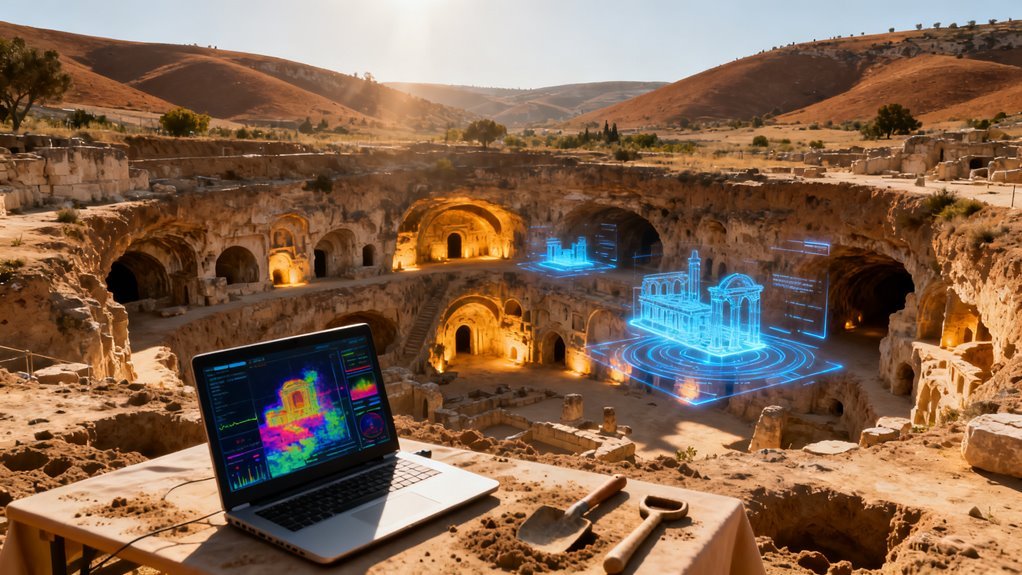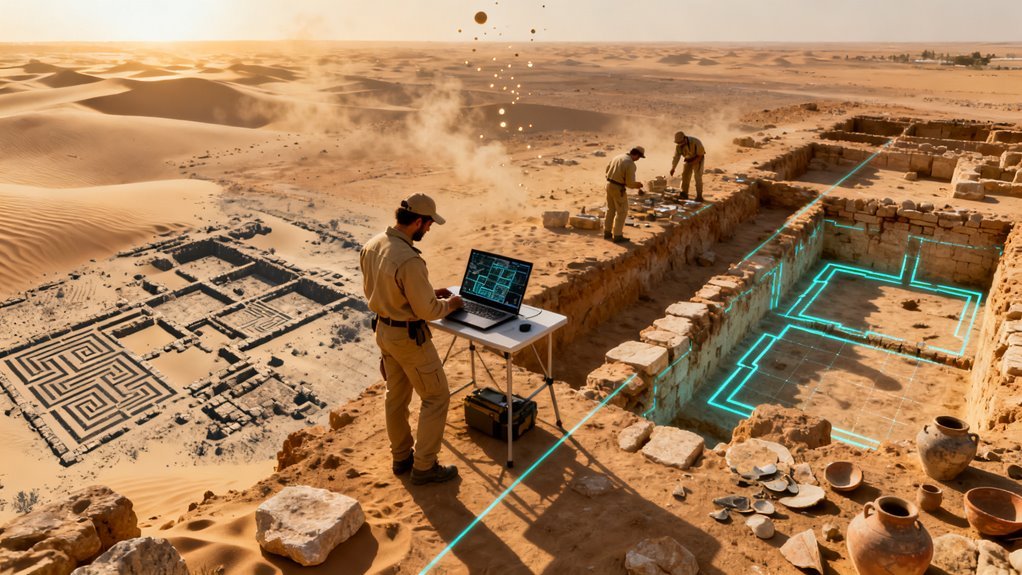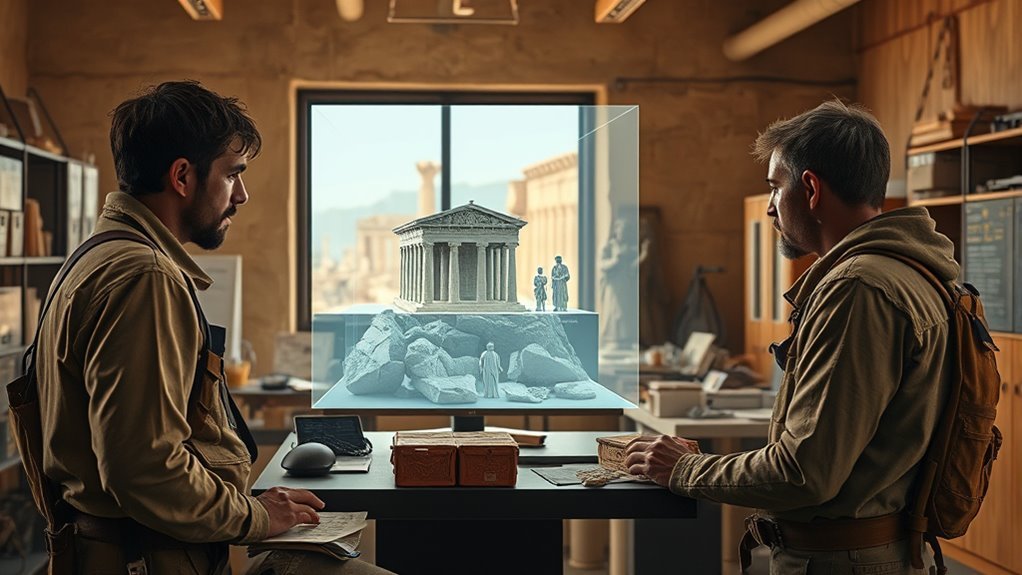

Claude Fable 5 is emerging as a new kind of research partner for archaeologists and historians at a time when artificial intelligence is already reshaping how the past is discovered, documented and protected. Beginning July 1, 2026, it became available to Pro, Max, Team, and Enterprise users as Anthropic’s most capable generally available model for ambitious coding and professional work. It arrives in a landscape where systems that once only scanned satellite images or classified pottery are starting to support entire research workflows, from excavation notes to museum archives.
How AI reached the trench and the archive
Artificial intelligence entered archaeology through relatively narrow tasks. Early systems focused on pattern recognition in remote sensing and satellite data, flagging possible sites that human teams could investigate. Deep learning and related approaches made it possible to detect subtle anomalies in aerial or multispectral imagery, revealing buried structures and previously unknown settlements under vegetation or urban cover.
AI’s early gaze parsed satellites and multispectral skies, teasing out hidden settlements buried beneath vegetation and concrete
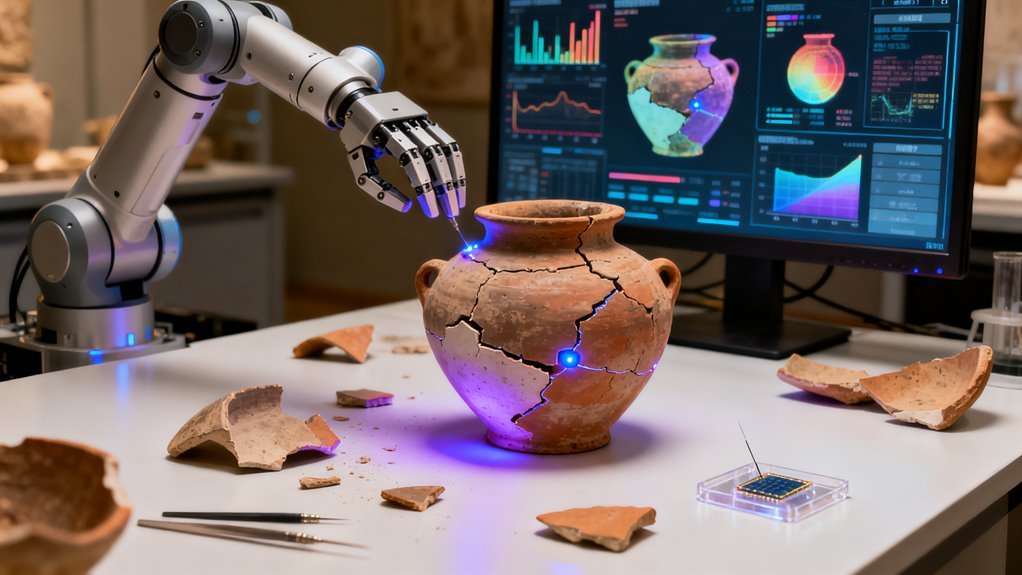
The field then expanded into conservation and heritage protection. Models are now used to create digital twins of vulnerable sites and monuments, simulate degradation under different environmental conditions and help plan preventive interventions. At the same time, machine learning has been applied to tasks such as classifying fragments, reconstructing ceramics, and analyzing human remains in order to infer social and historical context.
Most recently, AI has begun to act on the huge archives that archaeology has accumulated over decades. Scholarly work has shown that these techniques are well suited to large, heterogeneous datasets that span site reports, catalogs, images, and legacy databases, opening up new opportunities to generate knowledge from material that was previously difficult to synthesize. In parallel, more general studies of multimodal models in scientific domains highlight that systems which integrate text, images and structured data often outperform those limited to a single modality, especially when the goal is to capture complex relationships and trends across sources.
This broader evolution sets the stage for models that are not only classifiers or detectors, but persistent reasoning partners. Claude Fable 5 is presented as one of these models, designed to sit inside the day to day workflow of research teams rather than at the margins.
Claude Fable 5 as a long horizon analytical assistant
The defining promise of Claude Fable 5 is not a single breakthrough algorithm but sustained reasoning over extended projects. In research programs that attempt to reconstruct ancient cities, trade networks or imperial expansion, teams often work with evolving archives and questions that stretch across weeks or months. Claude Fable 5 is built to hold onto that context and to keep track of open questions, partial interpretations and alternative hypotheses as the work unfolds.
In practice this means archaeologists, historians and digital humanists can treat the model as a stable analytical colleague. It can ingest excavation notes, survey logs, stratigraphic descriptions and artifact inventories, then align them with satellite imagery, lidar scans, museum catalogs and older databases that may use inconsistent terminology or formats. The model is continuously updated within an agentic workspace, so a team can return to the same project day after day and expect the system to remember earlier discussions, unresolved puzzles and speculative leads.
This continuity matters for complex campaigns. Comparing fragmented inscriptions across multiple sites is not a single query but a sequence of tasks that include transcription, alignment of different corpora, cross reference with prior scholarship and integration of new imagery as it becomes available. Claude Fable 5 is configured to manage chains of such tasks, orchestrating code that cleans and normalizes heterogeneous datasets and then feeding those cleaned structures into further analysis.
Surveys of large language models in scientific workflows show that these systems can already assist in configuring and executing multistep pipelines, including data preparation, model selection and evaluation, while still requiring human oversight at critical points. Claude Fable 5 extends that concept into archaeology and the historical sciences, with an emphasis on long horizon projects rather than single experiments.
Multimodal evidence and deep synthesis
Archaeological research rarely relies on a single type of source. A typical project might combine excavation reports, field diaries, typology tables of artifacts, architectural drawings of structures and high resolution photographs of context and finds. Multimodal models are well suited to this kind of work because they can ingest and interpret different data types together, capturing complementary signals that are lost when each source is handled in isolation.
Claude Fable 5 is designed around this multimodal capability. Researchers can place long form texts alongside tabular data, maps and images within one workspace, then ask the system to look for patterns that cut across formats. It might correlate the distribution of a particular ceramic style with settlement layers, river courses and known trade corridors, drawing on satellite imagery and survey data to suggest routes and regional connections.
When experts are working with fragmentary inscriptions or damaged reliefs, they can pair earlier translations, scholarly commentary and new photographs. The model can then propose structured interpretations, highlight inconsistencies between sources and recommend where further data gathering might change the picture.
Evidence from other scientific domains supports this approach. Reviews of multimodal AI in areas such as neurodegenerative disease and biomedicine show that models which combine textual records, imaging and structured measurements can produce more accurate and nuanced predictions than systems that treat each modality separately. In archaeology the aim is not clinical prediction, but stronger and more coherent chronologies and cultural narratives. By helping teams trace how ritual practices, material technologies and political institutions transform across centuries, Claude Fable 5 is meant to shift the focus from isolated finds to long term processes.
From workflow support to genuine collaboration
One of the most interesting trends in recent AI research is the movement from single step assistance toward workflow level support. Studies of large language models in scientific computing describe how these systems can translate high level instructions into executable workflows, generate and modify pipeline components and help document decisions for later auditing. These models are not yet fully autonomous, and current work emphasizes that their value depends on careful prompt design, clear governance and sustained human supervision.
Claude Fable 5 adopts a similar philosophy. It can propose new queries as evidence accumulates, refine data models when inconsistencies appear and help teams compare competing hypotheses about trade routes, religious practices or political structures. When a field campaign pauses so that researchers can collect new measurements or open a new trench, the agentic workspace can be suspended and later resumed without repeating prior reasoning.
That continuity allows the system to run multi day analytical campaigns in which code that cleans and normalizes data feeds into progressively richer simulations of trade networks or demographic change. Importantly, the emphasis is on collaboration rather than automation. Just as clinical and trial guidelines now insist that any claim drafted with AI support be manually verified and that expert quality gates remain in place, similar norms are beginning to take shape in research institutions that use AI to analyze historical and cultural data.
Claude Fable 5 is positioned as a tool that works within those guardrails, not outside them.
Institutional adoption and the question of trust
Universities, museums and heritage agencies are under pressure to modernize their research infrastructure while protecting sensitive information. Guidance for AI use in areas such as clinical trials stresses the importance of institution approved platforms, clear documentation of model versions and hosting, and strict privacy and security safeguards. Those principles carry over directly into archaeology, which often touches on biological remains, potentially sensitive site locations and geopolitically delicate material.
Claude Fable 5 is intended to slot into standard research environments through cloud platforms and dedicated workspaces that can be governed by existing policies. Its guardrails aim to filter dangerous content, resist prompts that could lead to security risks and keep protected or identifiable information within institutional boundaries rather than public systems. That alignment with broader best practices is vital for trust.
Heritage organizations need confidence that deploying advanced reasoning systems will not inadvertently expose sites to looting, reveal sensitive data about human remains or compromise negotiations around repatriation and access.
At the same time, serious limitations remain. As surveys of workflow oriented AI make clear, large language models can misinterpret instructions, fabricate plausible but incorrect explanations and propagate biases present in training data. Archaeological evidence is often sparse, contested and open to multiple interpretations, which increases the risk that a system might overstate certainty or obscure alternative readings.
Responsible use therefore demands clear documentation of where AI is involved, transparent separation between machine generated suggestions and human expert conclusions, and continuous evaluation of outputs against primary materials.
What this means for research and for the future
The arrival of Claude Fable 5 in archaeological and historical workflows signals a broader shift in how AI is integrated into scientific practice. Instead of isolated tools used for niche tasks, research teams are beginning to work with persistent models that participate in every stage of a project, from data ingestion to hypothesis testing and narrative construction. Current research indicates that AI’s economic impact centers on task reconfiguration around AI assistance rather than outright job displacement.
If this approach matures, several outcomes are likely. Research groups may be able to revisit old archives with fresh eyes, uncover spatial and temporal patterns that were previously missed and test competing historical scenarios more systematically. Smaller institutions with limited staff could gain access to analytical capabilities that once required large specialist teams, potentially democratizing certain kinds of historical inquiry.
On the other hand, dependence on a few powerful models raises questions about methodological diversity, reproducibility and the risk of subtle homogenization of interpretations across the field. The next few years will probably determine whether systems like Claude Fable 5 become trusted collaborators or remain experimental add ons.
That trajectory will depend less on raw model capability and more on thoughtful integration into existing research cultures, transparent governance and rigorous evaluation of both successes and failures. For archaeologists and historians, the most constructive stance is neither uncritical enthusiasm nor reflexive rejection, but careful use of these tools to ask better questions while keeping human judgment firmly in the loop.
Frequently Asked Questions
How Is Claude Fable 5 Trained on Archaeological and Historical Data?
Claude Fable 5 is trained on a broad mixture of internet scale data, curated archives, and synthetic examples, and that blend includes substantial historical and archaeological material prepared specifically for machine learning use up to a knowledge cutoff in January 2026. Within that mix, structured cultural heritage ontologies such as CIDOC CRM help the model represent sites, artifacts, events, and actors in a way that preserves context rather than treating them as isolated facts.
Why the training strategy matters now
Over the past decade, historians and archaeologists have watched artificial intelligence move from experimental image classifiers to full language models that can discuss ancient texts, propose site interpretations, and synthesize excavation reports in seconds. Claude Fable 5 sits squarely in that evolution, as a generalist assistant that is nonetheless expected to reason competently about everything from Bronze Age trade to remote sensing surveys of Maya settlements.
Understanding what kinds of data go into the model, and how those data are structured, is no longer a niche concern. It affects whether archaeologists can trust its suggestions, how museums think about digitizing collections, and how cultural heritage agencies weigh the risks of exposing sensitive site locations.
From web scale text to curated historical corpora
Public documentation from Anthropic describes Claude Fable 5 as trained on a proprietary mix of publicly available internet content, public and private datasets, and synthetic data generated by other models. A separate support note confirms that the bulk of its training data runs through January 2026, which is why the assistant can discuss fairly recent papers and datasets while still missing the latest releases.
Within that broad corpus, historical and archaeological material typically enters in several forms. There are digitized books and journal articles covering excavation reports, regional surveys, and synthetic historical narratives. There are machine readable corpora constructed explicitly for generative models, such as the Latin inscription dataset that combines multiple epigraphy databases into a comprehensive training corpus for the Aeneas model. This epigraphic collection merges major Latin inscription databases into the largest machine actionable Latin inscription dataset to date, illustrating the scale and structure that modern historical training sets can reach.
While public sources do not name specific archaeological datasets used in Claude Fable 5, the training mix described by Anthropic aligns with the kinds of prepared corpora now common in the field. These include remote sensing collections like Archaeoscape, which offers airborne laser scanning data and derived terrain models for more than eight hundred square kilometers in Cambodia along with more than thirty thousand annotated archaeological features from the Angkorian period. They also include multimodal remote sensing datasets for Maya archaeology that pair airborne laser scanning, canopy height models, radar satellite data, optical satellite imagery, and manual annotations, all explicitly designed for use with deep learning models.
The presence of such datasets in the wider machine learning ecosystem means that a model trained on large volumes of scientific literature plus cultural heritage data can learn the terminology, spatial patterns, and interpretive frameworks that archaeologists use every day. Even when a specific dataset is not directly ingested, discussions of its design and findings in scholarly articles still shape the model’s understanding of archaeological practice.
Excavation reports, site registers, and artifact catalogs
Archaeological practice generates a characteristic family of documents, and many of them are now digitized at scale. There are excavation reports detailing stratigraphic layers, feature relationships, and material assemblages. There are site registers and national heritage databases that record coordinates, chronology, site types, and legal protection status. There are artifact catalogs describing typology, material, decoration, findspot, and sometimes laboratory analyses.
Separate work on machine learning for archaeology has produced training datasets in which site records and remote sensing imagery are carefully normalized, annotated, and split into training, validation, and test sets. One project provides high quality datasets for automatic site recognition, built from more than twenty thousand images prepared with standardized formats so that recognition models can learn to identify tells and other features. Another study explores simulated training data, using procedural methods to create lidar derived digital elevation models and feature masks in order to train neural networks without exposing sensitive real site locations.
These examples show the kind of archaeological data Claude Fable 5 is likely to encounter: structured records linking locations, features, and chronologies; imaging data tied to manual annotations; and methodological papers that explain how such datasets are assembled. Even when Claude does not train directly on the raw rasters or vector layers, it still ingests the textual descriptions, tables, and methodological notes that accompany them in the literature.
How CIDOC CRM and related ontologies shape the model’s understanding
A crucial part of making archaeological and historical data useful to machines is representing it in shared conceptual models. CIDOC CRM, developed under the International Council of Museums, is one of the most influential ontologies for cultural heritage. It is event oriented, meaning it represents acts such as production, discovery, and acquisition, as well as entities such as human made objects, places, and persons, and it encodes their relationships as machine readable triples that form knowledge graphs.
Recent work shows how large models can parse unstructured archival records into CIDOC CRM classes, turning handwritten ledgers, excavation notes, and geographic information system data into structured entities like human made objects linked to sites, time spans, and actors. When training data incorporates records that have already been mapped into CIDOC CRM, Claude Fable 5 can learn that pots, coins, and inscriptions are not just words on a page but objects produced at specific times, found in particular stratigraphic contexts, and then moved through collections.
Even when the training data includes only textual descriptions of CIDOC CRM, the ontology still provides a template for how to relate sites, artifacts, people, and events. This helps the model reason more consistently about questions like how a coin type connects to a mint, a ruler, a site, and a period, or how multiple excavation campaigns at the same location fit into a single stratigraphic sequence.
Multimodal training and the archaeological landscape
Claude Fable 5 is a text centric assistant, but its training data includes content derived from images and other media processed by upstream models. Archaeological machine learning work increasingly prepares remote sensing data in multimodal formats that are expressly described as suitable for convolutional neural networks and object detection tasks. Archaeoscape, for example, includes orthophotos and lidar derived normalized digital terrain models, along with annotations of anthropogenic features that are important for archaeological interpretation.
The Maya remote sensing dataset combines airborne laser scanning visuals, canopy height models, radar satellite data, optical satellite bands, and cloud masks, all bundled with manual annotations. When such datasets are discussed in articles and reports, they bring terms like canopy height model, sky view factor, and digital terrain model into the textual domain. Claude Fable 5 can then recognize that these are not abstract mathematical curiosities but specific tools that archaeologists use to identify causeways, platforms, mounds, and other features hidden under forest cover.
This multimodal context means that when a user asks about a lidar based survey in Cambodia or a satellite derived analysis of Maya sites, the model can connect the methods described in papers to the features highlighted in maps and diagrams.
Ancient texts, inscriptions, and chronology
Beyond sites and landscapes, generative models are trained on large corpora of historical texts, inscriptions, and scholarly commentaries. The Aeneas project shows one path forward by combining three major Latin epigraphy databases into a single machine actionable corpus of inscriptions, which it then uses to train a generative model that can contextualize ancient texts. Processing these databases produces the largest Latin inscription dataset designed for machine learning to date.
Claude Fable 5 is trained on a similarly broad literature of epigraphy, papyrology, and philology, including corpora like this and scholarly work built upon them. This allows the model to link inscriptions to places, deities, officials, and events, and to understand how modern scholars reconstruct chronology and social networks from fragmentary evidence. It also gives the assistant enough exposure to primary sources and interpretive debates that it can explain why different historians disagree on details such as the dating of a fortress or the identity of a dedicator, even when it cannot reproduce inscriptions verbatim because of copyright and safety constraints.
Synthetic data and reasoning traces
Anthropic notes that Claude Fable 5 was trained not only on human generated data but also on synthetic data created by other models. In the broader ecosystem, related projects publish supervised fine tuning datasets built from assistant reasoning traces, in which each example pairs a user context with a detailed chain of thought and final answer. One open dataset captures Fable 5 agent traces, preserving session level logs of tool use, reasoning, and responses in formats ready for supervised training.
Another uses these Fable traces, along with outputs from a different assistant, to fine tune a separate model in a distillation style setup. For archaeology and history, synthetic data and reasoning traces matter because they teach the model how to walk through complex interpretive problems step by step. Instead of simply memorizing that a site belongs to a period, the assistant can learn patterns of reasoning such as comparing ceramic typologies, stratigraphic relations, radiocarbon dates, and historical texts, then arriving at a plausible chronological assignment.
Over time, this kind of metatraining shapes how Claude responds to new queries about partially excavated sites or conflicting documentary evidence.
What this means for archaeologists and historians
The practical effect of this training regime is that Claude Fable 5 can often act as a knowledgeable generalist assistant for archaeologists and historians, particularly when synthesizing well published material. Researchers can use it to summarize excavation reports, trace connections between sites and trade routes, or outline the historiography of a contested chronological scheme.
Cultural heritage professionals can ask how CIDOC CRM represents certain entities, or how a particular lidar based dataset compares with other remote sensing efforts. There are real opportunities. Training on machine ready archaeological datasets and structured ontologies means the model can help spot gaps in documentation, suggest consistent modeling patterns for new collections, and highlight parallels between regions that may be buried in scattered literature.
In remote sensing, familiarity with methodologies and dataset designs allows the assistant to propose workflows and quality checks that align with current best practice. In textual studies, exposure to large epigraphic corpora makes it easier for the model to surface relevant inscriptions and scholarly debates when a user asks about a specific formula or place.
But the risks are equally tangible. The exact roster of archaeological and historical datasets used in Claude Fable 5 is not publicly disclosed, which means the model can reflect unknown biases in geographic coverage, language, and theoretical orientation. Training data through January 2026 leaves a moving gap where newer discoveries, repatriation debates, or policy changes are not yet integrated.
Remote sensing datasets raise concerns about revealing locations of vulnerable sites, even indirectly through synthesized descriptions. Synthetic reasoning traces, while useful, may encourage a polished narrative style that can obscure the degree of uncertainty in underlying evidence.
Transparency, limitations, and responsible use
From a trust perspective, the key point is that Claude Fable 5 is trained on a mix that combines internet scale text, specialized datasets, and synthetic examples, yet does not offer a complete public inventory of sources. The use of CIDOC CRM and similar ontologies signals a serious effort to model cultural heritage data in a structured way, but it does not automatically prevent interpretive errors.
Archaeological machine learning datasets illustrate what is technically possible, but they also show how much care goes into annotation, masking, and ethical access control. For practitioners, the safest posture is to treat Claude as a powerful assistant rather than an authority. When the model cites widely discussed projects such as Archaeoscape or Latin inscription corpora, those references can be trusted as pointers to genuine work, but any specific claim still merits verification against primary publications or databases.
Users should be explicit about uncertainty, ask the assistant to present multiple interpretive options, and cross check suggestions with domain experts, especially when site protection or community interests are at stake.
Looking ahead
Claude Fable 5 represents a moment when general purpose language models begin to feel genuinely conversant in the technical language and data structures of archaeology and history. Its training on a mixture of internet content, curated heritage data, and synthetic reasoning traces, combined with exposure to ontologies like CIDOC CRM and machine ready remote sensing datasets, gives it a rich internal map of how the past is documented and interpreted.
The next steps will likely involve more transparent partnerships between model developers and cultural heritage institutions, clearer documentation of which datasets are included and how sensitive information is protected, and better tools for users to see which sources underpin a given answer. If that happens, archaeologists and historians will be able to harness systems like Claude Fable 5 more confidently, using them to explore large corpora, test hypotheses, and design new surveys while keeping interpretive control firmly in human hands.
What Safeguards Prevent Misinterpretation or Bias in Reconstructed Civilization Models?
Artificial intelligence is becoming a powerful lens for reconstructing past civilizations, from simulating ancient cities to generating plausible narratives about everyday life in historical societies. When these models are wrong or biased, they do more than mislead researchers. They can distort cultural memory and reinforce old injustices under a veneer of scientific authority. That is why safeguards against misinterpretation and bias are no longer a nice to have. They are a core requirement for any serious civilization reconstruction project.
Why safeguards matter right now
Institutions that guard cultural memory—archives, museums, libraries, and research labs—are moving fast to apply machine learning to vast collections of texts, images, and artifacts. These systems can surface forgotten voices, reconstruct damaged sites, and connect disparate collections in ways that human teams would struggle to match. At the same time, they inherit the bias of historical records and the blind spots of the people building them.
Once an AI-generated reconstruction enters a catalog or a textbook, it can quickly be treated as settled fact. Researchers, community members, and policymakers may rely on these outputs to argue about heritage claims, land rights, or cultural identities. That creates a heavy responsibility for designers of these models to show exactly where evidence ends and speculation begins and to embed checks on bias at every stage of the pipeline.
Where bias in reconstructed civilizations comes from
Bias in civilization models is not just a technical glitch. It starts with history itself. Many archives over-represent dominant groups and under-represent marginalized communities, often through deliberate exclusion or unequal documentation practices. Heritage datasets also carry offensive terms, outdated classifications, and stereotyped representations that reflect the worldview of earlier curators rather than the communities they describe.
When that data is fed directly into modern AI systems without careful cleaning and annotation, the models learn these distortions as if they were neutral facts. The result can be reconstructions that erase certain populations, mislabel sacred objects, or present colonizer narratives as the default view of the past.
Technical bias adds another layer. If models are optimized purely for accuracy on existing labels, they tend to reproduce the statistical majority and ignore rare but important patterns, such as artifacts from smaller cultures or marginal languages. Without explicit fairness constraints and subgroup analysis, performance can look strong overall yet be deeply unfair across different communities.
Building trustworthy datasets as the first safeguard
Serious reconstruction work now treats data curation as a craft in its own right rather than a preliminary chore. That starts with representative datasets built from diverse sources across cultures, time periods, and media types so that no single archive silently defines the entire picture. Where core collections are skewed, institutions are supplementing them with targeted sampling and additional datasets focused on underrepresented groups.
Data cleaning is equally important. Offensive terminology and obviously biased labels are flagged and either relabeled or contextualized with expert and community input so that models do not treat those categories as timeless truth. Missing metadata, such as dates, locations, or community affiliations, is carefully reconstructed or clearly marked as uncertain so that downstream models can treat it appropriately.
Bias mitigation techniques at the data level provide another layer of protection. Strategies such as reweighting, resampling, and weighted sampling adjust how often certain records influence training so that small communities do not vanish in the noise of majority data. Supplementary synthetic examples can help fill representational gaps, but ethical practice requires validation with domain experts and affected communities before trusting those additions.
Context rich annotation for cultural heritage
Cultural heritage work shows that annotation is not just a technical label. It is a way to encode context, respect, and uncertainty. For images of artifacts, sites, and artworks, dedicated annotations can record the time period, cultural setting, provenance debates, and known biases in the depiction. This gives models explicit signals about what is contested, who is represented, and how different interpretations coexist.
For complex sites that evolved over centuries, annotations can mark distinct temporal layers and explain how objects moved or were repurposed over time. That helps models avoid flattening multiple eras into a single snapshot and reduces the risk of misattributing styles or practices from one period to another.
Human-in-the-loop annotation with heritage experts and community representatives is particularly effective. Research in cultural heritage AI shows that collaborative data work improves categorization accuracy and produces more respectful interpretations than purely automated pipelines. When community members help label data and review outputs, they can flag misinterpretations quickly and assert sovereignty over how their histories are represented.
Transparent models and traceable reconstructions
Transparent modeling is another safeguard that prevents AI-generated civilizations from turning into black boxes that look authoritative but cannot be questioned. Ethical frameworks for historical AI emphasize three pillars: bias, transparency, and accountability.
Transparency starts with thorough documentation. Model cards and datasheets describe what data went into a model, how it was cleaned, which fairness metrics were used, and what limitations remain. In the context of civilization reconstruction, this means clearly stating which regions, periods, and communities are well represented and where the model should be considered speculative.
Explainable models strengthen that documentation. When a system classifies an artifact or suggests a narrative, it should be possible to inspect the features and evidence that led to that prediction. Fairness-aware algorithms and adversarial debiasing can limit the influence of protected attributes, but they work best when paired with tools that reveal reasoning paths so that researchers can detect biased correlations early.
Uncertainty estimates are crucial. Instead of presenting a single confident story of a past civilization, responsible systems provide probability ranges, alternative interpretations, or explicit confidence levels. That keeps historians and community members in a position to argue with the model rather than accept its output as unquestioned fact.
Continuous bias auditing and governance
Bias is not something that can be fixed once and forgotten. Leading work on AI governance stresses ongoing audits across data, models, interfaces, and institutional processes. For reconstructed civilization models, this means regular subgroup analysis across ethnic, cultural, and temporal categories and monitoring of fairness metrics such as demographic parity, equal opportunity, and equalized odds.
Independent review bodies and governance committees play an important role in keeping these systems aligned with institutional values and community rights. Policies can specify when human approval is required for high-impact interpretations, for example, claims that affect land restitution, religious practices, or cultural heritage disputes. Logs of model runs and change histories support traceability so that controversial outputs can be traced back to specific datasets, configurations, or code changes.
Ethical guidelines, checklists, and mandatory impact assessments give teams a structured way to consider epistemic injustice, data sovereignty, and consent before deploying new reconstruction features. Over time, peer replication—where independent groups reproduce and stress test models against different datasets—becomes a powerful way to surface hidden weaknesses and prevent a single biased system from shaping historical narratives at scale.
Community sovereignty and participatory oversight
Reconstructed civilizations are not just academic objects. They are living parts of cultural identity. Recent work on AI-generated histories argues that communities should have direct control over their data and a say in how models use it. Platforms where communities can upload oral histories, photos, and documents give AI systems access to marginalized narratives while preserving community ownership and consent.
Participatory design brings community members into every stage, from data selection and annotation to validation of model outputs. When people from the cultures being represented can correct mistakes, add context, and challenge biased narratives, models are more likely to move toward epistemic justice rather than amplify existing inequalities.
AI literacy programs are another safeguard. As more institutions rely on AI to tell historical stories, communities need to understand how these systems work, where they are strong, and where they fail. Educational efforts that treat citizens as critical editors of AI narratives rather than passive consumers help ensure that biased or hallucinatory reconstructions are questioned rather than quietly absorbed.
Privacy, security, and access control
Safeguards against misinterpretation also depend on how data and models are handled behind the scenes. Strong privacy and security practices reduce the risk that sensitive cultural data is repurposed without consent or exposed to misuse. For example, zero retention policies for certain APIs ensure that user-provided data is not silently folded back into training sets and used to shape future reconstructions without explicit permission.
Access controls can limit who can run high-impact reconstruction models or modify key datasets, especially when they involve sacred sites, restricted knowledge, or politically sensitive histories. Clear governance around access helps prevent unofficial or opportunistic reinterpretations from gaining authority simply because they were generated by an impressive-looking model.
What these safeguards mean for the future of civilization modeling
Taken together, these safeguards are transforming civilization reconstruction from a purely technical challenge into a deeply interdisciplinary practice. Data scientists, heritage professionals, historians, ethicists, and community leaders all have distinct roles in building models that can be trusted.
For technology providers, this changes the definition of success. It is no longer enough to deliver accurate classifications or vivid generative reconstructions. They must show balanced performance across groups, clear documentation of limitations, and robust channels for communities to contest outputs. For museums, archives, and research institutions, the opportunity is significant; ethically designed AI can surface forgotten stories and reconnect dispersed collections while respecting cultural rights and historical complexity.
The risk is clear as well. If safeguards are treated as optional add-ons rather than core design principles, reconstructed civilizations could become yet another arena where dominant narratives are polished and minorities are sidelined with algorithmic precision. The work now is to ensure that every model trained to imagine the past is also trained to respect those who live with its consequences.
Key takeaways
Trustworthy civilization reconstructions depend on representative, audited datasets, rich contextual annotation, and explicit fairness strategies throughout the pipeline. Transparent models, uncertainty estimates, and thorough documentation make it possible to distinguish evidence-based reconstructions from speculative storytelling. Continuous bias audits, governance policies, and human approval gates protect against high-impact misinterpretations, particularly where identity rights and sovereignty are at stake. Most importantly, community participation and data sovereignty turn AI from a distant narrator into a collaborative tool that can help many cultures tell their histories on their own terms.
The future of reconstructed civilization models will be defined not only by how detailed their simulations become but by how honestly they represent uncertainty, how fairly they treat all communities, and how accountable they remain to the people whose pasts they are tasked with reimagining.
Can Independent Researchers Access Claude Fable 5 for Non-Academic Archaeological Projects?
Independent archaeologists and history enthusiasts are in a very different place today than even two years ago. Until recently, the most capable artificial intelligence models for deep analysis sat behind institutional walls, effectively reserved for universities, large museums, and well-funded corporations. Claude Fable 5 changes that equation by giving independent researchers access to the same class of tools that major heritage institutions are beginning to explore for reconstruction, analysis, and interpretation work.
The key question is whether a small field project, a local historical society, or a solo underwater archaeologist can realistically use Fable 5 for non-academic work without being attached to a university. The short answer is yes in principle and increasingly yes in practice but with serious budget, reliability, and governance issues that need clear eyes and careful planning.
How Claude Fable 5 fits into the current AI landscape
Anthropic introduced Claude Fable 5 in mid 2026 as its most capable model for long context reasoning and rich narrative understanding, positioned alongside the more tightly controlled Claude Mythos 5. Fable 5 is generally available across the Claude API, Anthropic’s own console, and major cloud platforms such as Amazon Bedrock, Google Cloud, and Microsoft Foundry, while Mythos 5 remains in limited access under the Project Glasswing program aimed at vetted security and research partners.
From the start, Fable 5 was framed as a workhorse model for complex analysis rather than a novelty system. Third-party performance and pricing reviews describe it as Anthropic’s most powerful generally available model with higher costs than Opus 4.8 and stricter metering to keep workloads sustainable. That combination of long context, strong reasoning, and controlled throughput is exactly what makes it appealing for archaeological data synthesis, stratigraphic interpretation, and multi-source reconstruction projects that may span thousands of pages of notes, datasets, and images.
The access story in detail
For independent researchers, the crucial point is that Anthropic sells access to Claude Fable 5 directly through standard Claude subscriptions and the public API, without any explicit requirement for university or institutional affiliation. Documentation and support articles describe Fable 5 as an option in the same interfaces used by individual professionals: Claude on the web, Claude mobile apps, Claude desktop, and related environments such as Claude Code and Claude Design. Within those apps, users simply choose Fable 5 from a model picker once their account has suitable billing enabled.
On the infrastructure side, Fable 5 is exposed through the Claude API under a dedicated model identifier and via cloud marketplaces including Amazon Bedrock, Google Cloud, and Microsoft Foundry. These channels are all open to small organizations and individuals who can create accounts, agree to terms of service, and provide payment methods, which makes them viable for non-academic archaeological teams, independent consultants, and volunteer heritage projects that have at least modest funding.
Availability has not been perfectly smooth. Anthropic’s own page for Fable has at times displayed notices that the model is temporarily unavailable, reflecting capacity and safety-related pauses during global rollout. At the same time, technical and pricing briefs emphasize that the API and cloud platform endpoints remain part of the general model portfolio, which suggests that any interruptions are more about metering or product surface than a permanent withdrawal. Practically, independent researchers should treat Fable 5 as a powerful but occasionally constrained tool and maintain fallback plans through other Claude models or alternative providers.
Pricing, metering, and what this means for project budgets
Access is not the main barrier for non-academic archaeological work. Cost is. Across multiple independent analyses and platform guides, Fable 5 is consistently priced at around ten dollars per million input tokens and fifty dollars per million output tokens on the API. This makes it the most expensive generally available Anthropic model for everyday use, roughly double the price of Opus 4.8 according to developer-facing comparisons. There is no permanent free public API tier for Fable 5 and no long-term free allowance on subscriptions once introductory windows close.
The consumer and team subscriptions experienced a sequence of time-limited inclusion windows that matter for budget planning. At launch in June 2026, Fable 5 was included at no extra charge on Pro, Max, Team, and certain Enterprise plans for a short period ending around June twenty-second, with usage counted against normal plan quotas. After that date, continued access shifted to separate usage credits, which charge Fable 5 consumption at the same per token rates used by the API.
When Fable 5 was reintroduced more broadly in early July, Anthropic and partner analyses describe a second controlled window. Pro, Max, Team, and premium Enterprise seats could use Fable 5 for up to half of their weekly usage limits through July seventh, beyond which all further use draws exclusively on paid usage credits. These credits are configurable via account settings and effectively turn Fable 5 into a pay-as-you-go resource on top of any subscription.
For an archaeological project, this has clear implications. A careful field team must model token usage with the same seriousness they would apply to radiocarbon dating budgets or drone survey flight hours. Long context analysis of multiyear excavation records, high-resolution image descriptions, and narrative synthesis can easily reach tens of millions of tokens over a season, meaning hundreds to low thousands of dollars in model costs if not actively managed.
Global reach and the end of geography as a gatekeeper
Anthropic’s public messaging and technical documentation stress that Fable 5 is available everywhere through the Claude API and major cloud platforms, subject to local regulation and standard cloud export controls. External guides echo that characterization, treating Fable 5 as a globally reachable model alongside Opus and other Claude variants rather than a region-locked experiment.
For independent researchers, this matters in two ways. First, a small archaeology cooperative in the Mediterranean, a rock art surveyor in Latin America, or a rescue archaeology team in Southeast Asia can in principle access the same model as a museum lab in North America so long as they can pay for usage and comply with local legal frameworks. Second, hosting through providers like Amazon Bedrock and Google Cloud makes it easier to integrate Fable 5 into existing digital workflows, including shared notebooks, data lakes, and content management systems that many projects already use for imagery and spatial data.
What independent archaeologists can practically do with Fable 5
Although official documentation focuses on general capabilities, third-party evaluations and the structure of the model suggest several particularly relevant uses for non-academic archaeology. Reviewers highlight Fable 5’s ability to work with very long contexts and to maintain narrative coherence across many thousands of tokens, which is ideal for synthesizing excavation diaries, stratigraphic descriptions, and survey reports into coherent site narratives.
Independent projects can apply this in at least four practical directions, even without institutional infrastructure. They can use Fable 5 as a drafting partner for site reports, where the human experts supply the interpretation and the model helps structure, cross-reference, and clarify dense documentation. They can lean on the long context to trace how interpretations of a layer or feature changed over successive field seasons and invite the model to highlight inconsistencies or missing links. They can experiment with speculative reconstruction narratives, clearly labeled as such, to test how different readings of incomplete evidence would affect the story told to the public. And they can build lightweight tools such as conversational site archives that let volunteers and local communities explore project records through natural language questions.
Cloud deployment options extend these scenarios. Because Fable 5 is exposed on platforms like Amazon Bedrock and Google Cloud, independent teams working with supportive partners can embed it behind permission-controlled interfaces, keeping sensitive site coordinates and unprocessed finds data within regulated environments while still benefiting from advanced analysis.
Risks, limitations, and ethical guardrails
The same features that make Fable 5 attractive for archaeology also raise serious concerns. Model cards and safety documentation highlight robust classifiers for dual-use content, including potential misuse in biology and cybersecurity. While archaeology is not the primary focus of those safeguards, they are a reminder that Fable 5 is powerful enough to infer and synthesize knowledge that was never explicitly written down, including sensitive information about site locations, looting risks, or culturally restricted narratives.
Service stability is another practical risk. The fact that Anthropic has at times marked Fable 5 as temporarily unavailable, even while treating it as a flagship model, suggests that capacity constraints and safety audits can interrupt access at short notice. Usage caps during promotional windows and strict metering after those windows indicate that Anthropic is actively shaping demand rather than simply opening the floodgates. Independent researchers cannot afford to assume continuous availability for critical tasks such as in-season documentation or regulatory reporting.
There is also the question of epistemic authority. Claude models are trained on vast mixtures of text and code, and their reconstructions are probabilistic, not archival. For heritage work, this means Fable 5 should support, not replace, the interpretive judgment of archaeologists and community stakeholders. Over-reliance on model-generated narratives risks washing out local voices, reinforcing canonical interpretations, or introducing subtle inaccuracies that propagate into public understanding and policy. Independent teams, which often operate without institutional review boards, need to self-impose strong documentation practices, including explicit labeling of model-assisted passages and clear separation between data, interpretation, and speculation.
Strategic advice for independent archaeological projects
Given the access conditions, pricing structure, and ethical landscape, independent archaeologists considering Claude Fable 5 can take several concrete steps to use it effectively and responsibly. They should design workflows that keep Fable 5 focused on tasks where its long context and narrative abilities provide clear marginal value over cheaper models.
They should pre-compress data where possible, for example by having humans write structured layer summaries rather than feeding raw field notes, to reduce token costs. They should model plausible token budgets at the proposal stage, so that funding applications to foundations, local governments, or private sponsors include realistic line items for model usage.
They should also build in redundancy. That means learning how to switch a workflow back to another Claude model such as Opus 4.8 or even a different provider if Fable 5 hits a quota cap or a temporary service pause. It means keeping human-readable documentation in formats that do not depend on any single model so that future collaborators, including those without access to Fable 5, can still understand what was done.
And it means engaging proactively with local communities and heritage bodies about the use of generative AI in site interpretation, so that concerns about misrepresentation, data sovereignty, or commercial exploitation are surfaced early rather than after a controversy.
Key takeaways and what to watch next
Claude Fable 5 represents a genuine opening for independent archaeological research. It is accessible through the same Claude subscriptions and APIs that freelancers and small businesses already use, without formal academic affiliation, and it is reachable globally through major cloud platforms.
At the same time, pricing, strict metering, and occasional availability constraints mean that it behaves less like a casual assistant and more like a metered laboratory instrument that must be scheduled, budgeted, and handled with care.
Looking ahead, two trends will shape how powerful this tool becomes for non-academic archaeology. One is economic. If competition drives per token prices down or if specialized heritage grants start funding AI usage explicitly, independent teams will be able to run more ambitious analyses without sacrificing fieldwork budgets.
The other is institutional. As more museums, universities, and community-led projects experiment with Fable 5, norms will emerge around documentation standards, ethical guardrails, and expectations for transparency about model involvement in published work.
For now, independent researchers can access Claude Fable 5, use it productively for long horizon analysis and reconstruction, and do so outside traditional academic structures. The challenge is not whether the door is open but whether archaeologists step through it with enough planning, skepticism, and ethical care to make this new class of tools genuinely serve cultural heritage rather than simply adding another layer of gloss.
How Does Claude Fable 5 Handle Conflicting Evidence From Different Excavation Sites?
Claude Fable 5 gives archaeologists a way to live with disagreement rather than hide it. Instead of forcing one neat story out of messy excavation records, it turns conflicting site reports into structured competing hypotheses with clearly labeled evidence, gaps and uncertainties, so experts can see where the real debates are and what new fieldwork would actually change the picture.
Why this matters now
Archaeology is drowning in digital fragments. Field notes, photographs, lidar surveys, artifact catalogs and laboratory measurements accumulate faster than teams can reconcile them into a coherent view of how a site was used. Most datasets are incomplete or recorded according to different standards, sometimes decades apart, and that chaos shows up most sharply when researchers try to compare multiple excavation areas or revisit an older dig.
At the same time, artificial intelligence has matured from simple image sorting and database search into systems that can integrate many data types and suggest probabilistic interpretations of past human activity. That shift raises a central question for anyone who cares about scientific integrity. When evidence from different trenches or survey campaigns does not agree, will the model gloss over the conflict to produce a single confident answer, or will it expose the disagreement and help humans reason through it?
Claude Fable 5 is designed firmly for the second path. It is not an oracle for archaeological truth. It is a research assistant built to catalog sources, track contradictions and tie every factual claim back to explicit documentation, with a human reviewer still responsible for judgment.
Background AI in archaeology and the problem of conflicting sites
Over the past decade, archaeologists have begun to use machine learning for everything from classifying pottery sherds to predicting the probability that an area contains undiscovered sites based on terrain, hydrology and past finds. Predictive models for regions such as Surkhandarya in Uzbekistan combine geospatial layers, optimised sampling strategies and ensemble algorithms like random forests and support vector machines to estimate site likelihoods and then explain which features drove those predictions.
Alongside these quantitative techniques, there has been a parallel effort to digitise legacy field records and convert handwritten notes, sketches and reports into structured data using optical character recognition and natural language processing. The goal is not just preservation but integration, so that images, coordinates, textual descriptions and lab results can be analysed together rather than in isolation.
These advances make the problem of conflicting evidence more pressing, not less. When previously separate datasets are brought into a unified system, contradictions and missing information become visible at scale. Researchers increasingly report that AI thrives on clean labelled corpora, while archaeology offers fragmentary and uneven documentation across sites and seasons. That tension makes workflows for contradiction detection and explicit uncertainty management essential rather than optional.
How Claude Fable 5 structures conflicting excavation evidence
Fable 5 is positioned as a research and analysis engine that only works as well as the evidence discipline around it. A typical workflow begins by defining a clear research question and evidence boundary, then cataloging every source that will be used for that question before any summarisation or interpretation happens. For a multi site excavation problem, that source inventory might include trench reports, stratigraphic diagrams, artifact logs, radiocarbon results and regional survey data.
Each document is then broken down into claims, metrics and caveats. Usage guides recommend extracting these into tables that explicitly record where a claim came from, what measurement supports it, how strong the evidence is and what uncertainties remain. Conflicting descriptions of a layer or feature are captured side by side rather than collapsed into a single narrative.
When working across different digs or seasons, Fable 5 helps standardise terminology by aligning local phrases in field notes with controlled vocabularies and shared schemas that cover context type, material category, feature function and dating rationale. This kind of normalization is already standard in archaeological database design. Machine learning based text analysis simply scales it to larger sets of reports and helps flag where the same term appears to be used in different ways across teams or time periods.
Crucially, contradiction checks are an explicit stage in the workflow, not something left to chance. Practitioners are advised to instruct Fable 5 to compare claims across sources, identify direct conflicts, weak evidence and missing data, and mark each insight as either source backed, inferred or speculative, with a confidence level attached. That means if one excavation report dates a floor to the early first millennium and another associates the same stratigraphic unit with a later occupation, the system will highlight that clash and label any synthesized statement about the floor as low confidence or speculative unless further evidence exists.
From fragments to probabilistic site use scenarios
Once the sources are cataloged and contradictions mapped, Fable 5 shifts from collection to synthesis. It does not simply average diverging opinions. Instead, it treats rival interpretations as competing hypotheses about how a site or set of sites was used over time. Using the structured tables created earlier, it can attach qualitative descriptions and quantitative signals to each hypothesis, then reason in probabilistic terms about their relative plausibility.
This approach mirrors broader trends in archaeological AI, where models assign probabilities to site presence or function based on input features and then evaluate model performance using metrics like accuracy and area under the curve. In prediction studies, negative sample optimisation and careful selection of non site points have significantly improved model accuracy because they sharpen the contrast between supported and unsupported patterns in the data. Fable 5 borrows that spirit for interpretive work. It focuses on which lines of evidence genuinely differentiate hypotheses, and which ones are shared background.
In practice, an archaeologist might ask for ranked interpretive scenarios for how a complex settlement evolved. Fable 5 can generate several structured narratives, each tagged with the evidence that supports it, the points where sources disagree and the additional data that would most change its ranking. Guidance for research use encourages a second pass where the model is asked to argue against its own conclusions, listing what evidence would weaken a scenario and which assumptions are doing most of the work. This adversarial step helps prevent the system from over committing to the most convenient or familiar story and surfaces alternative readings of the same excavation record.
Because Fable 5 is built to audit progress against actual tool results and to report only work that can be tied to concrete evidence for the current session, it is less likely to invent status reports or gloss over failed tests, even in long running analyses. That design choice is particularly important for archaeology, where a fabricated detail about stratigraphy or chronology can propagate through secondary literature and mislead later researchers.
The role of human experts and the limits of automation
Despite these advances, there is broad agreement that AI in archaeology works best within a human machine teaming model where algorithms perform initial feature detection and data processing while archaeologists provide validation and iterative feedback. Studies emphasise that responsible integration of AI requires clear methodologies, transparent documentation and ongoing refinement of models as new fieldwork and laboratory results come in.
Fable 5 therefore sits as a partner rather than a replacement. It can catalogue sources, expose contradictions, suggest ranked scenarios and point to the most decision relevant gaps. It cannot walk the site, re examine the soil, re date a sample or resolve disputes about context assignment without new evidence. Its strength is in keeping the complex web of claims and counterclaims organised and in enforcing a discipline where every factual statement must be traceable to a specific document, section or figure, or else explicitly marked as unsupported.
The limitations are practical and epistemic. Archaeological datasets often mix precise measurements with subjective field judgments. Many legacy reports lack the detail needed to align them confidently with modern standards. Spatial and temporal sampling is biased by the history of excavation and the politics of research funding. No matter how sophisticated the model, conflicting evidence sometimes reflects genuine ambiguity in the archaeological record. In those cases, the most honest output is a set of scenarios that remain unresolved until new digs or methods tip the balance.
Implications for technology, institutions and future research
The way Fable 5 handles conflicting evidence has implications far beyond archaeology. Many sectors live with messy overlapping records and partial truth. Think of environmental monitoring systems that combine sensor networks with manual surveys, hospitals that reconcile clinical notes with structured lab data, or companies that merge decades of inconsistent reporting into modern analytics platforms.
In each case, a model that quietly smooths over disagreement can create false confidence, while a system that surfaces contradictions and labels speculative conclusions can support more responsible decision making.
Fable 5 exemplifies a broader movement toward traceable AI, where models are expected to tie outputs to sources, distinguish between evidence backed and inferred claims, expose contradictions and make uncertainty visible instead of hiding it in a single score or narrative. For archaeological institutions, that can mean new norms where research synthesis always includes a map of conflicts across sites and seasons, and where funding proposals for follow up fieldwork are explicitly tied to the scenarios that most need new evidence.
Done well, this approach can make archaeological publications richer and more honest. Rather than presenting one polished story, teams can publish scenario sets that document how different lines of evidence pull in different directions and explain what data would help resolve those tensions. AI tools like Fable 5 can manage the combinatorial complexity of those scenarios, but the final choice of which interpretations to foreground remains a matter of disciplinary debate and ethical responsibility.
Key takeaways
Claude Fable 5 does not resolve conflicting excavation evidence by fiat. It makes the conflicts visible, organises them into competing hypotheses and attaches explicit evidence and confidence labels to each scenario, so that archaeologists can debate interpretations on a clearer foundation.
By combining structured source cataloging, contradiction checks, probabilistic modelling and adversarial review of its own conclusions, Fable 5 helps teams focus scarce field and laboratory resources where they will most reduce genuine uncertainty rather than just confirm existing beliefs.
The future of AI assisted archaeology will depend on how well tools like Fable 5 are embedded in rigorous human workflows and transparent institutional practices. If archaeologists use these systems to document disagreements, share scenario sets and plan targeted new excavations, the result can be a more robust and honest picture of the past. If they treat probabilistic outputs as definitive answers and ignore the flagged contradictions, the technology will simply add another layer of illusion on top of already fragmentary records.
The real opportunity lies in pairing disciplined AI workflows with the slow careful work of excavation and interpretation, so that every site story remains open to revision as new evidence enters the shared schema of the field.
What Ethical Guidelines Govern Using AI to Infer Lost Cultural Practices?
Artificial intelligence is starting to guess at what history left unsaid. Systems can now help reconstruct endangered languages, approximate missing musical traditions, and simulate rituals that were never fully recorded, which makes the question of ethics very immediate rather than theoretical. As governments, heritage institutions, and communities lean on AI to fill cultural gaps, they are also building a dense web of guidelines to keep this work grounded in human rights, cultural diversity, and community control.
From general AI ethics to culture specific guardrails
The ethical story begins with broader AI governance. The UNESCO Recommendation on the Ethics of Artificial Intelligence frames all AI uses in terms of human rights, human dignity, equality, and non discrimination, along with requirements for transparency, accountability, and environmental and social wellbeing. These general principles are meant to apply across the entire AI life cycle, from data collection to deployment, and insist on impact assessments, auditability, and human oversight for any significant AI system.
Cultural heritage bodies have started to adapt these general norms to the specific challenges of heritage, tradition, and memory. A contextual ethical framework for AI in cultural heritage management identifies clusters of ethics such as accountability, transparency, privacy and data governance, technical robustness and safety, diversity and fairness, and societal wellbeing as the foundation for trustworthy AI in this domain. Other frameworks distill similar values into principles like collective responsibility, cultural preservation, accessibility, the right to be forgotten, dependability, and respect for physical spaces and contexts.
At the same time, the human rights system has moved explicitly into this territory. A recent report on AI and cultural rights stresses that states must create clear legal frameworks for transparency, attribution, and liability when AI interacts with culture, and that developers must conduct human rights due diligence that includes risks to cultural communities and individual creators. This perspective treats AI not just as a technical instrument, but as something that can either support or undermine the right of communities to participate in and shape their own cultural life.
Why inferring lost cultural practices is uniquely sensitive
Inferring lost or fragile cultural practices is different from more routine AI tasks such as translation or image tagging. Intangible cultural heritage includes living traditions such as social practices, rituals, festive events, performing arts, and oral traditions, all of which carry context, symbolism, and community meaning that can be hard for machines to capture.
When AI tries to reconstruct a partly documented ritual or extrapolate a style of storytelling from fragmentary recordings, it does more than predict missing data; it proposes a version of the past that can influence how communities and outsiders understand that culture. Scholars have raised concerns about authenticity, misrepresentation, and technological determinism in this space. There is a real risk that AI generated cultural experiences might distort practices, flatten internal diversity, or encourage outsiders to treat synthetic outputs as authoritative versions of living traditions.
There is also anxiety about cultural appropriation and the use of sacred or restricted knowledge in ways that conflict with community protocols, especially when datasets escape local control. These are not hypothetical issues; they directly shape the ethical guidelines now emerging around AI reconstruction of cultural practices.
Core principles that govern AI inference of lost practices
Across international bodies, academic proposals, and cultural institutions, a set of recurring principles has crystallized around the use of AI to infer or reconstruct cultural practices.
Human rights and cultural rights as the baseline
AI work with cultural heritage is increasingly framed within a human rights and cultural rights approach. The UNESCO Recommendation on AI calls for all AI uses to respect and promote human rights, safeguard cultural diversity, and avoid any form of discrimination. The human rights report on AI and culture goes further, insisting that AI must respect the integrity, context, and meaning of cultural expressions and that simulations of culturally significant content should be guided by community perspectives and, where appropriate, community consent.
Transparency, explainability, and labelling
Guidelines consistently demand that AI systems used in cultural heritage be transparent and explainable, and that their outputs be clearly identified as synthetic. The UNESCO Recommendation requires that AI systems be auditable, traceable, and accompanied by oversight and due diligence mechanisms, so that their effects on human rights and culture can be evaluated. Cultural heritage specific frameworks add requirements for documentation of training data sources and model decisions, so that institutions and communities can understand how a particular reconstruction was produced. Transparency also covers the artificial origin of content, which human rights guidance sees as essential for preserving trust and enabling informed cultural participation.
Accountability, oversight, and auditability
Trustworthy AI guidelines insist that ultimate responsibility must remain with humans rather than machines, and that clear lines of accountability be established for AI projects in cultural heritage. States are urged to build governance frameworks that enable audits of AI systems, mitigate bias, and ensure that datasets used for cultural work are diverse, representative, and ethically sourced. Policy guidance from European institutions emphasizes safe, secure, and trustworthy use of AI in culture and calls for cultural institutions to adopt their own ethical guidelines aligned with human rights, democracy, and the rule of law.
Proportionality and legitimate aims
A recurring idea is that the choice to use AI at all, and the choice of particular methods, must be proportionate to a legitimate aim. The UNESCO Recommendation specifies that AI systems must not go beyond what is necessary to achieve such aims and must not violate foundational values or human rights. In cultural heritage contexts, this translates into careful scrutiny of whether generative models are truly needed for a given reconstruction, whether simpler or less intrusive methods would suffice, and whether the potential benefits justify the risks to cultural integrity or community trust.
Community participation and consent
Perhaps the most distinctive feature of culture oriented guidelines is the emphasis on participation and consent. International human rights guidance stresses meaningful and inclusive participation of individuals and communities, especially those in vulnerable situations, in decisions that affect their cultural rights. It also underlines the principle of free, prior, and informed consent for the collection, digitization, and use of Indigenous cultural data, including in AI projects. Research on intangible cultural heritage proposes multi phase methodologies that begin with community consultation and feasibility analysis and maintain participation throughout the design and deployment of AI systems.
Cultural data governance and tiered protection
Several frameworks recognize that cultural data is not just another category of information, but is embedded in social relationships and obligations. Ethical proposals for AI in intangible heritage describe tiered cultural data protection models that distinguish between public, community, sensitive, and sacred materials, each with different access rules and technical protections. Such models go beyond general data privacy and incorporate cultural protocols, including limitations on who may view or reuse certain narratives, images, or ritual fragments. This tiered approach is central to avoiding inadvertent exposure or misuse of sensitive cultural knowledge when training or deploying AI systems.
Safeguarding diversity and avoiding homogenization
UNESCO’s work on AI and culture treats safeguarding cultural diversity as a central ethical imperative and calls on states to examine and address the cultural impact of AI, including natural language processing systems, on linguistic nuance and expression. There is concern that AI might inadvertently accelerate the disappearance of endangered languages or dialects if systems privilege dominant languages or flatten tonal and stylistic variation. Ethical frameworks therefore urge the use of diverse, multilingual, and representative datasets and the design of AI systems that support rather than replace local languages and expressions.
Labelling, authenticity, and misrepresentation
Heritage institutions are encouraged to label AI generated narratives, reconstructions, and visualizations clearly so that users do not confuse them with authenticated historical records. Cultural heritage research stresses the need to prevent misrepresentation, especially when AI systems generate plausible but inaccurate reconstructions of rituals or practices that never existed. Some frameworks advocate cultural sensitivity assessments that consider ritual significance, sacred knowledge protocols, and community self determination before any AI reconstruction is released to the public.
How these guidelines play out in practice
When these principles move from policy documents to real projects, they translate into concrete obligations for researchers, institutions, and funders. Cultural heritage projects that use AI are increasingly expected to build in human rights impact assessments from the outset, documenting potential risks to communities, cultural meanings, and linguistic diversity.
Funding bodies and regulators, in turn, are asking for evidence of data provenance, consent processes, and plans for community engagement, not just technical performance metrics. Heritage institutions that deploy AI to reconstruct or visualize lost practices are under pressure to maintain human oversight at every stage. Curators and community representatives may be asked to review model outputs, flag misrepresentations, and help design interpretive labels that explain what is known, what is inferred, and what remains uncertain.
This kind of oversight aligns with broader AI ethics, which insist that AI must not displace ultimate human responsibility and that public understanding of AI and data should be enhanced through education and engagement. Community participation is also reshaping project timelines and methods. Frameworks for intangible heritage preservation describe multi phase processes in which community consultation, cultural technical assessment, and participatory design come before large scale data collection and model training.
That can slow down projects and complicate research workflows, but it also builds legitimacy and helps ensure that AI reconstructions reflect community understandings rather than only external scholarly interpretations. At the same time, these ethical expectations are pushing technical innovation. Work on trustworthy AI in cultural heritage is developing metrics and evaluation frameworks tailored to fairness and explainability in this domain, rather than relying on generic benchmarks.
Ethical proposals also stress the need for reliable, safe systems that can handle cultural data without corrupting, erasing, or misclassifying sensitive elements. This includes the design of access controls, logging, and audit trails that support cultural data governance and tiered protection schemes.
Opportunities, risks, and the path ahead
The guidelines that govern AI inference of lost cultural practices are not just about constraint; they also point toward positive opportunities. UNESCO and other bodies actively encourage the use of AI to enrich, manage, and increase access to cultural heritage, including endangered and Indigenous languages. With appropriate safeguards, AI systems can help communities document traditions, experiment with educational formats, and explore alternative reconstructions of practices that might otherwise fade from collective memory.
Yet the risks are equally clear. Without strong governance, AI generated cultural content can reinforce stereotypes, erase internal diversity within communities, or be used in ways that benefit outsiders more than the people whose heritage is being modeled. There are also serious concerns about uneven capacity: well resourced institutions in the global North may be better able to comply with sophisticated ethical frameworks, while under resourced communities may struggle to assert their rights or to negotiate equitable partnerships.
Looking ahead, three tensions stand out. The first is the balance between authenticity and imagination. Ethical frameworks must allow space for creative and speculative reconstructions that can stimulate interest and learning, while clearly distinguishing them from evidence based accounts of the past. The second is the balance between protection and access. Strong cultural data governance is essential, but so is avoiding a situation in which fear of misuse shuts down community driven experimentation with AI altogether.
The third is the balance between global norms and local protocols. International guidelines provide a valuable baseline, yet they must remain flexible enough to accommodate diverse cultural governance systems, including Indigenous legal orders and customary practices.
Key takeaways
Ethical guidelines for using AI to infer lost cultural practices are converging on a human rights based approach that centers dignity, non discrimination, and protection of cultural diversity as non negotiable conditions. They require transparency, explainability, and labelling of AI generated cultural content, backed by documentation, impact assessments, and mechanisms for audit and redress.
They insist on community participation, free and informed consent, and cultural data governance frameworks that recognize different levels of sensitivity and control, especially for Indigenous and marginalized communities. For technologists and institutions, the practical message is clear. Building AI systems that touch on cultural heritage is not only a technical challenge but a relational one that depends on trust, shared decision making, and humility.
For communities, these guidelines can serve as leverage to demand meaningful involvement and to set the terms under which their cultural materials and knowledge are used. And for policymakers, the next phase will likely involve turning soft law and expert guidance into binding standards that can keep pace with rapidly evolving AI capabilities while respecting the deep, living complexity of cultural practices.
Conclusion
Claude Fable 5 is emerging as a new kind of collaborator for historians and archaeologists, designed to help them navigate overwhelming volumes of digital evidence while keeping human judgment firmly in charge. By turning scattered inscriptions, images, maps and datasets into structured research workflows, it pushes historical reconstruction closer to an interactive dialogue with the past rather than a one way excavation.
Why this matters now
Over the last decade, historical research has shifted from dusty archives to digitized collections measured in billions of pages, images and sensor readings. Machine learning systems already restore damaged texts, predict missing fragments and link records across time and space, yet experts still spend much of their time stitching these partial outputs into coherent stories.
At the same time, new AI tools for cultural heritage are reconstructing buildings, cities and artifacts at a level of detail that makes them useful not only for public visualization but for serious comparative study. Researchers are discovering that the real gains come not from spectacular virtual reconstructions but from quieter improvements in legibility, searchability, provenance tracking and uncertainty modeling that make fragile evidence more usable at scale.
Claude Fable 5 fits into this landscape as a workflow oriented assistant that treats historians as project leads, not passive consumers of model output. It aims to combine the strengths of generative language models with proven techniques from AI supported epigraphy, architectural reconstruction and narrative analysis, all wrapped in workflows that can be inspected, revised and shared.
From early digital archives to AI co historians
The story starts with ambitious digitization efforts such as the Venice Time Machine, which set out to scan and index vast municipal archives to reconstruct local history at scale. These projects showed that once records were digitized, the bottleneck moved from access to interpretation, since no single scholar could read everything now available.
Specialized neural networks soon followed. Systems like Ithaca and later Aeneas were trained to restore missing portions of ancient inscriptions, and to predict dates and locations that previously required years of expert comparison. These tools did not replace epigraphers. Instead, they offered candidate restorations, time windows and place suggestions that had to be checked, debated and sometimes rejected by human scholars.
In parallel, architectural and city scale reconstruction began to adopt text to image and image to model pipelines. One recent framework combines careful data collection with iterative AI generated imagery and expert review, then tests reconstruction accuracy against historical and cultural criteria. Another line of work uses AI and augmented reality to visualise historical cities, allowing visitors and researchers to walk digitally reconstructed streets that reflect best available evidence.
To make sense of these scattered tools, newer systems such as Chronos were introduced as AI co historians. Chronos lets historians design and adapt research workflows through natural language, automating parts of their process while keeping them in the loop for validation and interpretation. In political and diplomatic history, similar approaches integrate natural language processing, topic modeling and large language models to analyze national narratives, with final summaries always manually checked and organized by researchers.
Claude Fable 5 stands on the shoulders of this evolution. It takes the idea of a co historian and pushes it further into multi step workflows that connect datasets, models and visualizations within a single environment, while preserving a clear chain of human decisions at each stage.
What Claude Fable 5 actually does
At its core, Claude Fable 5 acts as a conductor for complex research pipelines rather than a single monolithic model. Researchers describe their goals in conversational terms, such as reconstructing the political geography of a Bronze Age kingdom or recovering trade routes from fragmentary shipping logs, and the system maps these to a sequence of tasks.
A typical workflow might include automated transcription of inscriptions and manuscripts, clustering of similar text segments, extraction of entities and relationships, and generation of candidate timelines or maps that reflect hypothesized connections among places, people and events. These steps resemble existing human machine collaboration methods used to study modern national narratives, where code and intermediate outputs are produced by language models but guided and validated by historians.
Claude Fable 5 extends this pattern to material culture. It can interface with systems that reconstruct damaged architectures from photographs and scans, propose geometric relations among surviving fragments and assemble them into plausible three dimensional surrogates for expert review. It can also connect to climate and environmental models that infer past temperature and precipitation patterns from proxy data, helping scholars understand how climate shaped settlement, agriculture and migration.
Crucially, each stage is logged as a decision point rather than buried inside opaque automation. Scholars see which datasets were used, which model versions were applied, what confidence scores were produced and where conjecture begins. This is where the system earns trust. It does not pretend that a synthetic reconstruction is ground truth; instead it exposes the scaffolding behind each suggestion so that experts can argue with it.
How researchers use Claude Fable 5 in practice
Archaeologists working on shattered mosaics or fractured sculpture can use Claude Fable 5 to orchestrate image analysis tools that identify matching fragments, suggest possible reassemblies and simulate missing pieces based on stylistic parallels. In Italy, convolutional neural networks have already been used to reassemble Roman mosaics, and Claude Fable 5 can wrap such models into larger workflows that track provenance and record expert decisions about which reconstructions are accepted or set aside.
Egyptologists digitizing temple walls and tombs can connect drone based photogrammetry and laser scans to AI models that build high resolution three dimensional replicas of sites. The system can then align inscriptions, reliefs and architectural features across structures, proposing narrative links such as processional routes or ritual sequences for human evaluation.
Historians of ideas and institutions might focus less on stones and more on texts. Here Claude Fable 5 can draw inspiration from projects like CorDeep and Sphaera, where neural networks cluster illustrations and tables in early modern documents to reveal patterns that would be hard to spot manually. Fable workflows can scale such analyses, surfacing recurring imagery, formulae or rhetorical tropes that map the conceptual landscape of a past society, while leaving interpretation of meaning to humans.
Across these use cases, the system does not decide what counts as authentic or authoritative. Work on historical restoration emphasizes that AI is most helpful when it narrows expert attention, repairs access copies and models uncertainty clearly, while conservators and historians decide what is conjectural or should remain untouched. Claude Fable 5 is built for that division of labour, offering draft reconstructions and structured arguments rather than definitive answers.
Risks, limitations and ethical guardrails
Despite the promise, there are serious limitations and risks that any responsible deployment must confront. Studies of generative AI for cultural artifacts show that accuracy can be modest when models try to distinguish real from fake items, with some tests reporting average success rates around forty six percent for coin authenticity classification. This is far from a level where researchers could safely defer judgment to the machine.
Generative reconstruction systems also have a tendency to fill gaps too confidently. Architectural pipelines that turn partial blueprints or photos into full virtual buildings rely on learned priors that may or may not match local styles or construction realities. Without careful expert review, there is a risk of creating persuasive but misleading visions of the past that then seep into museum exhibits, games or public memory.
Chronos and related co historian frameworks respond to this by treating AI outputs as proposals within explicit workflows, not as autonomous discoveries. Claude Fable 5 follows the same philosophy. Every suggestion carries metadata about its source models, input evidence and confidence levels, allowing scholars to mark sections as conjectural, contested or established.
Ethically, there is also the question of whose past is being reconstructed. Digital replicas and time machine projects often focus on European archives and monumental heritage, while records from less resourced regions remain underdigitized and underrepresented. If Claude Fable 5 becomes a standard tool, its training data and connected resources must be scrutinized to avoid reproducing existing geographic and cultural biases in the historical record.
Finally, there is the institutional dimension. Universities, museums and archives will need clear protocols for version control, data governance and citation when AI assisted reconstructions are incorporated into scholarship or public exhibits. A reconstruction proposed through Claude Fable 5 should be traceable and reversible, not silently merged into canonical histories.
Implications for technology, business and society
For the technology sector, Claude Fable 5 is an example of a broader shift from general purpose chat interfaces toward domain specific research environments. Systems like Chronos and the Predicting the Past skill for epigraphic work show how grounding language models in specialized workflows can unlock complex scientific tasks through natural conversation. Claude Fable 5 extends that logic to whole civilizations, integrating text, image, model and map in a single research frame.
For businesses, the most immediate impact falls on cultural institutions, heritage tourism and educational media. Organizations already use AI to create detailed digital replicas of sites such as Angkor Wat or the Roman Forum, relying on generative algorithms to infer missing elements from surviving evidence. Claude Fable 5 can streamline such projects, connecting survey data, historical sources and design tools while documenting which parts of a reconstruction are supported by evidence and which are interpretive. That transparency can become a differentiator for museums and platforms that want to be trusted, not just visually impressive.
Societally, there is an opportunity and a risk. The opportunity lies in making complex histories more accessible, visual and interactive, inviting broader audiences into the process of questioning and revising narratives rather than simply consuming a finished story. The risk is that polished reconstructions might be mistaken for unquestionable reality, foreclosing debate about contested pasts or marginalizing voices that do not fit neatly into modelled timelines or maps. Responsible deployment of Claude Fable 5 therefore requires active collaboration with communities whose heritage is being reconstructed, and clear signalling of uncertainty in public facing outputs.
Looking ahead: a new kind of dialogue with the past
Taken together, the trajectory from digitization and early neural tools to co historian frameworks and Claude Fable 5 points to a new research paradigm. Historians, archaeologists and conservators no longer work alone against the limits of manual comparison. They design and supervise workflows in which AI systems carry out repetitive or computationally intense tasks, propose reconstructions and highlight anomalies, while humans interpret, challenge and refine these suggestions.
As this paradigm matures, Claude Fable 5 is likely to become a quiet partner in the long work of reconstructing ancient civilizations, transforming scattered fragments of data into evolving, evidence linked narratives. Researchers retain control over interpretation, yet their timelines, maps and cultural models sharpen through iterative collaboration with the system rather than isolated bursts of manual synthesis. What once demanded lifetimes of manual comparison begins to look more like a continuous, revisable conversation with the past, in which technological inference and human judgment meet to illuminate forgotten worlds. reddit