
Egyptian startup TokenAI has released Horus Hiero 9B and Horus Hiero Mini 4B, multimodal foundation models designed to natively read, translate and reason across Ancient Egyptian hieroglyphics, modern Arabic dialects and more than 100 other languages. Based in Alexandria, the company positions the models as open-weight infrastructure for cultural heritage and regional language technologies, optimised for the linguistic and historical contexts of Egypt and the broader Middle East and North Africa. The models were developed without funding and released as open-weight systems under a custom developer licence to encourage regional research and deployment.
Alexandria’s TokenAI debuts open-weight multimodal models bridging hieroglyphics, Arabic dialects and 100+ languages for MENA cultural tech
They are described as the first models in the Arab world to integrate a native hieroglyphic processing engine, enabling direct handling of ancient inscriptions rather than relying on separate optical character recognition pipelines. Regional technology outlets have framed the release as a milestone for Egypt’s emerging AI ecosystem and for efforts to embed historical and cultural grounding into modern language models.
The flagship Horus Hiero 9B is a nine‑billion parameter model built on the Qwen 3.5‑9B architecture, adapted to handle hieroglyphic, Arabic and multilingual reasoning tasks. Horus Hiero Mini 4B offers a four‑billion parameter configuration tuned for lighter hardware while retaining the core hieroglyphic and multilingual capabilities of the larger system.
Both variants are fully multimodal, accepting text, images and video, and can process extremely long contexts of up to hundreds of thousands of tokens through a hybrid attention mechanism designed for efficiency at scale. TokenAI presents Horus Hiero as a general-purpose foundation model family rather than a narrow translation tool, with support for around 150 languages and broad reasoning, coding and analytical abilities.
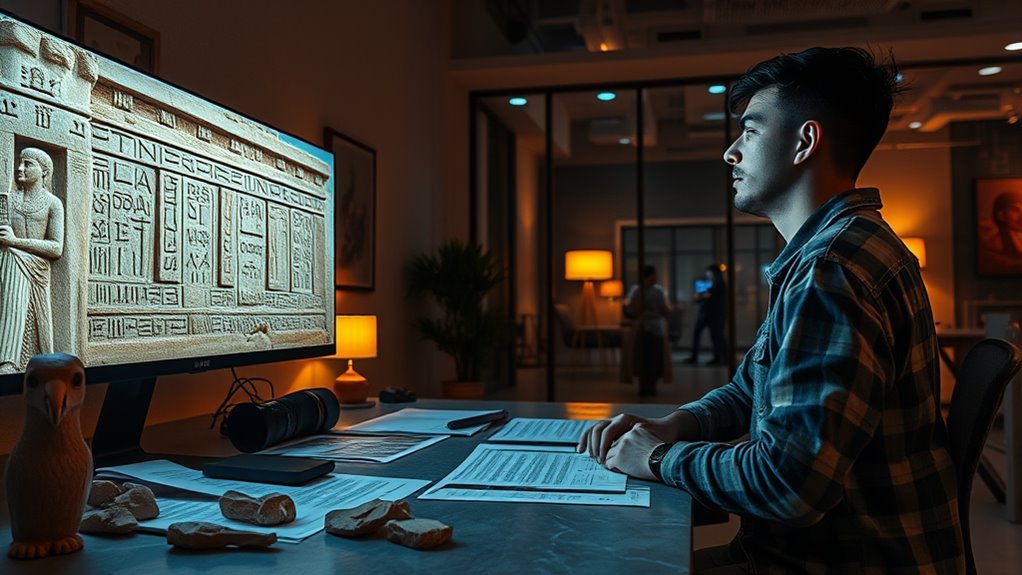
The core innovation is the native hieroglyphic processing engine, trained directly on high-fidelity epigraphic drawings, carved stone reliefs and manuscript-style papyrus documents drawn from temple walls, tombs and curated archives. Instead of piping images through generic vision systems and then applying separate translation models, Horus Hiero can take visual inputs of hieroglyphic inscriptions and produce structured English and Arabic translations in a single inference step.
This approach aims to recognise individual hieroglyphic signs, reconstruct their phonetic values and grammatical roles, and then interpret the wider religious, historical and cultural meanings encoded in full narrative sequences. It consequently targets full texts and narrative panels rather than isolated symbols, aligning model behaviour more closely with Egyptological reading practices.
TokenAI reports that the Horus Hiero 9B model scores 90 percent overall on its internal hieroglyphic benchmark, including 92.4 percent for visual symbol recognition and 89.3 percent for grammatical translation of hieroglyphic text. Horus Hiero Mini 4B achieves 84.2 percent on the same evaluation, reflecting a modest trade-off in accuracy for lower computational requirements.
The compact model is configured to run on standard CPUs and mobile devices, making offline real-time hieroglyphic translation feasible on budget hardware and in field settings such as archaeological sites or remote museums. On broader benchmarks, the flagship model posts competitive scores on mixed-subject reasoning, scientific question answering and code generation tasks, underscoring its role as a general-purpose system rather than a narrowly specialised heritage tool.