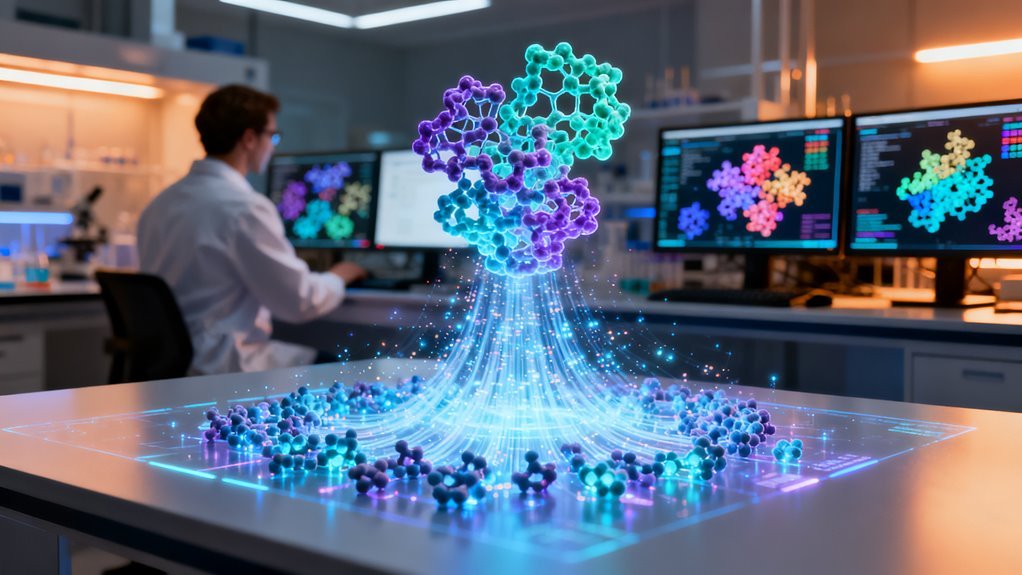
The protein universe just got a map. Meta’s ESM Atlas organizes roughly 6.8 billion protein sequences into a structured, searchable resource, pairing ESMFold2 for high resolution 3D structure prediction with ESMC for dense functional embeddings that capture what each protein actually does. A clustering algorithm carves this ocean of data into approximately 7.7 million protein neighborhoods, grouping sequences that share predicted functions even when their raw sequences show minimal overlap. The result is a resource that operates at five to thirty times the scale of DeepMind’s AlphaFold database, converting the massive and largely unexplored world of metagenomic protein data into something researchers and drug developers can actually work with.
That scale difference matters more than it might seem at first glance. AlphaFold transformed structural biology when it arrived in 2020, but its database primarily covers proteins from organisms whose genomes have been formally sequenced and cataloged. The metagenomic frontier, proteins found in environmental samples from ocean water to soil to the human gut, dwarfs that known universe by orders of magnitude. ESM Atlas is an attempt to make that dark matter of biology navigable.
For drug discovery teams, the practical value is immediate. Searching billions of proteins by predicted function rather than sequence similarity opens pathways to novel therapeutic targets and enzyme candidates that traditional homology searches would miss entirely. Enzyme engineering stands to benefit just as directly. Finding a protein with the right fold and the right predicted activity in a neighborhood of functionally related sequences compresses what used to be months of screening into computational queries.
But the competitive positioning, integration timeline and biosecurity implications of a resource this powerful reveal a more complex picture underneath the technical achievement.
Until this week, the vast majority of proteins known to exist on Earth were functionally invisible. They showed up in metagenomic surveys, got logged as sequences, and sat there. No structure. No annotation. No practical utility. The ESM Atlas changes that equation in a way that deserves more attention than it is getting.
Billions of proteins existed only as sequences. The ESM Atlas finally makes them visible, searchable, and useful.
Released as an open resource through the Biohub Platform, the atlas spans approximately 6.8 billion protein sequences pulled from bacteria, archaea, fungi, viruses, and animals. ESMFold2, the structural prediction engine at the center of this system, generates atomic level 3D structures directly from amino acid sequences, producing roughly 1.1 billion high resolution models. A protein language model called ESMC, trained on 2.8 billion sequences, encodes evolutionary signals into dense mathematical representations. And a sparse autoencoder breaks those representations down into about 16,000 interpretable features, effectively giving functional labels to proteins that no lab has ever physically characterized. This innovation aligns with AI agents that can rapidly generate hypotheses and propose experimental designs in scientific research.
The scale alone would be noteworthy. But what makes this consequential is the architecture behind it.
From Database to Landscape
Previous efforts in this space, including Meta’s own earlier metagenomic atlases containing 600 to 772 million structures, treated protein data more or less like a catalog. You could search it. You could compare entries. But the organizational logic remained anchored to conventional sequence homology, meaning you could only find what already looked like something you already knew about.
The ESM Atlas takes a fundamentally different approach. It treats protein space as a continuous, navigable landscape where every sequence carries an associated feature vector linking its structural and functional attributes. Protein clustering based on feature similarity groups the entire dataset into approximately 7.7 million neighborhoods, surfacing relationships that traditional sequence or structure comparison methods simply cannot detect. Two proteins with minimal sequence overlap might land in the same neighborhood because their learned representations share functional characteristics invisible at the sequence level.
This is not an incremental upgrade. It is a qualitative shift in how biological knowledge gets organized and accessed.
Why the Timing Matters
Three converging trends explain why this resource arrives now rather than two years ago.
First, the computational infrastructure for running protein language models at billion sequence scale has matured. Training ESMC on 2.8 billion sequences and generating over a billion structural predictions requires GPU clusters and engineering pipelines that were prohibitively expensive even in 2022, when AlphaFold2 was still the primary reference point for AI driven structural biology.
Second, the interpretability tooling has caught up. Sparse autoencoders capable of decomposing dense neural network representations into thousands of human readable features are a relatively recent development in the broader AI field. Anthropic has published notable work on similar decomposition techniques for large language models. Applying this approach to protein representations is a natural but nontrivial extension, and it solves a real problem: without interpretable features, a billion predicted structures are just expensive geometry.
Third, the metagenomic sequencing explosion has created a data surplus that existing tools could not metabolize. Environmental sequencing projects have been depositing vast numbers of uncharacterized protein sequences for years. The bottleneck was never data collection. It was making sense of what had been collected. The atlas converts that accumulated backlog into something researchers can actually work with.
Who Benefits and How
The immediate beneficiaries are computational biologists and drug discovery teams who previously had to choose between breadth and depth. Searching billions of proteins through sequence, structure, or natural language interfaces, with precomputed embeddings available through cloud APIs, collapses what used to be months of specialized pipeline construction into API calls. That is not hyperbole. Teams working on pathogen proteomics, host interaction networks, or enzyme engineering can now query protein space at a scale that was operationally impossible outside a handful of elite institutions.
Gene editing research stands to gain substantially. Mapping editing enzymes across the full tree of life reveals evolutionary trajectories and functional variants that manual literature searches could never surface. For companies building next generation genome engineering platforms, this is a competitive intelligence resource disguised as a scientific tool.
The CC BY 4.0 licensing on all metagenomic atlas components is worth pausing on. That license permits both academic and commercial reuse with attribution. In practical terms, biotech startups can build proprietary drug discovery pipelines on top of this atlas without negotiating data access agreements. The decision to make this fully open mirrors the strategic logic Meta has applied to its LLaMA language models: build the foundational layer, release it broadly, and let the ecosystem generate value that flows back through adjacent products and platform effects.
What People Are Overlooking
Most coverage of protein structure prediction still frames the field through the lens of AlphaFold versus everything else. That framing misses the real story. AlphaFold and AlphaFold2, developed by Google DeepMind, solved the structure prediction problem for individual proteins with extraordinary accuracy. But the ESM Atlas is solving a different problem entirely: organizing the functional relationships among billions of proteins into a system that supports discovery at scale.
The distinction matters because drug discovery and enzyme engineering are not bottlenecked by the ability to fold a single protein. They are bottlenecked by the ability to find the right protein among billions of candidates, understand its likely function without wet lab validation, and connect it to known biological systems. The interpretable feature layer and neighborhood clustering in the ESM Atlas directly attack that bottleneck.
There is also an underappreciated infrastructure story here. By exposing folding endpoints and embedding computations through cloud APIs, this resource becomes a building block for machine learning pipelines far beyond its original intended use. Expect to see it integrated into automated lab platforms, clinical genomics workflows, and agricultural biotech screening systems within the next 12 to 18 months.
The Competitive Landscape Shifts
Google DeepMind’s AlphaFold database currently covers over 200 million predicted structures and has been integrated into UniProt and other major biological databases. The ESM Atlas operates at roughly five to thirty times that scale depending on how you count, and it adds functional annotation and relational clustering that AlphaFold’s database does not provide. This does not make AlphaFold obsolete. It does mean that the frontier of computational biology has moved beyond structure prediction into something more ambitious: a unified, queryable map of protein function across all known life. Meanwhile, drug firms are increasingly creating their own protein databases to maintain proprietary advantages even as open resources like this reshape the competitive baseline.
For the broader AI industry, the ESM Atlas illustrates a pattern that keeps repeating. Foundation models trained on domain specific data, combined with interpretability tools and open access distribution, are quietly reshaping entire scientific fields. The same architectural principles driving progress in language, vision, and code generation are now producing results in molecular biology that would have seemed implausible five years ago.
The organizations best positioned to capitalize are those already building at the intersection of AI infrastructure and biological data. Recursion Pharmaceuticals, Isomorphic Labs (a DeepMind spinoff focused on drug discovery), and a growing number of startups in the computational biology space will all need to recalibrate their strategies in light of what is now freely available.
Risks and Open Questions
Open access to billions of annotated protein structures is overwhelmingly positive for science. It also raises questions that the research community has not fully resolved. Functional annotations derived from learned representations, however interpretable, are predictions. They carry uncertainty. When those predictions feed into drug target identification or enzyme engineering, the downstream consequences of errors become significant. The atlas provides extraordinary coverage, but coverage is not the same as accuracy, and the distinction between the two will matter in clinical and regulatory contexts.
There is also the dual use dimension. A searchable, feature annotated map of viral and bacterial proteins accessible through a simple API lowers the barrier to identifying novel pathogenic mechanisms. Biosecurity discussions have historically focused on DNA synthesis screening. Protein function prediction at this scale introduces a new category of concern that policy frameworks have not yet addressed.
What Comes Next
The trajectory here is clear. Within two to three years, expect protein language models to be standard components in pharmaceutical R&D pipelines, not experimental additions. The ESM Atlas establishes a baseline that future releases will extend with higher resolution predictions, richer functional annotations, and tighter integration with experimental validation data.
More broadly, this release reinforces a lesson the AI industry keeps teaching: the most transformative applications of foundation models are not chatbots or image generators. They are systems that organize previously inaccessible knowledge into forms that accelerate scientific and engineering work. Protein biology just got its searchable map. The question now is how fast the field can learn to read it.