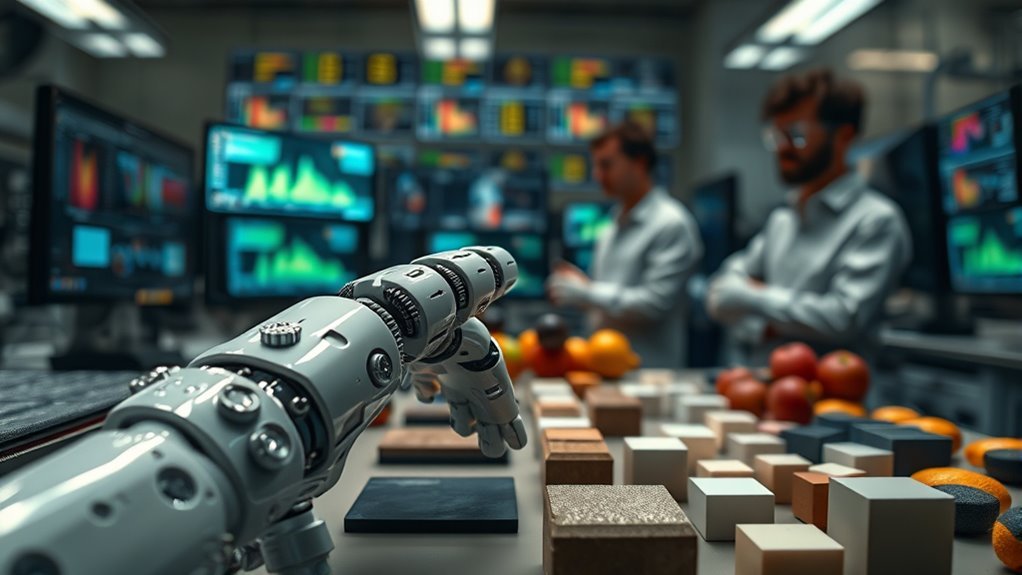

Touch is becoming the missing sense that separates clever robot demos from truly capable embodied agents. As foundation models for robots start to look more like their counterparts in language and vision, the decisive question is no longer only what a model can see but what it can feel and how it learns from millions of tiny contacts over time. This emphasis on touch underscores the fundamental role of physical interaction in human embodiment and highlights how far current robots still lag in matching that dexterity. By 2030, 25% of IT operations work is projected to be managed by autonomous AI, which further underscores the growing importance of advanced interaction modeling.
How we reached the touch first moment
For most of the last decade, robot learning was dominated by vision centric datasets and narrow task collections. Labs gathered a few dozen manipulation tasks, captured camera feeds, logged joint positions and trained policies that worked in carefully controlled environments. The systems often struggled when surfaces became slippery, objects deformable or contacts uncertain.
Vision-only robots falter when contact turns messy: slippery surfaces, deformable objects, uncertain grasps.
The new wave of tactile and embodied datasets is changing that picture by treating contact itself as a primary signal rather than an afterthought. Large dynamics centric foundation models such as LDA 1B rely on continuous streams of interaction trajectories to learn how actions transform the world over time, not just how to recognize scenes in static images. That shift demands data that spans robots and humans, simulation and reality, and multiple sensor modalities.
Inside EI 30k the embodied interaction backbone
The EI 30k Embodied Interaction Dataset is a good illustration of how seriously the community now takes this requirement. It collects more than 30 thousand hours of trajectories from human and robot interactions, all converted into a unified format that standardizes observations, actions and language.
The composition is deliberately diverse. Around 8.03 thousand hours come from real world robot executions, roughly 8.6 thousand hours from simulated robot runs, about 7.2 thousand hours from human demonstrations with actions, and another 10 thousand hours from human videos without explicit action labels.
Several design choices show a mature understanding of data quality. The subdatasets carry quality labels, making it possible to study how lower fidelity sources such as noisy simulation or actionless videos contribute to training compared with higher fidelity streams like real robot force readings and well curated human demonstrations. Everything is converted into the LeRobot format, so researchers are spared the usual engineering work of handling many different logging standards and can instead focus on model design and evaluation.
EI 30k supports multiple research directions at once. It enables direct comparison between synthetic and physical interaction, supports imitation learning from human examples, and provides rich context for grounding scene understanding in everyday embodied behavior. In practice, this means that a single foundation model can learn from a robot stacking blocks in a lab, a human cooking in a kitchen and a simulated agent manipulating tools, while sharing a common representation of actions and consequences.
From one off datasets to continuous industrial pipelines
The emergence of EI 30k sits alongside a quieter but equally important shift toward industrial scale data pipelines. The commercial order described from Robo.ai to DaBoss.AI for another 30 thousand hours of embodied robot training data is not an isolated anecdote. It reflects a broader movement from one time academic releases toward continuous inflows of calibrated interaction data.
In these industrial streams, the emphasis is on completeness and reliability. Data for Level 4 plus embodied AI models is engineered to combine RGB plus depth vision, six degree of freedom motion trajectories and force or tactile feedback tied directly to control and evaluation workflows. The definition of physical AI touch data here is very specific. Each contact is timestamped, calibrated against the robot geometry and linked to the commands issued and the outcomes observed, turning raw sensor readings into structured training input.
This is the sort of pipeline that businesses need if they want robots to adapt to evolving products, tools and environments. Rather than retraining from scratch on static datasets, they can maintain a growing reservoir of contact rich experience that reflects their actual operations. The tradeoff is governance. Industrial touch data can reveal fine grained information about production processes, quality issues and even worker behavior, so companies must treat it as sensitive operational telemetry, not disposable logs.
Bridging vision and touch in a single stream
A key technical challenge is connecting what robots see with what they feel in a way that models can exploit. Bridging datasets do exactly that by synchronizing camera images, tactile sensor outputs and end effector configurations.
One representative collection stores RGB images, tactile sensor images and end effector states at 20 frames per second. Each trial contains 40 aligned frames, preprocessed to a 256 by 256 by 3 RGB format. This kind of setup provides a compact but information rich slice of interaction in which the model can learn to predict not only the next visual frame but also the evolution of contact forces as the gripper moves or slides across a surface.
TacQuad pushes the idea further into the multisensor regime. It is an aligned multimodal tactile dataset collected from four different visuo tactile sensors, including commercial sensors such as GelSight Mini and DIGIT and custom devices like DuraGel and Tac3D. The dataset comprises 72 thousand 606 contact frames paired with visual information and text descriptions of tactile properties, giving models a granular view of how different sensors respond to the same physical events.
TacQuad was designed to address a specific historical problem. Because visuo tactile sensors have developed quickly with little standardization, most previous work trained models tied tightly to a single sensor type. Generalization across sensors was poor, and data scale was limited. By aligning data from multiple sensors and publishing it with an accompanying framework called AnyTouch, TacQuad offers a common space in which static tactile images and dynamic tactile videos can be integrated and learned jointly.
AnyTouch uses a multi level architecture to capture both fine grained pixel details for precise manipulation tasks and higher level sensor agnostic features that describe material and contact properties. New datasets such as TacVerse extend this trend by benchmarking multisensor tactile perception and emphasizing unified representations across touch, vision and language.
Collectively, these resources allow embodied agents to build latent dynamics models that predict how interactions will unfold, not just which object is present.
Contact rich manipulation at unprecedented scale
Touch data becomes truly transformative when scale meets task diversity. RH20T exemplifies this point. It is a large scale multimodal dataset focused on contact rich manipulation, collected by teams at Tsinghua University and Shanghai AI Lab. RH20T contains more than 110 thousand robot manipulation sequences captured in the real world, spanning around 147 task configurations grouped into 20 broad task families that include pouring, stacking, wiping, stirring, cutting, scooping and complex tool use.
Each sequence includes visual data, force readings, audio and action logs, together with a corresponding human demonstration video. That multimodal pairing makes RH20T especially useful for studying how to transfer skills from human teachers to robots and how to leverage sound and contact patterns to disambiguate visually similar states.
Other collections, such as rapid pipelines like Open X, TacTip based datasets and humanoid visual tactile action records, add breadth by covering more object types, surfaces and whole body interactions. On top of TacQuad, the AnyTouch framework and related efforts like AnyTouch inspired sensor tokens demonstrate how cumulative touch experience across many sensors and tasks can train policies that treat contact as the main feedback signal for control and planning in realistic environments.
Implications for technology and business
From a technology standpoint, these datasets are the foundation for robot models that resemble large language models in their generality but are grounded in the physics of contact. EI 30k and RH20T provide the breadth and depth needed to train dynamics centric models that can forecast future observations, infer hidden states from partial tactile cues and generate action sequences that achieve goals under uncertainty.
TacQuad and AnyTouch tackle the sensor heterogeneity problem, making it more feasible to deploy models across different hardware platforms without retraining from scratch for each new tactile device. For businesses, the practical upside is more adaptable automation. Robots that understand how a tool feels when it slips, how a deformable package reacts to pressure or how an unseen edge responds to touch can work with greater autonomy in manufacturing, logistics, agriculture and service environments.
Foundation models trained on embodied interaction data promise quicker retargeting of skills from one product line or environment to another, reducing downtime and integration costs. At the same time, there are real constraints. Robust generalization still depends on whether the tasks and materials seen during training resemble those in deployment. Many touch datasets focus on tabletop manipulation with a limited set of household or industrial objects. Domain gaps will remain when robots encounter atypical materials or novel tools.
Sensor hardware also evolves quickly, so representation learning frameworks must keep pace to avoid being locked into obsolete devices.
Societal considerations and emerging risks
On the societal side, touch aware robots will alter how people experience automation. Machines that can safely handle delicate items, interact more naturally with humans and operate in contact rich settings could enable new forms of assistance in healthcare, elder care and rehabilitation. They can also take on hazardous tasks in maintenance, construction and disaster response.
However, concentration of high quality embodied data in a small number of companies and research consortia raises questions. If only a few actors can afford to collect and maintain hundreds of thousands of hours of calibrated contact data, the resulting models may embed their particular assumptions about safety, efficiency and acceptable behavior.
Researchers have already begun to discuss how to benchmark embodied datasets not just on task coverage but on robustness, fairness and failure modes, as reflected in community debates about whether collections like EI 30k are sufficiently broad for reliable generalization.
Privacy and transparency are another concern. Industrial touch datasets may incidentally capture patterns related to human activity, tool use and workflow organization. Clear policies about data retention, anonymization and access control will be essential if this data is shared beyond the originating company or used to train general purpose models.
What to watch next
The trajectory is clear. Touch is moving from a niche research topic to a core component of robot foundation models, supported by systematic datasets and industrial pipelines. Over the next few years, progress will likely hinge on three intertwined threads.
First, scaling embodied datasets further while maintaining careful curation and benchmarking.
Second, improving multisensor representation learning so that models work across different tactile and vision setups without brittle recalibration.
Third, aligning industrial incentives with open research goals so that advances in touch aware robotics benefit a wide community rather than a few large players.
For practitioners, the takeaway is that investing in well structured touch data now is akin to investing in text corpora before the rise of modern language models. For policymakers and business leaders, the challenge is to ensure that the emerging touch infrastructure is governed responsibly and shared thoughtfully. How that balance is struck will determine whether touch data for smarter robots becomes a broadly empowering technology or a narrow competitive edge.
Conclusion
Robots are finally starting to feel the world rather than just see it, and a thirty thousand hour touch dataset is a meaningful turning point in that story. It moves tactile perception from a niche hardware curiosity into something that can be trained at scale, much closer to how vision and language models already grow with massive data.
Why touch data matters now
For most of the past decade, progress in artificial intelligence has been driven by text and images. Large language models train on trillions of tokens, and vision systems learn from millions of labeled images and countless hours of video. Yet robot learning has lagged behind because gathering real interaction data with the physical world is slow, expensive, and risky.
When groups such as Physical Intelligence reported collecting about ten thousand hours of robot data to train their first embodied foundation model, PI0, it was already seen as a major milestone in scaling robot experience beyond small lab datasets. In parallel, companies like Rokoko assembled more than ten thousand hours of human motion clips as a resource for training robotics and animation systems. These efforts showed that building large scale corpora for embodiment is possible, but they still leaned heavily on motion and observation rather than rich touch.
A corpus of thirty thousand hours focused on tactile interaction pushes that boundary further. It suggests that touch is becoming a first class modality for embodied intelligence, not an afterthought bolted onto vision and control.
How this dataset changes the game
The key difference with a touch focused dataset is what it captures. Visual datasets record how the world looks. Motion datasets record how bodies move. Tactile datasets record what physical contact feels like across many surfaces, pressures, failures, and successes.
Recent work such as the OpenTouch project already demonstrated that even a few hours of synchronized video, touch, and hand pose data can significantly improve models of contact rich manipulation and multimodal perception. The AGIBOT Rich Interaction dataset extended that idea by deliberately collecting both successful grasps and messy physical events such as collisions, drops, unstable contacts, and liquid splashes in real environments. These projects underline a simple principle. Embodied systems learn best when exposed to the full spectrum of what actually happens during interaction, not just clean demonstrations.
Scaling to thirty thousand hours of touch builds on that principle in three important ways.
First, it dramatically broadens the variety of contact events. With that amount of data, models can see rigid objects, deformable materials, textured surfaces, slippery liquids, accidental bumps, and purposeful grasps repeated across many contexts. That diversity is essential for learning robust tactile representations that generalize beyond a single lab setup.
Second, it aligns tactile learning with the scale of other embodied datasets. Egocentric collections such as Egocentric 10K with ten thousand hours of first person factory work video and more than one billion frames show how much visual experience can shape robot learning in industrial settings. A thirty thousand hour touch dataset starts to provide comparable depth for contact rich tasks, so unified models can learn joint patterns across sight, motion, and feel.
Third, it narrows the gap between simulation and reality. Simulated robots rarely experience the subtle edge cases of contact that define whether a manipulation succeeds or fails. By recording large volumes of real physical interactions, including imperfect behavior, tactile datasets provide anchors that help world models and neural simulators stay honest about friction, compliance, and unexpected dynamics.
Historical context for robot data at scale
To understand why thirty thousand hours of touch is notable, it helps to look at the broader history of robot and embodied data.
Vision and scene understanding moved first. Datasets such as Habitat Matterport 3D collected around one thousand detailed scans of indoor spaces to improve navigation and spatial perception for embodied agents. These benchmarks let researchers test path planning and exploration in realistic environments but did not directly capture contact.
Industrial and egocentric datasets followed. Egocentric 10K gathered ten thousand hours of authentic factory worker video across thousands of workers worldwide, framing industrial action from the human point of view. This kind of data offered rich hand motion and object usage, ideal for imitation learning and task recognition, but again the sense of touch remained implicit, inferred from what cameras could see.
More recently, companies have started treating data collection itself as a business. A Dubai based joint venture secured a contract to deliver thirty thousand hours of robot training data spanning teleoperated and autonomous task execution for an unnamed client. That agreement illustrates the growing belief that curated robot interaction data at large scale is valuable enough to be a standalone product, not just an internal cost.
Against this backdrop, a thirty thousand hour tactile dataset stands out because it directly targets the sensory channel that robots historically lacked. It signals that touch is catching up with vision and motion in terms of investment and scale.
Technical implications for embodied AI
On the technical side, a large touch dataset enables more than just better grasping. It can support several layers of embodied intelligence.
Tactile representation learning becomes more data driven. Instead of hand tuned features from individual sensors, models can learn high dimensional embeddings of contact episodes, where similar patterns such as sliding, tapping, squeezing, or slipping cluster together. With enough examples, these embeddings can be shared across different robot hands and skin designs, improving transfer and reducing per robot calibration.
Multimodal fusion gains a stronger foundation. Projects like OpenTouch already show that aligning video, pose, and touch improves egocentric perception and manipulation benchmarks. With thirty thousand hours of diverse data, researchers can train joint models that treat tactile signals as equal partners with images and proprioception. That matters for tasks where seeing is not enough, such as judging when a screw is fully seated or when a cloth has stopped wrinkling during folding.
Policy learning can shift toward foundation style models. When Physical Intelligence trained PI0 on about ten thousand hours of robot data, they demonstrated that a single large model could learn broadly useful manipulation skills that transfer across tasks. Combining that approach with rich tactile data opens the door to foundation policies that understand both what they see and what they feel, which in turn supports more general everyday behaviors.
Finally, data scale supports more realistic simulators. AGIBOT explicitly positions its Rich Interaction dataset as a resource for world models and physics informed perception. Thirty thousand hours of touch can feed similar simulators, letting them learn distributional properties of contact such as how often grips fail, where slip happens, and how objects deform. That can reduce the notorious sim to real gap that has limited deployment of robot learning systems.
Impact on businesses and industries
For businesses, the shift toward large scale touch data changes both capability and risk calculus.
Manufacturing and logistics stand to benefit first. Egocentric industrial datasets already help automate inspection, picking, and assembly because they capture how humans actually work on the shop floor. Adding rich touch data lets robots handle more delicate processes, such as fitting parts with tight tolerances, managing soft goods, or manipulating small components without damaging them. The result is not simply higher throughput but higher reliability under real conditions.
Data providers see a clearer market. The thirty thousand hour contract secured by Robo dot ai shows that selling embodied AI training data can be a meaningful revenue engine in its own right. A large tactile dataset follows the same logic. It can be licensed to hardware makers, platform companies, and research labs that need contact rich experience but cannot afford to gather it from scratch.
Human robot interaction also changes. When robots can sense and interpret touch with nuance, they can respond to pushes, taps, and shared guidance more like collaborative partners than blind machines. This unlocks new roles in healthcare, domestic assistance, and frontline service where physical contact is normal, but it also heightens expectations around safety and predictability.
Societal opportunities and risks
The societal story is complex and warrants careful analysis.
On the opportunity side, better tactile robots can reduce physical strain and injury in repetitive or hazardous jobs. Datasets like Egocentric 10K already document the complexity and ergonomics of factory work. When robots gain the ability to feel and adjust their force in real time, they can take over tasks that currently cause musculoskeletal issues for human workers, such as heavy lifting or fine repetitive manipulation.
Improved touch also supports assistive technologies. Robots that can sense subtle contact and pressure can help with dressing, mobility support, and home care without excessive risk of harm, provided that models are trained and validated rigorously.
However, scaling touch data raises serious questions.
Privacy and consent are central. Egocentric datasets of human activity typically rely on clear consent and anonymization to protect workers and participants. Tactile datasets might seem less sensitive, but they can still encode patterns of use, occupational processes, and proprietary workflows, especially when collected in factories or clinics. Careless sharing could expose competitive or personal information even without obvious identifiers.
Safety is another concern. AGIBOT highlights that real world interaction includes collisions, drops, and splashes as part of the training signal. While learning from these events is essential for robustness, deployed systems must be held to stricter standards. There is a risk that models trained on rich failure data might accept a level of physical risk that is appropriate for simulation or controlled labs but unacceptable in public spaces.
Labor dynamics also need attention. As tactile capable robots expand their domain, certain manual roles will change or disappear. Historically, automation of perception and motion has shifted tasks rather than simply removing them, but touch enabled robots can enter new categories of work that were previously protected by the need for fine physical skill.
Trust will hinge on transparency. Companies using large tactile datasets must explain where the data comes from, how it is curated, and what safeguards exist. Without that, the public will rightly be skeptical of robots that physically interact in sensitive settings.
Limitations and open questions
Despite the excitement, several limitations remain.
The true diversity of the thirty thousand hours matters more than the headline number. If most of the dataset comes from a narrow set of tasks, environments, or hardware, models may overfit to those conditions. OpenTouch, for instance, describes itself as the first in the wild egocentric full hand tactile dataset, emphasizing varied scenarios rather than sheer volume. A balanced tactile corpus must replicate that attention to breadth.
Sensor standardization is another open issue. Unlike cameras, tactile sensors vary widely in design, mounting, and signal processing. Creating models that generalize across different skins and grippers requires careful normalization and perhaps shared benchmarks similar to visual scene datasets such as Habitat Matterport 3D.
Evaluation is still immature. There is no widely accepted equivalent of ImageNet or COCO for touch. Benchmarks from projects like OpenTouch and AGIBOT are important first steps, but the community will need agreed metrics for tactile understanding, safe manipulation, and human interaction.
Finally, there is the question of access. Some large datasets, including Egocentric 10K and Rokoko motion data, are open or broadly accessible with clear licenses. Others, such as commercial training contracts, remain proprietary. The impact of a thirty thousand hour touch dataset will depend heavily on whether it is freely shared, partially restricted, or entirely closed.
What to watch next
Looking ahead, several trends are worth tracking.
First, convergence between modalities. As more datasets combine vision, motion, and touch in synchronized form, models will increasingly learn unified representations of interaction rather than siloed skills.
Second, the rise of foundation models for embodiment. PI0 and similar systems show what is possible with ten thousand hours of robot data. Adding thirty thousand hours of tactile experience may accelerate a new wave of generalist manipulation models that can adapt to new tasks with minimal fine tuning.
Third, the professionalization of data collection. Companies already treat embodied AI data as a service and product line. Expect specialized providers for tactile logging, annotation, and benchmarking, alongside stricter governance frameworks.
Finally, the policy conversation. Regulators and industry bodies will need to address safety standards for physically interactive agents, transparency rules for dataset provenance, and guidelines on human robot collaboration in touch heavy domains.
The release of thirty thousand hours of touch data does not make robots human, but it does give them a much richer vocabulary of physical experience. The real test will be whether the community uses that experience to build systems that are not only more capable, but also safer, more transparent, and genuinely aligned with human needs. reddit