Voices carry more than words. They encode memory, identity, and trust in a way that text never quite matches. When a voice is damaged or lost, whether through aging tape, a studio mishap, or a medical condition, the loss is personal and often irreversible. The reason the current wave of AI voice restoration matters is simple. For the first time, we have systems that do not just clean audio. They rebuild voices and extend them beyond the limits of their original recordings.
Over the past few years, AI audio technology has shifted from basic denoising to generative reconstruction. Traditional tools treated noise as something to remove and speech as something to preserve. They filtered, equalized, and masked, but they were constrained by the information present in the waveform. Generative models take a different view. They treat a damaged recording as a clue rather than a constraint and use learned representations of human speech to infer what is missing. Reviews of generative speech restoration systems point out that discriminative approaches cannot restore clipped syllables or bandwidth limited content, while diffusion and other generative models can plausibly reconstruct those lost components. This is the technical inflection point that makes true voice restoration possible, as AI’s economic impact centers on task reconfiguration rather than outright job displacement.
Under the hood, modern voice engines learn a compact representation of a speaker. The system ingests whatever clean audio exists, sometimes only a few seconds of usable material, and maps it into an embedding that captures pitch, timing, pronunciation, breath, and vocal color. Frameworks such as VoiceFixer and later Voice ENHANCE combine this kind of representation with generative vocoders and diffusion models to handle noise, reverberation, codec artifacts, and missing frequency bands in a unified way. In addition, federal safety evaluations ensure that these emerging technologies meet rigorous standards before deployment.
In plain terms, one part of the system learns what this particular person sounds like, and another part learns what undamaged speech ought to look like. When combined, the model can generate new lines in a familiar voice that may never have been recorded in the first place. This advancement comes at a time when data breaches pose significant risks to the integrity of AI systems. Furthermore, the ongoing U.S. scrutiny over intellectual property theft emphasizes the need for robust protections in AI technology.
That separation between linguistic content and vocal identity is strategically important. Once text and voice are decoupled, any sentence can be spoken in any learned voice. For creatives, that unlocks practical tools. An editor who has a rough script and a damaged interview can align transcripts to remaining audio, then use speech-to-speech synthesis to fill gaps with reconstructed dialogue that matches tone and pacing. Research on multi-speaker restoration shows that generative networks conditioned on degraded audio, transcriptions, and speaker embeddings can produce clear speech that preserves original prosody and timing even when the source is severely distorted.
For studios, this moves voice work from a fixed artifact to something that can be revised late in the production process without reshoots.
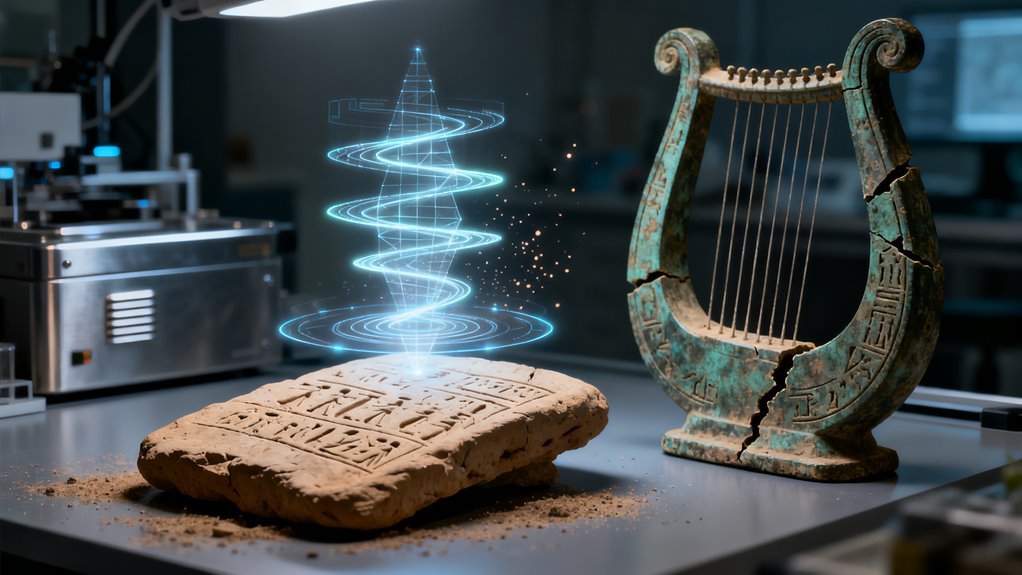
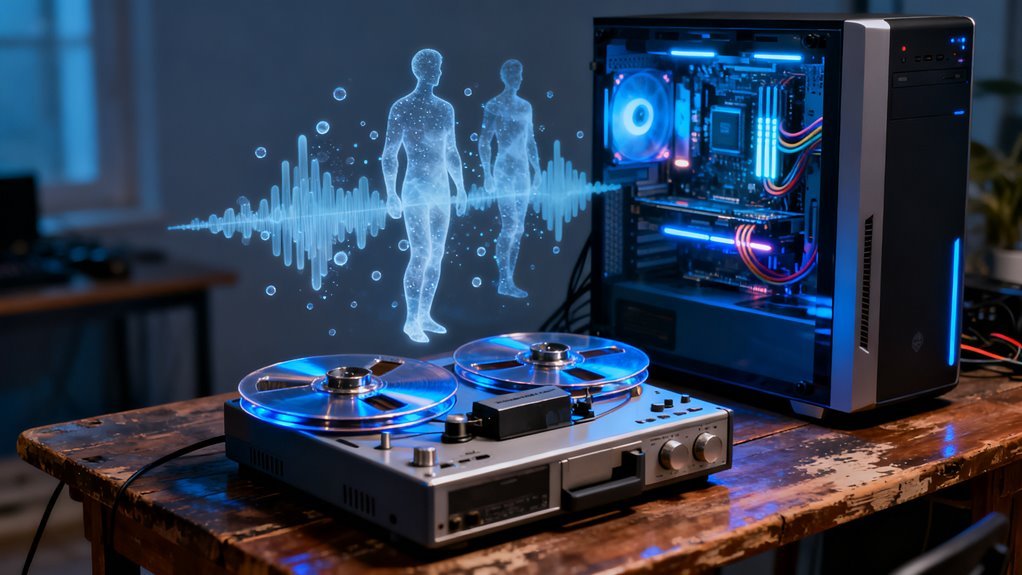
Archival projects feel this shift most acutely. Libraries, broadcasters, and film studios sit on vast catalogs of fragile recordings. Until recently, restoration meant cleaning the tapes as much as possible and accepting the remaining limitations. New pipelines treat every form of degradation as part of a joint inference problem. Unified restoration models trained on synthetic distortions can recognize the fingerprints of room echo, tape hiss, bandwidth limits, and packet loss, then resynthesize cleaner speech at higher sample rates.
A recent framework for high-resolution restoration uses latent diffusion to regenerate high-frequency details and consistently outperforms previous methods in human listening tests. That is not just a technical win. It changes how institutions think about the economic value of their archives because material that was previously unusable can now be turned into commercial documentaries, podcasts, and educational content.
There is a more emotionally charged use case. Several research groups have started to explore the reconstruction of deceased voices from low-quality sources. A preprint on low-quality speech reconstruction proposes combining advanced noise reduction, spectral patching, and text-to-speech and speech-to-speech models to rebuild coherent speaker-specific speech from degraded recordings. For families and cultural institutions, this offers a way to preserve or reanimate voices that would otherwise fade from living memory.
It also raises hard questions about consent, artistic integrity, and historical accuracy. The technology can interpolate missing words in an interview or recreate an entire reading that never happened. Archivists and ethicists will need to decide where restoration ends and fictionalization begins.
Clinical applications bring the stakes even closer. Voice banking services already allow people with progressive conditions to record samples in advance so that assistive devices can later speak in a voice that still feels like their own. For individuals with degenerative diseases such as ALS, voice banking can help preserve a sense of identity and emotional connection even after natural speech is lost. That concept is now merging with more advanced generative engines. Instead of a flat synthetic tone, assistive speech can carry personal inflection, regional accent, and emotional nuance.
Silent speech interfaces go further. Researchers have demonstrated systems that read subtle movements in neck muscles using optical sensors and then employ AI voice synthesis trained on the individual to reconstruct spoken words in their own voice. At the frontier, a brain-to-voice neuroprosthesis from the University of California Berkeley decodes signals from the motor cortex and synthesizes naturalistic speech in near real time. Taken together, these projects point toward a world in which a person who cannot vocalize in the traditional sense can still speak and still sound recognizably like themselves.
For technology companies, this is not a niche capability. Voice is becoming a core part of the interface layer for AI platforms. OpenAI, Google, and others have already moved from text-only assistants to multimodal systems that listen, speak, and interpret visual context. Although most of the public attention has focused on conversational convenience, the deeper shift is toward models that understand and reproduce human performance characteristics.
Once a model can reliably keep track of who is speaking, preserve vocal identity, and reconstruct damaged segments, the same underlying technology can be repurposed across products: customer service bots that mimic brand voices, accessibility tools that offer individualized speech, or collaborative editing suites where synthetic voice tracks are a standard part of the workflow.
The business impact cuts across sectors. Media companies gain new levers for extending their catalogs. Audio restoration powered by generative models allows studios to salvage previously unusable takes, reconstruct dialogue for international versions, and create director’s cuts that would have been impossible with physical reshoots alone.
A technical review of Voice ENHANCE describes a two-stage pipeline that first restores degraded signals and then performs voice conversion, yielding studio-level speech even from low bandwidth sources. That kind of quality opens revenue streams around remastered classics, immersive re-releases, and interactive experiences where historical voices respond to audience input. At the same time, independent creators gain access to tools that used to require specialist engineers, compressing the gap between big studio capabilities and what can be done on a laptop.
Healthcare and insurance ecosystems feel different pressures. As silent speech systems and neuroprosthetics move closer to clinical deployment, regulators and payers must decide how to classify and reimburse them. Are personalized voice models part of a medical device, or a cloud service attached to one? How is long-term storage of voice embeddings governed, and can they be ported between vendors when patients switch providers?
These are not just policy details. They determine whether hospitals and device manufacturers can build sustainable business models around voice restoration. In countries where public systems set reimbursement rates, the economic viability of speech neuroprostheses could hinge on how quickly regulators accept AI synthesizers as standard care rather than experimental add-ons.
Any technology that manipulates personal identity at this level invites abuse. The same voice cloning tools that reconstruct archived dialogue or restore a patient’s speech can create convincing impersonations of public figures and private individuals. Laws around deepfake audio are starting to emerge, but enforcement remains patchy and often reactive.
Banks and governments that rely heavily on voice authentication now face a rapidly closing window to upgrade their security. Pattern-based voiceprints are unlikely to remain robust once generative models can shape audio to match those features. Institutions will need layered identity checks and perhaps cryptographic links between approved synthetic voices and verified identities.
The industry is responding with a mix of technical and policy proposals. Watermarking systems that embed hidden patterns in synthetic speech are one avenue, but they require cooperation between tool providers and distribution platforms. Some researchers argue that watermarking should be integrated directly into the neural vocoders and restoration frameworks that produce the audio so that any output from those systems can be flagged downstream.
Others push for strict provenance tracking, where studios and broadcasters maintain signed records of when and how archival voices have been reconstructed. For now, there is very little consensus across borders, and the regulatory landscape is fragmenting. The European Union AI Act, various national deepfake statutes, and sector-specific guidelines are evolving in parallel but not in harmony.
For developers and founders, the opportunity sits in the gap between what the models can technically do and what institutions are ready to adopt. Tooling that makes voice restoration workflows reproducible and auditable will be in demand.
So will interfaces that help non-specialists understand the tradeoffs between aggressive reconstruction and conservative enhancement. A museum may accept more hallucinated content in a staged exhibit than in an official historical record. A hospital may prefer slightly less natural speech if it can be guaranteed to reflect the patient’s intent with higher fidelity. Products that allow those preferences to be encoded and enforced will stand out.
Looking across the broader AI trajectory, voice restoration is part of a shift toward systems that operate on human signals rather than just symbols. Text was the first substrate for large-scale models. Images and video followed. Now the boundary is moving into embodied channels, from muscle signals to neural activity.
The brain-to-voice work from Berkeley and silent speech systems using neck muscle sensing show how quickly decoding non-vocal signals into fluent speech is becoming practical. Over the next several years, expect more projects that treat physical recordings as loose hints and rely on generative priors for the heavy lifting.
The overlooked implication is that personal models are quietly becoming a new digital asset class. A voice embedding trained on a person’s speech is not just a one-off tool for a single app. It can follow them across services, devices, and time.
Businesses that help individuals manage, port, and retire those models responsibly could play a role analogous to identity providers on the web. Governments may eventually treat voice models as part of a broader category of biometric data that requires explicit consent and clear usage boundaries. Everyday users will need to decide whom they trust to hold the keys to something as intimate as their voice.
What began as a way to fix noisy recordings is turning into a deeper recalibration of how we think about identity in digital systems. AI that restores voices forces hard decisions about authenticity, consent, and ownership, but it also offers a path to preserve human presence in ways that were impossible even a decade ago.
The direction of travel is clear. As generative audio matures, businesses, institutions, and individuals will not just listen to what is said. They will ask who is speaking, how that voice was constructed, and what it means to give it life again.
Conclusion
As AI systems learn to pull coherent speech out of warped tapes and scratched discs, they quietly change what counts as lost history. Fragile recordings that once sat in boxes as emotional artifacts rather than usable documents are returning as clear, recognisably human voices that people can listen to and work with. The reconstructed tracks do not replace the originals; they sit beside them like a restored print beside a damaged negative, providing a reference point where the source had collapsed into noise. In institutional archives, small production studios and family collections, this kind of sound reconstruction turns memory into something searchable and revisitable rather than a vague story passed down across generations. Material that was technically beyond rescue becomes newly audible, expanding the record for historians, journalists and families who had assumed those voices were gone. The real surprise is not just the improvement in fidelity but the reminder that vast portions of the twentieth century soundscape still exist in damaged grooves and fading magnetic tape, waiting for someone to point modern models at them and listen.