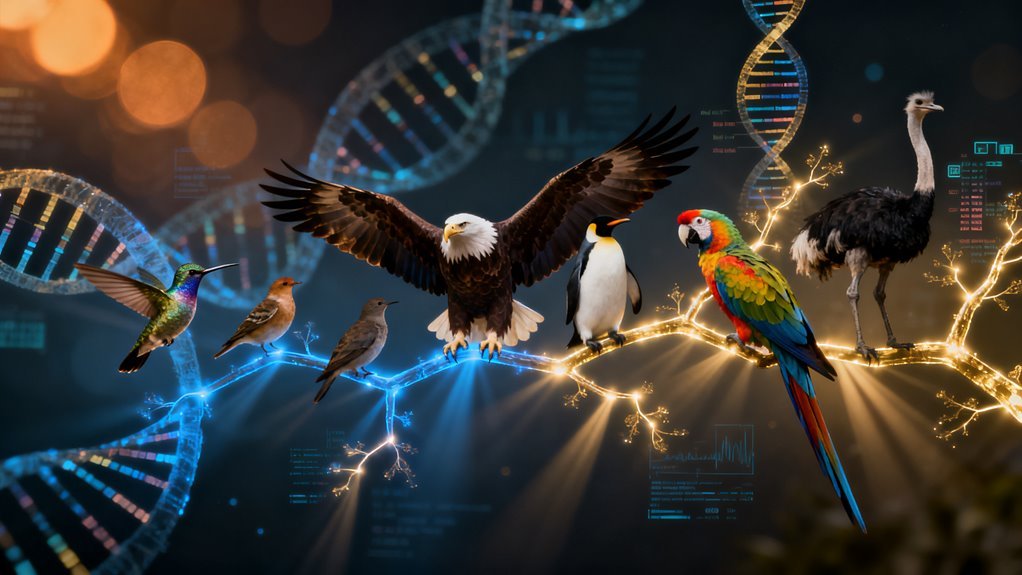

When AI Looks at Bird Bones, It Finds Something Paleontologists Missed for Decades
Evolution doesn’t always move at the pace we assumed. That’s the takeaway from a striking new study where machine learning tools did something human researchers never could at scale: they measured and compared thousands of passerine bird skeletons stored in natural history museums around the world, and the data tells a story that challenges one of biology’s longest running debates.
Two AI systems, Skelevision and Bifrost, automated what would have taken teams of anatomists years to accomplish manually. Skelevision handles the scanning and digitization of skeletal specimens. Bifrost processes the resulting data to identify morphological patterns across species and time periods. Together, they crunched through an enormous dataset of museum specimens and found that passerine birds, the order that includes more than half of all living bird species, didn’t diversify through slow, steady adaptation. Instead, their skeletal forms changed in rapid, dramatic bursts concentrated around two specific windows: roughly 35 million years ago and again around 15 million years ago.
Both periods coincide with major climate upheavals. The earlier window aligns with the sharp cooling at the Eocene to Oligocene boundary, when Antarctic ice sheets expanded and global ecosystems were reorganized. The later burst corresponds to the Middle Miocene disruption, another period of significant temperature and habitat change. The correlation is hard to ignore.
Why This Matters Beyond Biology
On the surface, this looks like a paleontology story. But the real significance sits at the intersection of AI capability and scientific methodology, and it carries implications that technology professionals should pay attention to.
What happened here is a pattern that keeps repeating across disciplines. Researchers had access to the raw data for decades. Museum collections holding these specimens have existed for over a century in some cases. The bottleneck was never access to evidence. It was the ability to process that evidence at scale with enough precision to detect signals buried in noise.
This is the same dynamic playing out in drug discovery, materials science, climate modeling, and genomics. AI isn’t generating new data in these cases. It’s making existing data legible for the first time. The tools are functioning as analytical microscopes, revealing structure that was always present but invisible to manual methods.
The comparison to what AlphaFold did for protein structure prediction is instructive. DeepMind’s system didn’t discover new proteins. It predicted the three dimensional shapes of proteins that scientists already knew existed but couldn’t model efficiently. The bird skeleton study operates on a similar principle: known specimens, new analytical power, previously invisible conclusions.
The Punctuated Equilibrium Question Gets Fresh Evidence
For readers less familiar with evolutionary biology, this study lands in the middle of a debate that has simmered since Stephen Jay Gould and Niles Eldredge proposed punctuated equilibrium in 1972. The traditional view, phyletic gradualism, holds that species evolve through continuous, incremental change. Punctuated equilibrium argues instead that most species remain relatively stable for long periods, with evolutionary change concentrated in brief, intense episodes often triggered by environmental disruption.
The debate has never been fully resolved because the fossil record is incomplete and measuring morphological change across thousands of species manually introduces inconsistency and observer bias. What makes this study different is the scale of measurement and the consistency that automated analysis provides. When you remove human measurement variability from thousands of specimens and let a trained model identify morphological clusters and transitions, the signal for burst evolution becomes remarkably clear.
This doesn’t settle the debate permanently. But it represents one of the strongest quantitative cases yet made for punctuated patterns in a major vertebrate lineage, and it was only possible because of the analytical tools involved.
What the AI Industry Should Notice
Several things stand out from a technology perspective.
First, the tools involved are not foundation models. Skelevision and Bifrost are purpose built systems designed for specific scientific tasks. This reinforces a trend that has been gaining momentum throughout 2024 and into 2025: the most transformative AI applications are often narrow, domain specific tools rather than general purpose chatbots. While the industry’s attention remains fixed on frontier models from OpenAI, Anthropic, Google and others, some of the most consequential work is happening in specialized pipelines that combine computer vision, measurement automation and statistical modeling.
Second, the study demonstrates the growing importance of AI in unlocking value from physical collections and legacy datasets. Museums, archives, libraries and government databases hold staggering quantities of undigitized, unanalyzed information. The organizations and startups that build reliable pipelines for converting these physical assets into computationally accessible data are sitting on enormous potential. This is not a glamorous category. It won’t generate the same headlines as a new GPT release. But the scientific and commercial value is substantial.
Third, the climate connection in the findings deserves attention from anyone thinking about AI’s role in environmental science. If bird evolution historically responded to climate disruption through rapid bursts of diversification, the current period of accelerating environmental instability raises obvious questions. What does the pattern predict about biodiversity trajectories over the next century? Can similar AI tools monitor morphological change in living populations fast enough to detect evolutionary responses in near real time? These are not hypothetical questions. Research groups are already exploring them.
The Bigger Picture for AI in Science
We are now several years into what might eventually be recognized as a fundamental shift in how science operates. The traditional model of hypothesis, experiment, analysis is being augmented by a new step: computational pattern detection at scales no human team can match. AlphaFold reshaped structural biology. Large language models are accelerating literature review and hypothesis generation. Computer vision systems are classifying astronomical objects, identifying cellular structures and, as this study shows, reading evolutionary history from bone measurements.
The risk, and it is a real one, is that these tools become black boxes generating conclusions that researchers cannot fully interrogate. To their credit, the team behind this study used interpretable measurements rather than opaque embeddings, which means their results can be verified and challenged through traditional methods. That design choice matters. As AI becomes more embedded in scientific workflows, the pressure to maintain interpretability and reproducibility will only increase. Regulatory bodies and funding agencies are already starting to ask harder questions about AI assisted research methodology.
What Comes Next
The immediate next step is predictable: other research groups will apply similar automated measurement pipelines to different taxonomic groups. If the burst pattern holds across mammals, reptiles and other lineages, the evidence for punctuated equilibrium becomes much harder to dismiss. Expect to see a wave of studies over the next two to three years using AI powered morphometrics on museum collections worldwide.
Longer term, the convergence of these tools with genomic data could produce something genuinely new: a unified, data dense view of how form and genetics co-evolve during periods of environmental stress. That kind of integrated analysis was computationally impractical five years ago. It is now within reach.
For the AI industry, the lesson is straightforward. The most important applications of artificial intelligence are not always the most visible ones. Sometimes, the real breakthrough is teaching a machine to measure bird bones more carefully than any human ever could, and discovering that evolution works differently than we thought.
The most consequential applications of artificial intelligence rarely make the loudest headlines. While the tech industry obsesses over chatbot benchmarks and image generators, a research team has quietly used computer vision to do something no human team could have accomplished at scale: systematically analyze thousands of bird skeletons to reconstruct how body shapes evolved across 50 million years. The answer upends a comfortable assumption. Evolution in passerines, the largest order of birds, did not proceed as a gentle, continuous drift. It happened in explosive bursts, separated by long plateaus where almost nothing changed.
This is not just a story about birds. It is a story about what happens when AI tools are pointed at scientific questions that were previously bottlenecked by the sheer tedium of manual measurement.
The Tools That Made This Possible
Two AI systems did the heavy lifting here. The first, called Skelevision, is a computer vision pipeline designed to scan and measure museum bird skeletons rapidly. Anyone who has worked in morphometrics knows the pain point: measuring bones by hand is painstaking, error prone at scale, and brutally slow. Skelevision replaced that process with automated scanning, turning what would have been years of graduate student labor into a tractable dataset. Remarkably, each specimen scan takes approximately 45 seconds, enabling the team to process thousands of samples with unprecedented efficiency.
The second tool, a statistical framework called bifrost, tackled a subtler problem. Traditional analyses tend to examine individual bones or traits in isolation, which misses the reality that skeletons evolve as integrated systems. A change in wing length is rarely independent of changes in the sternum or pelvis. Bifrost allowed researchers to analyze entire skeletal structures simultaneously, capturing the coordinated shifts across multiple traits that actually characterize how body plans transform over deep time. Generative design for molecules and materials is maturing, enabling similar breakthroughs in biological research.
Together, these tools achieved something genuinely new: a high-resolution reconstruction of evolutionary tempo across an entire major group of vertebrates, built on a dataset large enough to detect patterns that smaller studies would miss entirely.
What the Data Actually Shows
The central finding is striking in its clarity. The vast majority of skeletal change in passerines is concentrated into a small number of brief, intense episodes. Between those episodes, morphological evolution effectively flatlined. Statistical models confirmed this lopsided tempo, with bursts of rapid innovation clustered near the origins of major taxonomic groups and extended periods of minimal change filling the space between them.
Evolution doesn’t creep — it erupts, then goes quiet for millions of years.
One of the most significant bursts occurred roughly 35 million years ago, aligning with the Eocene to Oligocene transition and its severe global cooling. Another pattern emerged around 15 million years ago, when a cluster of evolutionary slowdowns coincided with Miocene climatic and geological shifts. When the researchers layered paleoclimate data onto their phylogenetic models, a consistent picture emerged: periods of heightened climatic instability repeatedly opened new ecological niches, which in turn fueled rapid speciation and morphological innovation.
There is also a spatial dimension that deserves attention. Bird communities at higher latitudes, where seasonal temperature swings are most extreme, showed considerably faster rates of body shape evolution than those near the equator. Polar and temperate passerine assemblages evolved faster than tropical ones, reinforcing a direct link between environmental variability and the pace of phenotypic change.
Why This Matters Beyond Ornithology
The punctuated pattern this study documents is not a new theoretical idea. Paleontologists have debated pulsed evolution versus gradualism for decades, going back to Gould and Eldredge’s punctuated equilibrium hypothesis in the 1970s. What is new is the ability to test these ideas at massive scale using AI-driven measurement and analysis. Previous studies were always constrained by sample size. You can only measure so many skeletons by hand, and small datasets make it difficult to distinguish genuine evolutionary signal from statistical noise.
This is where the AI angle becomes genuinely important rather than merely fashionable. The value of Skelevision and bifrost is not that they used neural networks or some novel architecture. The value is that they removed a bottleneck. They turned an intractable data collection problem into a solvable one, and in doing so, they enabled a scientific conclusion that could not have been reached through traditional methods at this scale.
This mirrors a pattern we are seeing across the sciences. Some of the most impactful uses of AI are not in generating text or images but in automating measurement, classification, and pattern detection in domains where human labor simply cannot keep pace with the volume of available data. DeepMind’s AlphaFold solved protein structure prediction. AI systems are accelerating drug discovery, materials science, and genomics. Now computer vision is unlocking museum collections that have sat in drawers for over a century.
The Bigger Picture for AI in Science
Natural history museums hold billions of specimens worldwide. Most have never been digitized, let alone systematically measured. If tools like Skelevision can be generalized and scaled, the implications extend far beyond birds. Every major vertebrate group, every insect collection, every herbarium sheet becomes a potential dataset for reconstructing evolutionary history at a resolution that was previously unthinkable.
The practical barrier is not algorithmic sophistication. It is institutional. Museum specimens require careful handling. Imaging pipelines need to be calibrated for different specimen types. Data standards vary across collections. Scaling this approach will require collaboration between AI researchers, museum curators, and evolutionary biologists, groups that do not always speak the same language or share the same incentive structures.
Still, the direction is clear. AI is becoming indispensable infrastructure for large-scale comparative biology. The question is no longer whether these tools will reshape the field but how quickly institutions will adapt to use them.
What People Are Overlooking
Most coverage of AI in science focuses on the flashiest results. What gets less attention is the methodological shift underneath. Bifrost’s ability to analyze integrated skeletal structures simultaneously rather than bone by bone represents a meaningful advance in how researchers think about morphological data. Treating the skeleton as a system rather than a collection of independent parts is biologically more honest, and it surfaces patterns that trait-by-trait analyses would miss.
There is also a climate story embedded in these findings that deserves more weight. The tight coupling between climatic instability and evolutionary bursts has direct relevance to understanding how biodiversity might respond to current and future climate change. If environmental volatility has historically driven rapid diversification, the extreme instability we are engineering today could trigger evolutionary responses that are difficult to predict. Whether those responses will manifest as adaptive radiation or mass extinction depends on variables that this study alone cannot resolve, but the historical pattern is sobering either way.
What Comes Next
Expect to see similar AI-driven approaches applied to other major groups in the near term. Mammals, reptiles, and amphibians all have extensive museum collections that are ripe for this kind of analysis. The combination of computer vision for automated measurement and sophisticated statistical frameworks for modeling evolutionary tempo is a template that generalizes well.
For the AI industry specifically, this study is a quiet reminder that some of the technology’s most durable impact will come not from consumer products but from scientific infrastructure. The tools that let us understand 50 million years of evolution in birds could eventually help us understand how ecosystems will reorganize under the pressures of the coming century. That is a use case worth paying attention to, even if it never trends on social media.