
AI Is Quietly Becoming the Best Tool We Have for Finding Alien Life
The question of whether we are alone in the universe has fascinated humanity for millennia. What has changed in the last few years is that answering it has become, in large part, a machine learning problem. With thousands of confirmed exoplanets now in the catalog and space telescopes generating data at rates no human team could process, artificial intelligence has moved from a supporting player to a central one in the search for extraterrestrial life. This shift matters not just for astrobiology but for anyone tracking how AI is being deployed in domains where the signal is faint, the noise is enormous, and the stakes of a missed detection are difficult to overstate.
From Needle in a Haystack to Automated Triage
Consider the sheer scale of the challenge. NASA’s Kepler mission alone produced light curves for over 150,000 stars. Its successor, TESS, monitors hundreds of thousands more. Each of those light curves must be examined for the tiny, periodic dips in brightness that indicate a planet transiting in front of its host star. For decades, this was painstaking human work supported by relatively simple algorithmic filters.
Today, convolutional and recurrent neural networks do the heavy lifting, identifying transit signals buried deep in noisy time series photometry with a speed and consistency that manual review cannot match.
Random Forest classifiers have demonstrated roughly 97 percent accuracy on curated datasets for joint exoplanet detection and habitability scoring. Neural network models powering citizen science platforms like Exoplanet Explorer report 95.2 percent predictive accuracy using just eight planetary features, with inference times around 42 milliseconds. Those numbers are impressive, but the real value is not the accuracy figure on a benchmark. It is the throughput.
AI lets researchers systematically evaluate millions of candidate signals, transforming what was once a bottleneck into a pipeline that scales with the data. That pipeline is genuinely end to end. Machine learning modules now handle the earliest stages of pre-processing, stripping instrument noise and correcting light curves before transit search algorithms even engage.
Autoencoders and anomaly detection models sit further downstream, filtering out false positives by learning the difference between genuine astrophysical events and instrumental artifacts. At the tail end, ML scoring metrics rank surviving candidates for spectroscopic follow up and inclusion in future mission target lists. The entire workflow, from raw photons hitting a detector to a prioritized shortlist of potentially habitable worlds, is now mediated by learned models at nearly every step.
What Makes a World Worth a Closer Look
Identifying a planet is one thing. Deciding whether it could support life is another entirely. Habitability classification draws on a web of physical and chemical parameters, and the way AI models weigh those parameters reveals something about both the science and the limitations of current approaches.
Most models prioritize a planet’s position within its star’s habitable zone and the likelihood of liquid water on its surface. That makes intuitive sense, given that liquid water is the only solvent we know can support the chemistry of life as we understand it.
But the models also incorporate surface temperature estimates, atmospheric composition, and even the presence of moons, factors that can stabilize a planet’s axial tilt and climate over geological timescales. Researchers have also proposed a two-tiered approach for assessing exoplanet habitability, where surface gravitational acceleration serves as a key physical parameter alongside mass and radius in determining whether a world can retain an atmosphere capable of supporting life.
Where things get particularly interesting is in atmospheric retrieval. Machine learning algorithms can now relate observed spectra to gas abundances and temperature profiles, enabling rapid assessment of whether an exoplanet’s atmosphere contains the chemical disequilibria that might indicate biological activity.
Dedicated AI tools have even been trained to detect the vegetation red edge, a spectral signature associated with photosynthetic life on Earth. In tests with simulated data, these tools correctly identified life bearing atmospheres about three quarters of the time and estimated the fraction of a planet’s surface potentially covered by vegetation.
Three quarters accuracy on simulated data is a long way from detecting actual alien plant life. But the strategic implication is significant. When the next generation of space telescopes, including the Habitable Worlds Observatory that NASA is currently studying, begins collecting spectra of rocky exoplanets in the 2040s, the AI infrastructure to interpret those spectra will already be mature.
The models being trained now on synthetic data are effectively rehearsals for the real observations to come.
Searching for Technology, Not Just Biology
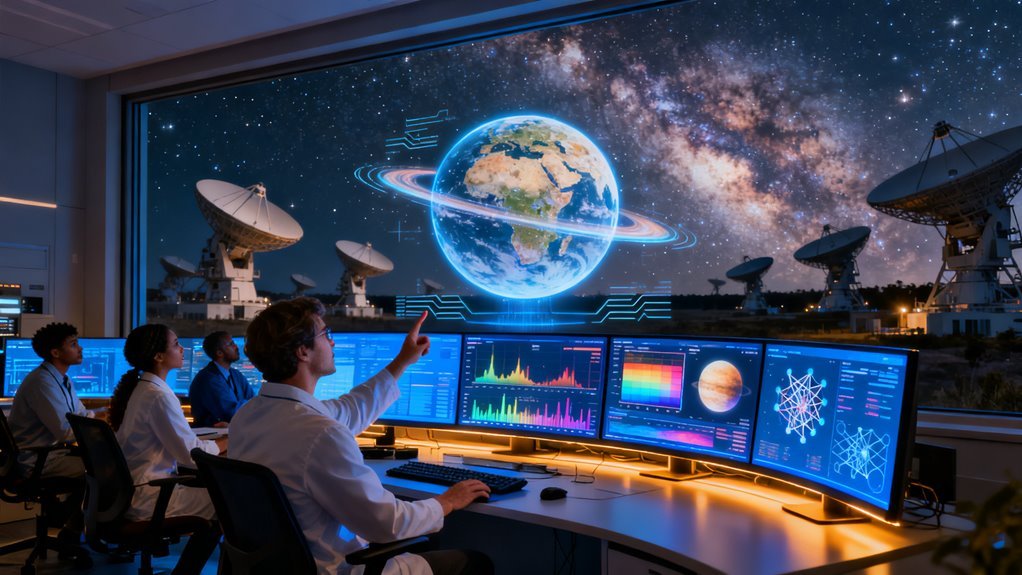
Perhaps the most provocative application of AI in this domain is in the search for technosignatures, evidence not of microbial life but of technological civilizations. The Breakthrough Listen program, backed by the Breakthrough Initiatives foundation, has integrated machine learning directly into its radio data pipelines.
The problem it faces is instructive for anyone working in anomaly detection across other industries. Radio SETI generates enormous volumes of data, most of which is terrestrial radio frequency interference. Traditional filtering approaches use hand-crafted rules to reject known interference patterns, but those rules inevitably miss novel signal types while also discarding unusual candidates that do not fit expected templates.
Machine learning flips the approach. Unsupervised methods, including autoencoders, function as generic anomaly detectors, flagging anything that deviates significantly from the learned distribution of normal data. Pre-trained object detection models handle the classification side, sorting candidates into known interference categories or forwarding them for human review.
A University of Toronto team has built algorithms that process thousands of candidates from SETI telescopes, substantially reducing false positives while surfacing patterns that human analysts and rule based filters had overlooked.
Models trained on simulated technosignature morphologies can highlight unconventional signals that traditional pipelines would discard as noise or interference. This is a pattern we see repeated across AI applications in science and industry.
When the signal you are looking for might take a form you have not anticipated, supervised learning alone is insufficient. You need unsupervised and semi-supervised approaches that can flag the genuinely unexpected. The SETI community’s adoption of these techniques mirrors developments in cybersecurity, fraud detection, and manufacturing quality control, domains where the adversary (or the phenomenon) does not announce itself in advance.
What People Are Overlooking
Most coverage of AI in exoplanet science focuses on detection accuracy and speed. Those are real gains. But several deeper dynamics deserve attention.
First, there is an emerging dependency risk. As AI pipelines become the default pathway through which astronomical data is processed, the community’s ability to catch systematic errors in those models becomes critical. A subtle bias in a training dataset or a misspecified loss function could cause an entire class of potentially habitable worlds to be deprioritized without anyone noticing.
The astronomical community is aware of this risk and has begun investing in interpretability and validation frameworks, but the pace of model deployment is outrunning the pace of rigorous auditing.
Second, the convergence of AI and space science is creating new competitive dynamics among space agencies and private organizations. The European Space Agency’s PLATO mission, expected to launch in 2026, will generate light curves for hundreds of thousands of bright stars. NASA’s upcoming missions will add to the flood.
Whichever teams build the most capable ML pipelines will effectively control which planets the community focuses on next. That is a form of influence that has no real precedent in astronomy.
Third, the synthetic data problem deserves more scrutiny. Many of the most impressive accuracy numbers in this field come from models tested on simulated or curated datasets. The gap between simulated and real observational data remains significant, and real world performance often lags benchmark results.
This is not unique to astrobiology. It echoes the well-documented challenges in autonomous driving, medical imaging, and robotics, where sim-to-real transfer is one of the hardest problems in applied machine learning.
Where This Is Heading
Over the next decade, several trends will shape this field. The volume of exoplanet data will increase by at least an order of magnitude as new missions come online.
Foundation models, large pre-trained architectures adapted for scientific domains, are already being explored in astrophysics and will likely become standard tools for atmospheric retrieval and signal classification.
Multimodal models that combine photometric, spectroscopic, and imaging data into unified representations could dramatically improve habitability assessments. The SETI side of the equation will benefit from the same advances, and possibly from broader AI capabilities in pattern recognition that are being driven by commercial investment.
The compute and modeling techniques developed for large language models and vision transformers are directly transferable to the kind of sequence analysis and anomaly detection that technosignature searches require.
For the AI industry more broadly, astrobiology represents something valuable: a use case where the data is abundant, the stakes are high, the ground truth is largely unknown, and the potential for genuine discovery is real.
It is also a domain where the responsible deployment of AI is not an afterthought but a necessity. When the question is whether a distant world might harbor life, getting the answer wrong in either direction carries consequences that extend well beyond a quarterly earnings call.
The search for life beyond Earth was once constrained by how many graduate students could stare at light curves. That constraint is gone. The new constraint is how well we can build, validate, and trust the AI systems that have taken their place.