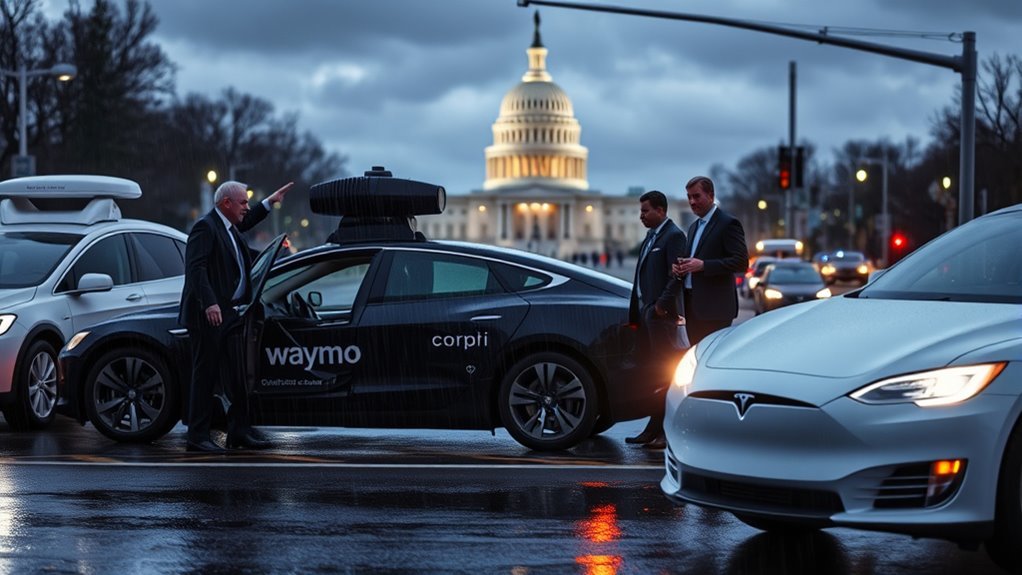

Washington, D.C. and Washington State are moving on separate but parallel tracks to regulate autonomous vehicles, with the District’s proposed legislation establishing a formal commercial framework while the state maintains an existing self-certification testing program. The diverging approaches reflect broader national uncertainty about how governments should structure oversight of robotaxi services as companies like Waymo push toward commercial expansion.
In Washington, D.C., Councilmember Charles Allen has introduced legislation that would create a structured regulatory pathway for autonomous vehicle companies seeking to operate commercially in the District. The bill establishes requirements covering safety, permitting, insurance, accountability, and data reporting. Rather than operating under ad hoc pilot permissions, autonomous vehicle providers would face formal local oversight before launching paid services.
Councilmember Charles Allen’s legislation would replace ad hoc pilot permissions with formal local oversight for autonomous vehicle operators.
The proposed framework imposes significant financial and operational barriers to entry. Companies must pay a $1 million application fee, a $5 million permit fee, and a $1 million renewal fee. Before launching commercial service, a provider’s fleet must complete at least 250,000 miles of operation within the District. An additional 180-day waiting period follows approval before paid rides can begin.
Fleet sizes would be capped at 200 autonomous vehicles until 2028, and a $0.15-per-mile travel tax would apply to each vehicle to discourage passengerless robotaxis from worsening congestion.
Waymo’s timeline for the District reflects both ambition and regulatory constraint. The company plans to begin operations with human safety drivers surveilling streets and prepared to intervene when necessary. Fully autonomous rides in Washington, D.C. are targeted for 2026, contingent on how safety driver requirements evolve under current and future regulations. Existing District rules still prohibit self-driving cars from operating without a human safety driver, meaning riders will not access fully driverless service until at least the year following initial safety-driver operations.
Washington State operates under a different model rooted in an executive order rather than legislative action. The Department of Licensing runs an autonomous vehicle self-certification testing program established through Executive Order 17-02. Any company testing or operating autonomous vehicles on state roads must complete a self-certification application before beginning and report intended testing jurisdictions to the department. Law enforcement agencies in relevant areas must also receive advance notification of testing activities.
Policy oversight in Washington State includes an autonomous vehicle work group created under HB 2970. The group monitors technological developments and recommends updates to policy, laws, and rules as the industry evolves. This adaptive structure contrasts with the District’s more prescriptive approach, which codifies specific fees, fleet caps, and mileage thresholds into proposed law. Companies operating under Washington State’s program must also maintain an umbrella liability policy of at least $5,000,000 per occurrence and submit a Certificate of Insurance to demonstrate compliance.
Together, the two regulatory environments illustrate the range of strategies governments are deploying as robotaxi services evolve from experimental operations toward commercial scale, with each jurisdiction balancing public safety concerns against industry pressure to accelerate deployment.