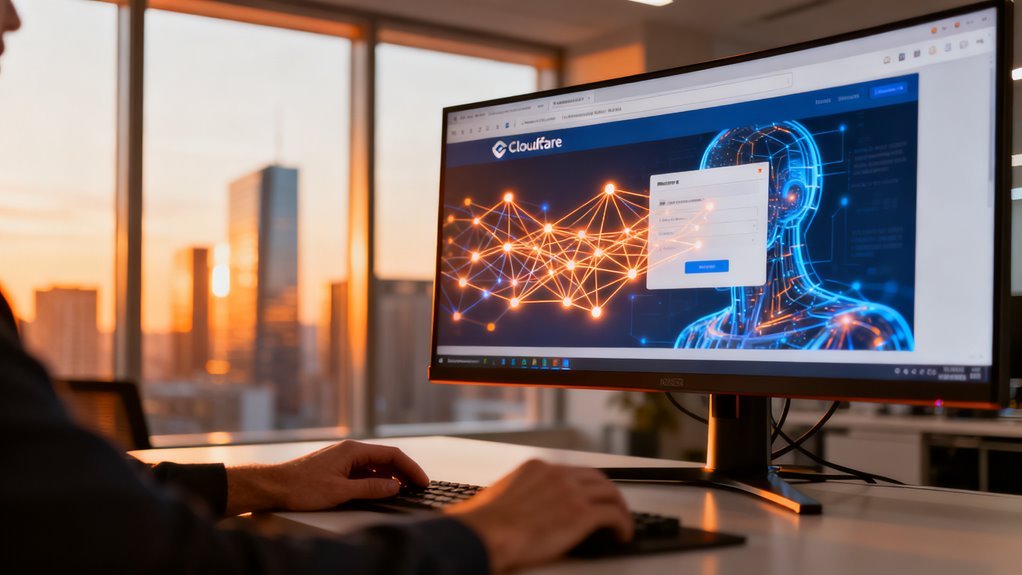
Escalating a new front in the U.S.–China tech confrontation, the Trump administration is threatening economic sanctions against Chinese artificial intelligence developers it suspects of systematically stealing American AI models and intellectual property. Treasury officials say the focus is on overseas open‑source systems, including widely used Chinese large language models, that may embed confidential artifacts from proprietary U.S. platforms. The concern is that these freely released models, trained on unlicensed American data and outputs, undercut U.S. firms that invested heavily to build frontier systems. Online news sites facing automated scraping often flag unusual activity from a computer network and present a “Are you a robot?” box that users must click to verify they are human before reading content.
Washington targets Chinese open-source AI models suspected of embedding stolen U.S. secrets, warning that unlicensed distillation will carry sanctions and national-security costs.
Treasury Secretary Scott Bessent has announced a systematic review of foreign open‑source AI models to determine whether they incorporate proprietary elements taken from American systems without permission. He has emphasized that Washington supports open‑source development in principle, yet insists that copying confidential model weights, fine‑tuning outputs, or other protected artifacts crosses a legal line. Recently, the formation of WAICO highlights the growing geopolitical context around AI governance and international cooperation.
Officials say they have already detected what they describe as watermarks from U.S. large language models inside several Chinese systems, evidence they argue suggests distillation of American capabilities into rival products that are then released at little cost. Those findings echo a broader narrative from the White House and science advisers, who say foreign entities primarily based in China are running deliberate, industrial‑scale campaigns to distill frontier U.S. models.
According to administration briefings, these actors operate tens of thousands of proxy accounts on leading American chatbots and use jailbreak techniques to bypass safety rules, extracting responses that expose proprietary behaviors and data. The resulting outputs are stored and reused to train new systems that, while not fully matching the originals, appear competitive on select benchmarks and exploit American research investment.
Major U.S. AI firms have pressed the case that these tactics constitute theft rather than ordinary competition. Anthropic has publicly described attempts by several Chinese companies to harvest features from its Claude chatbot through mass querying, calling the activity large‑scale data and intellectual property theft.
A State Department diplomatic cable has warned partner governments that certain Chinese offerings, including models marketed by firms such as DeepSeek, may be materially derived from proprietary American systems. U.S. officials frame such derivative models as products of industrial espionage cloaked in open‑source rhetoric.
To respond, policymakers are assembling a suite of measures that go beyond rhetoric. A Trump administration memo promises collaboration with domestic AI companies to identify distillation campaigns and recommend sanctions against offending firms.
Draft House legislation would direct agencies to name entities in China and Russia that improperly extract technical features from U.S. models and consider penalties, including placement on the Commerce Department’s entity list and restrictions under the International Emergency Economic Powers Act. These tools would complement existing export controls that limit China’s access to advanced chips and manufacturing equipment for training, reinforcing the message that AI model copying will be treated as a trade and national‑security violation.