
Humanoid robots are finally crossing the line from demo videos to day to day factory work, and Hyundai’s Atlas rollout is one of the clearest tests of what that future will actually look like for workers, unions and global manufacturing strategy. At the same time, Hyundai’s union in Korea is staging what many observers describe as the first auto industry strike explicitly centered on humanoid robot deployment, turning a technological roadmap into a front line labor issue.
From research icon to factory tool
For more than a decade Atlas was best known as Boston Dynamics’ acrobatic showpiece, a research platform that impressed with jumps and parkour rather than industrial productivity. Hyundai gradually shifted that story after acquiring a controlling stake in Boston Dynamics and committing to turn Atlas into a production ready humanoid aimed squarely at automotive and logistics work.
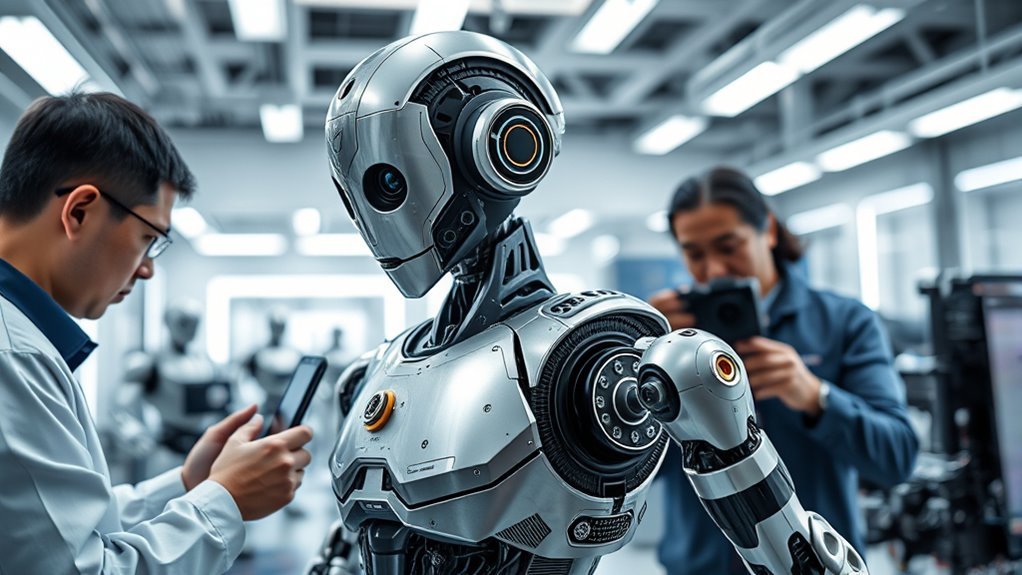
The current industrial Atlas is fully electric and designed to handle repetitive and physically demanding factory tasks, with a reach of about 2.3 meters and a certified lifting capacity around fifty kilograms. The robot’s body offers many degrees of freedom and rotated joints that allow it to maneuver in tight spaces and around complex assemblies, moving closer to the way human workers navigate busy production lines. Furthermore, its deployment aligns with the growing trend of autonomous AI to enhance operational efficiency.
Critically, Atlas is not being launched as a one off experiment. Hyundai has outlined a plan to build about thirty thousand Atlas units per year by 2028, with more than twenty five thousand of those earmarked for internal use in Hyundai and Kia factories. That scale is what shifts Atlas from a curiosity into a strategic technology that could reshape how large portions of the car industry operate.
The Savannah Metaplant as Atlas ground zero
Hyundai’s near term deployment strategy centers on Hyundai Motor Group Metaplant America near Savannah in the United States, a large electric vehicle complex that is non union and designed from the ground up as a highly automated site. Company executives have told investors that Atlas will make its factory debut there in 2028, with a follow on rollout to Kia’s nearby Georgia facility in 2029.
Before Atlas arrives on the main production lines, it will be trained at the Robotics Metaplant Application Center in Georgia, an internal facility described by Boston Dynamics leadership as a data factory where robots learn and refine manufacturing tasks using real production data and simulated workflows. The goal is to ensure that when Atlas enters the floor it already has robust task libraries and proven safety behaviors, reducing the risk of disruptive early failures.
Hyundai’s roadmap starts conservatively. Atlas will first handle support functions such as parts sequencing, kitting and material transport along production lines, especially for models like the Ioniq 5 and Ioniq 9 built at the Metaplant. These jobs involve moving and organizing components rather than performing intricate assembly, but they are essential to keeping lines running and are often physically demanding for human workers.
Around 2030 the scope is expected to expand to selected assembly tasks, including fitting door panels and inserting connectors, jobs that combine ergonomically difficult motions with tight quality tolerances. In later phases Hyundai plans to assign Atlas to repetitive heavy load and higher risk operations such as precision parts assembly near hazardous equipment and handling dangerous materials. At each stage the company says the expansion depends on safety validation and quality metrics from earlier pilots rather than a fixed schedule.
Hyundai repeatedly frames Atlas as a tool to remove hazardous and monotonous work from human shoulders while keeping people in supervisory, maintenance and process improvement roles rather than eliminating large numbers of positions outright. This framing is central to how the firm communicates the project to investors and regulators, but it is precisely where union skepticism is sharpest.
Korean factories and the deliberate gap in the timeline
One of the most telling aspects of Hyundai’s plan is where Atlas is not going first. The company has been clear that no specific timeline has been approved for introducing Atlas into domestic Korean plants such as the Ulsan complex. Public statements emphasize that any Korean deployment would follow consultations with local labor representatives and broader social consensus about how humanoid robots should be integrated into industrial workplaces.
Hyundai has described this as a phased global expansion that begins in non union United States facilities and only later moves to other regions once performance, safety outcomes and labor conditions have been validated at early sites. Executives argue that this sequencing means the immediate Atlas agenda is geographically and procedurally separate from the issues being negotiated in the current Korean wage and working condition talks. In their view, Atlas deployment in Korea remains a planning topic rather than a formal part of the present bargaining table.
This separation is not only rhetorical. Starting in the non union Georgia metaplant gives Hyundai maximum flexibility in task design, staffing models and pace of robot adoption without having to secure prior collective agreement. It also creates a test bed where the company can collect detailed productivity and safety data under its preferred conditions before presenting any proposals to unions elsewhere.
The first strike about humanoid robots
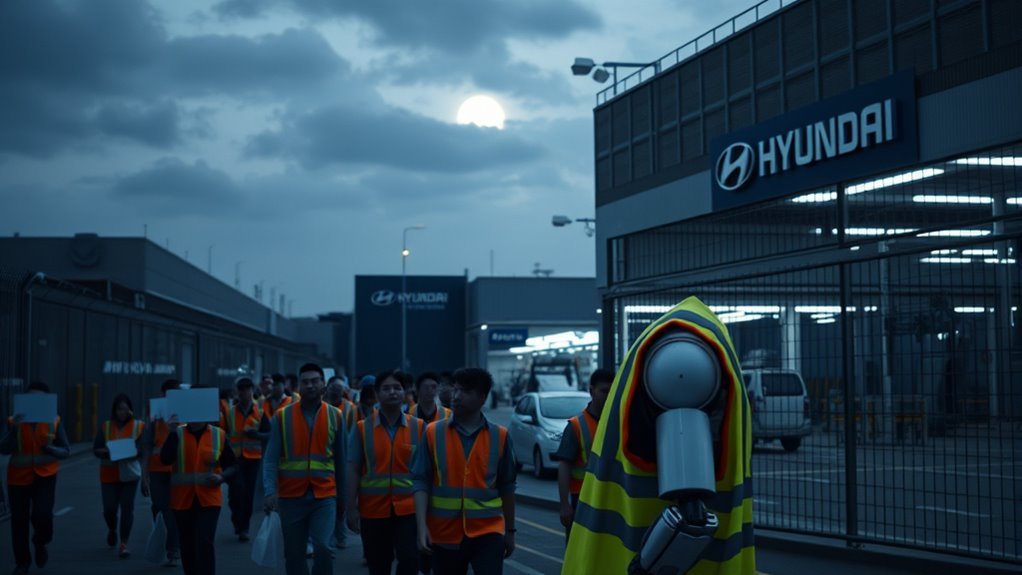
Korean labor leaders see the situation very differently. The Hyundai Motor union has launched what many accounts describe as the first strike in the auto sector explicitly focused on humanoid robot deployment, with Atlas as the central symbol. Union statements warn that large scale humanoid automation could accelerate workforce reductions beyond what traditional industrial robots have already produced and could undermine the long term security of younger workers in particular. The partial strike has already halted several Hyundai production lines and made disruption to vehicle output unavoidable, reflecting the union’s readiness to stop operations until management confronts the implications of Atlas.
The union’s demands go beyond general opposition. It is calling for legally enforceable job protections, strict limits on robot driven layoffs, guaranteed reskilling opportunities and a consent requirement that no Atlas unit can enter a Korean factory without a prior labor management agreement. In other words, the union wants veto power and binding safeguards before any humanoid robot crosses the threshold of domestic plants.
Management counters that Atlas deployment in Korea is still in the planning and pilot stage, with no approved domestic rollout, so it should not be treated as a formal agenda item in the current strike negotiations focused on wages and working hours. From the company’s perspective, negotiating over robots that have neither assigned tasks nor dates in Korean facilities is premature and risks freezing innovation.
Nevertheless, Atlas features prominently in union rhetoric and public messaging, and the strike is widely understood as a pre emptive move to influence how future decisions about humanoid robots will be made. The union is signaling that any shift from pilots to core assembly roles will be contested and that unilateral decisions will meet organized resistance.
Why Atlas matters beyond Hyundai
Humanoid robots in factories are not appearing in a vacuum. Industrial automation has been advancing for decades through fixed arm robots, conveyors and increasingly sophisticated computer control systems, with collaborative robots adding closer human machine interaction in recent years. Atlas marks an important step because humanoids can in principle perform a far wider range of tasks without expensive line redesign, thanks to their human like form factor and mobility.
Hyundai’s stated plan to mass produce thirty thousand Atlas units annually and deploy most of them inside its own production network turns that theoretical flexibility into a concrete business strategy. If the Metaplant pilots show significant gains in throughput, quality and safety, it will be hard for competitors to ignore similar humanoid options, whether from Boston Dynamics, Tesla’s Optimus project or other emerging players. Even if some of those rivals are not yet at Hyundai’s scale, the direction of travel for the sector is clear.
For businesses, humanoid deployment promises several potential advantages. It can reduce injury risks from heavy lifting, awkward postures and exposure to hazardous environments, lowering compensation costs and improving long term workforce health. It can support high mix production by rapidly retraining robots for new tasks without retooling entire lines, which is valuable as car makers juggle many electric and hybrid variants.
And it can provide a buffer against labor shortages in regions where younger workers are less willing to take repetitive factory jobs.
At the same time, Atlas exposes serious risks and uncertainties. Large fleets of humanoid robots could give management new leverage in wage talks if the perceived threat of replacement grows, even if the official narrative stresses collaboration. Productivity gains might not translate into shared benefits for workers if there are no binding frameworks for job security, reskilling and profit sharing. There are unresolved questions about accountability when robots cause accidents or quality defects, and about the psychological impact of working daily alongside human shaped machines.
The geography of labor and automation
Hyundai’s choice to start Atlas in non union United States plants while promising consultations before any Korean deployment exemplifies a broader pattern in global manufacturing strategy. Firms often introduce the most disruptive forms of automation first in locations where collective bargaining is weaker or absent, then use performance data from those sites in later negotiations elsewhere.
For Korean workers the Metaplant becomes a kind of distant laboratory in which their future might be decided. If Atlas achieves the forecast levels of automation, including significant portions of assembly work, the company will be able to present concrete numbers on cost savings and productivity improvements when it eventually sits down to discuss domestic rollout. The union’s current strike is therefore as much about shaping the rules for interpreting that future data as it is about present working conditions.
Hyundai’s emphasis on social consensus in Korea reflects an awareness of the country’s history with industrial transformation. Previous waves of automation and restructuring in sectors like shipbuilding and steel triggered intense labor conflicts and broader debates about employment, regional inequality and national competitiveness. Adding humanoid robots to that story raises public questions that go beyond one company, touching on national industrial policy and societal views on what kind of work humans should still be doing.
What a responsible Atlas rollout would look like
For a humanoid project of this scale to earn trust, several elements seem essential.
First, transparent task design and clear boundaries for what robots will and will not be allowed to do in the near term would help reduce fear and rumor among workers. Hyundai’s published roadmap for parts sequencing, kitting, transport and sequential expansion into selected assembly tasks is a step in this direction, but workers will want granular detail at each site, not just high level investor slides.
Second, binding agreements on job protection and reskilling are likely to become a standard demand wherever humanoids are introduced. The Korean union’s proposal for legal limits on robot driven layoffs and guaranteed retraining reflects a broader shift toward treating automation as a negotiated change rather than a unilateral management prerogative. Proactive co design of robot deployment with labor representatives could reduce conflict and improve outcomes.
Third, safety and incident reporting need to be robust and open. Atlas will be operating in close proximity to people, handling heavy parts and moving through shared spaces. The data that Hyundai collects at the Robotics Metaplant Application Center and at early factory deployments should be communicated in understandable form, including near miss incidents and corrective actions, rather than only as aggregate performance metrics.
Finally, policymakers will have to consider whether existing labor and safety laws fully cover humanoid robots or whether there is a need for updated frameworks addressing autonomy, liability and large scale workforce impacts. Atlas is not arriving in one or two units but in tens of thousands, which changes the scale of potential economic and social effects.
Takeaways and what to watch next
Atlas at Hyundai marks a turning point where humanoid robots move from research star to embedded industrial tool, backed by a plan to build thirty thousand units a year and deploy more than twenty five thousand across Hyundai and Kia factories starting with the Savannah Metaplant in 2028 and Kia’s Georgia plant in 2029.
The Korean union strike shows that workers are not waiting passively for that future but are trying to set the terms of humanoid adoption before robots arrive at their own sites.
Three developments deserve close attention over the next few years. The first is how effective Atlas proves in real factory conditions and whether the early task set of sequencing, kitting and transport truly delivers the promised safety and productivity gains.
The second is how Hyundai and its unions in Korea and elsewhere translate pilot data into formal agreements, especially around job protection and reskilling. The third is how competitors respond and whether humanoid deployments become a new benchmark in global auto manufacturing.
Humanoid robots will not decide the future of work on their own. That future will be determined by collective choices about how technologies like Atlas are designed, governed and integrated into workplaces. Hyundai’s project is one of the first large scale chances to see those choices play out in real time, and the outcome will influence not only car factories in Georgia and Ulsan but many other industries watching from the sidelines.
Conclusion
Hyundai’s latest move in its tense negotiations with its factory workers is deceptively simple. The company is insisting that plans to deploy Boston Dynamics’ Atlas humanoid robots are not part of the current strike talks, even as thousands of workers walk off the job with Atlas at the center of their demands. This distinction matters because it reveals how quickly automation is shifting from a technical decision to a question of power, consent, and long term governance inside one of the world’s largest carmakers.
Why Atlas Is Suddenly A Labor Flashpoint
The immediate backdrop is a rolling strike at Hyundai’s giant Ulsan manufacturing complex in South Korea, where tens of thousands of unionized workers have staged partial work stoppages in July after fifteen rounds of wage negotiations collapsed. Union members voted overwhelmingly to authorize strike action, with reported approval rates above 86 percent among nearly forty thousand workers.
On paper, the bargaining table looks familiar. The union is pressing for higher base pay, larger regular and performance bonuses tied to company profit, and an extension of the retirement age from sixty to sixty five. These are classic items in industrial labor disputes.
What is new is the demand that no Atlas humanoid robot be allowed into a Hyundai factory without formal labor management consent. Union leaders have framed Atlas as a core bargaining issue, not an abstract future technology, and are seeking written guarantees that any deployment will be negotiated and that income protections will be in place if robots reduce human work hours.
Hyundai’s Position: Atlas Off The Negotiating Table
Hyundai’s public stance is that humanoid robot deployment is not part of the current wage and bonus talks. Company representatives have emphasized that negotiations are focused on pay, bonuses, and retirement age, and that Atlas is a longer term project whose details will be decided later in consultation with local employees and workforce representatives.
Hyundai has also stressed that Atlas has not yet been assigned any task inside its Korean factories. The company’s near term focus is to introduce Atlas at its Metaplant America facility in Georgia, with an expected start of operations around 2028. Decisions about possible deployments at other sites, including in Korea, are officially described as future choices that will be made with input from local stakeholders.
This framing allows Hyundai to treat Atlas as a strategic technology initiative running on a separate track from yearly wage bargaining. It preserves management flexibility on how, when, and where humanoids are used while limiting the risk that current contract language could constrain future automation plans.
The Union’s Position: Consent Rights And Job Security
The union, affiliated with the Korean Metal Workers Union, has taken the opposite view. Atlas is not a side issue but a symbol of a broader concern that automation could be introduced unilaterally, with workers informed rather than consulted.
Union leaders have repeatedly stated that not a single Atlas unit should enter a Hyundai workplace without a labor management agreement. Earlier in 2026, they signaled this stance explicitly, warning that no robot using new technology would be accepted without a prior accord.
The union has also linked robot deployment directly to employment guarantees, including protection of working conditions related to artificial intelligence and automation. These demands are now bundled with wage and bonus proposals, creating a negotiation package that mixes short term economic issues with structural questions about how technological change will be governed on the shop floor.
This is not just a fear of immediate layoffs. Many workers are worried about gradual erosion of human roles, the possibility that robots take over hazardous yet still valued tasks, and the risk that management uses automation to weaken bargaining power over time. By pushing for formal consent rights, the union is trying to establish a precedent in which workers have a say in automation decisions before robots arrive, not after they are already installed.
A Historic First In Humanoid Robot Labor Politics
Industrial robots have been standard equipment in automotive plants for decades, welding and painting and moving parts with repeatable precision. What is different now is the introduction of humanoid robots designed to operate in spaces and roles closer to human workers.
Reporting on the Hyundai dispute has emphasized that this is one of the first auto factory strikes explicitly triggered by a plan to introduce humanoid robots onto production lines. The strike at Ulsan is being framed as a contest not only over wages and bonuses but over who gets a voice in deciding how and when humanoid systems are deployed in factories.
The timing also matters. On July twenty Hyundai Motor Group completed its full acquisition of Boston Dynamics, the company that developed Atlas, by closing a deal that included a put option for SoftBank. On the same day, around thirty five thousand Hyundai workers escalated their strike, demanding written guarantees about Atlas and insisting that no humanoid robot be placed on Korean production floors without union consent.
This convergence of corporate acquisition and labor action underscores that Atlas is no longer an external vendor product. It is becoming an internal strategic asset, and that intensifies the stakes for both management and workers.
What Atlas Represents For Hyundai’s Strategy
For Hyundai, Atlas and other advanced robots are part of a wider push toward smart factory operations and next generation automation. Humanoid platforms promise the ability to handle tasks that traditional industrial robots struggle with, particularly in environments designed around human workers.
Company statements describe Atlas as a future tool for hazardous or ergonomically demanding tasks, a way to improve safety and efficiency rather than to replace entire human workforces outright. If humanoids can take over the most dangerous jobs, reduce injury risk, and improve consistency, they align with long running automation goals in manufacturing.
At the same time, the financial logic is clear. Hyundai has posted strong profits, and robots that can work longer hours, adapt to new tasks through software updates, and integrate with digital planning systems are attractive in a highly competitive global auto market. Atlas is being positioned as a versatile asset that can support both safety and productivity, especially in new facilities like the Georgia Metaplant that are designed from the start with advanced automation in mind.
Governance Of Humanoids: The Emerging Core Issue
Where Hyundai sees humanoids as an extension of its technology agenda, the union sees them as a test case for governance. The key question is not simply whether Atlas is deployed, but who gets to approve deployments and on what terms.
The union’s demand for consent rights is effectively an attempt to create a governance framework inside the collective bargaining agreement:
- No humanoid robot enters a Hyundai workplace without prior labor management approval.
- Employment and working conditions related to artificial intelligence and automation must be guaranteed and not eroded by robot deployment.
- Income protections or profit sharing mechanisms should compensate workers if humanoid robots reduce available hours or alter job structures.
Hyundai’s insistence that Atlas deployment lies outside the current strike negotiations highlights a widening gap between management’s technology strategy and workers’ job security demands. For management, negotiation boundaries are an organizational tool. For workers, those boundaries risk excluding the very technologies that will shape their future employment.
Broader Implications For Technology And Society
Several deeper implications are emerging from this dispute.
*First, humanoid robots are becoming a political actor inside factories.* Atlas itself is not on strike, but workers have organized the first major labor action explicitly centered on its future role. That shifts robots from a neutral tool to a contested symbol of power and control over the workplace.
*Second, consent is becoming a central concept in automation.* Traditional industrial robots were often introduced as management decisions with limited prior negotiation. In contrast, Hyundai’s union is striving to embed consent rights into the contract, which could set a precedent for other sectors where humanoids are planned.
*Third, the dispute exposes a temporal mismatch.* Hyundai argues that Atlas deployment is a future question for later consultation, yet workers are bargaining preemptively to secure guarantees before any humanoids arrive. This reflects a growing awareness that contracts signed today will govern how companies handle technology over the next several years, often long after the ink dries.
*Fourth, the outcome may influence global norms.* Hyundai is not alone in exploring humanoid robots for manufacturing, and other automakers and logistics firms are watching how this conflict plays out. If the union succeeds in winning strong consent provisions, similar demands are likely to appear in other regions. If management keeps robots outside formal bargaining, companies elsewhere may adopt similar strategies.
Opportunities And Risks In Humanoid Deployment
There are real opportunities in careful use of humanoid robots. Atlas could reduce exposure to dangerous tasks, support older workers by taking on heavy or repetitive work, and help factories respond more flexibly to demand fluctuations. Combined with well designed training and redeployment programs, humanoids could become part of a softer landing for workers as production processes evolve.
Yet the risks are equally concrete. If robots are introduced without robust safeguards, the result could be accelerated job displacement, pressure on wages, and growing inequality between highly skilled technical roles and routine factory work. There is also the psychological dimension: working alongside human shaped robots may intensify anxiety about replacement and alter the social fabric of the workplace in ways that management rarely measures.
Transparent governance mechanisms, including joint committees, clear data on how robots affect staffing, and binding commitments about retraining and income support, can help balance these tensions. The Hyundai dispute shows that workers are now actively demanding such mechanisms rather than waiting to see what management proposes.
What This Means For Hyundai’s Industrial Future
Regardless of how the current strike is resolved, humanoid robot governance is likely to remain central to Hyundai’s labor relations and industrial strategy. Hyundai can keep Atlas off the formal agenda for one bargaining round, but it cannot avoid the underlying issue indefinitely.
If the company and union reach a compromise that recognizes both the strategic value of automation and the need for worker consent and protection, Hyundai could become an early example of constructive humanoid adoption in heavy industry. Such an outcome would also demonstrate to investors and regulators that advanced robots can be integrated without ignoring social and labor concerns.
If the gap between management’s technology agenda and worker expectations widens, the dispute may foreshadow recurrent conflicts every time a new robot or artificial intelligence system is introduced. That scenario would add a layer of uncertainty to Hyundai’s automation plans and could influence how quickly the company deploys humanoids beyond the Georgia Metaplant.
Key Takeaways And What To Watch Next
Several clear lessons stand out from this moment.
- Humanoid robots are no longer a distant concept. They are now a primary subject of union votes, strike actions, and corporate strategy conversations inside major manufacturers.
- Workers are seeking formal consent rights before robots arrive, aiming to shape automation governance rather than merely reacting to it.
- Companies that treat robot deployment as separate from labor negotiations may gain short term flexibility but risk long term mistrust if workers feel excluded from decisions that affect their future.
- The Hyundai case is likely to influence how other firms and unions approach humanoid deployments, especially in sectors where safety, productivity, and job security all intersect.
Looking ahead, the most important signals will be the language in any eventual agreement, the timeline for Atlas deployment in Korea versus Georgia, and whether consent and income protection provisions become standard elements in contracts at Hyundai and beyond.
For now, the message from Ulsan is clear. Humanoid robots are not just machines on the line. They are catalysts for a deeper renegotiation of who decides how technology reshapes work, and on what terms that transformation proceeds.