
The decision by AMD to power Foundation Future Industries humanoid robots with its new Ryzen AI Embedded X100 processors is a meaningful moment for both robotics and artificial intelligence. It signals that serious players are now betting that full autonomy will live not in distant cloud data centers but inside the robots themselves, including in factories and even active conflict zones. In practice, this means a focus on industrial and defense deployments where resilient edge compute becomes as critical as mechanical robustness. This shift underscores the growing need for continuous safety evaluation in operational environments.
This matters because the industry is at a pivot point. Just a few years ago, most advanced AI robotics stacks assumed constant high-quality connectivity to cloud infrastructure. Today, between growing bandwidth constraints, rising cloud costs, and contested environments from rural infrastructure sites to electronic warfare theaters, that assumption no longer holds. The AMD Foundation partnership is an explicit test of whether edge-first AI can scale in the real world.
How we got here: from factory arms to dual-use humanoids
Industrial robots have been common on automotive and electronics lines for decades, but they were essentially programmable machines anchored to the floor. They excelled at repeating the same motion thousands of times and they relied on simple control logic rather than high-capacity learning models.
Humanoid robots represent a different ambition. Instead of building a new fixed machine for each task, companies are trying to create general-purpose physical workers that can walk into human-designed spaces, use existing tools, and adapt to new workflows through software updates rather than new metal. Over the past five years, a wave of startups and big tech initiatives has pushed this vision forward, from warehouse-focused bipeds to lab assistants and defense prototypes.
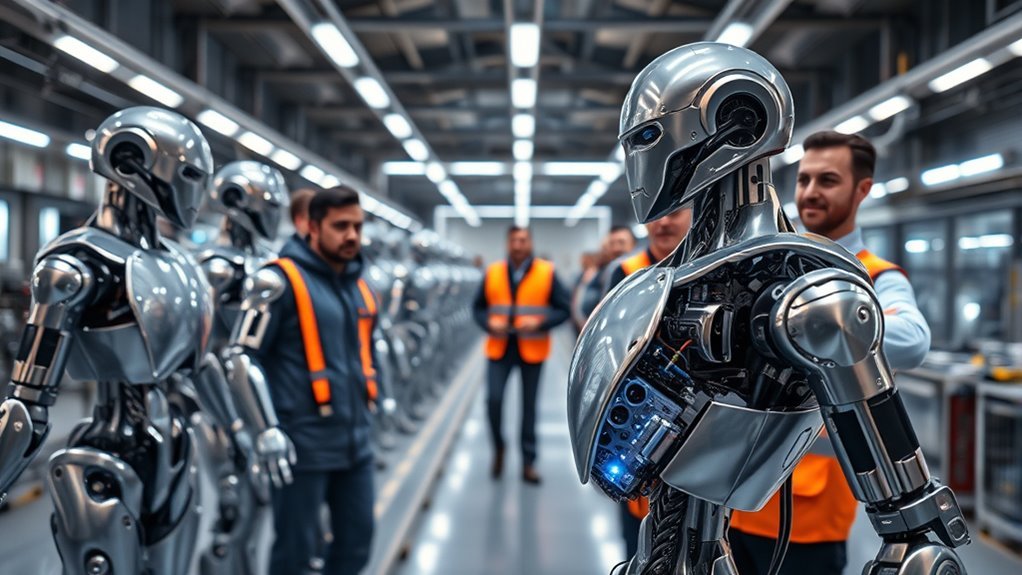
Foundation Future Industries sits squarely in this new generation. Founded in 2024, the company is developing dual-use humanoid systems designed to operate both in civilian industrial settings and in military environments. Its Phantom series robots are meant to function in factories and logistics hubs, but also in contested areas where communications are degraded and human presence is dangerous. Earlier Phantom MK 1 units have already seen use on production lines and have been tested in Ukraine, supporting logistics and hazardous operations, which shows a deliberate focus on practical deployment rather than pure research.
The venture also embodies a growing blend of political influence and deep tech capital. Backers include Narya Capital, co-founded by current United States Senator JD Vance, and the effort has been linked to support from Eric Trump. That mix raises both opportunity and scrutiny. Political networks can accelerate defense-related pilots and procurement, yet they also invite questions about oversight, export controls, and how these systems might be used across different regimes and alliances.
What AMD is bringing to the table
At the silicon level, the partnership revolves around AMD Ryzen AI Embedded X100 processors, a new family announced in early 2026 for edge inference and physical AI workloads. These system-on-chip parts combine Zen 5 CPU cores, RDNA 3 point 5 graphics, and an XDNA 2 neural processing unit in a compact embedded package.
The X100 line is designed to scale up to 16 CPU cores, giving enough general-purpose compute to run complex planning, control, and orchestration workloads on device. AMD positions the integrated RDNA 3 point 5 GPU as the engine for high-bandwidth perception and vision tasks, while the XDNA 2 NPU handles continuous, low-power inference for things like object recognition and audio understanding.
Beyond raw performance, several characteristics make these chips attractive for autonomous robots in harsh environments. The Ryzen AI Embedded portfolio targets thermal design power envelopes from roughly the mid-teens of watts to just over fifty watts, which fits the power budgets of battery-powered or tightly constrained edge systems. The parts are rated to operate from approximately forty degrees below zero to more than one hundred degrees Celsius and are specified for service lifetimes on the order of a decade, even under continuous operation.
That combination of environmental tolerance and long-term availability is crucial for industrial buyers and defense programs that expect components to be supported for many years. Performance claims are aggressive as well. AMD cites deterministic control loop latencies on the order of hundreds of microseconds on the CPU, sub hundred millisecond AI reasoning on the GPU, and sub millisecond vision classification on the NPU for representative workloads.
In public comparisons, the company touts more than double the multithreaded CPU performance versus recent Intel Core Ultra parts and significantly higher floating point throughput than competing Nvidia edge platforms, along with several fold improvements on generative AI token generation throughput. These figures are marketing claims rather than independent benchmarks, but they signal a strategic intent to challenge incumbent offerings in robotics and edge AI.
In the Foundation partnership, Ryzen AI Embedded X100 chips will become the core compute platform for the Phantom MK 2 humanoid, forming the center of both hardware and software stacks. That means everything from low-level motor control and real-time sensor fusion to higher-level navigation, manipulation, and tactical decision modules will be designed around AMD silicon.
Inside the Phantom platform: from production lines to combat logistics
Phantom robots are being framed as workhorses rather than lab curiosities. In industrial settings, they are positioned to take on repetitive, hazardous, and precision-dependent tasks, such as materials handling, assembly assistance, and moving goods through warehouses.
The vision is not science fiction androids replacing entire human workforces overnight, but fleets of specialized robots handling predictable routines while humans supervise, troubleshoot, and manage exceptions. Foundation is planning leasing models and manufacturing roadmaps that assume thousands of units in the field, with eventual factory capacity for tens of thousands of robots per year. That kind of scale is still aspirational, but it is consistent with the broader industrial robotics trend where once niche systems become economical as volumes rise and supply chains mature.
The defense use case is more sensitive and more controversial. In military contexts, Phantom systems are being developed for tasks such as autonomous patrols, reconnaissance, logistics support, and the movement and inspection of weapons in combat zones. The company has already tested earlier units in Ukraine, which is emerging as a proving ground for many new defense technologies. Prototype deployments under United States and Ukrainian programs suggest that militaries see value in sending robots into areas where human casualties would be likely.
Here the choice of edge-first compute matters a great deal. In contested environments, communication links may be jammed, degraded, or actively targeted. Running perception, navigation, and decision-making directly on the robot reduces dependence on distant data centers and decreases the vulnerability created by constant command links. It also lowers latency in time-critical situations, such as navigating rubble under fire or quickly identifying and avoiding threats.
Why on-device autonomy is becoming the default
The architectural shift toward local intelligence is not unique to Foundation or AMD, but this partnership encapsulates it in a concrete way. For the Phantom MK 2, the plan is to execute the full stack of perception, sensor fusion, motion planning, and manipulation workloads on device using the CPU, GPU, and NPU resources of the X100 platform.
There are several reasons this model is gaining ground.
First, latency. Even with good connectivity, round trips to a cloud service add tens to hundreds of milliseconds. In human-robot interaction and fine-grained manipulation, that delay is noticeable and sometimes dangerous. Local compute can respond in microseconds to millisecond scale windows that are required for stable control and safe operation.
Second, reliability. Industrial customers and armed forces do not want critical systems to fail because a network link went down or a cloud region had problems. Embedded autonomy allows robots to continue functioning when links are unavailable and to synchronize logs or updates opportunistically rather than in real time.
Third, privacy and security. Keeping sensor data local reduces the exposure of audio, video, and telemetry streams that might include sensitive information about facility layouts, personnel, or operations. That is particularly important for robots operating near adversarial networks or under active electronic warfare, where uplink channels may be surveilled or attacked.
Fourth, cost. Running large fleets of robots that stream everything to the cloud incurs significant bandwidth and compute costs over time. Dedicated accelerators like XDNA 2 NPUs are designed to provide much better inference per watt and per dollar than general-purpose cloud instances when workloads are steady and predictable.
The trade-off is flexibility. Cloud-based models can be updated centrally and can draw on vast shared compute pools for rare heavy workloads. On-device systems require careful software engineering to fit models and logic within constrained resources. The AMD Foundation collaboration will be a live test of how far current embedded platforms can stretch.
Competitive landscape and strategic implications
AMD is not entering a vacuum. Nvidia has spent years building an ecosystem around its Jetson modules for robotics and edge AI, and Intel has pushed various embedded and mobile AI platforms that integrate CPUs, GPUs, and NPUs. By positioning Ryzen AI Embedded X100 as a high-performance, thermally flexible solution specifically for physical AI and robotics, AMD is trying to carve out a distinct lane.
A humanoid robot design win with a politically connected dual-use startup is valuable for several reasons.
It gives AMD a visible flagship deployment that showcases its edge AI capabilities in a demanding environment, from temperature extremes to vibration and long duty cycles.
It deepens relationships with defense-adjacent customers at a time when many governments are re-evaluating their industrial and military supply chains.
It provides a real-world feedback loop for AMD’s robotics-oriented partner programs and software stacks, including Linux and ROCm-based toolchains that target developers building complex autonomous systems.
For Foundation, aligning with a major chip provider offers several advantages as well. It ensures a long-term supply of parts with guaranteed lifecycles, rather than depending on commodity PC components that may be discontinued quickly. It also allows the company to market Phantom robots as built on a platform that industrial and automotive customers already recognize and trust.
However, the partnership does not eliminate risk. Humanoid robotics remains an unproven business at scale. Many previous efforts have stalled in the gap between impressive demos and sustainable economics. The hardware is expensive, the integration work is messy, and customers often underestimate the complexity of changing processes and training staff to work alongside robots.
On the chip side, AMD still must prove that its performance and reliability claims hold up across diverse real-world workloads and over long deployments, and that its developer ecosystem can match or surpass the maturity of competitors that have a head start.
Societal and ethical questions
Deploying dual-use humanoid robots at scale raises hard questions that go well beyond chip architectures.
In factories and warehouses, there is a genuine productivity upside. Robots can take over jobs that are physically punishing, monotonous, or dangerous. Over time, that can reduce injuries and allow humans to focus on higher-value activities.
At the same time, the impact on employment and bargaining power is uneven. Workers in certain roles may see displacement or downward pressure on wages, while new technical roles emerge elsewhere. Policymakers, unions, and employers will need to engage seriously with these shifts rather than treating them as an abstract future.
In defense settings, the stakes are even higher. Using humanoids for logistics and hazardous operations can save lives by keeping soldiers away from unexploded ordnance or active fire. Yet the line between logistics support and direct combat roles is not fixed. Once general-purpose autonomous platforms exist and are battle-tested, pressure will grow to arm them or to integrate them more tightly into lethal decision loops.
Edge-first autonomy entails that many critical decisions could be made on device with limited human oversight, especially when communication links are degraded. That reality makes rigorous testing, transparent rules of engagement, and strong fail-safe mechanisms essential. It also raises questions about accountability when a robot makes a mistake in a high-stakes environment.
On the geopolitical front, the involvement of politically connected investors and defense-oriented programs means that export controls and alliance dynamics will play a role in where and how systems like Phantom can be deployed. Countries that do not have access to similar technology may seek alternative suppliers, potentially fragmenting standards and norms.
What to watch next
Over the next few years, several milestones will reveal whether this partnership is an inflection point or an isolated experiment.
First, technical performance in the field. Independent evaluations of Phantom MK 2 robots in factories and logistics hubs will show whether the Ryzen AI Embedded X100-based stack can deliver the real-time responsiveness and reliability that production environments require. Metrics such as uptime, maintenance needs, and integration effort will matter as much as raw AI benchmarks.
Second, the pace and scale of deployments. Leasing models and ambitious production targets indicate that Foundation aims for thousands of units and eventually tens of thousands per year, but actual customer adoption will depend on return on investment, regulatory acceptance, and organizational readiness.
Third, the evolution of AMD’s edge AI roadmap. If the company continues to invest heavily in robotics-oriented features, long lifecycle guarantees, and developer tools, it will signal confidence that physical AI is a strategic growth area rather than a side bet.
Fourth, regulatory and ethical frameworks. Governments and international bodies are beginning to craft rules for autonomous systems, especially in defense. The way regulators classify and oversee dual-use humanoid robots will influence not only this partnership but the entire ecosystem.
Key takeaways
The AMD Foundation Future Industries deal is more than a chip design win. It is a live experiment in whether high-capability humanoid robots, powered by fully on-device AI stacks, can move from pilot deployments to meaningful scale in both industrial and defense contexts.
AMD is using the Ryzen AI Embedded X100 family to challenge entrenched competitors in robotics and edge AI, offering a tightly integrated CPU, GPU, and NPU platform that is engineered for harsh environments and long lifecycles. Foundation is betting that this hardware, combined with its Phantom humanoid designs and politically connected backers, can deliver robots that operate reliably in factories and battlefields where cloud connectivity cannot be taken for granted.
If the partnership succeeds, it will accelerate a broader shift toward edge-first autonomy in physical systems and intensify debates about how far societies are willing to go in delegating physical work and risk, including in war, to machines. If it struggles, it will still provide valuable lessons about the technical and social limits of humanoid robotics today.
Either way, this collaboration is a development worth following closely, because it sits at the intersection of AI, industry, and geopolitics, where the consequences of technological choices are felt well beyond the lab.
Conclusion
AMD is positioning its chips at the center of the next wave of industrial automation by partnering with Foundation Future Industries to power autonomous humanoid robots with Ryzen AI Embedded X100 processors. This collaboration aims to scale production from thousands to tens of thousands of robots per year for use in factories and defense operations, which could reshape labor, logistics, and military support while escalating competitive and ethical scrutiny of humanoid machines worldwide.
Why This Partnership Matters Now
Humanoid robots are moving from laboratory demonstrations and limited pilots into real commercial deployments, but until now most efforts have been small scale and highly experimental. At the same time, manufacturers are struggling with more than two million unfilled factory positions globally and are under pressure to boost productivity without compromising safety or resilience.
The AMD and Foundation agreement lands precisely at this inflection point. Foundation already has robots working in customer facilities and contributing to automotive production, which gives this deal a different weight than a speculative memorandum or research project. With plans for factories that can produce tens of thousands of units annually and a clear focus on both industrial and defense missions, this is one of the clearest signals yet that humanoid robots are being treated as near term infrastructure, not a distant bet.
Background The Road To Industrial Humanoids
The idea of humanoid robots has been around for decades, but until recently most platforms were either research projects or carefully staged demonstrations that avoided the realities of dust, vibration, and nonstop production cycles. Early systems such as Honda Asimo and later Boston Dynamics Atlas showcased impressive mobility and balance but did not see sustained industrial use.
Over the past five to ten years, the picture has begun to change. Agility Robotics has deployed its Digit robot in Amazon logistics centers, mainly for moving totes and bins rather than precision assembly. Figure AI is piloting humanoids at a BMW facility for material handling and parts transfer, while Tesla is using its Optimus robot internally at its Fremont plant. These are serious deployments, but they focus on narrow tasks that avoid the most demanding requirements of modern manufacturing, such as sub millimeter accuracy at automotive cycle times or heavy payload handling in hazardous environments.
In parallel, major players have been exploring new combinations of robotics hardware and advanced foundation models. Boston Dynamics and Google DeepMind are collaborating to use Gemini Robotics models to extend Atlas into more general industrial tasks, relying less on task specific programming and more on flexible perception and reasoning. Nvidia has demonstrated humanoid robots powered by its Jetson Thor edge AI modules at Hannover Messe, completing logistics operations in a blueprint autonomous factory environment.
Against this backdrop, the AMD and Foundation partnership represents a notable expansion of the field. It links a chipmaker with deep experience in CPUs, GPUs, AI accelerators, and adaptive computing with a startup that already has revenue generating deployments and a dual focus on factories and defense.
What AMD And Foundation Are Actually Building
Under the agreement, Foundation Future Industries will use AMD Ryzen AI Embedded X100 Series processors in the Phantom MK 2 variant of its humanoid robot line. These chips, introduced in early 2026, are designed for edge AI workloads and combine CPU cores, integrated graphics, and dedicated AI acceleration in a single embedded package suitable for harsh environments. Foundation is also leveraging AMD adaptive computing hardware such as field programmable gate arrays to handle precise real time control of robotic hands and sensors, integrating high frequency tactile feedback into deterministic control loops.
AMD executives describe the goal as unifying perception, reasoning, and real time control on one coordinated stack, so that a humanoid robot can see its environment, plan tasks, and execute fine motor actions without relying on separate, loosely coupled systems. Foundation claims performance advantages over competing platforms, saying that the Ryzen AI Embedded X100 processors deliver two and a half times better efficiency for inference workloads and roughly three times faster training compared with leading Nvidia solutions used in similar robots.
On the hardware side, the Phantom MK 2 is being designed for harsh industrial and defense conditions, including resistance to very high levels of vibration, an IP67 rating for resistance to water and dust, and complete panoramic vision. These specifications underscore that the robots are meant to work around heavy machinery, outdoor facilities, and potentially in contested environments rather than only in pristine labs or demonstration booths.
Scale And Economics From Pilots To Fleets
The scale of Foundation’s manufacturing plans is one of the most striking parts of this story. The company expects to open a factory in October that can produce about five thousand Phantom robots per year, and is already planning a second facility with capacity for fifty thousand units annually starting early next year. This is far beyond the typical batch production of a few dozen or a few hundred robots that has characterized most humanoid efforts to date.
The economics are equally revealing. For industrial use, Foundation leases its humanoid robots to customers at roughly one hundred thousand dollars per year, positioning them as subscription based workforce augmentation rather than one time capital purchases. For defense applications such as materials handling and reconnaissance, units are sold to government customers for about three hundred thousand dollars each. The company reports that its robots already operate around the clock for five days a week in client facilities and that they have helped assemble more than twenty four thousand cars in 2025 while generating around one hundred million dollars in annual recurring revenue from contracts.
Market research suggests that these figures are aligned with broader trends. Analysts estimate more than two million factory jobs remain unfilled worldwide and project that the total bill of materials cost for humanoid robots could fall below fifty thousand dollars by 2030, thanks to declining hardware prices and economies of scale. Combined with the growth of electric vehicle manufacturing, which could reach thirty one million units annually by 2030, there is a clear incentive to introduce robots that can flex across tasks rather than rely entirely on fixed industrial arms and conveyor systems.
Industrial And Defense Implications
Technologically, the AMD and Foundation collaboration is a test of whether a unified edge AI stack can deliver both high level reasoning and low level control in environments that demand reliability and safety around humans. If the claims hold up in production, factories could gain robots that not only perform repetitive motions but also adapt to new tasks after a relatively small number of demonstrations, as recent advances in AI have enabled robots to learn from tens rather than hundreds of examples.
For manufacturers, this could mean new flexibility in areas such as material handling, inspection routes, and light assembly operations where cycle times are slower and tolerances less extreme, but where human workers spend long hours on physically taxing and monotonous tasks. The leasing model also reduces upfront cost and allows factories to treat robots as an operating expense, which can be easier to justify during periods of demand uncertainty or economic volatility.
On the defense side, Foundation already has Pentagon contracts and is developing robots for materials handling and reconnaissance, explicitly positioning its platform as dual use infrastructure that can move between factories and military logistics or surveillance missions. That dual focus raises complex questions about export control, battlefield autonomy, and the line between support roles and direct engagement in contested areas. It also connects the partnership to broader geopolitical narratives, since Foundation is backed by Eric Trump, who serves as chief strategy advisor and emphasizes themes of military and manufacturing resurgence in public messaging.
Competitive Stakes And The AMD Versus Nvidia Angle
From a chip industry perspective, this deal is a direct challenge to Nvidia’s early lead in powering humanoid robots. Nvidia has been showcasing humanoid platforms using its Jetson Thor modules and promoting an end to end robotics stack that spans simulation, training, and deployment. Foundation’s decision to standardize on AMD hardware for its next generation robots signals that there is room for alternative architectures, especially where deterministic control and tight integration of general purpose compute and adaptive logic are important.
By demonstrating robots that are already deployed in customer operations and claiming clear performance gains over Nvidia based setups, Foundation offers AMD a high visibility proof point for its edge AI strategy. At the same time, market observers note that strategic collaborations are becoming a core pattern in humanoid robotics, whether in the form of Boston Dynamics and Google DeepMind for foundation model integration or automotive and logistics firms partnering with startups for pilot programs. AMD is effectively placing a bet that a combination of AI accelerators, CPUs, graphics, and adaptive computing will become a preferred stack for robots that must see, think, and act in real time.
If the Phantom MK 2 platform scales as planned, this could push Nvidia to respond with more specialized edge offerings and intensified partnerships, which in turn might accelerate innovation but also increase fragmentation as different robotics firms align with different semiconductor ecosystems.
Societal And Ethical Considerations
The move toward tens of thousands of humanoid robots raises understandable concerns about job displacement, safety, surveillance, and militarization. While current deployments mostly focus on material handling and noncritical tasks where robots operate under human oversight, the combination of general purpose AI and mobile manipulation creates the possibility of robots performing increasingly complex work without direct human supervision.
In manufacturing, the most realistic near term scenario is not a sudden replacement of skilled workers but a gradual shift in task allocation, with robots handling the most physically demanding or repetitive work and humans focusing on oversight, troubleshooting, and higher skill activities. However, without clear policies and transparent communication, affected workers may experience anxiety and mistrust, particularly in regions already facing economic stress.
The defense angle adds another layer. Robots used for reconnaissance and materials handling can reduce risk for human soldiers, but they may also expand the reach of military operations, including in environments where accountability and rules of engagement are contested. The involvement of politically prominent figures and government contracts heightens scrutiny and could lead to questions about procurement fairness, dual use export policies, and the potential for rapid deployment in sensitive regions.
AMD’s broader corporate responsibility commitments, including efforts to promote responsible product use and support STEM education through philanthropic initiatives, provide some context for how the company publicly frames its role in emerging technologies. Still, responsible deployment of humanoid robots will require more than corporate statements. It will demand rigorous safety standards, independent auditing, clear reporting on incident rates, and rules for data collection and use, especially when robots operate in workplaces and public spaces.
What To Watch Next
Several uncertainties remain. First, it is not yet clear how Phantom MK 2 robots will perform at scale in the most demanding industrial tasks, such as high speed assembly with tight tolerances, heavy payload handling, or work in hazardous rated environments, where most experts remain skeptical about near term feasibility across any current humanoid platform. Second, the cost curve and maintenance burden for large fleets of humanoid robots is still evolving, and real world reliability data over multiple years of operation will be critical for assessing true return on investment.
Third, regulatory and standards frameworks for humanoid robots lag behind the technology. Existing industrial safety norms were designed around fixed robotic arms and cages, not mobile humanoid machines that share space closely with human workers. Governments are only beginning to consider how to regulate dual use platforms that can move between civilian and military roles, and this partnership will likely become part of that policy conversation.
Finally, the competitive landscape is moving quickly. Other firms are pushing their own platforms, from logistics focused robots to more general purpose industrial humanoids, and they are experimenting with different combinations of hardware, software, and foundation models. As these systems mature, interoperability, security, and long term support will become as important as raw performance.
Key Takeaways
The AMD and Foundation Future Industries partnership is a significant step toward large scale deployment of autonomous humanoid robots that can operate continuously in industrial and defense environments. It connects a major chipmaker with a dual use robotics startup that already has meaningful revenue and real deployments, and it commits both sides to a production ramp measured in tens of thousands of units per year rather than small pilot fleets.
For technology and business leaders, the core message is that humanoid robots are shifting from speculative prototypes to planned infrastructure, with clear business models and competitive hardware claims. For society, the development brings both promise and risk, offering potential relief for labor shortages and dangerous tasks while raising questions about job quality, surveillance, and military applications.
The next few years will show whether AMD’s edge AI strategy and Foundation’s dual use robots can deliver on their technical and economic promises without undermining safety, trust, and accountability. Close attention to deployment data, worker outcomes, defense use cases, and emerging regulation will be essential for separating durable progress from short lived hype.