AI Can Drive a Rover, but It Cannot Command a Mission. That Gap Tells Us Something Important.
When NASA’s Perseverance rover autonomously selects a rock to zap with its laser on Mars, it is exercising a form of intelligence. It evaluates texture, mineral signatures and scientific priority, then fires without waiting for instructions from Earth. That capability is real, it is impressive, and it is also profoundly limited. The rover has no concept of the mission it serves. It cannot decide that the geology in a nearby crater warrants abandoning its current traverse. It cannot weigh whether conserving battery power today matters more than capturing data before a dust storm arrives tomorrow.
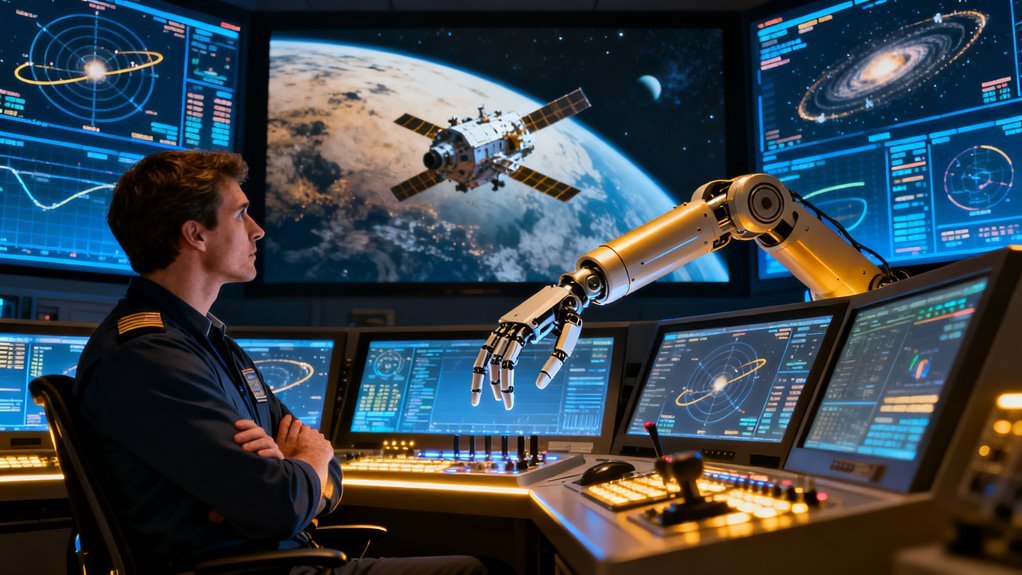
This distinction between task autonomy and mission autonomy sits at the center of a question the space community is now grappling with openly. Could AI ever run an entire space mission without human oversight? The emerging consensus from researchers, mission planners and aerospace engineers is a qualified no. Not yet. And the reasons why reveal as much about the current state of artificial intelligence as they do about space exploration.
Narrow Brilliance in a Domain That Demands Breadth
The AI systems operating in space today are genuinely capable within their lanes. The European Space Agency’s autonomous collision avoidance systems can detect a conjunction risk and fire thrusters without ground intervention. Mars rovers plan their own driving routes across hazardous terrain. Satellite constellations adjust orbits using onboard decision logic. These are not toys. They represent decades of engineering and meaningful advances in machine perception, planning and control.
But every one of these systems operates inside a tightly bounded problem space. The objectives are predefined. The decision trees are constrained. The failure modes are anticipated and accounted for in advance. What none of them can do is reason across domains, reconcile competing priorities or adapt mission objectives in response to genuinely novel circumstances.
This is not a minor limitation. Space missions are defined by exactly the kind of open ended, multi objective reasoning that current AI architectures handle poorly. Should a crewed mission to the Moon prioritize a crew health anomaly over a time sensitive science observation? Should an asteroid survey spacecraft sacrifice propellant reserves to investigate an unexpected finding? These are judgment calls that involve scientific value, risk tolerance, resource constraints and strategic priorities simultaneously. No existing AI system can navigate that landscape reliably.
Why Foundation Models Do Not Solve This Problem
It is tempting to look at the rapid progress of large language models and multimodal AI systems from OpenAI, Google DeepMind and Anthropic and imagine that general purpose reasoning is nearly within reach. GPT class models can synthesize information across domains, generate plausible strategic recommendations and even simulate expert reasoning on complex topics. Could something like that eventually sit in the command seat of a deep space mission?
The short answer is that the failure modes are incompatible with the stakes. Large language models hallucinate. They produce confident, well structured outputs that are simply wrong. In a consumer application, that means a bad summary or a fabricated citation. On a spacecraft 200 million kilometers from Earth with a 20 minute communication delay, a hallucinated navigation decision could end a billion dollar mission.
More fundamentally, current AI systems lack what researchers sometimes call situational metacognition. They do not reliably know what they do not know. A human mission controller, confronted with ambiguous telemetry data, will recognize the ambiguity, flag it and escalate. A well trained AI system might do the same in scenarios it has been explicitly prepared for. But the signature challenge of space exploration is that the most consequential moments are often the ones nobody anticipated.
Hardware Constraints That Software Cannot Overcome
Beyond the algorithmic limitations, the physical environment of space imposes constraints that terrestrial AI development rarely confronts. Radiation degrades processors. The computing hardware that can survive deep space environments lags years behind what is available on Earth. The processors aboard most operational spacecraft would be considered antiquated by the standards of a modern smartphone, let alone a data center running inference on a frontier model.
This creates a fundamental bottleneck. Even if the software existed to support autonomous mission command, the hardware environment of space would throttle it severely. Running a large neural network requires power, cooling and computational throughput that spacecraft power budgets simply cannot accommodate today. Some researchers are exploring neuromorphic chips and radiation hardened accelerators as potential paths forward, but these remain experimental and years from operational deployment.
Verification presents another barrier that is often underappreciated. Before any autonomous system is trusted with mission critical authority, it must be validated against an enormous range of scenarios. For narrow task autonomy, this is achievable. For something approaching general mission command, the verification space becomes effectively infinite. How do you certify an AI system for situations that, by definition, have never occurred before? The aerospace industry’s safety culture, built on exhaustive testing and formal verification, does not yet have an answer.
The Real Story Is About Shifting Boundaries, Not Binary Replacement
Framing this as a question of whether AI can or cannot run a mission alone actually misses the more interesting development. What is happening in practice is a steady, incremental expansion of the autonomy envelope. Each mission pushes the boundary outward. Perseverance has more onboard autonomy than Curiosity. ESA’s upcoming Hera mission to the Didymos asteroid system will carry more autonomous navigation capability than any previous interplanetary probe. The trend line is clear, even if the destination of full autonomy remains distant.
This incremental approach mirrors what we see in other high stakes domains. Autonomous vehicles were once predicted to eliminate human drivers within a decade. Instead, the industry settled into a long middle phase where automation handles increasing portions of the driving task while human oversight remains essential for edge cases. Aviation followed a similar trajectory over decades. Autopilot systems fly the plane for most of a commercial flight today, but no airline operates without pilots, and the reasons are as much about accountability and public trust as they are about technical capability.
Space is likely to follow this pattern. The communication delays inherent in deep space exploration create a genuine operational need for greater onboard autonomy. When a spacecraft near Jupiter faces a thruster anomaly, waiting 90 minutes for instructions from Earth is not viable. The AI must act. But acting on a thruster anomaly within predefined parameters is fundamentally different from deciding to alter the mission plan.
What This Tells Us About AI More Broadly
The space autonomy question functions as a useful stress test for claims about artificial general intelligence. If the most sophisticated AI systems available cannot be trusted to independently command a robotic spacecraft operating in a known physical environment with clear objectives, that tells us something about the gap between current capabilities and genuine autonomous reasoning.
This is not a criticism of the technology. The progress over the past five years has been remarkable. But it is a corrective to narratives that treat artificial general intelligence as imminent or inevitable on short timescales. The space domain strips away the ambiguity that sometimes clouds AI capability assessments in other fields. There is no room for a plausible sounding but subtly wrong answer when the consequence is a lost spacecraft.
For the AI industry, the lessons from space autonomy research are directly applicable to autonomous systems in defense, critical infrastructure, healthcare and industrial operations. The pattern is consistent across all these domains. AI excels at well defined tasks within bounded environments. It struggles with open ended reasoning under genuine uncertainty. And the verification challenge of certifying AI for high consequence autonomous decisions remains unsolved in any domain.
Where This Goes Next
The next several years will likely see meaningful advances on specific fronts. Onboard AI for anomaly detection and response will become more sophisticated. Autonomous science prioritization, where spacecraft decide which observations are most valuable, will expand significantly. ESA and NASA are both investing in what they call cognitive spacecraft architectures that push more decision authority to the vehicle.
But mission command authority, the ability to set objectives, allocate resources across competing priorities and make strategic decisions in genuinely novel situations, will remain with human operators for the foreseeable future. The technical barriers are real, the verification challenges are profound, and the institutional culture of space agencies is appropriately conservative about trusting lives and billion dollar assets to systems that cannot explain their reasoning.
The boundary will keep shifting. That shift is worth paying close attention to, because the pace at which autonomy expands in space will tell us a great deal about how quickly AI can be trusted with consequential decisions in every other domain on Earth.
The idea of an AI system commanding a deep space mission without human input sounds like the plot of a dozen science fiction films. But the conversation has shifted. It is no longer about whether machines can make decisions in space. They already do. The real question is whether they can be trusted with all of them, simultaneously, for years at a time, with zero margin for error and no one watching over their shoulder. This question is particularly urgent given that 54% of enterprises report confirmed AI agent security incidents or near-misses in the past year.
The real question isn’t whether AI can make decisions in space — it’s whether we trust it with all of them.
That question matters right now because the economics and physics of space exploration are pushing hard in one direction. As missions target destinations further from Earth, communication delays grow longer. A signal to Mars can take over 20 minutes each way. For missions to Jupiter’s moons or beyond, the delays stretch even further. Every minute of latency is a minute where a spacecraft must fend for itself. The deeper humanity pushes into the solar system, the more autonomy becomes not a luxury but a structural requirement.
What AI Already Does in Space (and Does Well)
It is easy to underestimate how much autonomy already exists in current missions. NASA’s Perseverance rover does not wait for a human to tell it where to drive. Its terrain relative navigation system compares real time camera data against orbital maps to land precisely, and its enhanced AutoNav software plots safe driving paths across Martian terrain independently. The AEGIS targeting system, deployed across multiple planetary missions, identifies and photographs scientifically interesting rock formations without any instruction from Earth. These are not toy demonstrations. They represent genuine decision making under real constraints.
Earth orbit tells a similar story. AI handles satellite station keeping, manages faults, and processes enormous volumes of observation data onboard before any of it reaches the ground. Robotic assistants on the International Space Station perform inspection and logistics tasks, reducing the cognitive load on crew members between communication windows with mission control.
None of this is trivial. But every one of these systems operates within a narrow, carefully defined domain. Perseverance can drive itself, but it cannot decide to abandon a science campaign and relocate to a different crater. AEGIS can pick interesting rocks, but it cannot weigh that choice against power reserves, upcoming orbital geometry, or a revised mission timeline. The autonomy is real, but it is also bounded. Strategic authority still belongs to humans.
The Hardware Problem Nobody Wants to Talk About
When the AI industry on Earth debates compute requirements, the conversation centers on data center power consumption and GPU availability. In space, the constraints are orders of magnitude harsher and fundamentally different in character.
Spacecraft operate on power budgets that would make a mobile phone engineer wince. Every watt allocated to computation is a watt not available for communication, propulsion, thermal management, or scientific instruments. The kind of large language models and reinforcement learning systems that represent the frontier of AI capability on Earth demand computational resources that simply do not exist on any spacecraft flying today or planned for the next decade.
Radiation compounds the problem in ways that are difficult to appreciate from the ground. High energy particles in deep space can flip bits in memory, corrupt processor operations, and degrade hardware over time. Radiation hardened processors exist, but they are generations behind commercial silicon in performance. The gap between what a terrestrial AI system can do on an NVIDIA H100 and what a space qualified processor can do is not a small delta. It is a chasm.
Thermal extremes add another layer. Components cycle between punishing heat in sunlight and extreme cold in shadow. This mechanical stress degrades electronics, introduces unpredictable failure modes, and limits the operational lifetime of any sufficiently complex computing system. When you combine constrained power, limited memory, radiation vulnerability, and thermal cycling, you get an environment that is hostile to exactly the kind of intensive, continuous computation that full autonomous mission control would demand.
This is worth comparing to what companies like Google DeepMind, OpenAI, and Anthropic are building on Earth. Their most capable systems rely on massive inference infrastructure, redundant hardware, constant monitoring, and the ability to restart or roll back when something goes wrong. None of those safety nets exist on a spacecraft 400 million kilometers from the nearest technician.
The Verification Wall
Even if the hardware problem were solved tomorrow, a deeper challenge would remain. How do you prove that an AI system will make the right decision in every scenario it might encounter over a mission lasting years?
In traditional software engineering for space systems, verification is exhaustive. Every line of code is tested against formal specifications. Every branch, every edge case, every failure mode is mapped and validated. This process is expensive and slow, but it produces systems with extraordinary reliability. The software running critical spacecraft functions has some of the lowest defect rates of any code ever written.
Machine learning models break this paradigm. A neural network trained to recognize geological features or plan navigation paths does not have discrete, inspectable logic branches. Its decisions emerge from millions of weighted parameters in ways that resist straightforward explanation. You can test it against thousands of scenarios and it may perform flawlessly, but you cannot prove it will handle the thousand and first. For a consumer app, that residual uncertainty is acceptable. For a spacecraft where a single wrong decision can destroy a billion dollar mission with no possibility of recovery, it is not.
This is the same verification challenge that is slowing autonomous vehicle deployment on Earth, but amplified by the impossibility of remote intervention. A self-driving car operating in San Francisco can pull over and phone home. A probe orbiting Europa cannot.
The space industry’s emphasis on safety, reliability, and sustainability is not conservative for its own sake. It reflects the absolute consequences of failure in an environment that offers no second chances.
What the Terrestrial AI Trajectory Tells Us
The rapid advances in AI capability over the past three years, from GPT 4 to Claude 3.5 to Gemini, have reshaped expectations about machine intelligence. Reasoning benchmarks that seemed out of reach in 2022 are now routine. Multimodal understanding, long context processing, and tool use have all progressed faster than most forecasters expected.
It is tempting to extrapolate this curve directly onto space applications and conclude that full autonomous mission control is just a few model generations away. That extrapolation misses critical differences.
Terrestrial AI progress has been driven primarily by scaling compute and data. Space applications cannot scale compute in the same way. Progress in space AI will depend on making smaller models dramatically more reliable and interpretable, on developing radiation tolerant neuromorphic processors, and on creating verification frameworks that can certify learned systems to aerospace standards. These are hard engineering problems with long development cycles. They do not follow the same exponential curve as transformer scaling.
That said, there are reasons for measured optimism. Research into efficient model architectures, quantization, and edge inference is accelerating, partly driven by mobile and embedded applications on Earth. Advances in formal verification of neural networks, while still early, are a growing area of academic and industrial focus. Companies like NVIDIA and startups in the space tech sector are investing in radiation tolerant computing platforms with significantly more capability than legacy designs.
The European Space Agency and NASA have both signaled increased investment in onboard AI capabilities. Private companies including SpaceX and emerging ventures focused on deep space logistics see autonomy as a competitive differentiator. The economic incentive is clear: every task that can be handled autonomously reduces mission operations costs and enables missions to destinations where human oversight is physically impossible.
Who Benefits and Who Should Be Paying Attention
The organizations best positioned to benefit from expanded space AI are those building the middleware layer between raw spacecraft hardware and mission planning. Companies developing lightweight, verifiable AI models for embedded systems are working on a problem that has applications well beyond space, including defense, underwater robotics, and remote infrastructure monitoring. Investors looking at space technology should watch the computational hardware pipeline as closely as they watch launch vehicles.
Government space agencies face a strategic consideration. As commercial entities push autonomy further, regulatory frameworks will need to evolve. Who is responsible when an autonomous spacecraft makes a decision that damages another nation’s asset in orbit? Current space law was not written with AI decision makers in mind. The broader discipline of Space AI has identified ethical governance as one of its key challenges, underscoring how urgently these accountability frameworks need to catch up with the technology.
For the broader AI research community, space represents one of the most demanding test environments imaginable. Solving the reliability, verification, and efficiency problems required for space autonomy would produce breakthroughs applicable across safety critical domains on Earth, from medical devices to power grid management.
The Honest Assessment
Full mission command by AI alone is not happening on any timeline relevant to missions currently in development or planning. The convergence of hardware limitations, verification gaps, and the unforgiving physics of the space environment places this goal firmly in the category of long term research aspiration.
But framing this as a binary, either AI runs the whole mission or humans do, misses the more interesting and more consequential trend. The boundary between human authority and machine autonomy is shifting steadily outward. Each generation of missions delegates more responsibility to onboard systems. The transition is incremental, task by task, decision by decision, and it is accelerating.
The question worth asking is not whether AI will someday command a space mission alone. It is how we will recognize the moment when it effectively already does, making so many decisions independently that human oversight becomes a formality rather than a functional necessity. That moment is closer than the official timelines suggest, and the industry is not yet ready for the accountability questions it will raise.





1 comment
Comments are closed.