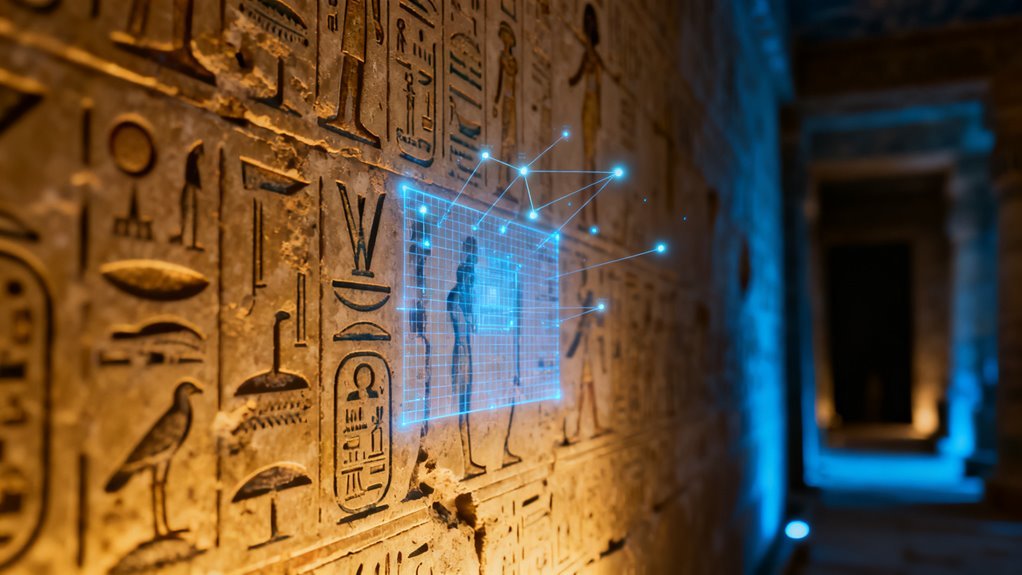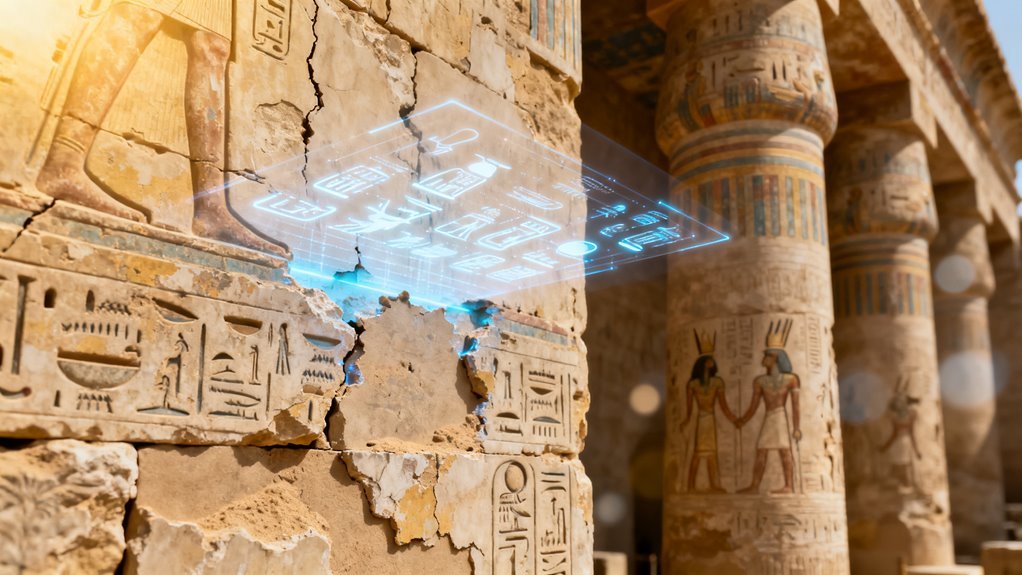
For decades, Egyptologists have stared at crumbling temple walls and fragmented papyri, painstakingly guessing which symbols once occupied gaps left by millennia of erosion, looting, and neglect. That painstaking work now has a digital collaborator. A convergence of language models, computer vision, and deep metric learning has produced AI systems capable of predicting missing hieroglyphs, classifying individual signs from photographs, and translating ancient Egyptian text into modern languages. This shift towards reusable multimodal models is changing how researchers approach the recovery of ancient texts.
Treating Damaged Inscriptions Like Autocomplete
The most conceptually striking development is HieroLM, an LSTM based system that reframes hieroglyph recovery as something functionally identical to next token prediction. If that sounds familiar, it should. The same principle underlies GPT and every other autoregressive language model in production today.
HieroLM exploits local semantic patterns in hieroglyphic sequences to predict which glyph most likely occupied a damaged section of text, achieving over 44% accuracy in single shot recovery experiments.
That number deserves context. Ancient Egyptian hieroglyphs comprise hundreds of distinct signs that can function as logograms, phonetic characters, or determinatives depending on position and context. Forty four percent accuracy on a single guess, drawn from that enormous possibility space, is substantially better than any baseline and competitive with what trained philologists achieve on badly damaged passages.
More importantly, the system extends to multi shot predictions and performs credibly even when training data is scarce. For Egyptologists working with fragmentary corpora where parallel texts simply do not exist, that capability changes the practical calculus of what restoration projects are worth attempting.
The deeper signal here is methodological. Researchers did not need to build something fundamentally new. They adapted sequence modeling architectures that the NLP community had already refined for modern languages. The hieroglyphic writing system, despite being extinct for over 1,500 years, contains enough internal statistical structure that models designed for English or Mandarin can learn its patterns given sufficient aligned data. The LSTM architecture was specifically chosen for its strong local semantic affinity in modeling hieroglyph texts, making it particularly well suited to capturing the short range dependencies that characterize ancient Egyptian writing.
Computer Vision Moves Beyond Generic Architectures
On the recognition side, the story follows a pattern that will be familiar to anyone tracking computer vision over the past five years: general purpose models get you started, but purpose built architectures close the gap to production quality.
Teams have benchmarked ResNet 50, Inception v3, and Xception on curated hieroglyph image datasets. All perform respectably. But Glyphnet, a custom CNN designed specifically for hieroglyphic classification, outperforms each of them in accuracy, training stability, and computational efficiency.
This is not surprising. Domain specific architectures almost always win once the problem is well enough understood to encode useful inductive biases. What matters is that someone built it, validated it, and published the results for others to build on.
For multi sign images, where a photograph might contain dozens of glyphs packed tightly together, Mask RCNN based segmentation networks handle the detection step, locating bounding boxes and contours for individual signs before passing them to downstream classifiers.
Deep MML, a deep metric learning model, pushes classification accuracy to 98.8% on standard test sets and 88.9% on previously unseen reference pages. That second number is the one practitioners should focus on. Performing well on test data drawn from the same distribution as your training set is table stakes.
Maintaining nearly 89% accuracy on completely new material, under severe class imbalance where some signs appear thousands of times and others appear in single digits, demonstrates genuine robustness.
Open source decipherer projects are already deploying transfer learned CNNs on edge devices, letting field researchers detect and classify hieroglyphs directly from smartphone photographs without sending data to centralized servers. The practical implications for archaeological fieldwork are significant.
Excavation teams working at remote sites in Egypt, Sudan, or museum storage rooms can get preliminary readings in real time rather than waiting weeks for specialist review.
Translation: The Hardest Problem, With the Most Promising Early Results
Recovery and classification are enabling technologies. Translation is the destination.
The Hieroglyphic Transformer adapts Meta’s M2M 100 multilingual framework to convert hieroglyphic input sequences into German and English, trained on aligned corpora from the Thesaurus Linguae Aegyptiae, one of the most comprehensive digital repositories of ancient Egyptian texts.
Early experiments show meaningful translation accuracy, though researchers are careful to note this remains an active area of development rather than a solved problem.
This is where the comparison to broader AI trends becomes instructive. M2M 100 was designed to handle translation between 100 modern languages without routing through English as a pivot.
Repurposing it for a dead language with no living native speakers and a fundamentally different writing system is an ambitious architectural stretch. The fact that it produces usable output at all speaks to how general the representational capacity of transformer architectures has become.
Broader pipeline projects are now combining image processing modules for glyph detection with natural language processing components for end to end text generation, attempting to close the gap between raw inscription photographs and readable English output.
The vision is exactly what you would expect: point a camera at a wall in the Valley of the Kings and receive a preliminary translation on your screen.
Why This Matters Beyond Archaeology
It would be easy to file this under “interesting but niche.” That would be a mistake.
First, these projects represent some of the cleanest demonstrations of transfer learning working across radical domain boundaries. The techniques being refined on hieroglyphs, recovering structured information from noisy and incomplete data, classifying symbols under severe distribution shift, translating between representation systems that share no surface similarity, are directly applicable to problems in medical imaging, materials science, satellite reconnaissance, and any domain where experts spend most of their time staring at degraded or ambiguous signals.
Second, the data economics are instructive. Ancient Egyptian is a genuinely low resource language. The total surviving corpus, while extensive by archaeological standards, is tiny compared to what modern NLP systems typically require.
The fact that researchers are achieving usable results by combining data augmentation through Neural Style Transfer synthesis, careful architectural choices, and metric learning approaches offers a playbook for anyone working with specialized or proprietary datasets too small for brute force scaling.
Third, there is an institutional dynamic worth watching. Egyptology has historically been one of the most conservative academic disciplines, with deep traditions of manual scholarship and healthy skepticism toward computational shortcuts.
The adoption of these tools, however cautious, signals a broader shift in how humanities disciplines relate to AI. If machine learning can earn credibility in a field this methodologically traditional, the barriers to adoption in other knowledge intensive professions will continue to fall.
What Comes Next
The logical next step is integration. Right now, glyph recovery, sign classification, and translation exist as separate systems built by different research groups using different datasets and architectures.
The convergence toward unified pipelines that handle the full chain from photograph to translated text within a single framework is already underway, but the engineering challenges are real. Error propagation across pipeline stages remains a concern.
A misclassified glyph early in the process can cascade into a nonsensical translation downstream.
Multimodal architectures offer a potential path forward. As vision language models from OpenAI, Google, and Anthropic continue to mature, it is reasonable to expect that future systems will process inscription images and produce translations in a single pass, learning jointly from visual and textual features rather than stitching together separate modules.
Whether those systems will be built by Egyptologists adapting commercial foundation models or by AI labs collaborating with domain experts is an open question with significant implications for who controls the resulting tools and data.
There is also a regulatory and ethical dimension that deserves more attention than it currently receives. Many of these inscriptions reside in countries with strict antiquities laws and legitimate concerns about cultural heritage.
AI systems that can rapidly interpret and translate previously unread texts raise questions about data sovereignty, access, and credit that the archaeological community has not fully resolved even for traditional scholarship.
For now, the most honest assessment is that AI is not replacing Egyptologists. It is giving them capabilities they did not have five years ago and could not have built without the broader explosion in language modeling and computer vision.
The damaged wall is still damaged. But the machine can now make an educated guess about what it once said, and increasingly, that guess is good enough to be useful.