When AI Looks at Rocks and Finds Monsters
A team of researchers just used artificial intelligence to do something paleontologists have struggled with for over a century: positively identify the fossilized jaw structures of an ancient cephalopod so large it likely preyed on marine dinosaurs. The creature, which patrolled Late Cretaceous oceans somewhere between 100 and 72 million years ago, stretched nearly 20 meters long. That is larger than most marine reptiles swimming alongside it. The discovery itself is remarkable, but the method behind it signals something far more consequential for how science will operate going forward.
The Problem AI Actually Solved
Fossils embedded in rock present a notoriously difficult imaging challenge. Mineralized biological material and the surrounding sediment often share nearly identical densities, which means traditional scanning techniques like CT frequently fail to distinguish one from the other. For decades, paleontologists have relied on painstaking manual preparation, essentially chipping away at rock grain by grain, or accepted blurry, ambiguous scan results that left critical questions unanswered.
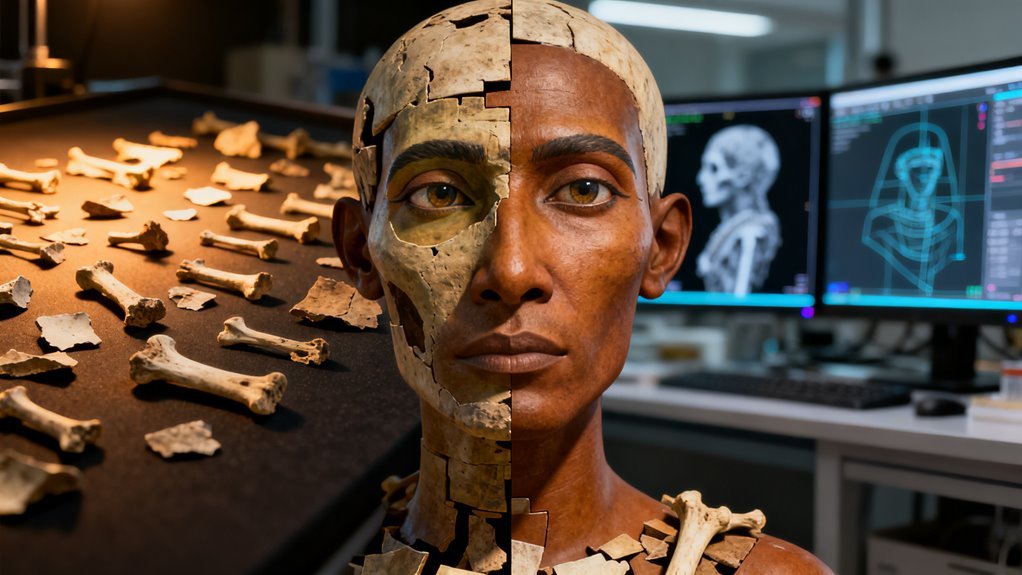
The research team, working with specimens recovered from Japan and Vancouver Island, combined high resolution grinding tomography with a purpose built AI model trained to differentiate subtle material boundaries within fossil matrices. Grinding tomography involves physically slicing through a specimen in microscopic increments, photographing each layer, then reconstructing a three dimensional image from thousands of sequential photographs. The AI component handled what human eyes and conventional software could not: parsing the vanishingly small differences between ancient bone, mineralized tissue and stone.
This is not a general purpose large language model being shoehorned into a science application. It is a specialized vision model built for a specific and extremely narrow classification task. That distinction matters.
Why This Is an AI Story, Not Just a Paleontology Story
The temptation is to file this under “cool dinosaur news” and move on. That would miss the point entirely.
What happened here represents a pattern accelerating across scientific disciplines. AI is not replacing scientists. It is unlocking data that was physically present but functionally invisible. The fossils sat in collections for years. The biological information was always there, encoded in mineral gradients too subtle for human perception or traditional computational methods to resolve. A trained neural network changed what counts as observable evidence.
We have seen this exact dynamic play out in other fields over the past two years. Google DeepMind’s AlphaFold did it for protein structure prediction. AI models in materials science are identifying novel compounds from existing experimental datasets that chemists had already generated but could not fully analyze. Medical imaging AI is flagging pathologies in scans that radiologists reviewed and cleared.
The consistent thread is not that AI is smarter than domain experts. It is that AI excels at detecting patterns in high dimensional data where the signal to noise ratio defeats human cognition. Paleontological imaging, it turns out, fits that profile perfectly.
The Technical Architecture Deserves Attention
Building an AI model for this kind of work is nontrivial in ways that matter for anyone thinking about applied machine learning beyond the consumer chatbot space.
Training data is the obvious bottleneck. There is no ImageNet equivalent for fossilized cephalopod jaw structures. The team would have needed to generate labeled training examples through expert annotation of grinding tomography slices, a slow and expensive process that demands world class paleontological knowledge just to produce the ground truth labels. This is the kind of domain where synthetic data augmentation and few shot learning techniques become critical, because you simply cannot scale labeled examples the way you can for, say, cat detection.
The model also had to operate on volumetric data reconstructed from sequential 2D slices, which introduces alignment and registration challenges that standard image classifiers do not face. Every imperfection in the physical grinding process, every slight variation in lighting or camera position across thousands of sequential photographs, becomes noise the model must handle gracefully.
None of this is glamorous work. It will not generate breathless headlines about artificial general intelligence. But it is precisely the kind of applied AI engineering that produces genuine scientific breakthroughs, and it is dramatically undervalued in public discourse relative to its actual impact.
What the Market Should Be Watching
The commercial implications extend well beyond paleontology. The core capability demonstrated here, AI driven material discrimination in complex imaging environments, has direct applications in mining, geology, semiconductor inspection, archaeological conservation and industrial quality control. Any domain where you need to distinguish visually similar materials within a heterogeneous matrix stands to benefit from the same fundamental approach.
NVIDIA has been positioning its hardware and software stack for exactly these scientific computing workloads. The company’s push into digital twins and simulation, combined with GPU accelerated imaging pipelines, creates a natural infrastructure layer for this category of AI application. Meanwhile, smaller specialized companies building domain specific vision models for industrial and scientific use cases are quietly assembling valuable moats. The training data, domain expertise and validation workflows required to build these systems are extraordinarily difficult to replicate, which means the competitive dynamics look nothing like the commoditizing race underway in general purpose language models.
For investors, this is a useful reminder that some of the most defensible AI businesses will not look anything like OpenAI or Anthropic. They will look like small teams of scientists who happen to be excellent machine learning engineers, solving problems nobody else has the domain knowledge to even properly define.
What Comes Next
The broader trajectory here is clear. As AI imaging tools improve and become more accessible, the backlog of unanalyzed fossil material sitting in museum collections worldwide becomes a goldmine of potential discoveries. Paleontology has always been constrained less by a shortage of specimens than by the labor intensity of analysis. AI changes that equation fundamentally.
Expect to see more announcements like this one across the natural sciences over the next 12 to 18 months. The combination of improved vision models, cheaper compute and growing institutional willingness to adopt AI tools is hitting an inflection point. The researchers who move fastest to integrate these methods into their workflows will have an outsized advantage, not because AI will do their thinking for them, but because it will show them things they literally could not see before.
A 20 meter predator hiding in plain sight inside a rock for 72 million years is a fitting metaphor. Sometimes the most important discoveries are not buried. They are just waiting for better eyes.
Somewhere in a lab processing ancient seafloor sediments from Japan and Vancouver Island, an AI model did something no human eye could reliably do. It detected fossilized jaw structures buried inside rock samples, structures belonging to a cephalopod predator that lived between 100 and 72 million years ago and stretched nearly 20 meters long. That is longer than most marine reptiles swimming in the same waters during the Late Cretaceous.
The creature itself is remarkable. But for readers of this publication, the real story is the technology that found it.
What Actually Happened
Researchers combined high resolution grinding tomography with an AI model specifically trained to identify fossilized structures within rock matrices. The AI did not simply enhance images or clean up scans. It learned to distinguish mineralized biological material from surrounding sediment at a level of granularity that manual analysis struggles to achieve consistently. This approach mirrors how AI systems are becoming core infrastructure in various scientific fields, reshaping research methodologies.
The result was a reconstruction of crushing jaw morphology with what the team describes as unprecedented accuracy, revealing an apex marine predator occupying the highest trophic levels in Cretaceous ocean ecosystems.
This is a concrete example of AI doing something that changes the output of scientific work, not just accelerating it. Without the trained detection model, these jaw fragments might have remained ambiguous structures in rock, cataloged but not understood. The AI turned noise into signal.
Why This Matters Beyond Paleontology
The application pattern here is worth paying attention to because it keeps showing up across domains. Train a model to detect specific structures in complex, noisy data. Deploy it against datasets too large or too ambiguous for human experts to process reliably. Extract findings that reshape understanding of the underlying subject.
We have seen this same pattern in medical imaging, where AI models detect tumors in radiology scans that clinicians miss. We have seen it in materials science, where machine learning identifies crystal structures in electron microscopy data. We have seen it in satellite imagery analysis, archaeological surveys, and protein structure prediction. DeepMind’s AlphaFold was arguably the highest profile example, but the underlying logic is identical to what happened with these Cretaceous fossils.
What is changing now is the breadth of scientific domains where this approach is becoming standard practice rather than a novelty. Five years ago, a paleontology paper using AI for fossil detection would have led with the AI angle as the primary finding. Today, the AI is infrastructure. It is the tool that enables the science, not the science itself. That transition from headline to methodology is one of the clearest indicators that a technology has matured.
The Technical Details Worth Understanding
Grinding tomography works by physically removing thin layers of a sample and photographing each exposed surface. The result is a stack of high resolution images that can be reconstructed into a 3D volume.
The challenge is that fossilized structures often have similar density and color to surrounding matrix rock, making automated segmentation extremely difficult. Training an AI to handle this task requires labeled datasets where experts have painstakingly identified fossil boundaries in sample slices.
The model then learns texture, density gradients, and spatial continuity patterns that distinguish biological structures from geological noise. Once trained, it processes new samples orders of magnitude faster than manual annotation, and in many cases with greater consistency.
This is not a large language model. It is not generative AI in the way most people use that term today. It is a specialized computer vision model doing classification and segmentation work. The distinction matters because the public conversation around AI has become so dominated by chatbots and text generation that genuinely transformative applications in scientific imaging get overlooked.
A Cretaceous World of Apex Predators
The paleontological findings themselves paint a striking picture. This 20 meter cephalopod was not operating in isolation. The Late Cretaceous was saturated with apex predators across every environment. The fossils belonged to extinct finned octopuses known as Cirrata, and well-grown specimens showed up to 10% of their jaw tip worn away, evidence of aggressive feeding strategies that placed them firmly at the top of the marine food chain.
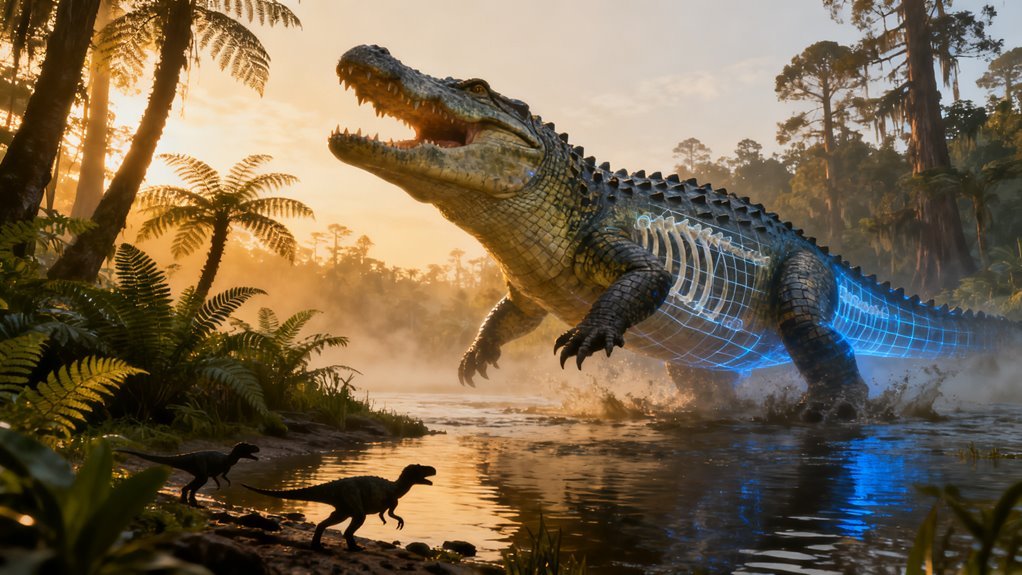
On the shores of North America’s Western Interior Seaway, Deinosuchus thrived between roughly 82 and 73 million years ago. Fossil evidence is unambiguous on this point. Dinosaur bones recovered from these environments bear puncture wounds, scratch marks, and fracture patterns that match Deinosuchus dentition.
One species, Deinosuchus schwimmeri, reached an estimated 31 feet in length and has now been reconstructed as the first scientifically accurate life size mounted skeleton of its kind. These animals were ambush predators, lurking in shallow water and striking terrestrial dinosaurs that ventured too close.
Meanwhile in Patagonia, a different kind of threat was operating entirely on land. Kostensuchus atrox, dating to approximately 70 million years ago, was a 3.5 meter crocodilian relative with more than 50 serrated teeth that resembled those of Tyrannosaurus rex. Its limb and shoulder anatomy points to adaptation for active terrestrial pursuit rather than aquatic ambush.
This was a land predator built like a crocodile but hunting like a theropod. The emerging picture is of a Cretaceous world where dinosaurs faced lethal pressure from ocean, coastline, and open terrain simultaneously.
And that picture is becoming clearer specifically because AI tools are enabling researchers to extract more information from fossil material than was previously possible.
What People Are Overlooking
The conversation around AI in science tends to focus on drug discovery, genomics, and climate modeling. These are important applications with significant funding and public attention.
But the quiet revolution happening in paleontology, geology, archaeology, and other field sciences deserves more recognition. These disciplines generate enormous volumes of imaging data. They have historically been constrained by the number of trained experts available to analyze that data.
A single grinding tomography dataset can contain thousands of image slices. A field survey might produce terabytes of lidar and photogrammetry data. The bottleneck has never been data collection. It has been interpretation.
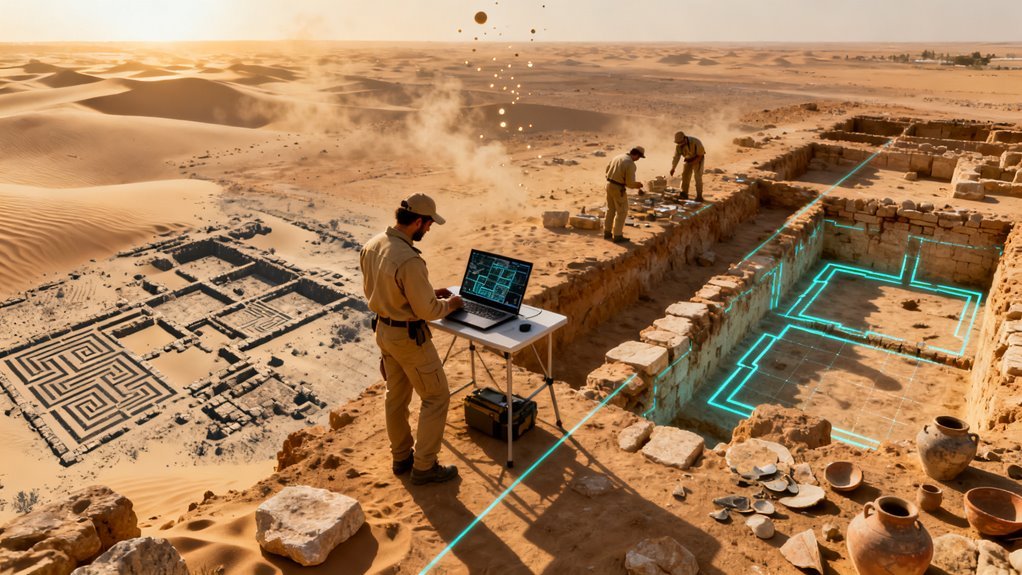
AI models trained for domain specific detection and segmentation tasks are removing that bottleneck. The implications extend well beyond finding ancient squid jaws. Consider the potential for automated mineral identification in geological core samples, artifact detection in archaeological excavation records, or species identification in fossil beds.
Each of these applications follows the same pattern. Train on expert labeled data. Deploy against volumes no human team could process manually. Surface findings that change what we know.
The Business and Funding Angle
For investors and founders tracking where AI creates durable value, scientific imaging is a sector worth watching. Companies like Voxel and Dragonfly (acquired by Comet Technologies) have built businesses around 3D image analysis for materials science and industrial applications.
The paleontology use case is niche, but the underlying technology transfers directly to mining, oil and gas exploration, construction materials testing, and manufacturing quality control. The market dynamics are favorable. Scientific and industrial imaging generates massive datasets.
Domain experts are scarce and expensive. Accuracy requirements are high. These conditions favor AI solutions with strong moats built on proprietary training data and validated performance in specific verticals.
Google, Microsoft, and AWS all offer general purpose computer vision APIs, but the real value in these applications comes from domain specific training. A model trained on generic image classification will not reliably detect fossilized cephalopod jaws in grinding tomography slices.
That specificity creates defensible positions for startups and research groups that invest in building the right training datasets.
What Comes Next
Expect to see more papers across earth sciences, paleontology, and archaeology where AI detection models are listed in the methods section as standard tools rather than novel contributions. The technology is crossing the threshold from experimental to expected.
The deeper question is whether this pattern accelerates the pace of scientific discovery in meaningful ways. Finding a 20 meter predatory cephalopod is fascinating.
But if AI imaging tools enable researchers to process backlogs of unanalyzed fossil collections sitting in museum storage, the cumulative impact could reshape our understanding of evolutionary history at a scale that individual discoveries cannot.
That is the real promise here. Not one ancient predator reconstructed, but thousands of specimens reanalyzed with tools that see what human eyes cannot.