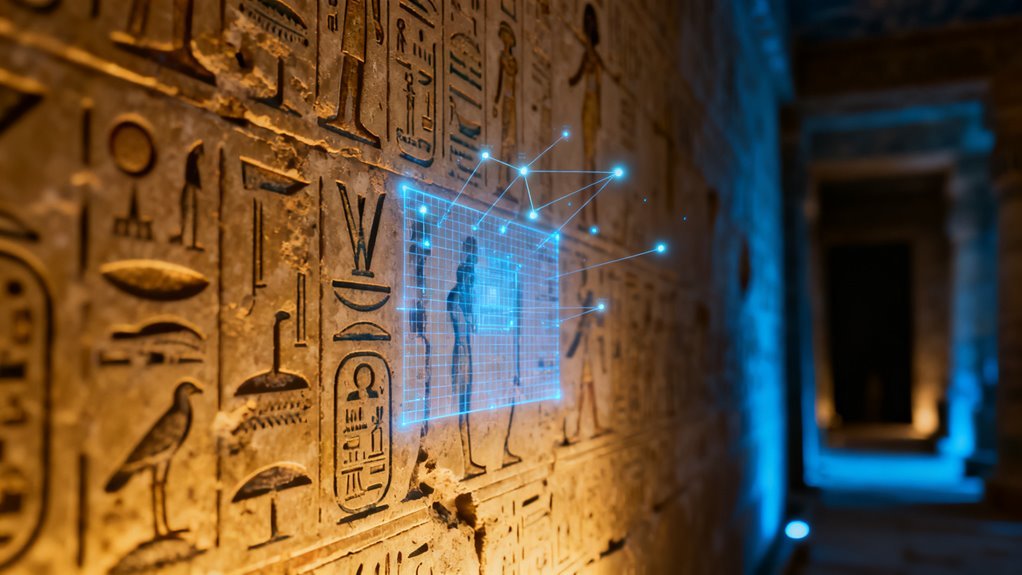
Deciphering Egyptian hieroglyphs has always been one of the most labor-intensive intellectual pursuits on the planet. A single inscription can take a trained specialist hours to parse, cross-referencing damaged symbols against established catalogs, weighing grammatical possibilities, and layering in historical context that only decades of study can provide.
Now, a cluster of AI-powered tools is compressing parts of that workflow from hours to seconds, and the implications stretch well beyond archaeology.
What makes this development worth paying attention to is not the novelty of applying machine learning to ancient scripts. Researchers have experimented with pattern recognition on historical texts for years. The shift is that these tools have reached a level of maturity and accessibility where they are changing the daily practice of a discipline that has operated with essentially the same methodology since Jean François Champollion cracked the Rosetta Stone in 1822.
What Actually Exists Right Now
Google’s Fabricius, which grew out of the company’s Hieroglyphics Initiative, remains the most visible platform in this space. Built on Google Cloud AutoML, it compares traced symbols against a database of more than 800 unique glyphs and organizes its functionality into three tiers: Learn, Play, and Work.
The first two serve public engagement and education. The third is where the real action happens. Scholars can upload inscription photographs, build facsimile layers over damaged surfaces, digitally enhance eroded signs, and receive suggested translations based on sign sequences mapped to Gardiner’s Sign List, the standard classification system that groups hieroglyphs into categories like birds, reptiles, and human body parts.
The entire codebase is open source, available in English and Arabic, and explicitly designed to invite outside contribution.
Then there is Hieroglyphs AI, which takes a different and arguably more rigorous approach to the recognition problem. Its deep convolutional neural networks were trained on 1,000 images per class across 444 hieroglyph categories.
Rather than outputting a single answer, the system returns the top five candidate signs with Gardiner codes and probability scores. That design choice matters. It treats the tool as a collaborator rather than an oracle, giving specialists enough information to exercise their own judgment on ambiguous or damaged inscriptions.
On the mobile side, the Egyptian-developed app Manetho markets itself as the world’s first real-time hieroglyphic translator, promising to convert 3,000-year-old inscriptions into modern text on the spot.
The claim is bold and deserves some skepticism, but the fact that a locally built product is competing in this space signals something important about where AI development for cultural heritage is heading.
Why This Matters Beyond Archaeology
The obvious read is that these tools make Egyptologists faster. That is true but insufficient. The deeper story involves what happens when you dramatically lower the barrier to processing an entire category of historical information.
Consider the scale of the problem. Tens of thousands of inscriptions sit in museum storage rooms, temple walls, and private collections around the world, many of them only partially documented. The bottleneck has never been access to the physical artifacts. It has been the scarcity of human experts qualified to read them.
There are perhaps a few hundred people alive who can fluently read Middle Egyptian hieroglyphs. Semi-automated classification pipelines do not replace those experts, but they do something almost as valuable: they triage. A system that can produce a reliable first-pass reading of an inscription lets a specialist skip the mechanical identification stage and jump straight to the interpretive work that actually requires human expertise.
This pattern should look familiar to anyone watching how AI is reshaping other professional domains. Radiology, legal document review, code debugging: the most effective deployments consistently follow the same template. The machine handles volume and pattern matching. The human handles ambiguity, context, and judgment.
What is happening in Egyptology is a textbook case of that division of labor playing out in one of the last fields anyone expected to see it.
The Technical Puzzle Is Harder Than It Looks
It is tempting to view hieroglyph recognition as a solved image classification problem. It is not. Ancient inscriptions present challenges that would make most computer vision engineers wince.
Surfaces are eroded, cracked, partially destroyed, or obscured by millennia of mineral deposits. The same glyph can be drawn in wildly different styles depending on the period, the region, and the skill of the original scribe. The handcrafted nature of hieroglyphs means that variability in pictorial detail among individual carvers and across different time periods adds yet another layer of complexity to automated recognition. Some signs are visually almost identical but carry completely different meanings depending on context.
And unlike modern languages, there are no native speakers to consult and no large-scale digitized corpora to train on. The 1,000 images per class that Hieroglyphs AI trained on sounds adequate until you compare it to the millions of labeled examples that power modern facial recognition or object detection systems.
These models are operating in a genuinely data-scarce environment, which makes their performance all the more notable and their limitations all the more important to acknowledge.
Google’s decision to open source Fabricius addresses one piece of this puzzle. By releasing the code, they are effectively inviting the global research community to expand training datasets, refine classification algorithms, and build specialized tools for subdomains like Demotic or Hieratic scripts that current platforms do not cover well.
Who Benefits and Who Should Be Watching
The immediate beneficiaries are obvious: academic Egyptologists, museum curators, and graduate students who can now process material faster.
But the second-order effects are potentially more significant. Cultural heritage agencies in Egypt and across North Africa stand to gain substantial leverage. The Manetho app is a telling example.
For decades, the computational tools used to study Egyptian history have been built primarily in Western labs. A locally developed AI translator, even an imperfect one, represents a shift in who controls the technology used to interpret a nation’s own cultural record. That has political and economic dimensions that extend well beyond the technical specifications of any neural network.
Tourism is another angle that deserves attention. Real-time translation apps could fundamentally change how visitors experience archaeological sites. Imagine pointing a phone at a temple wall and receiving an immediate, reasonably accurate reading of the text.
That is not science fiction anymore. It is an engineering problem with a clear path to deployment within the next few years.
For the broader AI industry, the hieroglyph case study offers a useful lens on how specialized models perform in low-resource domains. The techniques being refined here, training robust classifiers on limited data, handling noisy and degraded inputs, building human-in-the-loop systems that present probabilistic outputs rather than false certainty, have direct applications in medical imaging, forensic analysis, industrial inspection, and dozens of other fields where labeled data is scarce and stakes are high.
What People Are Overlooking
There is a risk that gets surprisingly little discussion: the authority problem. When a machine learning model suggests a translation, it carries an implicit weight of objectivity that a human scholar’s tentative reading does not.
Egyptologists routinely disagree about the meaning of specific inscriptions. Those disagreements are productive. They surface competing hypotheses and force researchers to defend their interpretations with evidence.
If AI-generated readings become the default starting point, there is a real possibility that they subtly narrow the interpretive space before human experts even engage with the material. This is not a hypothetical concern.
We have already seen analogous dynamics in other fields. Predictive policing algorithms, medical diagnostic tools, and automated hiring systems all exhibit a tendency to anchor human decision-making around their outputs, even when those outputs are presented as probabilistic rather than definitive.
The Hieroglyphs AI approach of returning five candidates with confidence scores is a smart design choice precisely because it resists this anchoring effect. But not every tool in this space is built with the same discipline.
There is also the question of what happens to expertise pipelines. If early career researchers rely on AI for the mechanical work of sign identification, will they develop the deep familiarity with the writing system that currently comes from years of manual practice?
The parallel to GPS navigation is instructive. Drivers who rely exclusively on turn-by-turn directions often develop weaker spatial awareness than those who learned to navigate with paper maps. Whether that tradeoff is acceptable depends on the context, but it is a tradeoff that should be made consciously rather than by default.
Where This Is Heading
The trajectory is reasonably clear. Within the next three to five years, expect to see multimodal models that combine visual recognition with natural language processing to produce contextually informed translations rather than simple sign-by-sign mappings.
The integration of large language models trained on Egyptological literature could enable systems that not only identify glyphs but also flag inscriptions that appear to contain unusual grammatical constructions or previously unattested word combinations, essentially automating parts of the discovery process itself.
Broader deployment will likely follow the pattern we have seen with other specialized AI tools: initial resistance from established practitioners, gradual adoption as the tools prove their value on routine tasks, and eventual integration into standard academic workflows.
The open-source nature of Fabricius accelerates this timeline by allowing institutions to customize the platform for their specific collections and research questions.
The most important development to watch is not any single tool. It is the emergence of a feedback loop between AI capabilities and the digitization of archaeological collections.
As more inscriptions are photographed, cataloged, and fed into training datasets, the models improve. As the models improve, they become more useful for processing the backlog of undocumented material. That cycle, once it reaches critical mass, could unlock a volume of historical information that has been physically present but functionally inaccessible for centuries.
Ancient Egypt’s scribes could not have imagined that the symbols they carved into stone would one day be parsed by silicon. But then, they also invented one of the most durable information storage systems in human history.
There is a certain symmetry in the fact that it took another revolution in information processing to fully unlock what they left behind.



1 comment
Comments are closed.