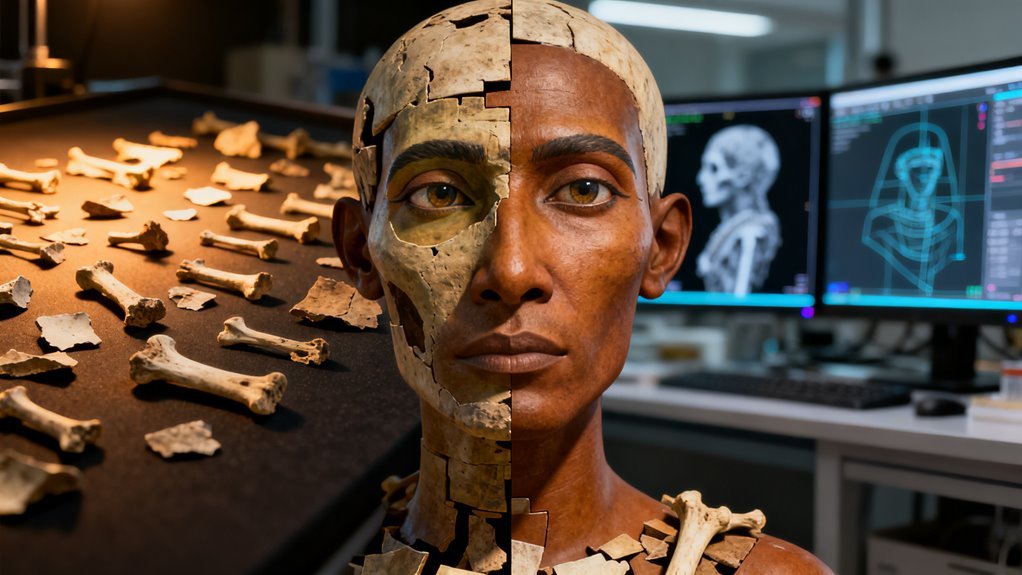

The face staring back from a screen in a forensic imaging lab belongs to someone who died roughly 3,000 years ago. That fact alone would have seemed absurd a decade ago. But a convergence of CT imaging, deep learning, and forensic anthropology has made it possible to digitally reconstruct the faces of ancient Egyptian mummies without removing a single layer of linen wrapping. The results are not artistic interpretations. They are probabilistic portraits built from bone geometry, tissue depth statistics, and machine learning models trained to predict how soft tissue drapes over a skull.
This matters well beyond archaeology. The same computer vision pipelines reassembling ancient craniofacial structures from fragmentary bone data share technical DNA with systems being developed for surgical planning, disaster victim identification, and even age progression of missing children. When AI can look at a damaged, resin coated skull encased in bandages and produce a plausible human face, the implications ripple outward into medicine, law enforcement, and the broader trajectory of 3D reconstruction technology. Additionally, the technical progress in error reduction with AI models enhances the reliability of these reconstructions.
The same AI rebuilding ancient faces is quietly advancing surgical planning, forensic identification, and missing persons cases.
How the Pipeline Actually Works
The technical workflow is more sophisticated than most coverage suggests. Multidetector CT scanners capture the mummy in thousands of slices, each about 0.6 mm thick, generating volumetric data dense enough to distinguish bone from linen from centuries old embalming resin. That distinction is where deep learning earns its place in the process.
Segmentation models trained on anatomical datasets identify bony regions and strip away surrounding materials digitally, producing clean cranial surfaces that can be exported as STL files for 3D modeling.
What happens next is the genuinely interesting part. The CT bone data gets treated as thousands of tiny virtual fragments. AI algorithms recombine these into complete craniofacial reconstructions, filling gaps where bone has deteriorated or been damaged. This is essentially the same class of problem that 3D inpainting models solve in other domains, predicting what missing geometry should look like based on learned anatomical priors. The difference is that the stakes here involve scientific accuracy rather than visual plausibility.
Once the digital skull is complete, forensic facial reconstruction follows the Manchester method, which layers anatomical muscle modeling over the cranial surface using tissue depth markers calibrated to sex, age, and ancestral population. Digital sculpting tools like ZBrush handle the manual artistry, while machine learning systems refine contours, shading, and bilateral symmetry. The final face is not a guess. It is a constrained prediction, bounded by forensic science and shaped by statistical models of how human faces actually form around bone.
Why This Matters Now
Several developments have converged to make this moment significant.
First, the segmentation models used to isolate bone from surrounding materials have improved dramatically in the past three years. Medical imaging AI, driven by massive investment from companies building diagnostic tools, has produced segmentation architectures that transfer well to unconventional subjects like mummies. The same U Net variants and transformer based models that identify tumors in clinical CT scans can be retrained to recognize embalming resin boundaries.
Second, 3D reconstruction from partial data has become a serious research focus across the AI industry. NVIDIA, Meta, and Google have all published work on neural radiance fields and 3D generative models. The ability to reconstruct complete geometry from incomplete scans is a capability that mummy facial reconstruction shares with autonomous vehicle perception, robotic manipulation, and augmented reality. Investment in those commercial applications has indirectly improved the tools available to forensic anthropologists.
Third, the cost of high resolution CT scanning has dropped substantially. What once required dedicated research hospital time can now be accomplished with mobile scanning units, making it feasible to image mummy collections across multiple museums without transporting fragile remains.
The Faces That Have Emerged
The roster of reconstructed individuals now includes some of the most recognizable names in ancient history. Pharaohs Khufu, Khafre, Menkaure, Amenemhat III, and Ahmose I have all had AI supported facial algorithms applied to their remains, combining mummy CT data with surviving statuary for cross validation. Notably, the only surviving statue of Khufu, builder of the Great Pyramid, is a small ivory figure, making AI facial reconstruction from his mummified remains an especially valuable complement to the limited visual record.
Ramesses II and Tutankhamun, subjects of earlier reconstruction efforts, have been revisited with newer techniques. Lesser known individuals, including a well preserved female mummy reconstructed using computer aided sculpting systems like FreeForm Modeling Plus, have received equally rigorous treatment.
The inclusion of non royal subjects is arguably more scientifically valuable. Pharaohs have statues and historical records. Ordinary people from the New Kingdom or the Third Intermediate Period, roughly 945 to 715 BCE, have almost nothing. Giving them faces creates a different kind of historical evidence, one that connects modern viewers to individuals rather than civilizations.
What People Are Overlooking
Most discussion of this work focuses on the “wow factor” of seeing an ancient face. That is understandable but superficial. The deeper story is about validation. Every reconstructed mummy face is a test case for the accuracy of AI driven 3D reconstruction from degraded, partial, and noisy data.
When researchers can cross reference a digitally reconstructed face against surviving statuary of the same individual and find plausible correspondence, that is evidence that the underlying models generalize well.
This has direct relevance to forensic identification of modern remains. Disaster victims, skeletal remains in criminal investigations, and unidentified individuals in mass graves all present the same fundamental problem: incomplete bone data, environmental degradation, and the need to predict soft tissue appearance from hard tissue geometry. The mummy reconstruction pipeline is essentially a high profile proving ground for techniques that will eventually be deployed in those contexts.
There are also legitimate concerns about overconfidence. A probabilistic facial reconstruction is not a photograph. It represents the most likely face given the available data and the assumptions encoded in tissue depth databases and machine learning models. Those databases skew heavily toward modern populations.
Applying them to individuals who lived three millennia ago introduces uncertainty that is difficult to quantify. Ancestral population categories used for tissue depth calibration are necessarily approximate for ancient subjects. The reconstructions are scientifically grounded, but they carry error bars that are rarely communicated to general audiences.
Where This Technology Goes Next
The trajectory points toward increasingly automated pipelines. Right now, significant manual intervention is required at the digital sculpting stage. As generative 3D models improve, particularly diffusion models operating in 3D space, the manual steps will shrink.
Within five years, it is reasonable to expect near fully automated reconstruction from CT scan to rendered face, with human forensic artists serving as reviewers rather than primary creators.
The broader pattern here is familiar. AI enters a specialized domain as an assistive tool, improves to the point where it handles most of the routine work, and eventually redefines the role of the human expert. Forensic facial reconstruction is following the same arc as AI in radiology, legal document review, and code generation.
For the AI industry, the mummy reconstruction work is a useful reminder that some of the most compelling applications of computer vision and 3D modeling are not in consumer products or enterprise software. They are in domains where the data is messy, the subjects are irreplaceable, and the margin for error demands the kind of careful, constrained AI deployment that the industry talks about far more than it practices.
Ancient faces rebuilt from bone fragments and deep learning models are, in that sense, a quiet benchmark for how good these systems have actually become.