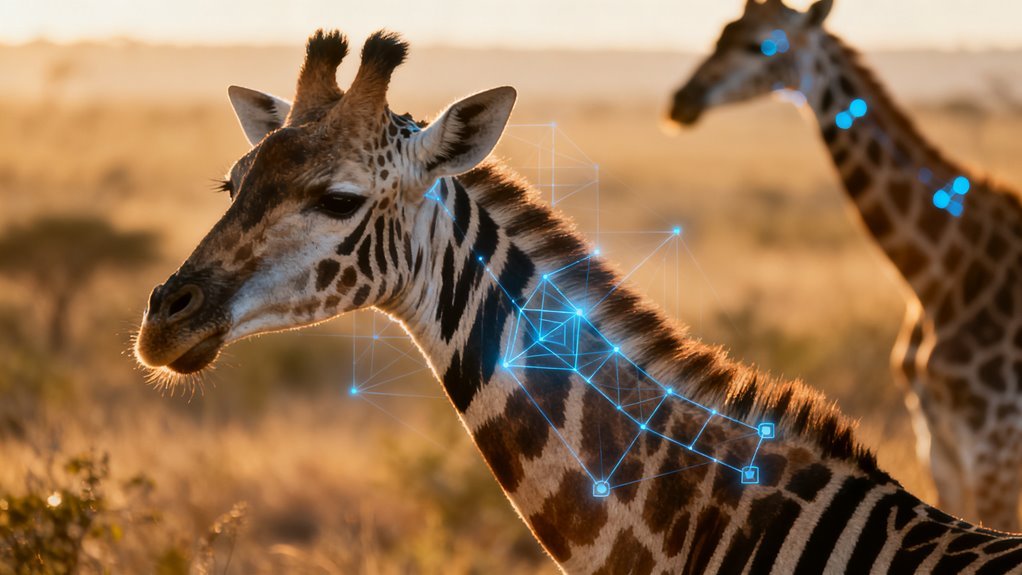

Wildlife Conservation Just Got Its Killer App, and It Runs on Pattern Recognition
For decades, tracking individual wild animals meant tranquilizer darts, GPS collars, ear tags, and research budgets that could make a nonprofit weep. That era is winding down faster than most people realize. A new generation of computer vision systems can now identify specific animals in real time by reading the biological barcodes they already carry: the unique arrangement of spots on a jaguar’s flank, the unrepeatable geometry of a zebra’s stripes, the fractal patterning on a giraffe’s neck. No sedation. No hardware bolted to an animal’s body. Just a camera, an edge device, and a convolutional neural network that treats every coat pattern like a fingerprint.
The accuracy numbers are already compelling. Field deployments are reporting identification rates around 93% under real world conditions, which means variable lighting, partial occlusion, mud, motion blur, and all the other chaos that cameras encounter when bolted to trees in the Serengeti or the Pantanal. Processing speeds of 40 to 60 images per second mean the system does not just log sightings after the fact. It identifies animals as they move through a frame, which opens up use cases that were simply impossible with manual photo identification or cloud dependent pipelines.
Why This Is More Than a Cool Demo
The timing here is worth unpacking. Three converging trends made this moment possible, and none of them originated in conservation biology.
First, edge AI hardware got cheap and power efficient enough to deploy in remote locations. The same silicon that powers smart doorbells and autonomous drones now runs inference models in waterproof enclosures strapped to camera traps. NVIDIA’s Jetson lineup and a growing ecosystem of competitors have driven costs down to the point where a single research grant can instrument an entire wildlife corridor.
Second, transfer learning dramatically reduced the data requirements for training accurate classifiers. Five years ago, building a species specific identification model would have required tens of thousands of labeled images per individual animal. Today, foundation models pretrained on massive image datasets can be fine tuned with a few hundred examples. That makes it feasible to deploy identification systems for rare species where photographic records are inherently scarce.
Third, the explosion of camera trap networks created the data infrastructure these models need. Organizations like Wildlife Insights, backed by Google, have aggregated hundreds of millions of camera trap images into searchable databases. The raw material for training and validation was already sitting in cloud storage, waiting for models capable enough to use it.
The Anti Poaching Angle Changes the Economics
Real time identification is where this story gets strategically interesting. When a system can recognize a specific rhino or elephant within seconds of it appearing on camera, it transforms passive monitoring into active defense. Rangers can receive instant alerts when a known high value individual enters a vulnerable area. Patrol routes can be dynamically adjusted. Response times shrink from hours to minutes.
This matters enormously because the economics of poaching are brutal. A single rhino horn can fetch $60,000 per kilogram on black markets, which means poaching syndicates operate with the resources and sophistication of organized crime. Conservation agencies, by contrast, typically operate on shoestring budgets with vast territories to cover. Any technology that acts as a force multiplier for rangers has outsized impact.
Several national parks in Kenya and South Africa have already integrated AI powered camera systems into their security operations, though most are cautious about publicizing the technical details for obvious reasons. The pattern is similar to what happened with predictive policing algorithms in urban settings, except the ethical calculus is far less controversial when the subjects are endangered animals rather than citizens.
Biodiversity Credits and the Financialization of Wildlife Data
Here is where the story takes a less obvious turn. The ability to reliably identify and track individual animals creates something that did not previously exist at scale: verifiable, continuous biodiversity data. That data has suddenly become valuable because of the emerging market for biodiversity credits.
Think of it as carbon credits for ecosystems. Governments and corporations are increasingly under pressure to demonstrate positive biodiversity outcomes, not just reduced emissions. The EU’s Corporate Sustainability Reporting Directive, the Taskforce on Nature Related Financial Disclosures, and similar frameworks are creating demand for quantifiable proof that conservation investments actually work. Counting individual animals over time, with cryptographic confidence in the data’s integrity, is exactly the kind of evidence these frameworks require.
This creates an interesting feedback loop. As biodiversity markets mature, the economic incentive to deploy wildlife identification systems increases. More deployment generates more data. More data improves model accuracy and enables tracking of population dynamics at a granularity that was previously reserved for heavily studied species like Yellowstone wolves. Better data, in turn, makes biodiversity credits more credible and tradeable.
Early stage companies are already positioning around this opportunity. Startups combining computer vision with blockchain based verification are pitching institutional investors on the idea that wildlife monitoring infrastructure could become as standardized and investable as weather stations or air quality sensors.
What People Are Overlooking
The optimism is warranted but incomplete. Several challenges deserve more scrutiny than they are currently receiving.
Species generalization remains difficult. A model trained to identify individual jaguars does not automatically work on leopards, even though both have rosette patterns. Each species requires its own training data and validation pipeline, which means scaling across the roughly 6,000 mammal species that conservation biologists care about is a multi year, multi institution effort.
Environmental variability is another underappreciated problem. Animals change appearance seasonally. They accumulate scars. Juveniles look different from adults. Lighting conditions in tropical forests differ enormously from open savannas. A 93% accuracy rate in controlled field trials may not hold when systems are deployed across diverse biomes without ongoing recalibration.
There is also a data sovereignty question that conservation organizations are only beginning to grapple with. Detailed location data for critically endangered species is extraordinarily sensitive. If a database mapping the real time movements of every black rhino in a reserve were breached, it would essentially hand poaching syndicates a targeting system. The cybersecurity requirements for these platforms are not trivial, and many conservation organizations lack the technical capacity to implement them properly.
Where This Fits in the Broader AI Trajectory
Zoom out and this development illustrates something important about where applied AI is heading in 2025 and beyond. The most consequential deployments are increasingly happening at the edge, in constrained environments, on specialized tasks where domain expertise matters more than model size.
The conservation use case shares a structural similarity with precision agriculture, industrial inspection, and medical imaging. In each domain, the winning approach is not to build the largest possible model but to build the most efficiently adapted one. Fine tuned vision models running on low power hardware, processing data locally, generating actionable outputs in real time. This is not the glamorous frontier of AGI research, but it is where AI is delivering measurable returns right now.
It also highlights a pattern that investors and builders should pay attention to: the most defensible AI businesses are often built on proprietary data pipelines rather than proprietary models. The organizations that control the camera trap networks, maintain the labeled datasets, and hold relationships with national park authorities will likely capture more long term value than the teams building the classifiers themselves. The models are becoming commoditized. The data and the deployment infrastructure are not.
What Happens Next
Expect three developments over the next 18 to 24 months. First, consolidation among the handful of startups and academic labs working on wildlife identification, likely through acqui hires by larger conservation technology platforms or by cloud providers looking to burnish their sustainability credentials.
Second, integration with satellite and drone imagery. Individual identification from ground level camera traps is powerful, but combining it with aerial monitoring creates a comprehensive surveillance layer that can track animal movements across landscapes rather than just at fixed camera points. The computer vision challenge is harder at altitude, but several research groups are making progress.
Third, regulatory frameworks for biodiversity data will start to crystallize, particularly in the EU and among signatory nations to the Kunming Montreal Global Biodiversity Framework. As those standards take shape, they will define what counts as acceptable evidence of biodiversity outcomes, and AI powered individual identification is positioned to become the gold standard.
The underlying message is straightforward. Conservation has historically been data poor and intuition rich. That ratio is inverting rapidly, and the implications extend well beyond biology into finance, policy, and the ongoing maturation of edge AI as a deployment paradigm. The animals already had unique identities. We are just now building systems perceptive enough to read them.
The Quiet Revolution in Wildlife Monitoring: How AI Coat Pattern Recognition Is Reshaping Conservation at Scale
For decades, tracking individual wild animals meant catching them first. Researchers would tranquilize a jaguar, clamp a tag to its ear, maybe fit a radio collar, then release it and hope the stress of capture didn’t alter the very behavior they were trying to study. That entire paradigm is now being dismantled by computer vision systems that can identify individual animals from photographs alone, reading spots, stripes, and skin patterns the way a fingerprint scanner reads a human thumb.
This is not a laboratory curiosity. The technology has reached a level of field maturity that demands attention from anyone tracking the intersection of AI and real world applications, because the underlying techniques are migrating rapidly into adjacent domains including livestock management, ecological insurance modeling, and biodiversity credit markets that could be worth billions within the decade.
What the Systems Actually Do
The core idea is deceptively simple. Every jaguar’s rosette pattern is unique. Every zebra carries a distinct arrangement of stripes. Giraffe spots, tiger flanks, even the chest markings on African penguins all function as natural biometric signatures that never repeat across individuals within a species.
Convolutional neural networks trained on labeled photograph databases can learn to extract these signatures, encode them as numerical descriptor vectors, and match new observations against a library of known individuals.
The preprocessing pipeline handles the unglamorous but essential work: cropping animals from raw camera trap frames, discarding blurry or overexposed shots, separating left flanks from right flanks so comparisons remain consistent. Field reports indicate 90 to 95 percent accuracy at these preparatory stages alone, which matters enormously when the input is millions of images from remote cameras that nobody will manually review.
Pose estimation algorithms and 3D model fitting address a problem that does not arise with human fingerprints. Animals move. They twist, stretch, roll in mud, and present themselves at wildly inconsistent angles. Converting these variable postures into standardized templates is where much of the recent engineering progress has concentrated.
Dynamic Feature Prediction Trees now enable distortion tolerant matching even when an animal’s visible markings are partially deformed by movement or body position. One particularly notable approach translates visual coat patterns into what researchers call dermatoglyphic text descriptors. These are structured textual representations of pattern geometry that enable cross modal identification, meaning the system can match a photograph against a text based description of a pattern rather than requiring direct image to image comparison.
Test set accuracy for this method has reached 99.8 percent, though test set performance and field performance remain different conversations entirely.
Field Reality: The Numbers That Matter
Laboratory benchmarks tell one story. Deployment in actual ecosystems tells another, and the gap between them reveals both the technology’s genuine promise and its honest limitations.
Jaguar identification through spot pattern analysis currently reaches about 93 percent accuracy in field conditions. Zebra stripe recognition hits 80 percent, though environmental factors like dust, rain, lighting variation, and partial occlusion from vegetation all degrade performance.
Giraffe spot configurations have proven reliable enough to support population tracking programs that have entirely eliminated physical tagging from their protocols. African penguin monitoring achieves a 92 percent genuine acceptance rate at a false acceptance rate of one in a thousand, numbers that would satisfy many commercial biometric applications.
Tiger identification has leveraged dermatoglyphic frameworks applied to stripe patterns, enabling the same cross modal matching approach that produced headline accuracy numbers in controlled testing.
But the most instructive data point may be the least celebrated. Zebra identification accuracy measured 62 percent in Kenyan study populations compared to 88 percent in Zimbabwean populations of the same species. That 26 percentage point spread has nothing to do with the animals and everything to do with operational conditions: image quality from different camera equipment, environmental variability across habitats, and population density affecting how often the system encounters novel individuals absent from its reference database.
This variance should sound familiar to anyone who has deployed machine learning systems in production. Model performance is inseparable from deployment context. The algorithm does not degrade. The world around it introduces complexity that no training set fully anticipates.
Edge Computing Changes the Operational Calculus
Processing photographs at the point of capture rather than transmitting everything to centralized servers represents a meaningful architectural shift. Edge computing deployed on drones and camera traps means identification can happen in near real time without reliable internet connectivity, which describes most of the places where endangered species actually live. The RAPID algorithm exemplifies this capability, processing 40 to 60 images per second on standard PCs and roughly 10 images per second even on basic edge devices with limited processing power.
This matters for more than convenience. Poaching response, for instance, depends on speed. If a camera trap captures an image of a known high value individual in an unexpected location, the ability to flag that observation immediately rather than days later during a batch upload cycle could trigger patrol redeployment that prevents a kill.
Modular open source designs have made integration with existing field equipment practical rather than theoretical. Conservation organizations that have invested years building camera trap networks do not need to replace their hardware. They add a software layer.
Batch processing capabilities can chew through millions of archived images, retroactively identifying individuals across years of accumulated data and constructing population histories that would have been impossible to assemble manually.
The labor implications are substantial. Researchers who previously spent hundreds of hours sorting photographs by hand now allocate that time to analysis, fieldwork, and grant writing. Whether this constitutes augmentation or displacement depends on your perspective, but the practical effect is that smaller teams can monitor larger territories with greater precision than was possible even five years ago.
The Hard Boundaries
Honest assessment of what this technology cannot do is as important as enthusiasm about what it can.
The fundamental constraint is biological. Coat pattern recognition requires coat patterns. Elephants, many primate species, most marine mammals, and countless other conservation priority species lack the kind of individually distinctive surface markings these systems depend on.
For those animals, the search for non invasive identification continues through other channels: ear shape analysis, vein pattern mapping, acoustic signature recognition, and gait analysis, all of which remain less mature than coat pattern methods.
Each deployment demands species specific training. A system built to identify jaguars cannot pivot to zebras without retraining, because the underlying pattern structures differ fundamentally. This creates a fragmentation challenge. Every new species application requires its own labeled dataset, its own validation study, and its own accuracy baseline.
Scaling across the full breadth of global biodiversity monitoring will be slow and expensive even with the most efficient transfer learning approaches. Reference databases must exist before matching can begin. You cannot identify an individual you have never cataloged. Building initial databases still requires significant field effort, and populations with high turnover rates or low recapture probabilities present bootstrapping problems that software alone cannot solve.
Image quality requirements remain non trivial. Distinctive features must be visible with minimal occlusion or distortion. A jaguar photographed from behind, or a zebra half hidden in tall grass, may produce images the system cannot process. This is a data quality problem dressed up as a technology limitation, and it constrains real world recall rates more than most published accuracy figures suggest.
Why This Matters Beyond Conservation
The strategic significance of AI driven wildlife identification extends well beyond its immediate ecological applications, and this is the dimension that technology professionals, investors, and policy analysts should be watching most closely.
Biodiversity credit markets are emerging as a parallel to carbon credit markets, and they need measurement infrastructure. You cannot trade credits for species preservation if you cannot reliably count and track the species being preserved.
Non invasive individual identification provides exactly the kind of auditable, repeatable, technology verified monitoring that financial instruments require. The connection between a camera trap network running coat pattern recognition and a tradeable biodiversity asset is shorter than most people realize.
Insurance products tied to ecosystem services face the same measurement problem. Parametric insurance that pays out when a monitored population drops below a threshold needs monitoring systems that generate trustworthy, continuous data. Manual surveys conducted annually do not provide the temporal resolution these products demand. Automated visual identification running continuously on edge devices does.
Agricultural applications are already borrowing from the wildlife identification playbook. Livestock identification through coat and hide pattern analysis uses architecturally similar systems, and the livestock sector’s willingness to pay for individual animal tracking far exceeds the conservation sector’s budget.
Commercial revenue from agricultural deployments may ultimately subsidize the open source tools that conservation researchers depend on, creating an unusual cross sector dynamic where cattle ranchers indirectly fund jaguar monitoring.
Regulatory and Ethical Terrain
Surveillance infrastructure deployed in natural environments raises questions that conservation organizations have not historically needed to answer. Who owns the data generated by camera trap networks operating on indigenous lands?
What happens when population monitoring data reveals the location of endangered animals to anyone with database access, including poachers? How should movement data be governed when it crosses national boundaries, as migratory species inevitably do?
These are not hypothetical concerns. Several African nations have already imposed restrictions on the export of wildlife location data, recognizing its dual use potential. The same GPS tagged, individually identified animal records that help researchers also create targeting information for illegal hunters.
Encryption, access controls, and data sovereignty frameworks designed for wildlife monitoring systems are emerging as a specialized governance need that most existing data protection regulations were never designed to address.
The animal welfare argument for non invasive monitoring is straightforward and largely uncontested. Eliminating capture, handling, and physical tagging removes a documented source of stress, injury, and behavioral disruption.
But the surveillance dimension introduces a subtler ethical question about whether continuous monitoring of wild animals alters the wildness we claim to be protecting. That philosophical tension will not impede adoption, but it will shape how conservation organizations communicate their work to donors and the public.
What Comes Next
Three developments are worth tracking over the next two to three years.
First, multimodal identification systems that combine coat pattern analysis with acoustic signatures, movement patterns, and environmental context will push accuracy closer to the 99 percent threshold across a broader range of species and field conditions.
The dermatoglyphic text descriptor approach hints at this direction by enabling cross modal matching, and extending that framework to incorporate non visual data streams is a natural next step.
Second, foundation models trained on large scale wildlife image datasets will reduce the species specific training burden. Rather than building bespoke models for each new target species, researchers will fine tune general purpose animal recognition systems, collapsing months of data collection and annotation into weeks.
Meta’s segment anything model and similar architectures are already being adapted for ecological applications, and purpose built foundation models for biodiversity monitoring are likely within 18 months.
Third, the commercial infrastructure around biodiversity credits will create financial incentives for monitoring network expansion that dwarf traditional conservation funding streams. If biodiversity credits reach even a fraction of the carbon credit market’s scale, the demand for verifiable, technology backed species monitoring will trigger a deployment wave that makes current camera trap networks look like pilot programs.
The technology for reading an animal’s identity from its skin already works. The harder question, and the one that will determine whether this capability transforms conservation or remains a research novelty, is whether the economic and institutional infrastructure can scale to match what the algorithms have made possible.
Early signs suggest it can, but the timeline depends less on computer vision breakthroughs than on market design, regulatory clarity, and the willingness of governments and financial institutions to treat biodiversity data as critical infrastructure rather than academic output.